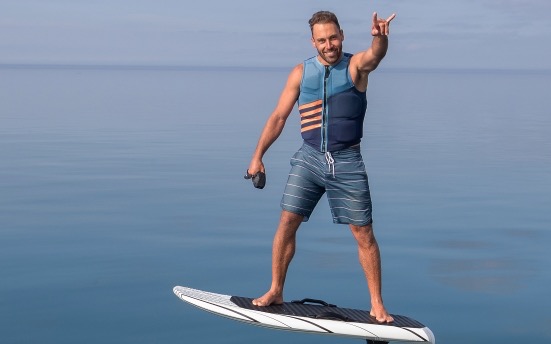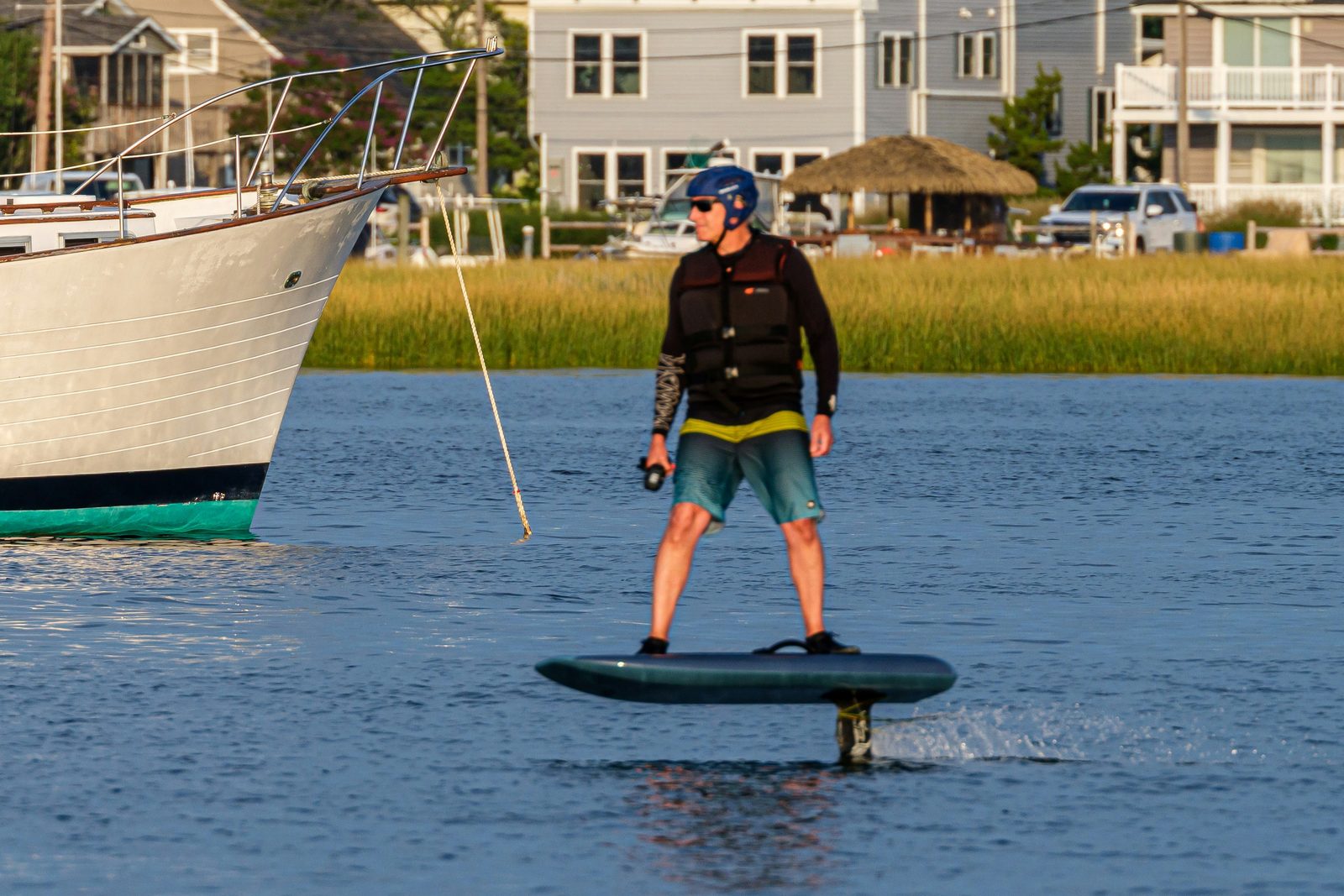
Cape Town has the coastline, Langebaan has the lessons
Cape Town itself has no published eFoil lesson price. Search for one and the trail leads, as of late October 2026, to a single school on Langebaan Lagoon, about an hour north of the city.
Closer to town, Efoil South Africa in Llandudno sells Flite and Waydoo boards and trains instructors near Stellenbosch, yet shows no public lessons. eFoil Riders' old Cape Town page now forwards to a location list without South Africa.
Then there is the coast. Hout Bay and Simon's Town lie, by the boundaries as published, inside a marine protected area that bans personal watercraft, and the V&A Waterfront basins are port water.
Flamingo Wing Foil Center on Langebaan Lagoon
Flamingo is a VDWS licensed school based at Flamingo Beach House, 1 Cloete Street, in Langebaan, and it works with the Windtown Lagoon Hotel. Wing foiling is in the name, but the price list, headed “Price list 2026 / 27” when we read it on 26 October 2026, carries eFoil lessons and rental too.
The line on its site that matters to a beginner reads “No experience needed, the instructor controls the speed until you are ready”. You work on balance and leave the speed to the instructor. Both lesson lengths include an impact vest and a radio helmet.
Flat water, and no wind needed
Langebaan Lagoon is part of West Coast National Park. Flamingo sells “Electric hydrofoil lessons and rental on the flat lagoon” with “no wind needed, any day of the week”. That is the school's own claim. The national small vessel regulations count a tidal lagoon as sheltered water, not sea, and Langebaan, a tidal lagoon, falls on the sheltered side of that line. Wetsuits are not in the lesson price; they cost extra.
Rental and riding your own board
Rental is for riders who already fly, and only after a safety and equipment check; independent foil rental also needs a VDWS card or a short assessment on the water. Riders on their own equipment can buy a rescue pass, boat safety cover on the lagoon for the season. Booking goes through WhatsApp, and every price includes the equipment unless a line says otherwise.
What an hour on the lagoon costs in rand
Swipe sideways to see all columns
| What | Length | Price | Notes |
|---|---|---|---|
| eFoil lesson | 30 minutes | R1,900 | Vest and radio helmet |
| eFoil lesson | 1 hour | R2,800 | Vest and radio helmet |
| eFoil rental | 1 hour | R2,500 | Safety check first |
| eFoil rental | 2 hours | R4,500 | Safety check first |
| eFoil rental | 5 hours | R10,600 | Safety check first |
| eFoil rental | 10 hours | R17,500 | Safety check first |
| Wetsuit rental | 1 hour or 1 day | R150 or R300 | Extra to any lesson or rental |
| Rescue pass | Per season | R3,500 | Boat safety cover for riders on their own gear |
A lesson hour costs R300 more than a rental hour, and for a beginner the gap is beside the point: rental is for people who can already ride, so your first hours on the board are lessons whatever they cost.
Once you fly, buying hours in bulk pays. Ten hours of rental work out at R1,750 each, against R2,500 for a single hour. If you are weighing that against a board of your own, the eFoil price guide sets out what new and used boards cost.
Llandudno, a dam near Stellenbosch, and lessons to confirm
Efoil South Africa is based in Llandudno, Cape Town, and its old address efoilcapetown.co.za forwards to efoilsouthafrica.co.za. The site is mainly a shop for Flite (Fliteboard) and Waydoo boards, while the booking page names Flite, Lift and Takuma as brands it stocks.
Inland, the company runs a three day eFoil instructor course on its own dam at Devonbosch, near Stellenbosch, for people who will teach yacht guests. Wetsuits, helmets and impact vests are provided and a certificate comes at the end; no price is shown. The company calls the dam usable in all weather.
What the site leaves out is a public lesson. There is no lesson price, and the booking page offered no lesson on a sample date in October 2026, which proves nothing either way. If you hope to ride with them, check with the operator first.
SAMSA's small vessel rules and the 1,000 meter line
Small craft across South Africa fall under the Merchant Shipping (National Small Vessel Safety) Regulations, 2007, published as GN R. 705 of 8 August 2007 under section 356 of the Merchant Shipping Act 57 of 1951 and amended by GN R. 731 of 11 July 2008. SAMSA, the South African Maritime Safety Authority, administers them.
Regulation 2 sorts the water first. Sheltered waters are tidal lagoons and rivers, water inside port breakwaters and all inland water; the sea excludes them. The regulating authority is whoever has jurisdiction over the shore or the water.
Regulation 3(4) applies the rules to craft under three meters unless the text says otherwise, subject to regulation 8(4), and that one is a single sentence: “No vessel under three metres may go to sea except in an area designated for that use by a regulating authority, but in any event not more than 1 000 metres offshore.” Regulation 8(2) forbids operating a vessel carelessly or without due care and attention.
On sheltered water the regulating authority takes over. The skipper follows its rules under regulation 8(1)(g), and regulation 37(1) lets a vessel enter only where it permits. Regulation 37(2) keeps personal watercraft and jet skis under three meters to demarcated areas, never more than 1,000 m offshore.
Take the definitions at face value and an eFoil is a power-driven craft under three meters, so at sea it belongs only in a designated area and never beyond 1,000 m offshore. On a lagoon such as Langebaan, inside a port or on a dam, the authority in charge decides where you launch. The regulations never mention eFoils, and no text we found says whether SAMSA treats one as a personal watercraft.
Hout Bay, Simon's Town and the marine protected area
Table Mountain National Park's Marine Protected Area was declared by GN 695 in Government Gazette 26431 of 4 June 2004, under section 43 of the Marine Living Resources Act 18 of 1998, and it follows the coast from Green Point around the peninsula to Bailey's Cottage at Muizenberg.
Regulation 1 defines a personal watercraft as a power-driven vessel with a fully enclosed hull, operated by a person standing, crouching, kneeling or sitting astride. Regulation 11(3) leaves nothing to interpret: “No person may use or attempt to use any type of personal watercraft or hovercraft within the Marine Protected Area.” Breaking the regulations can cost a fine of up to R100,000 or up to two years in prison, under regulation 12. Regulation 5 adds restricted zones on top, among them Karbonkelberg (from Hout Bay to Oudekraal), Boulders and St James.
The water off Hout Bay and Simon's Town falls within this MPA as the boundaries are drawn, and an eFoil appears to meet the personal watercraft definition: powered, a closed hull, ridden standing. Riding there looks prohibited unless an authority says otherwise.
Boating SA reported on 18 March 2025 that an amendment now admits personal watercraft longer than 3 m inside the MPA, while smaller ones stay excluded. It gave no gazette reference. Even if the change holds, a board under three meters would stay on the excluded side.
Two Cape Town bylaws: launch sites, bathers and dams
The City of Cape Town Coastal By-law, 2020 was approved by Council on 27 May 2020 and promulgated on 11 August 2020 in Provincial Gazette Extraordinary 8301. Under section 21(2) a motorized vessel, jet skis included, may be launched in the coastal zone only from a public launch site, which section 21(1) defines as one designated and published on the City's website. Papers must be ready on demand, safety equipment on board, and a kill switch attached to the skipper unless the engine is under 15 hp.
Section 21(3) forbids operating a vessel in a way that puts the coastal zone or anyone at risk. Where signs prohibit it, and without the City's written authorization, section 14(1)(d) bars motorized vessels from within 100 m of a bather or of the low-water mark in a bathing area. Under section 27(1) an official may impound a vessel linked to an offence, without a warrant.
Vleis, dams and estuaries
Inland water has its own text, the Recreational Water-Use By-law, 2018, published in Western Cape Provincial Gazette 8033 and in force since 29 January 2019. It covers vleis, dams and estuaries the City owns or manages, and its vessel includes any flotation device you can stand on, powered mechanically, electrically or by hand.
Section 3(3) allows launching only at a slipway the City designates. By notice the City can ban vessel types, limit speeds and times and set zones (section 5(2)), and once a Code of Practice is adopted, section 5(3) keeps power boats and electric boats inside designated areas. An eFoil answers the by-law's description of a stand-on, electrically powered vessel, so on City water it launches from a designated slipway and rides only where the City allows.
The V&A Waterfront and Cape Town's port rules
The Waterfront basins count, by every map we could lay hands on, as part of the harbor of the Port of Cape Town, which runs on Port Rules approved under section 80(2) of the National Ports Act 12 of 2005 and published on 6 March 2009. Rule 83(2) allows water sports within port limits only in areas the port authority has designated. Rule 124(1) goes further: no pleasure vessel may approach, enter, shift within or leave a port without the Harbour Master's permission.
So an eFoil at the Waterfront would need both, a designated area and the Harbour Master's permission. No public eFoil area in the port has been announced that we know of.
Langebaan's three marine zones
West Coast National Park's management plan (sections revised in 2018) splits Langebaan Lagoon into zones. Motorized vessels may use Marine Zone A, launching from designated sites or the beach. Zone B is for non-motorized craft only, and Zone C is an exclusion zone where access is strictly prohibited.
That puts an eFoil in Zone A. SANParks announced a review of the plan on 23 April 2024, so the zoning may change; on your own board, ask where Zone A ends before you launch.
What this page says about the rules is a summary of the texts as published, and wherever an interpretation of ours creeps in, the sentence flags it. The authority in charge of a stretch of water may see its own rules differently, and its view is the one that binds. How the board itself works is covered in our eFoil guide.