What is a foil assist?
A foil assist is a compact electric drive that bolts onto the hydrofoil setup you already own. You get a small motor on the mast or inside the board, a battery of a few hundred watt-hours, and a remote. The remote is usually handheld, though Duotone’s is a watch with a finger ring and FLITELab builds its buttons into the deck. The motor has one main job, the takeoff: carrying you onto the wing with no wave, no wind and no boat tow. Once the board is flying, you glide and pump under your own steam, and plenty of riders leave the throttle alone for the rest of the session. Foil Drive, the Australian company that invented the category, describes it as a short burst of thrust followed by pure gliding. That is what this gear is for.
An eFoil works the other way around. There, a battery of 0.8 to 2.55 kWh, depending on model and pack, feeds a motor that runs the whole time, and that motor is what keeps the board flying. An assist system carries a battery of 141 to 864 Wh and adds roughly 3.5 to 8.8 kg to your gear, depending on the maker and the battery. The 3.5 kg is FLITELab’s AMPJet with one battery. The 8.8 kg is Manta’s TakeOff Flow, a 6.8 kg main unit with its battery plus the 2 kg motor. What you get in return is a board that still behaves like a surf foil, light and lively, and on a wave or a pump it glides in a way a full eFoil board, carrying all that extra mass, never can.
Foil assist is now one of the more crowded parts of the foil market. Duotone, Fliteboard and several smaller builders have followed the Australian pioneer Foil Drive in, and Lift comes at the idea from the eFoil side with a hybrid board. Below we go through the 2026 field using each maker’s own published data, re-read on their pages and stores on 5 October 2026.
Three ways to build a foil assist
You will find three basic layouts on the market. Each puts the motor and the battery somewhere different, so picking one mostly means picking the set of trade-offs you can live with.
1. A retrofit pod on your existing mast. This is the classic solution. A streamlined motor pod clamps to your mast, and the battery stays under the board, not on the deck. Foil Drive bolts its battery unit between board and mast, with a cable running down to the pod of its Retro Fit mount. Manta Foils fits its main unit between the board’s foil track and the mast, above the universal pod. On the TakeOff Evo the battery can ride in an optional backpack instead. On the Stoke Foil Boost the battery is carried on the drive unit itself, which sits at the top of the mast. The big plus of a pod is that your whole quiver stays in play, and the system can move to a different mast later on.
2. An integrated mast. The motor is built into the mast at the factory. Hydrodynamically that is cleaner. The catch is that you are committed to a dedicated mast. The Duotone Foil Assist works this way with an 84 cm eMast, and Foil Drive also sells integrated masts for foils from AFS, AK, Armstrong, AXIS, Cloud IX, CODE, Foil Cedrus, F-ONE, NORTH, RRD, Slingshot and Unifoil.
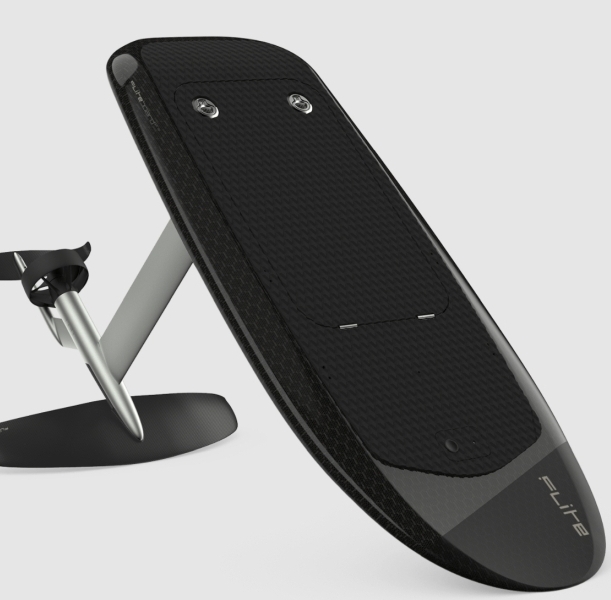
3. A jet inside the board. Fliteboard’s FLITELab AMP system keeps the motor off the mast entirely and builds a sealed water jet, the AMPJet, into the middle of the board. You need a dedicated AMP board for it. Your mast and wings stay the ones you know, so under the water nothing changes.
Each layout also puts the weight somewhere else, and you notice it underfoot. Pod systems carry the weight at the top of the mast, under the board. Duotone moves it onto your hips. FLITELab hides it inside the board. On thrust the makers set their own priorities. In the table below, thrust runs from 25 kg for the FLITELab AMP to 35.5 kg for the Foil Drive MAX+, which is enough, because the drive only has to push you up to takeoff speed, not carry you all session. Top speed goes unpublished by most brands, and of the makers on this page Stoke is the only one that prints a figure.
If you already know Foil Drive and are looking for an alternative, the real question is where you would rather carry the hardware. Duotone builds the motor into its own 84 cm eMast and takes the batteries off the board altogether: two 159.6 Wh cells sit in a waterproof box on a hip belt. The FLITELab AMP goes the other way and leaves everything under the water alone, because the jet lives in a dedicated board and runs on 142 Wh AMPCells. Neither is simply a better Foil Drive. With the aluminum Duotone mast you keep your wings through a fuselage adapter, made for Duotone’s own foils and ten other brands, while the AMP asks you to buy a new board in place of a new mast.
Air travel shaped the design of most of these batteries. Duotone’s 159.6 Wh cells come in just under the 160 Wh limit for passenger flights. The travel batteries for the older Foil Drive MAX and for the Slim split into modules that each stay below it, and Flite’s AMPCells hold 142 Wh. Manta goes lower still and builds its Air battery from 97 Wh packs, under the 100 Wh line. Anything between 100 and 160 Wh needs the airline’s approval under IATA rules. Foil Drive’s newer MAX+ and Fusion have no travel battery yet. Spare packs never go in checked baggage, so the traveling foiler these designs are aimed at carries the batteries into the cabin.
The main systems in 2026
Every figure below comes from the makers’ own pages and stores, re-read on 5 October 2026. Where a brand publishes nothing, the number is left out. We do not guess.
Foil Drive Assist MAX+, Assist Slim and Fusion
Foil Drive created this category, and the Australian brand’s tagline makes no secret of it: “the original foil assist”. The all-rounder in the range is the Assist MAX+, which replaced the 40-volt Assist MAX, discontinued by Foil Drive in September 2026. On its spec sheet the MAX+ runs at 43.2 V on the 648 Wh FM+ 650 battery and delivers 35.5 kg of thrust and 2,150 W of peak power. Minimum installed weight is 6.71 kg. Foil Drive’s FAQ puts the MAX+ level with the Fusion for power and thrust, although the Fusion sheet prints 34 kg. The MAX+ gets no printed ride time from Foil Drive, and there is no travel battery for it yet. The whole unit is sealed to IP68. In the company’s European webshop, read on 5 October 2026, a complete MAX+ with the battery and a retrofit motor costs €4,892.14 to €5,536.14 with VAT included. Packages with an integrated mast run from €5,803.14 to €6,803.14.
The Assist Slim is aimed at riders who care about pumping and gliding. The spec sheet lists added weight from 3.75 kg, 26.5 kg of thrust and batteries of 166 to 241 Wh, and the pack you pick sets both the weight and the price. Again, no ride time is published for the Slim. In that webshop a complete kit with battery and a retrofit motor is listed at €3,895 to €4,570, depending on the battery and motor you choose. Like every other Foil Drive price, those figures include VAT. Foil Drive publishes no top speed for any of its systems, and that says plenty about what these products are for. With an assist, the number that matters is how easily you get up on the foil, not how fast you go once you are there.
The Fusionopened Foil Drive’s newer Gen2.5 generation before the MAX+ joined it. At 43.2 V, it runs either on the 864 Wh Fusion 860 battery or on the lighter 648 Wh FM+ 650, and pushes with 34 kg of thrust. Only Manta’s TakeOff Flow carries a pack as large as that bigger battery, and nothing else on this page beats it. You pay for the capacity in weight: with the 864 Wh battery the minimum installed weight is 7.9 kg, the heaviest in Foil Drive’s range. Unlike the MAX+ and the Slim, the Fusion comes with ride times from Foil Drive, given as indicative averages for an 85 kg rider: up to 110 minutes in the surf or 61 minutes as an eFoil on the 864 Wh battery, and up to 70 or 48 minutes on the FM+ 650. A complete kit with battery and a retrofit motor costs €5,719 to €6,676 with VAT included. With an integrated mast, the packages run from €6,804 to €8,043.
Duotone Foil Assist
Duotone, part of the Boards & More group, builds its 2026 answer around the integrated mast. The motor lives in a dedicated 84 cm eMast, with the propeller 17 cm below the mount. Neither of the two batteries rides on the board; both sit in a waterproof eHarness box on a hip belt, and the drive is controlled with a waterproof smartwatch-style ring called the eRemote Watch Ring. With its box and batteries the harness weighs approximately 3.76 kg. For the 84 cm eMast, the specs table on the set and eMast pages gives 3.45 kg in aluminum (AL) and 3 kg in carbon (D/LAB), with a possible tolerance of 5% either way. The quoted ride time is 25 to 40 minutes, while Duotone publishes neither thrust nor top speed. The sets are sold in Duotone’s own online shop and through its dealers. On 5 October 2026 the Foil Assist Set AL 2026 cost €4,799 and the D/LAB set €5,999, VAT included, plus shipping, and a third set, the Foil Cruise Set AL 2026 with an 80 cm mast, also cost €4,799.
Fliteboard FLITELab AMP
FLITELab, the sub-brand of Fliteboard, goes about it in a completely different way: the AMP boards carry a water jet drive called the AMPJet in the middle of the board, and your own mast and your own wings attach underneath. With two flight-friendly 142 Wh AMPCell batteries the system delivers 25 kg of thrust. In the maker’s US shop a set runs from $7,924 to $8,419, before shipping and tax, and it covers everything above the water, board and AMPJet included. According to FLITELab’s FAQ, the jet adds 3.5 kg with one AMPCell and 4.5 kg with two, give or take, on top of the board. The same FAQ puts two cells at some 40 boosts, which for most riders is enough for a session of around two hours.
The rest of the field: Manta, Stoke and the Lift hybrid
Manta Foils builds the TakeOff Evo around swappable batteries. An Air battery pairs two 97 Wh packs for 194 Wh, two Air batteries make 388 Wh, and the Endurance battery holds 518 Wh. On one Air battery the Evo weighs 4.5 kg (2.5 kg for the main unit and battery plus the 2 kg motor) and runs 15 to 20 minutes. The largest combination, Air plus Endurance, holds 712 Wh and is claimed to give 65 to 70 minutes. The TakeOff Flow is built differently: its 864 Wh battery is not removable and stays inside the main unit, which weighs 6.8 kg before the 2 kg motor, and Manta quotes 70 to 90 minutes for it. Manta sells through an EU shop with a configurator. On 5 October 2026 the TakeOff Evo cost €5,380 there with one Air battery and €6,688 with the 712 Wh combination, before the faster charger or the three-blade propeller, and the TakeOff Flow full kit cost €5,022, all with VAT included. Stoke, an Australian brand, mounts its Foil Boost systems high on the mast, right under the board. For the Ultra version Stoke quotes 68 lbs of thrust (about 31 kg), a 35 km/h top speed (roughly 22 mph) and 30 to 60 minutes of running time at mixed throttle, or 25 to 30 at full throttle.
The LIFTX from Lift belongs in a category of its own. Instead of a retrofit kit, it is a hybrid eFoil: a complete board of around 20 kg with a 0.9 kWh battery, which rides as a surf foil once the motor is switched off. At $13,999 it sits firmly in eFoil territory. What it chases is the feeling an assist system gives you, a powered takeoff followed by free gliding.
The big systems side by side
Swipe sideways to see all columns
| Foil Drive MAX+ | Foil Drive Slim | Foil Drive Fusion | Duotone Foil Assist | FLITELab AMP | |
|---|---|---|---|---|---|
| Build type | Pod on your mast / integrated mast | Pod on your mast / integrated mast | Pod on your mast / integrated mast | Integrated eMast | Jet in the board |
| Battery | 648 Wh | 166-241 Wh | 648 or 864 Wh | 2 × 159.6 Wh (on a hip belt) | 1 or 2 × 142 Wh |
| Ride time (maker) | not published | not published | up to 110 min surf, 61 min eFoil (864 Wh) | 25-40 min | about 40 boosts, around 2 h (2 AMPCells) |
| Added weight | from 6.71 kg | from 3.75 kg | 7.9 kg (864 Wh battery) | 3.76 kg harness plus 3.45 kg (AL) or 3 kg (D/LAB) eMast | approx. 3.5-4.5 kg on top of the board |
| Thrust | 35.5 kg | 26.5 kg | 34 kg | not published | 25 kg |
| Price (approx.) | €4,892.14-5,536.14 | €3,895-4,570 | €5,719-6,676 | €4,799 (AL) / €5,999 (D/LAB) | $7,924-8,419 (with board) |
If you are retrofitting a setup you already ride, we would start with Foil Drive, which has the most experience behind it, an established service path, the longest list of compatible masts and now three system sizes to choose from. Foil Drive accounts for both “not published” cells in the ride time row; the gap is Foil Drive’s own choice, not an oversight on our part. With the battery on your hip, the Duotone approach gives you the lightest board of the group. FLITELab makes sense for riders who were going to buy a new board in any case and want everything below the waterline to stay as it is.
Foil assist or eFoil?
Seen on the beach, the two are easy to mix up, but they are built for different riders and solve different problems. An eFoil, sometimes written e-foil, is built so that someone with no foiling background is often flying above the water within an hour. The motor runs continuously, the big battery covers 45 minutes to two and a half hours of riding depending on board and pack, and the board itself is stable and forgiving. A foil assist assumes you already have the skill. The motor lifts you onto the wing, and after that a wave, a pump or the wind has to keep you going.
You feel the weight difference the moment you are on the water. An assist adds somewhere between 3.5 and 8.8 kg on top of the board and foil you already ride. A complete eFoil set typically weighs 25 to 35 kg, and even Lift’s light LIFTX comes to 20 to 21.5 kg. In return, the eFoil gives you predictable ride time, and you do not need a wave. On price the two sit closer than most people expect, since entry-level eFoils and the upper assist packages overlap. Our eFoil comparison table and the page on eFoil prices go into the models and prices in detail.
As a rule of thumb, take the assist if you already foil and you are after that surfy glide. If you still want to learn how to fly above the water, or the board will be shared around the family, take the eFoil.
Buying one, and what to check first
Foil assist systems are still a rare sight in local shops, so most of this buying happens online. Foil Drive sells direct from a European webshop that prices in euros and ships within the EU, which keeps import duty out of the equation for buyers inside that market, and Manta also runs an EU shop in euros. Duotone offers the Foil Assist sets in its own online shop and through its dealers, Fliteboard sells through its own online stores, and Lift sells the LIFTX both in its own online store and through the local partners listed in its dealer locator. Wherever you are, it pays to buy from a storefront that already serves your region, because cross-border orders add customs handling, longer service loops and, for batteries, a shipping headache.
Before you order, check compatibility. A pod system cares about the width and material of your mast. With an integrated mast, the question is whether an adapter exists for your wings. Then look at battery service. A replaceable pack is the reason these systems stay useful for years, so it makes a real difference what a replacement costs and how it can be shipped to you, given that lithium batteries travel as dangerous goods.
A foil assist is a motorized craft, and the rules for those differ by country and often by individual lake or stretch of coast. Check your local regulations before your first session.
Who a foil assist is for
This gear pays off most for people who already do a foil sport. Surf and prone foilers let the motor stand in for the push of a wave on days when no clean wave is running. Downwind paddlers hand over the hardest part of the ride, the takeoff, and wingfoilers get on the water when there is no wind to speak of. For wingfoilers that matters more than it might sound. Inland lakes and sheltered bays can sit glassy for days, well below what a wing needs, and a foil with an assist will still lift off on water like that.
If you have never been on a foil, learn the basics first. A lesson on an eFoil, or a wing lesson, will make an assist system far more rewarding later. Flying above the water comes quickly. Gliding on with the motor off, which is what an assist is for, is the part that takes practice.