What Wing Surfing and Wingfoiling Mean
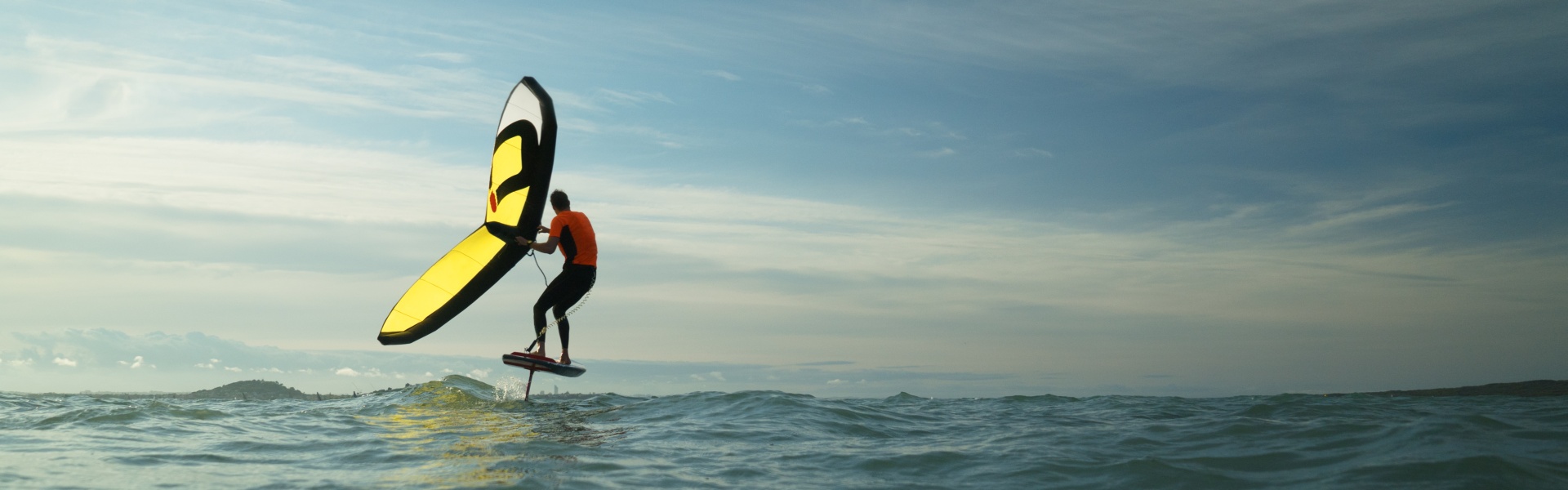
Wingfoiling, often written wing foiling, is riding a hydrofoil board with an inflatable wing in your hands: the wind pulls you along and the foil lifts you above the water. Take the foil away and the wingfoiler is wing surfing, standing on a plain board while wind fills the wing. How you angle it decides where you go, and how quickly you get there.
Put a hydrofoil under that board and the sport becomes wingfoiling. Once the foil lifts the board out of the water, the mast and the foil itself are all that still cut through it. Drag drops sharply, and your speed climbs noticeably. You stop riding on the water and start gliding above it. That mix of wing and foil is the reason wingfoiling counts as one of the most exciting watersports of recent years.
Not everyone splits the two names this way. Plenty of riders say “wing surfing” and mean wingfoiling, while Britain's Royal Yachting Association keeps the name for the first stage, learned on a large windsurf board or windSUP with no foil underneath.
Pros and Cons of Wingfoiling
No rig, no lines
Pump it up and go
Lightweight wing
A 4 m² wing weighs about 2 kg
Works in moderate wind
Rideable from about 10 knots on a big wing
Easy to transport
Folds into a small bag for travel
Harder without foil experience
It helps to learn foiling first
Needs steady wind
Nothing happens in a lull
Learning curve in waves
Much harder once swell builds
Light wind means no ride
Beginners want 15 to 20 knots
The Wing, the Board and the Rest of the Gear
The big draw of a wing is that it has no rig and no lines. You pump it up, pick it up and ride. Out on the water you adjust its position constantly, to suit where the wind is coming from and where you want to go. For a first wing, Ensis suggests around 4 m² if you weigh under 70 kg and about 5 m² for heavier riders. A wing weighs so little that you can carry it to the water under one arm.
Every wing needs a leash, worn on the wrist or on a waist belt, so it can't drift away after a crash.
For the board, beginners should go for the biggest one they can get. It sits steadier on the water and makes standing up a lot easier, and because a high-volume board floats you better, more of your attention is left over for working the wing.
Getting Started
Ensis recommends learning in around 15 to 20 knots of wind. Once you feel secure on a foil, a bigger wing gets you going in lighter wind, and Duotone rates its 5 m² Unit from 10 knots. Keep your first attempts to smooth water without waves, because chop makes balancing and handling the wing much harder than it needs to be.
The foil has sharp edges, and you can hurt yourself on them in a fall. So wear a helmet, a flotation vest and neoprene booties.
Wingfoiling comes much easier if you have already tried foiling without a wing. A few sessions of surf foiling or SUP foiling make ideal preparation, and so does some time on an eFoil. Windsurfers pick it up especially fast, since steering the wing works on much the same principles as a sail.
You can see how close the two sports sit at the north end of Lake Garda. One Trentino rulebook there covers windsurf and wing boards, bans electric foils, and lets wingfoil beginners start in open water from a school or club boat.