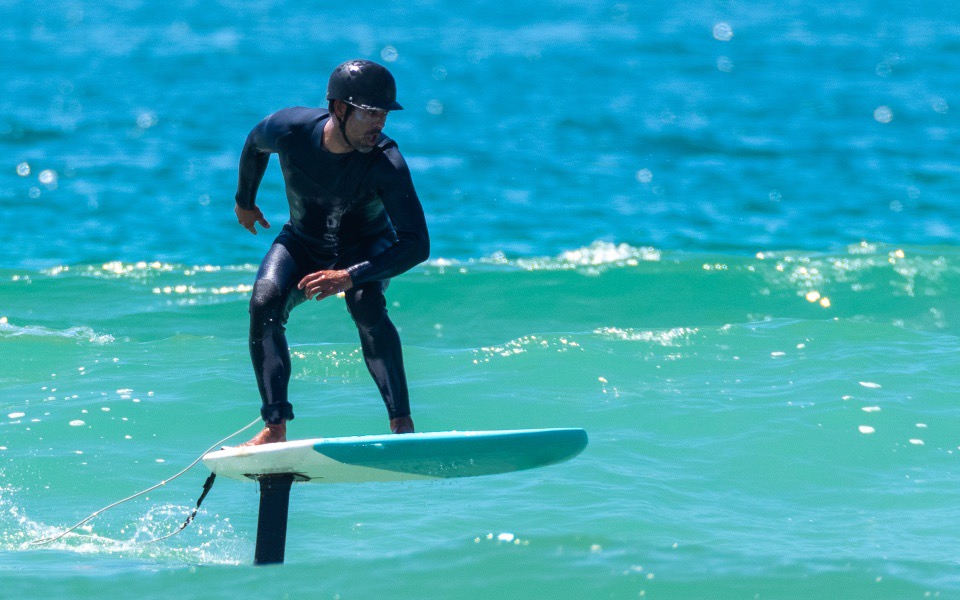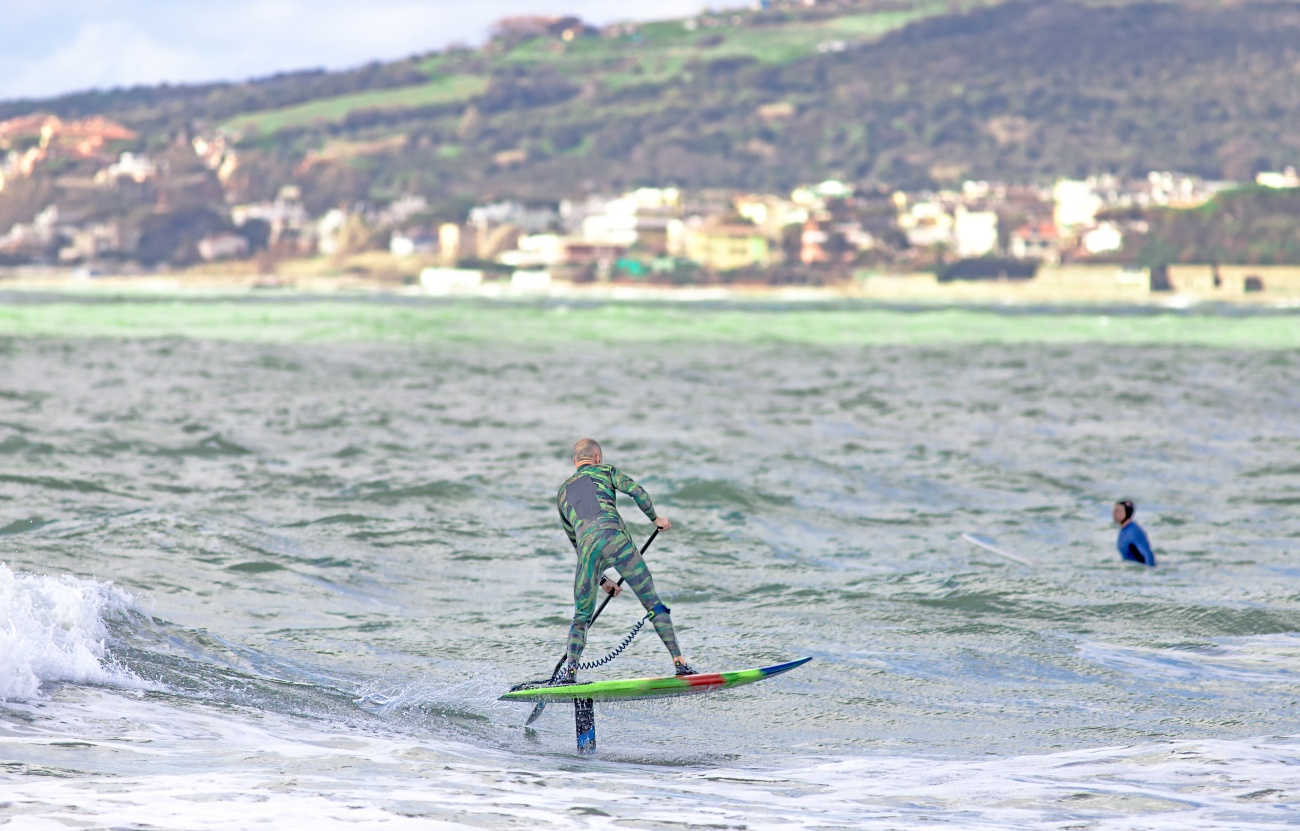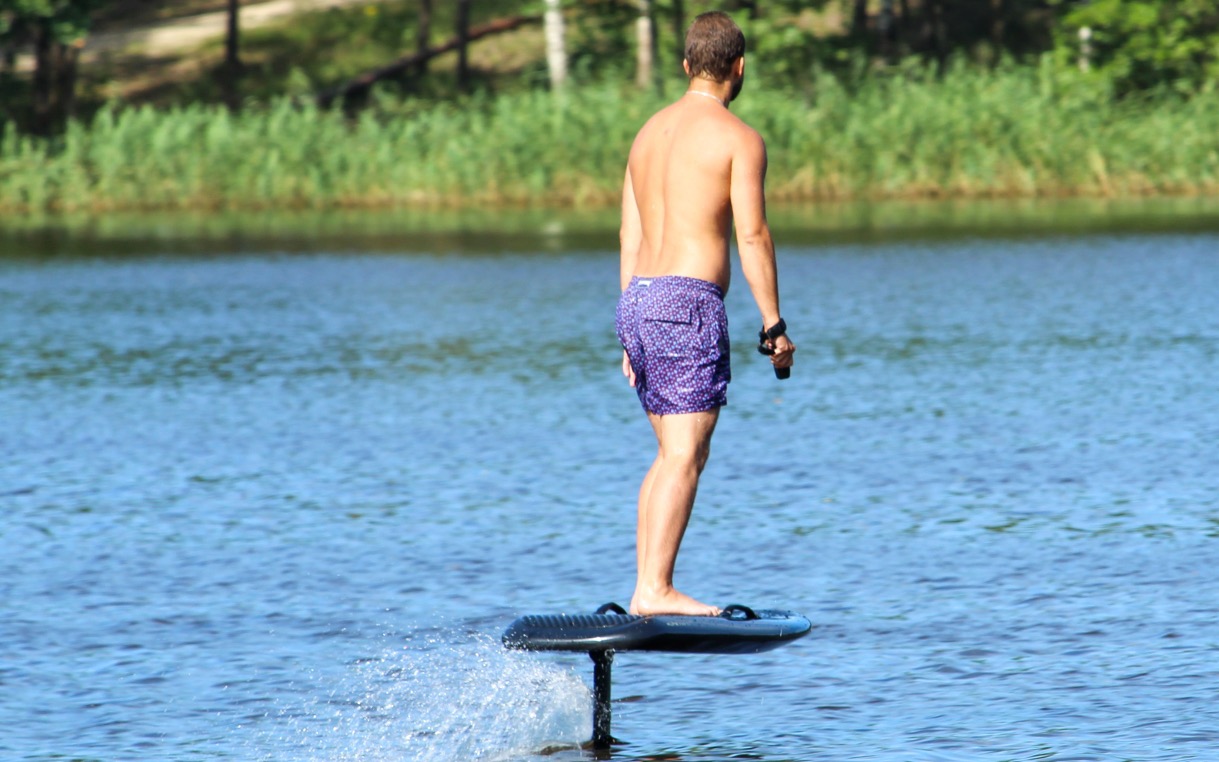
What is an electric SUP?
A stand-up paddle board with an electric drive on it is an electric SUP. There are two ways to end up with one. Buy a ready-made e-SUP board, with the motor and battery built in at the factory, or fit a retrofit SUP motor to the board you already paddle.
Touring paddlers and families are the first audience, along with anyone who wants an easy day on the water. Adrenaline is not the selling point. That is the territory of the eFoil and the jetboard. A motorized paddle board is for gliding quietly over longer distances without much effort. When your arms give up, or the way back runs straight into a headwind, the motor takes over most of the work.
Take a summer evening on your home stretch of flat water, an inland lake or a sheltered coastal bay. You paddle along the shoreline at an easy pace, and when your shoulders start complaining you switch the assist on. The board pulls ahead on its own while you stand there, look around and take photos. Then the wind picks up for the return leg. That turns into a sweaty grind on a plain SUP. With a motor you hold a steady pace all the way back to the beach.
This is what the thing is for. Speed has little to do with it; you get the freedom of knowing your time on the water belongs to you and not to the headwind.
The motor adds to paddling rather than replacing it, and how hard you work stays your decision. Paddle with no assist at all, use a gentle push to hold your pace, or hand the propulsion over entirely. Being able to switch between all three is the real strength of the format. One board covers fitness paddling, day tours and lazy afternoons, depending on what you feel like.

Who it suits, and who should skip it
Some riders get a great deal out of one of these and others very little, so work out which group you are in before looking at any hardware. An electric SUP is not built for everyone, and because it is made for a narrower group, it works very well for the right rider.
An electric SUP is a good fit if:
- you plan longer trips and would rather not have your shoulders decide how far you get;
- you head out with family or kids and want a predictable pace home even when the wind turns against you;
- you fish or shoot photos from the board and need it to keep moving while your hands are busy with something else;
- you love paddling, but fitness or an old injury limits how long you can keep it up;
- you are after a calm, quiet time on the water where speed and thrills are not the point.
Give it a miss if:
- you are chasing speed and a rush, which is what jetboards and eFoils exist for;
- you want the sensation of flying above the surface, which is firmly eFoil territory;
- you paddle as training, in which case a throttle is more temptation than help;
- you like traveling light: a motor and a battery mean extra weight, extra charging and extra upkeep.
If most of the first list describes you, one decision is left, and it is a technical one: a board with the drive built in at the factory, or a motor added to the board you already own.
E-SUP board or retrofit SUP motor?
Decide this before any money changes hands. The ready-made e-SUP board is a complete system, with board, motor and battery designed around each other. A retrofit motor is the flexible, cheaper way into motorized paddling, and it goes onto a board you may already own.
Three simple questions settle most of the decision:
- Do you already own a board you like? A retrofit motor is the obvious move. Nothing forces you to part with a board that already works for you.
- Is the motor the main event or an occasional helper? If motorized riding is the point, a purpose-built e-SUP gives you the more coherent package. If you only want a push now and then, a retrofit unit covers it comfortably.
- How do you carry and store the board? Built-in hardware adds weight, and you feel it every time you haul the board from the car down to the water.
Swipe sideways to see all columns
| E-SUP board | Retrofit SUP motor | |
|---|---|---|
| Best for | A complete package when you want an electric SUP from the start | Upgrading a board you own, occasional assist |
| Speed | Varies by maker; SipaBoards states 3 to 4 knots cruising | Aqua Marina BlueDrive S up to 4 km/h (low) or 6 km/h (high); JAYKAY e-Fin 2.0 top speed 7 to 8 km/h |
| Battery / run time | Varies by maker; check the spec sheet | Maker-dependent: 0.5-4 h (JAYKAY), up to 60 min (BlueDrive S), 75 min-10 h (Bixpy) |
| Price (ballpark) | €2,599 to €3,990 with 22% VAT (SipaBoards) | From €499 (JAYKAY e-Fin 2.0); Bixpy K-1 Outboard Kit $1,399 plus a $99 SUP adapter |
| Strength | Matched system, tidy integrated design | Cheaper, and your existing board stays in service |
| Weakness | Costs more and carries the extra weight of built-in hardware | Aftermarket mounting; board and motor do not always suit each other |
With a board you trust already in the garage, a retrofit motor is the path of least resistance. Starting from scratch, with the motorized riding as the whole point, you will make fewer compromises on a purpose-built e-SUP.
With a retrofit system, no detail matters more than mount compatibility. Nearly all retrofit motors clamp into the fin box. Fin boxes are not standardized and their shape differs from board to board, so check before you buy that the motor matches yours. A solid, properly seated mount is reassuring, and it is more efficient too, because a unit that wobbles and vibrates throws away part of its thrust.
How the drive works
Whatever the brand, an electric SUP runs on a battery and a small electric motor, and the motor pushes the board forward with either a water jet or a propeller. Pace is set with a remote or a stepped throttle. Several levels come with most systems, from a gentle, battery-sparing push up to full power, so you choose how much of the work the motor does.
On the water, jets and propellers behave slightly differently. A jet is a closed system: it accelerates water inside a housing and expels it out the back, so nothing spins in the open under your board. A propeller is the simpler, more traditional answer, but exposed blades are more sensitive to anything floating around. With either one, feed in the throttle gently at first and give yourself time to learn how the board responds.
Run time per charge varies with the maker and with the power setting you ride in, and the published figures cover a wide range. SipaBoards quotes up to 3.5 hours on the two 90 Wh packs its boards ship with (up to 3 hours on the BMW Tourer), JAYKAY gives the e-Fin 2.0 roughly half an hour to four hours, and Aqua Marina lists up to 60 minutes for the BlueDrive S. Bixpy's page for its PP-378 pack promises over 75 minutes at full power or 10 hours at trolling speed. Charge times spread just as wide, running from one hour for a SipaBoards 90 Wh pack to three and a half hours for the JAYKAY fin and about five hours for the Bixpy pack on its wall charger, which makes overnight the safe option.
An electric SUP has one real advantage here: it works in shallow water, because no deep wing hangs below the board the way one does on a SUP foil. Weed and reeds are the catch. Both wrap around a propeller in seconds and can choke a jet intake, so steer around overgrown shallows when you can.
No matter what range the maker quotes, you need a little planning before one charge gives you a relaxed outing. The rule of thirds works well: one third of the battery for the outbound leg, one third for the return, one third held back as reserve. Head out into the wind where you can, so you do the work early and get pushed home later by wind and motor together. Check the charge level before every launch. Against a stiff breeze, expect the motor to draw noticeably more than it does on glassy water.
Your first outing, step by step
Launching with a motor is no harder than a normal SUP session. The routine just gains a few extra steps. A calm, safe first ride goes like this.
- Prepare at home: charge the battery and the remote, then check that everything is tight: motor, fin, screws.
- Choose the place and the moment: a windless day and a familiar piece of shoreline, well away from swimmers and jetties, make the best debut.
- Mind the depth: an electric SUP handles shallow water, but you still need enough under the board that the drive never touches the bottom.
- Paddle without the motor for the first few minutes and get reacquainted with the board. Built-in hardware or a mounted motor shifts the balance a little.
- Start in the lowest setting and ride in a straight line. Feel how the board accelerates and how long it carries before you move up a level.
- Practice stopping and turning on open, empty water. A turn under power behaves differently from a paddled one.
- Turn back early, long before the battery runs low. The last stretch can always be paddled, and turning early keeps a real reserve in hand.
A handful of beginner mistakes are easy to sidestep:
- Launching downwind. You fly out and then have to fight your way home, so doing it the other way round pays off every time.
- Going straight to the top setting. That looks good, but it drains the battery fastest and makes the board twitchier than a newcomer needs.
- Riding into reeds or weed beds. Weed wraps around a propeller, and it can stall a jet drive just as effectively.
- Expecting to charge at the launch site. A full charge takes anywhere from one hour for a SipaBoards 90 Wh pack to about five hours for Bixpy's PP-378, so do it at home, ideally the night before.
Rules and safety on the water
Electrically powered watercraft are regulated, and the rules differ by country and often by individual lake or stretch of coast. We have not researched those rules for electric SUPs, so look up what applies on the water where you plan to ride, including whether a motor is allowed there at all. Wherever you ride, keep your distance from swimmers and designated swimming areas, and ride in a way that puts nobody else at risk.
A few unwritten rules sit alongside the official ones, and they keep everyone safer. Wear a life jacket. A motor takes you further from shore than paddling ever would, and that is when flotation matters. A leash keeps the board from drifting off after a fall. The forecast deserves a glance before you launch, and if a thunderstorm builds, head for shore immediately; on big open water the wind can come up startlingly fast. Tell someone on land where you are going and when you plan to be back. Of all the safety equipment there is, that is the cheapest piece.
Because rules can change, and can differ from one body of water to the next, always check the local rules before you launch. Harbor offices, lake authorities, national park administrations and local clubs are the usual places to ask, and in most cases a five-minute phone call settles the question for the whole season.
When to go out
Timing matters more than most people expect. The hour and the season you pick often do more for the experience than any extra piece of kit.
- Early morning is the best window. Your odds of still air are highest then, the water is smooth and the shoreline is empty, all of which suits the quiet gliding an electric SUP is built for.
- On summer days, swimmers call for more attention. Give designated swimming areas a wide berth and look for the quieter sections of shoreline.
- Spring and autumn bring emptier water and better light, along with colder temperatures. A wetsuit starts to make sense, and you should expect the battery to fade sooner in the cold than it does in midsummer.
Much of the weather drops out of the equation with an electric SUP. You need no swell and no wind. A free morning, a charged battery and a calm patch of water are enough.
Care and end of season
An electric SUP asks for no workshop and no mechanical skill. Keeping one working reliably for years takes a few regular habits, nothing more:
- Rinse the motor and mounts with fresh water after every session, and clear sand and weed out of the drive so the moving parts stay clean.
- Never let the battery cook in direct sun. On the beach and in the car alike, it belongs in the shade.
- Follow the manufacturer's instructions for charging and storage. As a general rule, a battery that is going to sit unused for a while should never be stored completely flat.
- If you ride a retrofit motor, check the mounting bolts now and then through the season. Vibration works them loose slowly, often without you noticing.
- If your board is inflatable, pack it away clean and completely dry at the end of the season, and store the battery indoors over winter where it cannot freeze.
How you finish one season shapes how the next one starts. Spend ten minutes tidying up in autumn and you save yourself a repair bill in spring. When the first trip of the year comes round, go over the battery, the connectors, the mounts and the remote without hurrying, and only then head out for the first lap.
Electric SUP or eFoil?
A day on one of these feels nothing like a day on the other. The electric SUP is the touring machine. You stand stable on the board, cruise at a civilized pace and keep up with family or friends without breaking a sweat. The eFoil gives you the sensation of flight instead, with the wing lifting you clear of the surface so you hover above it. The thrill is bigger, and it asks for practice and far more attention.
Swipe sideways to see all columns
| Electric SUP | eFoil | |
|---|---|---|
| Experience | Calm gliding along the surface | Flying above the water |
| Speed | 3 to 4 knots cruising per SipaBoards, about 5.56 to 7.41 km/h (3.5 to 4.6 mph) | Top speeds of roughly 35 to 60 km/h (22 to 37 mph), from the slowest current model to the fastest |
| Learning time | A few minutes | Several hours of practice |
| Shallow water | Fine, since nothing hangs deep below the board | Needs deeper water because of the wing |
| Price | €2,599 to €3,990 for a complete board with 22% VAT (SipaBoards), from €499 for a retrofit fin (JAYKAY) | From €4,999 excl. VAT (SiFly Rider) or €5,807 with VAT (Waydoo Flyer EVO Lite), shipping extra |
| Who it is for | Tourers and families | Anyone who wants to fly |
For jetboards and the rest of the electric watersports family, our electric surfboard overview walks through the whole category and is also the place to start if you are still torn between these two.
A table only takes you so far. The best way to decide is a session on the water, so if you get the chance, try both before you commit. Coached eFoil sessions are available at plenty of spots, and an hour with an instructor teaches you more than any brochure ever could. For the cost side, our guide to electric surfboard prices breaks down, category by category, what you should budget for.