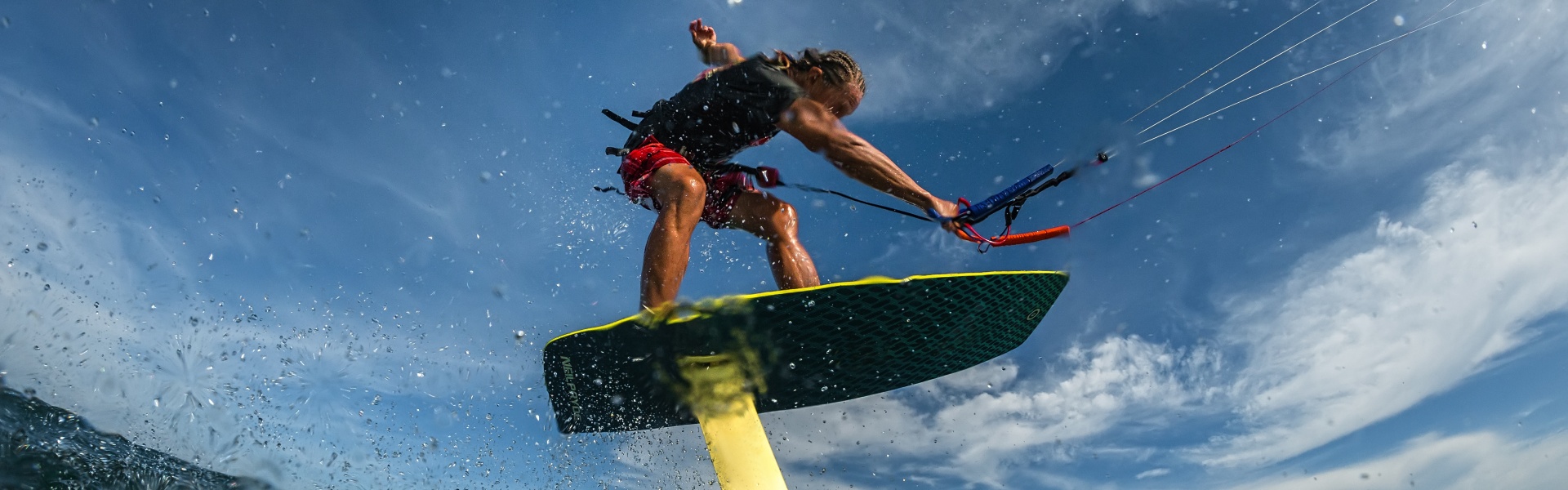
What is a kitefoil?
A kitefoil has a hydrofoil where a normal kiteboard would carry its fins. The wing under the board works like an aircraft wing, only in water. Past a certain speed it makes enough lift to push the whole board clear of the surface, and you “fly” up to about a meter above the water with only a thin mast still touching it.
Nothing about the kite changes. You fly it on your usual bar, edge against a familiar pull, and ride upwind and downwind the way you always have. The difference is all under your feet. A twin tip planes across the surface and feels every ripple of it all session long. A foil slices a narrow line through the water and leaves the chop somewhere below.
Light days are where it pays off most clearly. With most of the drag gone, a kite that could barely keep you moving on a twin tip suddenly has power to spare. That is why foils took over light-wind sessions on inland lakes and sheltered bays, and Formula Kite, the class that gave kiteboarding its Olympic debut in Paris 2024, is raced on hydrofoils for the same reason. World Sailing says the riders can reach 30 knots downwind, in races that last about 12 minutes.
Kitefoil: pros and cons
More speed
The foil cuts water drag dramatically
Flies in light wind
Makes good use of days with marginal wind
Less physical effort
Easier on the body than twin-tip riding
Sharper turns
The foil steers with more precision
Comfort deserves a place on that list. Rough water stops mattering once you are above it. The mast carves through the surface while the board rides in clean air, so the hammering that normally comes up through your knees on choppy days is gone. A foil also points far higher upwind than a twin tip does. Long tacks, downwinders and small patches of water all become much more usable.
Near-silent gliding, almost no effort and a real sense of speed. Together they add up to a completely different ride.
Sharp hardware
A foil carries real injury risk
Bulkier transport
More to pack than a twin tip
Higher price
Costs more than a standard kiteboard
More upkeep
Bolts and wings need regular checks
None of these is a dealbreaker, but together they change your habits. You pack the gear differently, you look at the bolts before you rig instead of waiting for something to rattle loose, and every time the board gets away from you, you start thinking about where your body is going to land.
The parts of a kitefoil
Hang a hydrofoil under a kiteboard, a wing board or an eFoil and the build does not change: four pieces, plus the plate that joins it to the board.
- Mast. The vertical strut between board and wings. Kitefoil masts mostly fall between roughly 60 and 100 cm. A shorter mast keeps your crashes lower and works in shallower water, so beginners tend to start there. With a longer one you get more room to ride above chop before the wing breaches the surface.
- Fuselage. The horizontal spine that holds the front wing and the stabilizer at a fixed distance from each other. Go long and the foil settles down, and pitch gets easier to manage. A short fuselage turns quicker and feels livelier.
- Front wing. This is the wing that does nearly all of the lifting, and nothing else in the setup shapes how it rides as much. A big, low-aspect wing comes up early at low speed and forgives mistakes. The slim, high-aspect wings used for racing glide better and go faster, though sloppy weight shifts get punished quickly.
- Stabilizer. The small rear wing, which keeps the whole thing in trim, much as a tailplane does on an aircraft. Change its size or angle and you change how eager the foil is to climb.
- Baseplate. Where the foil meets the board. That can be a track mount that slides fore and aft, a fixed plate, or a box the top of the mast slots into. Small moves along a track change how the whole board balances, so plan on a few sessions of trial and error before you settle on a position.
Materials split the market roughly in two. Aluminum masts and fuselages cost less and take abuse well, at the price of extra weight and a little flex. Full carbon is stiffer, lighter and more responsive, and the price climbs accordingly. For a first foil, a forgiving front wing counts for more than stiffness. A big wing on an aluminum mast will teach you more in a weekend than a race setup will in a month.
Boards and kites for foiling
A foilboard is built differently from a twin tip: it is directional, it has no fins, and the whole board is built around a reinforced mount that can take the load of the mast. Freeride shapes commonly land in the 120 to 140 cm range. That is long enough to give you something to stand on during the slow, wobbly part of a water start, and small enough to stop feeling like a raft once you are flying. On light days volume matters more than length, because a floaty board lets you get organized before the kite has to do any real work.
Foot straps are what most riders use, though plenty go strapless once they are comfortable. Straps hold you in place through touchdowns and make jumping possible. Without them it is much easier to bail cleanly, which explains why so many people learn with the back foot out.
Your kite choice shifts as well. Because the foil needs so little drive to keep moving, you can either fly a smaller kite than the wind would normally call for, or fly your usual size in far less wind. For freeriding, inflatable kites stay the popular choice, since they relaunch easily, hold their shape in gusts, and are what most kiters already own. Ram-air foil kites, which generate more power per square meter and drift better, dominate racing and light-wind riding, but they demand more care in the water and a bit more skill to relaunch.
Foil gear is modular, and that matters when you buy. Masts, fuselages and wings from one manufacturer usually mix and match when they share its connection system (some makers run more than one), so a front wing swap can change the character of the setup without a new board. Twin tracks keep the board itself open to foils from other makers. F-One says its carbon masts connect to virtually all twin-track boards on the market. Check that compatibility before you commit, especially if you plan to add a smaller, faster wing later. For the physics behind all of it, our hydrofoil guide covers how lift, speed and wing area interact across every foil sport.
Learning to kitefoil
Aim for at least 15 knots while you are learning. A well-pressured kite sits still in the sky, and that is one less thing to think about. Later, once the technique settles, you need much less wind. Practiced kitefoilers get going from around 8 knots, on days when a twin tip would never come out of the bag.
Solid kiteboarding fundamentals come first; the rest only makes sense once you have them. With those in place, still give yourself plenty of time: some people are up on the foil after fifteen minutes, and others need ten hours on the water. Wear a helmet and an impact vest while you learn, because you are going to crash often.
Many riders learn with the back foot out of the strap. Balance is easier to find that way, and when you go down, you get clear of the board in a hurry.
From there, the progression looks fairly consistent whoever is learning:
- Park the kite and get used to the water start. A foilboard wants a slower, gentler pull than a twin tip. Yank it, and the wing lifts before you are standing.
- Ride on the surface first, with the foil still fully submerged. Weight forward, speed low, kite steady. For some people this alone takes a session.
- Try short, deliberate lifts. Ease pressure off the front foot and the board rises. Shift it back on and it settles. Two seconds of flight is a win.
- Learn to touch down on purpose. Weight forward, board back on the water, keep riding. Riders call this touch-and-go, and most of your control over the foil grows out of this one skill.
- Keep the kite lower than instinct suggests. Beginners tend to fly it high, which lifts them off the board instead of driving them forward.
- Stretch the flights out. Once you can hold a steady height for ten or fifteen seconds, riding upwind starts to feel remarkably easy, and from that point the whole sport falls into place.
- Learn to fall properly. Flat and wide, away from the board, never head first into the water where the foil is. If the board is going to catch up with you, keep your arms in and stay under the surface for a moment.
The classic beginner mistakes tend to come as a set. You stand too far back, you over-sheet the bar, and you stare down at the board instead of looking ahead. Fix the eyes first: keep them on where you want to go, and your weight tends to sort itself out.
Conditions, safety and local rules
You want flat water that is deep enough. A mast is long enough to hit the bottom in shallows, and a foil striking sand at speed stops the board instantly while you keep going. Learn somewhere with room downwind, water well over head height, and no swimmers or moored boats in the landing zone.
Few kitefoilers ride with a board leash. With a twin tip a leash is a convenience. On a foil it ties a sharp, heavy object to you on a short elastic string, and that object can come back at you. So body dragging back to your board is a fundamental skill here, and it belongs in your toolkit before the first foil session, not after it.
A helmet and an impact vest are the standard kit, and both earn their place well past the learning phase. Some riders also wear a light long-sleeve top or thin wetsuit purely to take the edge off contact with the wings, because trailing edges on carbon wings can be very sharp.
The rules on where you are allowed to ride differ by country and often by individual lake or stretch of coast, and access windows, launch zones, minimum distances from swimmers and protected areas all vary. Check your local regulations before you ride. If the spot has an established kite community, ask them first; they usually know the arrangement that keeps everyone welcome.
Kitefoil compared with the other foil sports
Across all of them, the wing under the board barely changes. The power source does, and with it everything about how a session feels.
Kitefoil vs wingfoil. A kite flies far above you on lines and pulls hard for its size, and that pull gives a kitefoil its speed and its upwind angle. A handheld wing produces less power. In exchange there are no lines to tangle, the setup takes a couple of minutes, and you can launch off a crowded beach without a helper. Kiters who already ride a foil come to the wing with a head start: they know the foil, and they know how to read the wind.
Kitefoil vs surf foil. Surf foiling takes its energy from the swell itself, so it needs waves, and a ride is measured in seconds and connected bumps, never in hours. Among the versions of foiling it is the purest, and the one you will have the hardest time finding conditions for.
Kitefoil vs eFoil. With its own electric motor and battery on board, an eFoil needs neither wind nor waves, and the makers pitch it at complete beginners. Lift says most riders are up and flying within their first session. You pay for that in weight, price and battery life. A kitefoil costs less to buy, weighs a fraction as much, and never runs out of charge, but it only works when the wind shows up.
The foil family has a few more branches: windfoiling puts a rig and sail over the foil, SUP foiling uses a paddle to get onto the wing, and foil assist adds a small motor to a regular foilboard, mainly to help you get up and flying.
Looking after a kitefoil
A foil asks more of you than a twin tip does. The maintenance list is short, but none of it is optional. Rinse everything in fresh water after saltwater sessions, hardware included. The bolts need regular checks, because the load path from wing to mast to board runs through a handful of screws and vibration works them loose over time. Anything that has come loose once will come loose again, so re-torque it properly rather than just nipping it up on the beach.
If you ride an aluminum mast with stainless bolts, corrosion between the two metals is what will eventually seize a fitting. You can prevent most of it with a dab of anti-seize on the threads when you assemble, and with the habit of taking the foil apart now and then instead of leaving it bolted together all season. Carbon parts need another kind of attention. After any hard contact, look over the leading and trailing edges for chips, since a damaged edge lets water into the layup.
Transport is the other adjustment. A foil comes apart into mast, fuselage and wings, and that modular build is the reason it packs down at all. Padded wing covers pay for themselves the first time a board slides across the wings in the back of a car. Count on a few extra minutes at both ends of every session. Call it the cost of flying.
Frequently asked questions
What is a kitefoil?
A kiteboard with a hydrofoil bolted underneath where the fins would be. The kite still does the pulling. The wing under the board makes lift, though, so with a little speed the board rises clear of the surface and you ride up to about a meter above the water.
How much wind do you need to kitefoil?
Around 15 knots or more is comfortable while you are learning, since a kite with steady pressure is easier to fly than a soft one. Once the technique settles in, the number falls a long way, and experienced kitefoilers get going from roughly 8 knots, on days when a twin tip would never leave the beach.
Do you need to know how to kiteboard first?
Yes. Confident water starts, riding upwind, self-rescue and body dragging back to your board all come before the foil. With a foil you have a second thing to balance, and learning goes much faster when flying the kite is already automatic.
How long does it take to learn kitefoiling?
It varies enormously. Some riders are flying within about fifteen minutes, while others spend ten hours on the water before the first clean, controlled flight. Give yourself time and forget the deadline, and expect plenty of crashes along the way.
Is kitefoiling dangerous?
The main risk is the hardware. A mast and a set of wings are hard, thin and often sharp, and landing on top of your own gear hurts more than landing on a twin tip. Wear a helmet and an impact vest, and fall flat and away from the board. Beyond the protective gear, most riders skip the board leash entirely, so the foil cannot spring back at them.
Where can you ride a kitefoil?
Flat water with plenty of depth is ideal, because in the shallows a mast is long enough to strike the bottom. Beyond depth and space, the rules change from country to country and often from one lake or stretch of coast to another, so check the local regulations before you ride.