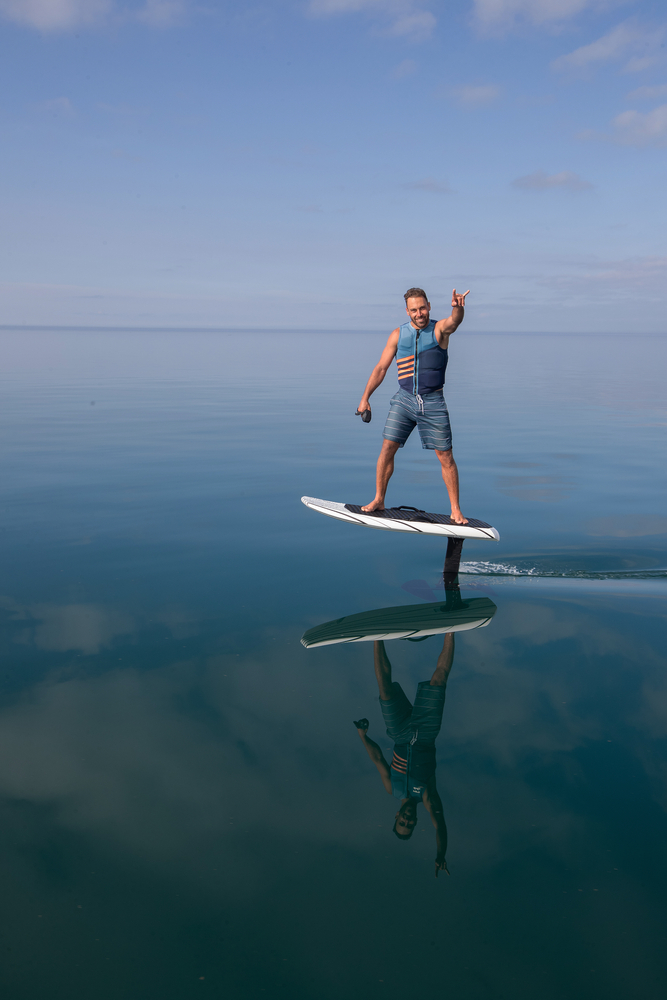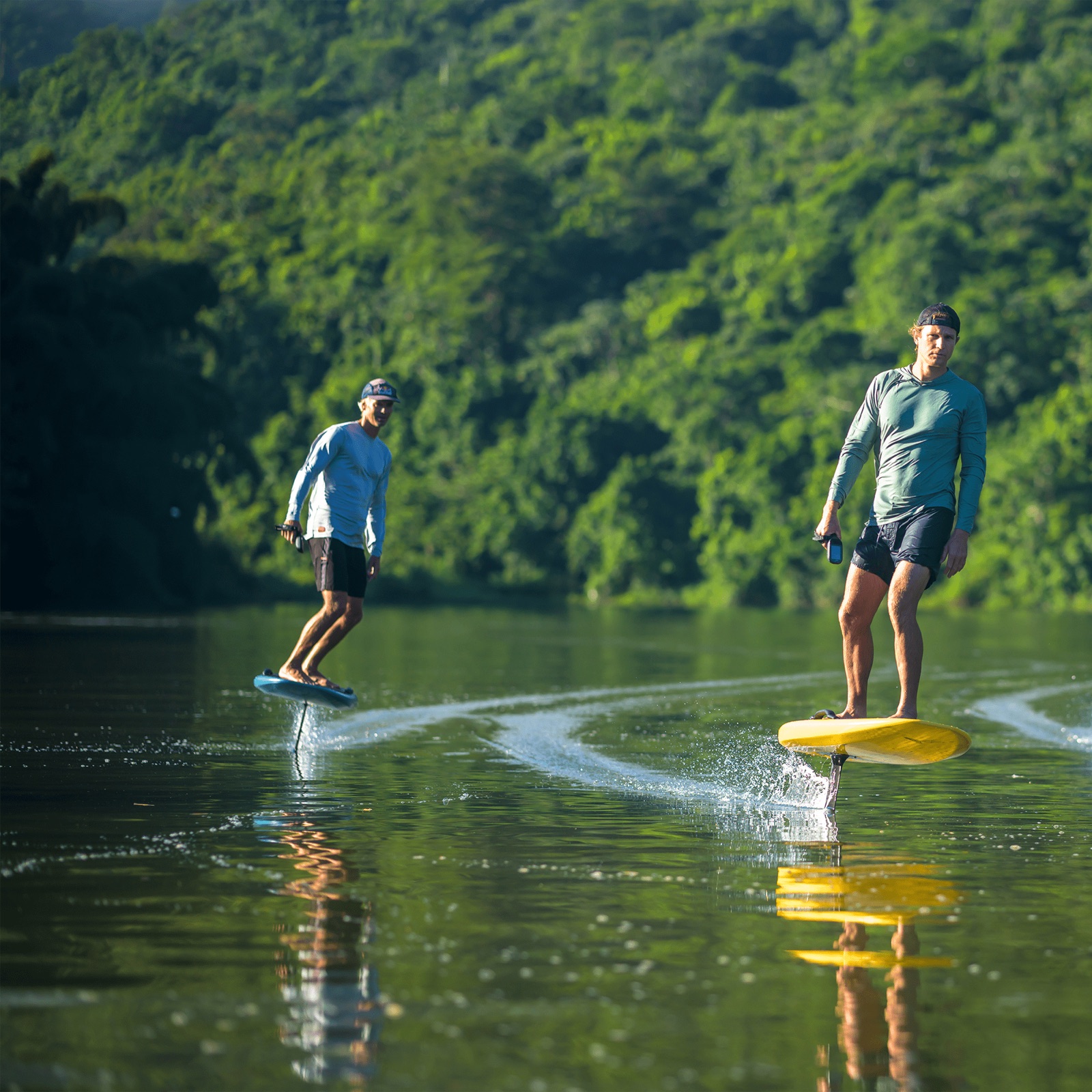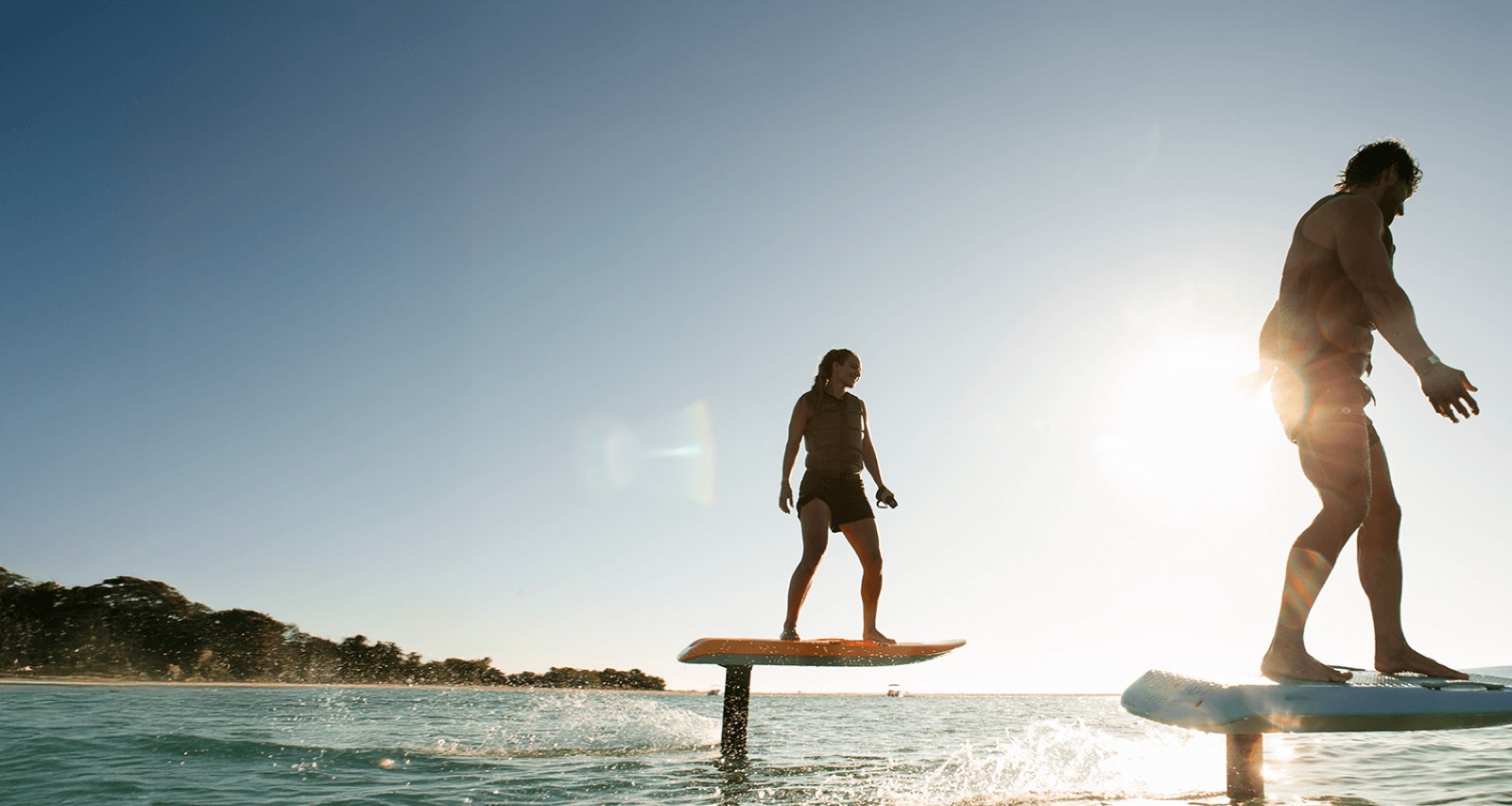
One island, two eFoil schools, two ways of working
Only two businesses in Turks and Caicos do nothing but eFoil lessons and rentals, by the count of Visit TCI, the visitor guide at visittci.com. Both are on Providenciales, both teach complete beginners and rent boards by the hour, and both will meet you at your villa or resort when the sea allows it. Beyond those two, several boat charters carry an eFoil as an add on, which is how you reach the outer cays.
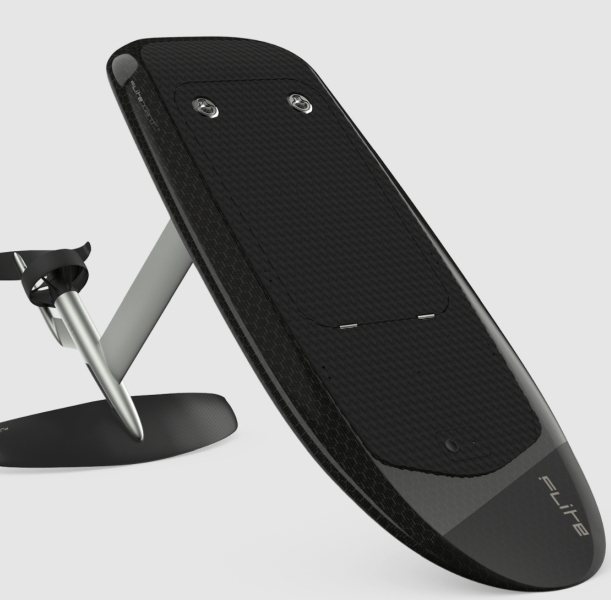
Fly TCI has no fixed beach. It decides each day where to ride, going by tide, wind and swell. Foil Turks & Caicos keeps to Grace Bay. One school rides Lift equipment, the other Fliteboard, and our pages on Lift and Fliteboard describe the boards. For a first lesson we would worry less about the make than about the launch. The trade wind turns some beaches into kite water and leaves others glassy.
Providenciales also rents e surf boards and jetboards. They have a flat bottom and no foil, so they skim the surface, and the island sells them as a separate activity. Our electric surfboard guide sets the two apart. Everything below is about boards that fly on a hydrofoil.
Fly TCI, the school that picks its beach every morning
Lift Foils boards are what Fly TCI rides, and Visit TCI names the school on its eFoil page. Its FAQ lists four main spots (Long Bay Beach, Grace Bay Beach, the Leeward channels and Sapodilla Bay Beach), and lessons can also happen at your villa. Three more details come from the Visit TCI listing for the school. The launch base is a small Leeward beach used by eco tours near Mangrove Cay. Helmets have radio contact with the instructor. Groups go up to eight.
Beginners choose between a 30 minute intro on the Blowfish, a board the school describes as easier to learn on, and the First Time Lesson, a beach briefing followed by about an hour on the water. Both come with a certified instructor and all equipment, and both take up to three riders. Groups of four or more get a discount.
Rental boards go to experienced riders only. Extras are an instructor ($25 to $50), a spare battery ($150 to $250) and a GoPro ($30 to $50 per group). Delivery is free from three rental days and $150 otherwise, and the school pre authorizes a $500 damage deposit for each day. A villa lesson brings a 30 minute dry land briefing, 120 minutes on the water, helmets, life jackets, water shoes, setup and transport. With three boards as the minimum, its price comes to $1,500 before the 20% gratuity. That sum is our arithmetic, so confirm it when you book.
The minimum age is 12. From 9 a child can join with wake surfing or wakeboarding experience and a written parental consent and release. The life jacket stays on for the whole session, helmets and water shoes are provided, and anyone who cannot swim has to tell the instructor beforehand. Pack a swimsuit, a rash guard, a towel and sunscreen.
Everyone signs a waiver first. The FAQ is frank about the hazards it has in mind, naming shallow water along with predatory fish and other aquatic life. Fly TCI expects one to two hours before the board feels familiar, and riders who already know a board sport often get there sooner. Its team also runs a sister company, Surf TCI, for private boat charters with wakesurfing and snorkeling.
Foil Turks & Caicos, the Fliteboard school of Island Watersports
The second school is Foil Turks & Caicos, the eFoil division of Island Watersports. The parent company offers kiteboarding, wing foiling and SUP on Grace Bay and runs private boat charters. Foil Turks & Caicos calls itself an authorized Fliteboard partner and covers the boards from every angle. It teaches, rents Fliteboards to beginners and experienced riders alike, sells boards with a demo ride first, and hires out batteries and accessories.
It does not move around the island. The school stays on Grace Bay and describes the water there as calm, clear, shallow flats. That is its own view, and Visit TCI paints a more mixed picture of the same beach, with offshore wind, depth that comes quickly and heavy traffic. Classes are capped at four riders. Instructors are trained in water safety and first aid, and each rider wears a full wrap helmet and a PFD and has real time radio contact.
A standard lesson gives you about an hour on the water, with the briefing, setup and safety checks around it. The Fliteboard, a charged battery, the remote, the helmet and the PFD are part of the price. You bring swimwear, sunscreen, water and a towel. GoPro and photo packages are sold as extras. Under 18s need a guardian's consent, and parents of younger children are asked to contact the school first. Lesson and rental prices sit behind an online booking widget that showed us no list price, so ask the school directly.
On the learning curve the two schools are far apart. Foil Turks & Caicos says most people stand and ride within 15 to 30 minutes, because it matches board, mast and wing to the rider and keeps the first speeds low. Fly TCI's one to two hours describe getting used to the feel of the board, which is a longer process than the first stand up, so the gap may be smaller than it looks. Both figures are the schools' own claims.
Island Watersports has its shop at Saltmills Plaza on Grace Bay Road, Providenciales, and says Flite eFoils are available there, price on request. The Foil Turks & Caicos website is more open. On 23 October 2026 it listed Fliteboard boards from $8,999 for the Flite AIR up to $15,795. If an hour on the water turns into a purchase, our eFoil price guide covers what owning a board costs over the years.
US dollar list prices, the 12% tax and the tip
Every price on Providenciales is in US dollars. Visit TCI's price guide gives eFoil lessons from around $200 an hour as its 2026 figure, and a few companies sell half hour new rider sessions from $125. Tips and transport are usually extra. The table below comes from Fly TCI's own site, as we read it.
Swipe sideways to see all columns
| Session | Riders | List price |
|---|---|---|
| Intro on the Blowfish board, 30 min | Up to 3 | From $125 |
| First Time Lesson, briefing plus about 1 h on the water | Up to 3, each extra rider $50 | From $250 |
| Villa lesson, 120 min on the water | Minimum 3 boards, up to 6 riders | $250 per board per 60 min, plus 20% gratuity |
| Rental by the hour, experienced riders only | Per board | From $200 |
| Rental by the day, experienced riders only | Per board | $375 to $850 |
Tax is the charge most likely to surprise you. The Hotel, Restaurant & Tourism Taxation Ordinance puts a 12% tax on prescribed tourism services, and its list includes tour operator services, watersports, and the rental of watersports or beach equipment. Visit TCI notes that water sports companies must charge it on rentals and tours and that it may or may not be in the listed price. Ask which applies before you pay. If the weather rules out a session, Visit TCI says most companies reschedule or refund.
Grace Bay, Long Bay and the calm water on the south side
Grace Bay Beach runs a little over 3 miles (4.8 km), and a barrier reef about 1 mile (1.6 km) out keeps the Atlantic swell off it. Visit TCI calls it a popular place to learn, with many suitable spots along that coast. Its kiteboarding page shows the other side. Here the trade wind mostly blows offshore, the water soon gets too deep to stand in, and this is the busiest stretch of coast on the island, for boats and people alike. Neither Grace Bay nor Long Bay has lifeguards.
Long Bay Beach, on the southeast side, is about 3 miles (4.8 km) long, with water that stays waist deep a long way out. It faces the east southeast trade head on and is the main kite beach of the island; on a windy day more than 20 kiters can be out. When the wind drops, it becomes good eFoil water, and on rough days Visit TCI finds it calmer than Grace Bay more often than not. Summer brings more sargassum to the south coast beaches, Long Bay among them. In winter the weed is largely absent.
With the trade wind up, the sheltered beaches take over. Visit TCI names Leeward Beach near Leeward Going Through, Sapodilla Bay Beach and Turtle Tail Beach as often calm and out of the east southeast wind. Taylor Bay, next to Sapodilla Bay, is among the calmest beaches on Providenciales and often quiet. Leeward Beach begins east of Grace Bay, and the water around the Leeward Channel and the Princess Alexandra Nature Reserve is sheltered on most days. Leeward Going Through itself has currents and boat traffic, and Visit TCI's kite page does not recommend it to beginners.
Depth limits the choice more than the view does. A foil mast needs about 4 to 5 ft (1.2 to 1.5 m) of water and a calm surface, and at speed the rider rises about 2 ft (0.6 m) above it. On our reading, waist deep water is less than that, so a beach that stays waist deep far out, like Long Bay, can only be ridden where the bottom drops away. Fly TCI's FAQ names shallow water among its hazards.
Half Moon Bay, Water Cay and Pine Cay are too far to ride to from Providenciales. A private boat charter that carries eFoils will take you, and Visit TCI lists several charters that offer the board as an add on.
Princess Alexandra National Park and the ban on jet skis
The Department of Environment and Coastal Resources (DECR) published a Notice of Changes to the National Parks Order in 2016, under section 3(4) of the National Parks Ordinance, Cap. 10.01. It lists Princess Alexandra Land and Sea National Park as NP 9, with 13,410.82 acres in Providenciales along the reef wall from Blue Mountain east to the Pine Cay and Water Cay area. Princess Alexandra Nature Reserve, NR 23, covers 523.6 acres around Little Water Cay, Donna Cay and Mangrove Cay. Chalk Sound is NP 2.
Visit TCI counts Grace Bay Beach as part of the national park. On our reading of the 2016 notice, the Leeward water lies inside NP 9 too. If that is right, Grace Bay and the Leeward shore, two of the coasts where the schools ride most, are both protected water.
On 1 May 2024 DECR announced “No jetski” buoys in Princess Alexandra Land and Sea National Park and the Nature Reserve. Its notice, as Radio Turks & Caicos carried it, quotes the National Parks regulations. Section 3(1)(g) prohibits jet skis and hovercraft in all National Parks. Section 3(2)(f) covers water skiing, jet skis or hovercraft in Nature Reserves, and sections 3(3)(i) and 3(4)(g) extend the ban to Sanctuaries and Areas of Historical Interest. Under section 13 of the National Parks Ordinance, a summary conviction can bring a fine of $5,000 to $50,000, prison, or both.
None of those texts mentions an eFoil. The DECR leaflet for visitors and residents goes a step further than the quoted sections and says “Jet skis or similar PWC are not permitted within protected areas”, without defining similar. Whether a battery powered foil board falls under that phrase is, as far as we can see, an open question that no published text settles. The licensed schools ride on Grace Bay, which shows how the trade works today and says nothing about how an officer or a court would read the leaflet. Anyone who wants to ride a privately owned board in the park should ask DECR first.
The leaflet also sets rules for every visitor. Speed in all National Marine Parks is limited to 15 mph, except in designated water ski zones. Towing happens only in designated areas, and a spotter is a legal requirement. Vessels are strongly advised to keep to 5 mph or less within about 330 ft (100 m) of any shore, and we read that advice as the one an eFoil lesson meets first, since lessons start close to the beach. Fishing of any kind is banned in protected areas. Taking coral, sand, shells or wildlife is illegal, as is feeding wildlife. Anchoring on coral or seagrass is not allowed, and swimmers keep out of boat lanes.
Registration, imports and licensed operators
The Department of Maritime and Shipping (DMS) set out its Small Craft Policy in a gov.tc file dated 1 July 2024. Section 4.1 defines small craft as vessels under 24 m (78.5 ft), powered or not. Section 4.3 requires every small craft, commercial or private, to be registered by the DMS before any license is issued. eFoils appear nowhere in the document, and it is a policy, not an ordinance.
Section 4.11 matters to anyone thinking of shipping a board out. Effective with the policy, it put a moratorium on further importation, registering and licensing of personal powered recreational watercraft, with jet skis named in brackets, until Cabinet lifts it. We read the section as aimed at jet skis. Nothing in it says whether an eFoil is caught, and the DMS is the office to ask before a board goes in a crate.
Section 4.13, written for canoes, kayaks, paddleboards and sailing boats, asks for an approved PFD with a whistle at all times, no use between sunset and sunrise, and nothing in hazardous conditions under the Met Office small craft advisory. eFoils are not on that list; treating it as a sensible standard for one is our suggestion alone.
Under section 1.2, vessels offering tourism services are licensed under the Beach Vending Ordinance or the National Parks Ordinance and its regulations. Visit TCI wrote on 19 March 2026 that every tour company in the islands needs a valid business license, that vessels and captains need special licenses to give tours, and that the police advise booking water sports only with licensed operators. A licensed company should be able to show its business license and TIDES certification when you ask.
This section and the one above summarize published texts as we read them on 23 October 2026. They are not legal advice. DECR decides questions about the parks, and the DMS decides questions about craft.
Trade wind, warm water and the hurricane months
Flat calm with no wind at all is what Visit TCI rates best for eFoiling. It describes the usual wind as the east southeast trade, on and off all year and more regular in winter, while summer days alternate between breezy and completely calm. Kiters commonly get 15 to 20 knots from the southeast, and for them November to May probably has the best wind. A board with a motor wants the opposite. Our reading is that summer offers more glassy days, and that in winter the sheltered south and Leeward beaches carry more of the load.
The sea runs from about 78°F (26°C) in winter to 85°F (29°C) in summer, warmer in shallow bays such as Sapodilla and Taylor Bay. May to October is the hot half of the year and November to April the cool one, and only about 10°F (5°C) separates them. On those numbers we would leave the wetsuit at home and bring a rash guard.
Sun is the harder part. A UV index of 12 is common, and unprotected skin can burn in about 15 minutes. DECR asks for biodegradable sunscreen or SPF rash guards, which suits a lesson spent standing in open water with no shade.
Hurricane season runs from 1 June to 30 November. Most of the hurricanes that hit the islands came between late August and mid September, and Visit TCI calls a serious hit rare. Rain tends to pass quickly; about 8 to 10 times a year, a few days of rain and heavy cloud settle in.
For the forecast, look at Providenciales International Airport (PLS). The main weather station of the islands sits there, and NOAA uses its data.
Booking a first eFoil session on Provo
Lessons on the island mostly follow one pattern, as Visit TCI describes it. A safety and skills briefing of about 30 minutes comes first, on land. Out on the water the instructor follows on an eFoil of their own and sets the power of your board. The minimum age is typically 12 but varies by company. Some schools add a handheld wing, which turns the session into a first taste of wing foiling.
Where you sleep can settle the choice. Foil Turks & Caicos launches from Grace Bay, which suits a stay on that beach. In a week of strong trade wind, Fly TCI can move to Sapodilla Bay or the Leeward channels. For a child under 12 who already wakeboards, Fly TCI's rule from the age of 9 is the clearer path.
A few questions save trouble at the booking stage. Is the 12% tax in the quoted price? Where will you launch, and how deep is the water there? Can a session move to another day if the wind comes up? Non swimmers should say so when they book. A lesson early in the stay leaves room for a reschedule.
For a second warm water option in the region, our Miami eFoil page covers the schools on Biscayne Bay and the Florida rules. Anyone weighing a purchase after the trip can start with the eFoil battery guide, which covers capacity and ride time.