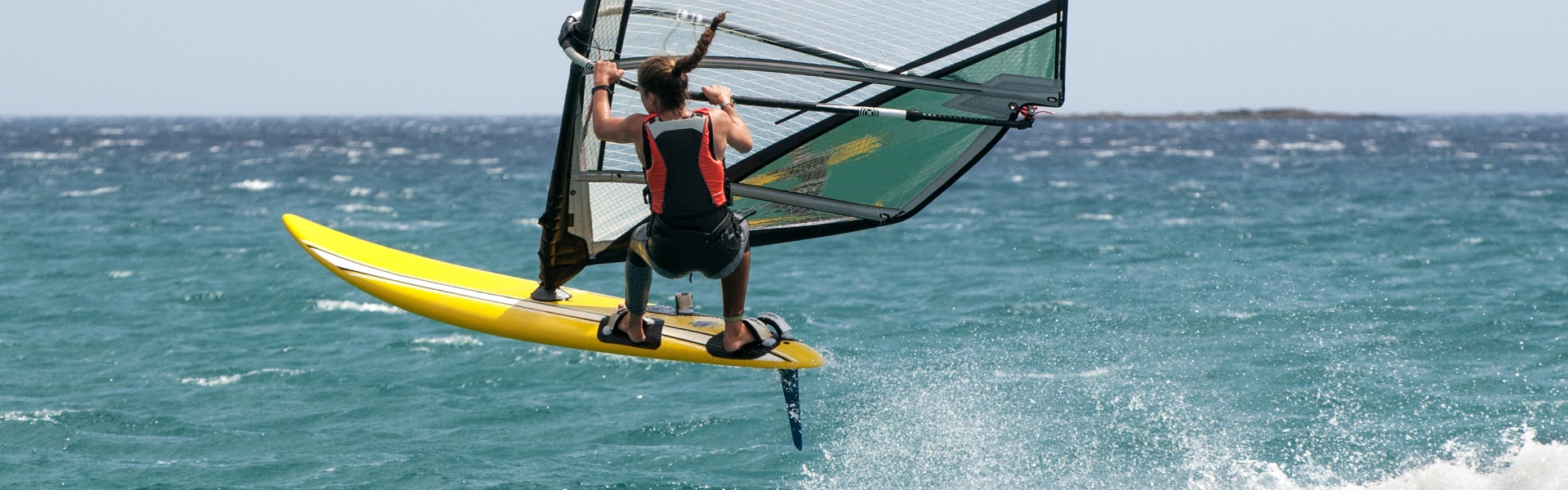
What is a windfoil?
A windfoil is a hydrofoil mounted under a windsurf board. Everything above the deck stays familiar, from the mast and boom to the sail and your stance. Below the deck the setup is completely different. Past a certain speed the wing under the water produces enough lift to carry board and rider clear of the surface, and you “fly” above the water. A windfoil is already in the air in 8 to 10 knots of wind. Low-wind take-off is the big appeal on inland lakes and sheltered bays, where the breeze rarely fills in the way it does on an exposed coast.
Windfoiling keeps the wind and the rig you already know from windsurfing and still turns the sport into something entirely new.
Once the board hovers clear of the surface, almost nothing is left to slow it down, so it goes much faster. The foil also helps with jumps and transitions, and it sharpens the steering. Compared with conventional windsurfing, you need less raw strength, and a smaller sail will do, with up to 2 m² less area. Anyone who can already windsurf can learn it.
The speed is only part of the appeal, since a foil also takes chop out of the picture. A fin board slams through every ripple, while a foil lifts you clear above the texture of the water, so the ride turns smooth and almost silent. The difference shows again on the way back upwind. A foil points higher and holds its speed while doing it, so the return leg stops being the hard part of the session.
Windfoiling grew up fast. What began as a niche experiment among light-wind sailors now sits at the very top of the sport. At the Paris 2024 Games, Olympic windsurfing was raced on foils in the iQFOiL class, and that class has also been chosen for Los Angeles 2028.
Windfoil pros and cons
Flies from 8-10 knots
Made for light-wind lakes and bays
Less physical effort
Compared with conventional windsurfing
A smaller sail is enough
Up to 2 m² less area
Open to every windsurfer
Your windsurfing skills carry over
Windsurfing skills first
Learn to windsurf, then learn to foil
Sharp foil: fall carefully
Keep your hands on the boom as you go
Bulkier to transport
The foil adds weight and packing volume
Balance takes practice
Flying is a skill of its own
How a windfoil works
A foil behaves like a small aircraft flying under water, and it is built from four parts. The mast is the vertical strut that connects the board to everything below it. The fuselage is the horizontal spine at the foot of the mast. The front wing sits at the leading end of that spine and generates almost all of the lift. The smaller wing at the back is the rear stabilizer, which does the job a tailplane does on an airplane and keeps the whole thing from pitching nose-up or nose-down out of control.
Because water is roughly 800 times denser than air, a hydrofoil wing can be far smaller than an aircraft wing and still lift a rider. As the board accelerates, water flowing over the curved front wing produces lift. Once that lift exceeds the combined weight of rider, board, and rig, the hull leaves the water, and only the foil and its mast stay submerged. Drag collapses. The board is no longer pushing a bow wave, so a given amount of wind suddenly delivers far more speed.
Ride height needs constant attention, and you hold it second by second with your feet. Pressure on the front foot pushes the nose down and brings you closer to the water. Easing that pressure and loading the back foot lets the foil climb. Get too greedy with the climb and the front wing breaks the surface, the lift vanishes instantly, and you get the classic breach: board and rider dropping sideways. In the first sessions, a beginner mostly learns where that narrow flight window sits and how to stay inside it.
Sail trim changes on a foil, because the geometry under you changes. On a fin board you drive mast foot pressure down into the board to keep it flat and planing. On a foil, too much mast foot pressure pins the nose to the water and the take-off never comes. So you learn to stand more upright, keep the rig raked slightly to windward, and let the foil do the lifting without forcing it.
Board, foil and sail: the windfoil setup
The board. Dedicated windfoil boards are short, wide, and flat, with a heavily reinforced foil box and cut-away rails so the tail can sit at an angle without catching the water. The reinforcement matters, because a foil levers against the box with enormous force, far more than a fin ever does, and bolting one onto an old board that was never built for it is a bad idea. Plenty of riders start on a big freeride board with a strong deep Tuttle box. Generous volume helps in light wind, since you can still uphaul and get going when the breeze drops.
The foil. Masts come in aluminum or carbon. Aluminum costs less and takes abuse well, but it is heavier and flexes more, which you feel as a vague, delayed response at speed. Carbon is stiffer and lighter and turns foot input into height change much more directly. The single biggest choice you make, though, is front wing area. A large wing lifts earlier, flies slower, and forgives more, which is what you want for learning and for days with very little wind. A small wing needs more speed before it flies, tops out much higher, and punishes sloppy trim. Many riders keep one of each and choose between them according to the forecast.
The sail. Any sail you already own will work. Foil-specific sails have a stable, forward-set draft that keeps pulling smoothly as the board accelerates, and they tend to be light, so the rig does not fight you while you balance. There is room to size down as well. Whatever you would rig on a fin board can usually come down by up to 2 m² on a foil, and a 5 to 6 m² sail suits a wide range of conditions. The foot straps move too, further inboard than on a slalom board and often a little further back, because you steer the foil with balanced weight over the mast and not by railing the board.
The board, the foil, and the box all have to match, so check that first, before any money changes hands. Deep Tuttle is the most common windfoil standard, but plate and track mounts exist as well. Mast length has to suit your home water. A shorter mast is friendlier for learning and for shallow launches, while a longer mast gives you more clearance over chop once you can hold height.
Learning to windfoil
Windfoiling is not one of the truly risky watersports. Protection still matters, so wear a helmet, a flotation vest, and a wetsuit every time you go out. When you fall, keep your hands on the boom and never reach toward the foil, because those wings are sharp enough to cause serious injury. Start on a short mast: you fly lower, and the board is easier to keep under control.
If you already windsurf, the switch is no great leap: most people need 2 to 4 hours of practice before they are up and flying, and the sail handling, balance and feel for the wind you bring from windsurfing all pay off here.
Aim for 12 to 15 knots of wind and a smaller sail of 5 to 6 m² while you learn. Taking off means shifting your weight back so the front wing starts lifting the board. Bring your center of gravity forward again and the board settles gently back onto the water.
Keep those first flights short on purpose. Lift off, hold it for two or three seconds, touch down, repeat. Long, wobbly flights that end in a breach teach you far less than a dozen controlled take-offs. Controlled touchdowns are a skill in their own right. Stay sheeted in as the hull touches the water and you can fly again, without stopping dead and starting over. Plenty of unplanned touchdowns in session one are simply part of learning to fly a foil, so expect them.
Straight-line flight is the quick part. Jibing and tacking on the foil without touching down is a far longer project than that first flight. There is nothing violent about the move, since foil speeds through a turn stay low, but you have to keep the wing loaded through the whole arc while your feet and the rig swap sides. Break it into stages. Carve while touching down first, then hold flight through the entry, and finally through the exit.
While you are learning, choose your water with care. The foil needs depth under it, and that usually means launching from water at least waist deep and staying well clear of sandbars, weed beds, and moorings. Give swimmers and other riders a wide berth. From a distance, a foil under the surface is close to invisible. Whether you may ride there at all depends on rules that differ by country and often by individual lake or stretch of coast, so check the local regulations before you go out.
Windfoil or another foil sport?
Under the water, every foil discipline runs on basically the same hardware. What sets one apart from another is mainly where the power comes from. Windfoiling takes its drive from a rigid windsurf rig you hold with both hands through a boom. The rig is both its great strength and its main cost. Control is direct and upwind performance is superb, but the gear is the bulkiest in the family to carry and to rig.
Wingfoiling replaces the rig with a handheld inflatable wing. A wing packs smaller, needs no mast track, and sets up faster, though it generally wants more wind than a windfoil to get going. Kitefoiling is pulled along by a kite far overhead and covers a very wide wind range. The price for that is lines, a launch area, and the safety routine that comes with them.
Other foil sports leave the wind out entirely. Surf foiling draws its energy from swell, and SUP foiling from a paddle and your own legs, so both depend far more on conditions and on fitness. The eFoil sits at the other end. An electric motor supplies the thrust and a handheld remote sets the speed, so the sport works on a glassy, windless morning with no swell at all.
If you already windsurf and your home spot is short on wind, windfoiling is the shortest path to flight you will find. The skills you have transfer, you already own the rig, and the days you used to write off turn into the ones you look forward to. If you are new to all of it, start with the hydrofoil basics and then pick the power source that fits your water.
Frequently asked questions
What is windfoiling?
Windsurfing with a hydrofoil bolted under the board. The rig itself does not change at all. Once you build enough speed, the underwater wing lifts board and rider clear of the surface, and you fly above the water, no longer sliding across it.
How much wind do you need to windfoil?
Roughly 8 to 10 knots, low enough to make a windfoil a natural fit for light-wind lakes and sheltered bays. Starboard puts its own boards lower still. By its figures the Olympic iQFOiL 95 takes off from 6 knots, while the GO-Fly learner board stays in steady flight from 6 to 25 knots or more. For the first sessions, 12 to 15 knots works best, with enough power to get up on the foil and not so much that the board feels wild.
Do I need to know how to windsurf before I try a windfoil?
Yes. Sail handling, waterstarting or uphauling and reading the wind all have to be automatic before a foil goes under the board. Experienced sailors pick it up quickly, because everything they know from windsurfing carries straight over.
How long does it take to learn windfoiling?
Usually 2 to 4 hours to get flying, if you windsurf. Controlled foiling jibes and tacks take much longer.
What sail size should I use for windfoiling?
In moderate wind, 5 to 6 m² is a good size to learn on. As a rule of thumb you can go up to 2 m² smaller than you would on a fin setup in identical conditions, since the foil takes over much of the work the sail used to do.
Is windfoiling dangerous?
No, it is not a high-risk sport, but respect the foil. The edges are sharp and it sits right under you, so ride in a helmet, a flotation vest and a wetsuit, fall flat and away from the board, and never reach toward the foil. Rules on where you may ride differ by country and often by individual lake or stretch of coast, so look up the local regulations before you go out.