
Where Miami eFoil lessons start on Biscayne Bay
Pick a Miami eFoil school and you also pick a stretch of Biscayne Bay, because the lessons leave from different points and the water differs at each. In Coconut Grove, E-FoilUSA runs its eFoil, wing foil and kitesurf school from the US Sailing Center at 2476 South Bayshore Drive, on Dinner Key. Across the bay, FloFoil meets Miami students at Hobie Beach North on the Rickenbacker Causeway and at 4493 Collins Avenue in mid Beach, between Indian Creek and the Atlantic.
Hobie Island Beach Park is about 5.6 km (3.5 mi) in a straight line from the Grove base, and Crandon Park Marina on Key Biscayne is about 7.7 km (4.8 mi) from it.
FloFoil also teaches in Fort Lauderdale, Riviera Beach and Jupiter, from an office in West Palm Beach. A booking marketplace lists a 90 minute one to one session in English and Spanish from Bay Road on the bay side of South Beach, without naming the operator.
E-FoilUSA teaches mostly on the open bay when conditions suit, with the barrier islands close by, and moves to more sheltered water when the wind picks up. It mentions dolphins, turtles and manatees on its sessions, and the manatees are why so much of the shoreline here is slow speed water all year.
Schools and rental stations
E-FoilUSA
Coconut Grove, Biscayne Bay, United States
2476 South Bayshore Dr, Coconut Grove, FL 33133
- Lesson: $689, for 2 riders
- Lesson: $385, 2 h, Lift 5'9"
- Lesson: $999, 2 h, for 6 riders
FloFoil
Miami, United States
Hobie Beach North, Rickenbacker Causeway
- Lesson: $389, 2 h
- Lesson: $689, 2 h, for 2 riders
- Lesson: $989, 2 h, for 3 riders
FloFoil
Miami Beach, United States
4493 Collins Avenue
- Lesson: $389, 2 h
- Lesson: $689, 2 h, for 2 riders
- Lesson: $989, 2 h, for 3 riders
Updated October 31, 2026
E-FoilUSA at the US Sailing Center in Coconut Grove
A private lesson here begins on dry land, with a clinic on board handling and the speed settings of the remote. Then you head out in a helmet, a life jacket and water shoes, all supplied and all required, ideally over a long sleeve lycra and leggings. Students ride two board sizes back to back, so within one session you feel the difference between a beginner board and an advanced one.
The school's favorite teaching setup is a Lift 5'9" with the 300 front wing and the 48 rear stabilizer, at speed setting 4. So “Lift lessons” in Miami means lessons on Lift boards at E-FoilUSA, which also services them (drop off repairs from $150).
The lesson is listed at two hours, though battery life has the last word on your time over the water, and the school reschedules for weather. Cancel 24 hours ahead for a full refund, on the day for a partial one; a no show gets nothing.
For groups, E-FoilUSA takes the boards out by boat. The package runs two hours or the length of the battery, three boards are shared by up to six riders taking turns, and boat, captain, life jackets and helmets are included. E-FoilUSA says it has taught riders from 4 years old to their late 70s, a description of its students, not an age rule.

FloFoil on the Rickenbacker Causeway and in mid Beach
FloFoil's two hour introduction starts with a safety overview and instruction on land. On the water you go from kneeling to standing and then to lifting the board onto the foil. Each student wears a helmet with a two way radio, so the instructor can talk you through the moment the board rises.
The board comes with one battery, the remote, booties, helmet, impact vest and wetsuit, though FloFoil would rather you brought your own booties and wetsuit. The school rides and sells Waydoo and lists the Flyer One+ Carbon at $7,799 and the One+ EPP at $6,399. If that brand is on your shortlist, a lesson there is also a test ride.
The two Miami meeting points are not interchangeable with each other. One is on the Rickenbacker Causeway, the other on Miami Beach between Indian Creek and the Atlantic. Ask FloFoil which one your lesson uses, and which water you will ride from there.
What two hours on an eFoil costs in Miami
The two schools price a private lesson almost level. E-FoilUSA lists $385 for two hours with one rider on one board, FloFoil $389 for two hours, and a double lesson for two riders on two boards is $689 at each. Those are the list prices that the operators give on their own sites.
On group bookings the two schools price quite differently. E-FoilUSA charges $999 for up to six riders sharing three boards for two hours, boat and captain included. FloFoil prices by the board, from $989 for three boards and three people, and its budget option puts two boards between three and six people for $689, which means more waiting for your turn.
Swipe sideways to see all columns
| Operator | Meeting point | Session | List price |
|---|---|---|---|
| E-FoilUSA | Coconut Grove | Private, 1 rider, 1 board, 2 hours | $385 |
| E-FoilUSA | Coconut Grove | Double, 2 riders, 2 boards | $689 |
| E-FoilUSA | Coconut Grove | Group, up to 6 riders, 3 boards, boat and captain, 2 hours | $999 |
| FloFoil | Hobie Beach or Collins Ave | Private, 1 board, 2 hours | $389 |
| FloFoil | Hobie Beach or Collins Ave | Double, 2 hours | $689 |
| FloFoil | Hobie Beach or Collins Ave | Group, 3 boards for 3 people, 2 hours | $989 |
| FloFoil | Hobie Beach or Collins Ave | 2 boards shared by 3 to 6 people, 2 hours | $689 |
| FloFoil | Hobie Beach or Collins Ave | Full day event, 5 hours | $1,489 |
Two hours is the length of the booking, not a promise of two hours spent on the foil. E-FoilUSA says lesson length varies with battery time, and FloFoil includes one battery. Owning a board is a separate sum, and our eFoil price guide walks through it.
Is an eFoil a boat under Florida and federal law?
US Coast Guard Policy Letter 01-22, issued by CG-BSX on 26 August 2022 after a vessel determination of 23 September 2021, holds eFoils and jetboards to be vessels, with every rule for machinery propelled recreational vessels attached; they can exceed 35 mph. The letter says it is not itself a rule.
Paragraph 4.a asks for a validated hull identification number before the state issues a certificate of number. The state of principal operation numbers the board (33 CFR 174.17 and 174.19), and the number goes on the forward half of the deck in block characters at least 3 inches (about 7.6 cm) high (33 CFR 173.27). Paragraph 4.e lists the rest: the certificate carried when underway, a PFD on whatever terms state and federal rules lay down, a whistle or other sound device, the Inland Navigation Rules of 33 CFR 83 with lights at night or in poor visibility, and an engine cut off switch if one is fitted.
Florida gets there through definitions. Section 327.02 of the Florida Statutes (2026) makes any watercraft usable for transport on water a vessel, and one with machinery for propulsion a motorboat, which makes an eFoil a motorboat. A personal watercraft there is under 16 feet with an inboard motor powering a water jet pump, so a propeller eFoil escapes the personal watercraft rules of s. 327.39 (a PFD on every rider, no riding from half an hour after sunset to half an hour before sunrise, no operator under 14). A jet board could differ.
Section 328.48(2) requires every vessel used on Florida waters to be registered, except on private lakes and ponds, US government vessels, lifeboats and non motor vessels under 16 feet. That puts an eFoil on Biscayne Bay on the register and leaves a wing foil board off it. You apply to the county tax collector with a driver license or ID from any US state or a valid passport (s. 328.48(1)(a)) and put the decal on the port side within 6 inches of the number. An eFoil falls into Class A-1 under s. 328.72, the class for boats under 12 feet, which costs $5.50 per 12 months plus service fees.
Less settled is the boating card. Under s. 327.395(1), anyone born on or after 1 January 1988 needs photo ID and a boating safety identification card, or a 90 day temporary certificate, to run a motor of 10 hp or more. Whether an eFoil reaches 10 hp depends on the model, so ask the Florida Fish and Wildlife Conservation Commission (FWC).
This section summarizes the published texts and is not legal advice. For a ruling that holds, ask FWC and the county tax collector.
Slow speed water for the manatees
Section 327.46(1)(b) lets cities and counties set idle speed zones within 500 feet (about 150 m) of public ramps, slow speed zones within 300 feet (about 90 m) of bridge fenders and vessel exclusion zones at public bathing beaches and swim areas, though not on the Intracoastal Waterway. So the distance limits off Miami's shores are local, not one statewide rule.
Behind most of the slow speed water is Florida Administrative Code rule 68C-22.025, “Dade County Zones”, dating from 25 December 1991, which sets year round and seasonal manatee speed zones for motorboats in Miami-Dade. The National Park Service names collisions as the leading human caused threat to the animals.
Off Coconut Grove, paragraph (1)(a)12 makes the water within 1,000 feet (about 300 m) of the western bay shore slow speed all year, from south of SW 15th Road to the Cutler Drain Canal; in our reading that includes the US Sailing Center. Paragraphs (1)(a)15 and 21 do the same off Virginia Key's southwest shore, in Bear Cut near the bridge, off the west and south shores of Key Biscayne and off the north shore of the Rickenbacker Causeway islands, which puts the bay side of Hobie Beach in a slow speed zone.
From 15 November to 30 April, stretches of the Intracoastal Waterway off Miami Beach are slow speed (30 mph the rest of the year), and the Biscayne Canal, the Little River and the Coral Gables Canal are closed to entry. Fisher Island's southeast shore is off limits to motorboats within 400 feet (about 120 m) all year.
Rule 68C-22.002 defines slow speed as fully off plane and completely settled into the water. An eFoil therefore has to come down off the foil in these zones and stay down until it is clear of them, which leaves the flying off the Grove for water beyond the first 1,000 feet. No Florida text names eFoils, so this is a reading and not a quoted rule.
Riding near the national park and off Key Biscayne
Biscayne National Park covers more than 250 square miles of water, and personal watercraft are banned in all of it, jet skis and waverunners included. Whether an eFoil counts as one is a question the park leaves unanswered, so ask before you ride there. The water is shallow, which makes the tide table and NOAA chart 11451 part of the kit, and the park keeps its own manatee slow speed zones.
Stiltsville lies inside those waters, about 10.9 km (6.8 mi) from the Grove. The stilt houses stand over shallow seagrass flats, with a history back to the 1930s and 27 structures at the 1960 peak. To set foot on one of them you need a permit. Clear an eFoil trip out there with the park first.
Crandon Park on Key Biscayne keeps personal paddleboards and kayaks off its beach unless you are on an EcoAdventures tour or renting from the concession. Personal vessels launch from the marina, and Rule 16 under chapter 26 of the Code of Miami-Dade bars flotation devices from bathing areas. Our reading is that a private eFoil goes in at the marina ramp, two miles south of the causeway's fixed bridge, where launch and retrieve fees apply and the marina listens on VHF 16 and 68. Miami-Dade County's parking rates are $7 plus tax Monday to Thursday and $10 plus tax Friday to Sunday.
Which months to book on Biscayne Bay
NOAA's monthly averages for Virginia Key run from 71.6 °F in January to 87.3 °F in August, about 22 to 31 °C, so cold water hardly enters the planning.
Swipe sideways to see all columns
| Month | °F | About °C |
|---|---|---|
| January | 71.6 | 22 |
| February | 72.9 | 23 |
| March | 75.1 | 24 |
| April | 78.3 | 26 |
| May | 82.1 | 28 |
| June | 85.2 | 30 |
| July | 87.1 | 31 |
| August | 87.3 | 31 |
| September | 85.8 | 30 |
| October | 82.2 | 28 |
| November | 77.3 | 25 |
| December | 74.0 | 23 |
Rain matters more than heat when you choose dates. The National Weather Service in Miami puts the median rainy season from 20 May to 17 October, 153 days on average and about 70% of the year's rain, with lightning, damaging thunderstorm winds, flooding and hail, most of the severe weather falling between May and August. Rip currents are common when onshore winds persist.
The Atlantic hurricane season runs from 1 June to 30 November, averaging 14 named storms, 7 hurricanes and 3 major hurricanes a year over 1991 to 2020, and South Florida's tropical peak comes from August to October.
Book the dry season, mid October to mid May. The water stays above 70 °F and there is less thunderstorm weather, even if hurricane season formally lasts to 30 November. Summer pairs the warmest water with afternoon storms. Whatever the month, go early. E-FoilUSA rates flat, calm, windless days best for a new rider and wants a first lesson away from sand bars, boat traffic, beachgoers and surf. If you are weighing Miami against another winter trip, our eFoil guide to Dubai covers the Gulf side.
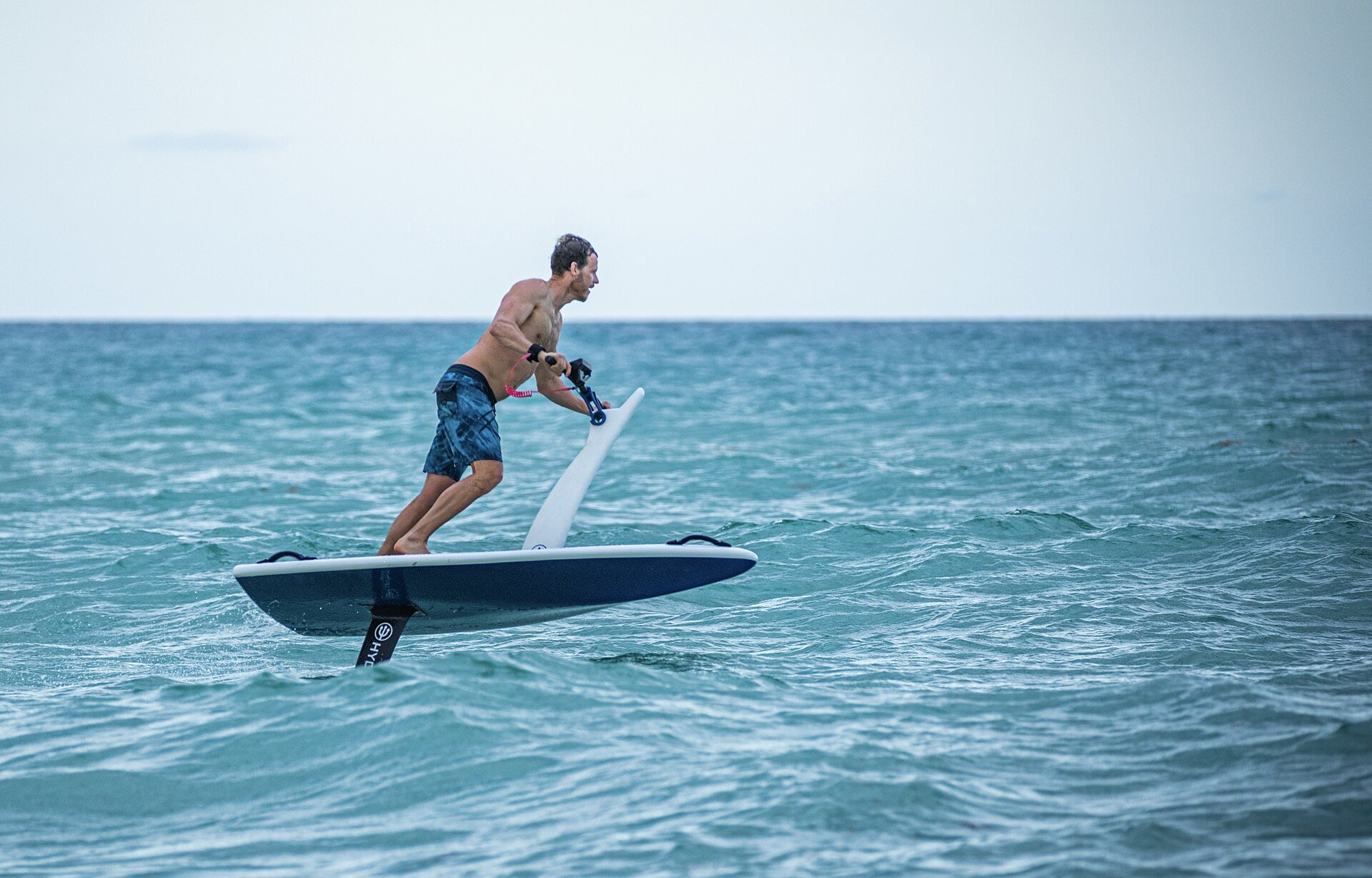
Wing foiling and kites on Biscayne Bay
The breeze that spoils a first eFoil lesson is the one the wing schools wait for. E-FoilUSA's introductory wing foil lesson is a two hour beach start for $295, at a spot picked by wind direction, and its boat and downwinder session from Coconut Grove is $395 for two hours, on Cabrinha wings, boards and foils. FloFoil lists wing foiling at $180 an hour, and PADL Wind Club runs a two hour beginner lesson at Crandon Park.
For kiters, E-FoilUSA books downwinders that cruise the flats at Stiltsville. A board with no motor on it needs no Florida registration under s. 328.48(2).

Distances from MIA, and what to pack
In a straight line from Miami International Airport, the Grove base is 8.9 km (5.5 mi) away, Hobie Beach 12.4 km (7.7 mi), Bay Road on Miami Beach 14.3 km (8.9 mi) and 4493 Collins Avenue 16.4 km (10.2 mi). The drive is longer than any of those figures.
For E-FoilUSA, pack a long sleeve lycra and leggings. For FloFoil, bring booties and a wetsuit if you own them. Sunglasses go on the water only with a strap or a float.
If a board of your own is the longer plan, either school gives you a fair sample first, two board sizes back to back at E-FoilUSA or a Waydoo at FloFoil, before you open our eFoil buying guide and brand comparison. A board of your own on Florida waters needs a hull identification number, county registration with the decal on the port side, and the safety kit the Coast Guard letter lists.
For the rest of the state, our page on eFoil in Florida looks beyond Miami, and eFoil in Tampa Bay takes the Gulf coast around St Petersburg. If your trip runs to the other coast, eFoil in California has the schools out West, and eFoil in Hawaii goes further, out to the islands. Staying on the Atlantic side but heading north, eFoil in the Outer Banks is about the sounds of North Carolina, and further up the coast eFoil on Cape Cod deals with summer riding in Massachusetts. Heading south instead, eFoil in Turks and Caicos stays on one island, our eFoil in the Caribbean page takes in the wider region, and eFoil in the Cayman Islands lies further southwest, while eFoil in Cancun is the Mexican Caribbean and eFoil in Puerto Rico sits further east. Inland, eFoil in Austin describes the Texas lakes and the Texas rules, our page on eFoil in Michigan the Great Lakes state, and further north eFoil in Kelowna is Okanagan Lake in British Columbia, eFoil in Ontario the lakes of the east, and eFoil in Canada looks at the rest of the country.


