The brand
When people talk about electric boats in earnest, Candela is the name they reach for first. Gustav Hasselskog founded the company in Stockholm in 2014 around a single idea. Short range had always been the biggest weakness of the electric boat, and he meant to solve it with physics, not with an ever bigger battery. The answer was the hydrofoil. Lift the hull out of the water and most of the drag goes with it, so one battery pack carries the boat several times as far. The C-7 entered production in 2019, and no fully electric hydrofoil boat anywhere had been built in series before it.
The numbers show how far ahead of the field the company now is. By March 2026 investors had put €129 million in total into the company, and the IFC, part of the World Bank Group, came in on the most recent round. At that point more than 65 boats were on order. A second factory is planned, sized for 70 ferries a year. TIME magazine named the P-12 Shuttle one of the best inventions of 2025. A team of more than 200 people designs and builds everything in Stockholm.
There are two boats in the range, aimed at very different buyers. The C-8 is a daycruiser for private owners, while the P-12 is a passenger vessel built for urban water transport. Underneath, both boats run on actively controlled carbon foils and the in-house C-POD drive. That common base goes a long way toward explaining how the company moves as fast as it does. Work on the ferry feeds straight back into the leisure boat, and the other way around.
Candela in action
Official images and details: candela.com ↗
Why the boat flies: the technology
Everything about a Candela starts with active foil control. Under the hull sit carbon foils, and an onboard computer trims their angle of attack a hundred times a second. Sensors in the bow read the waves ahead while the system keeps correcting from height, roll and pitch data. The boat rides less like a boat than like a carriage on an invisible rail. No slamming, no pounding. According to the manufacturer, even passengers who normally get seasick cope well with it.
The physics behind this is fairly simple. A conventional hull burns its energy dragging a large wetted surface through the water and pushing a wave system along in front of and behind itself. Foils remove almost all of that in one go. Once the hull is up, the only parts still in the water are the slim struts, the wings and the C-POD drive. On a Candela that transition comes somewhere between 16 and 18 knots. Above that speed the ride gets quieter and smoother the faster you go, which is the reverse of what most powerboat owners are used to.
In Candela's own figures, foiling cuts energy use by 80 percent compared with a conventional planing hull. The drive is the company’s own C-POD, a torpedo-shaped pod holding two gearless, directly water-cooled electric motors that turn counter-rotating propellers. Those motors are sealed and need no oil or fluid changes. When Candela launched the C-POD in 2021, it rated the drive for more than 3,000 operating hours without maintenance. The yard's FAQ still recommends one scheduled service a year, and in cold climates it advises winterizing the boat before it goes into storage.
The boat has also shown this on a long open-water run. In September 2024 the C-8 made what Candela calls the first crossing of the Baltic Sea between Sweden and Finland by an electric boat. The boat went from Stockholm to Mariehamn in the Åland Islands and back, 150 nautical miles in a single day, stopping to charge three times along the way. The whole trip used 213 kWh of electricity, worth roughly €40 to €50. Over that distance the gasoline-powered escort boat burned close to €750 of fuel.
Models
Candela C-8: the flying daycruiser
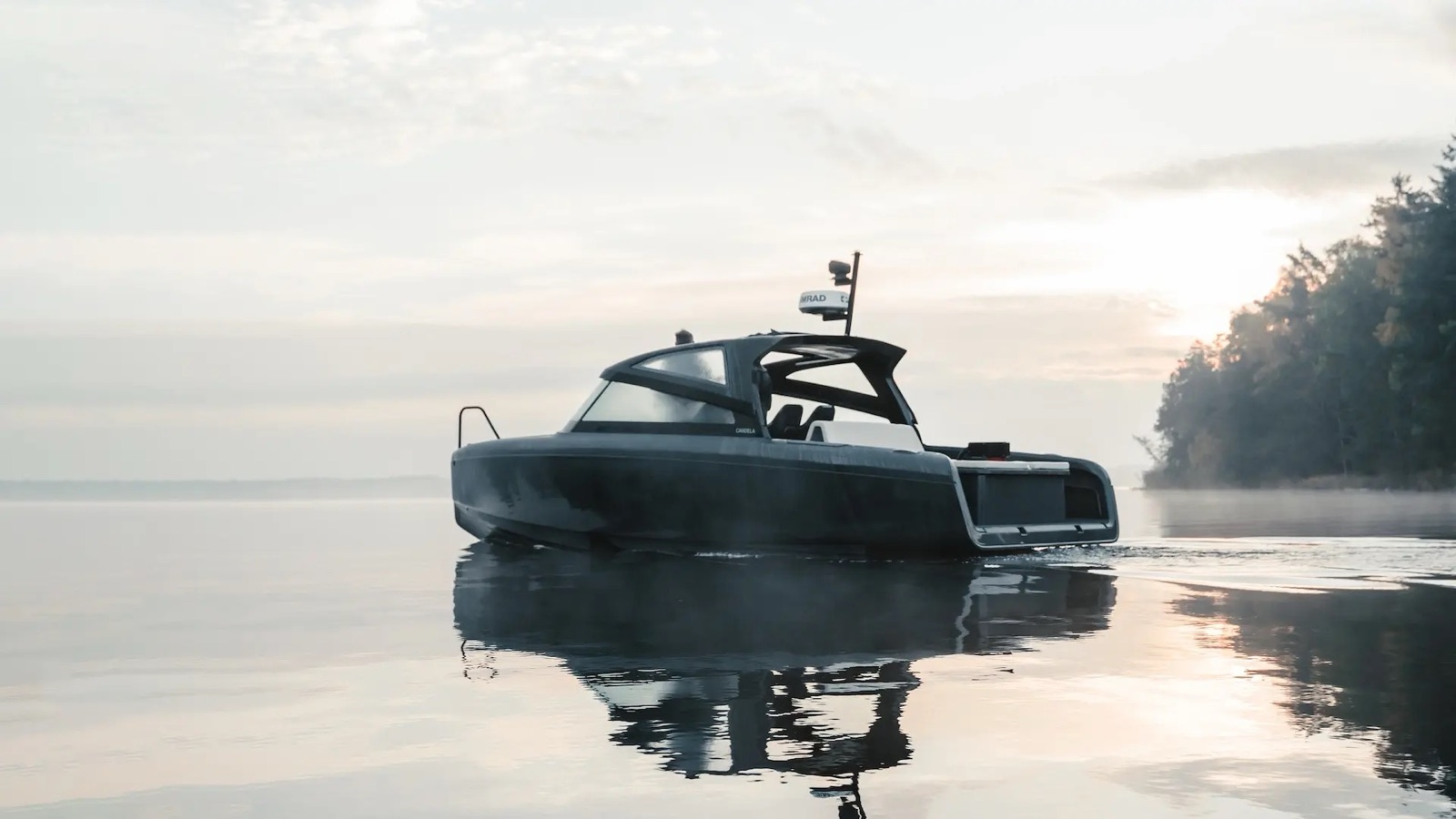
The C-8 heads the leisure range: an 8.5 meter daycruiser with a carbon hull, built in three versions (DC Interior with a cabin, T-Top, and a fully enclosed Hardtop). A 69 kWh Polestar battery gives it 57 nautical miles (just over 105 km) at a 22-knot cruise, and top speed is 27 knots. Five guests fit on board alongside the driver. On 11 kW AC a charge takes 6.5 hours, while a 135 kW DC fast charger takes the battery from 10 to 80 percent in half an hour.
So the boat behaves unlike anything else of its length. On a C-8, 22 knots is the normal way to travel rather than a sprint, since the range figure is quoted at exactly that speed and not at a displacement crawl. The low wake matters as well, both for the boats you pass and for the shorelines you run along.
Pricing is firmly premium, and candela.com prints no list price. The yard has put two figures in writing. The release that launched the boat on 26 August 2021 gave €330,000 excluding VAT for the original C-8 with a 44 kWh battery. A release of 24 May 2023 put the starting price of the C-8 Polestar edition, which carries the 69 kWh battery described above, at €400,000 or $450,000, without saying whether VAT is included. Other sums circulate in articles and dealer listings, and we leave them out. If you want a binding figure, ask the manufacturer directly.
The yard's first model, the C-7 of 2019, has since been discontinued and now turns up only on the used market. A 40 kWh battery took it 50 nautical miles at 22 knots. More than anything, it was the boat that proved the electric hydrofoil was a working concept and not a show model.
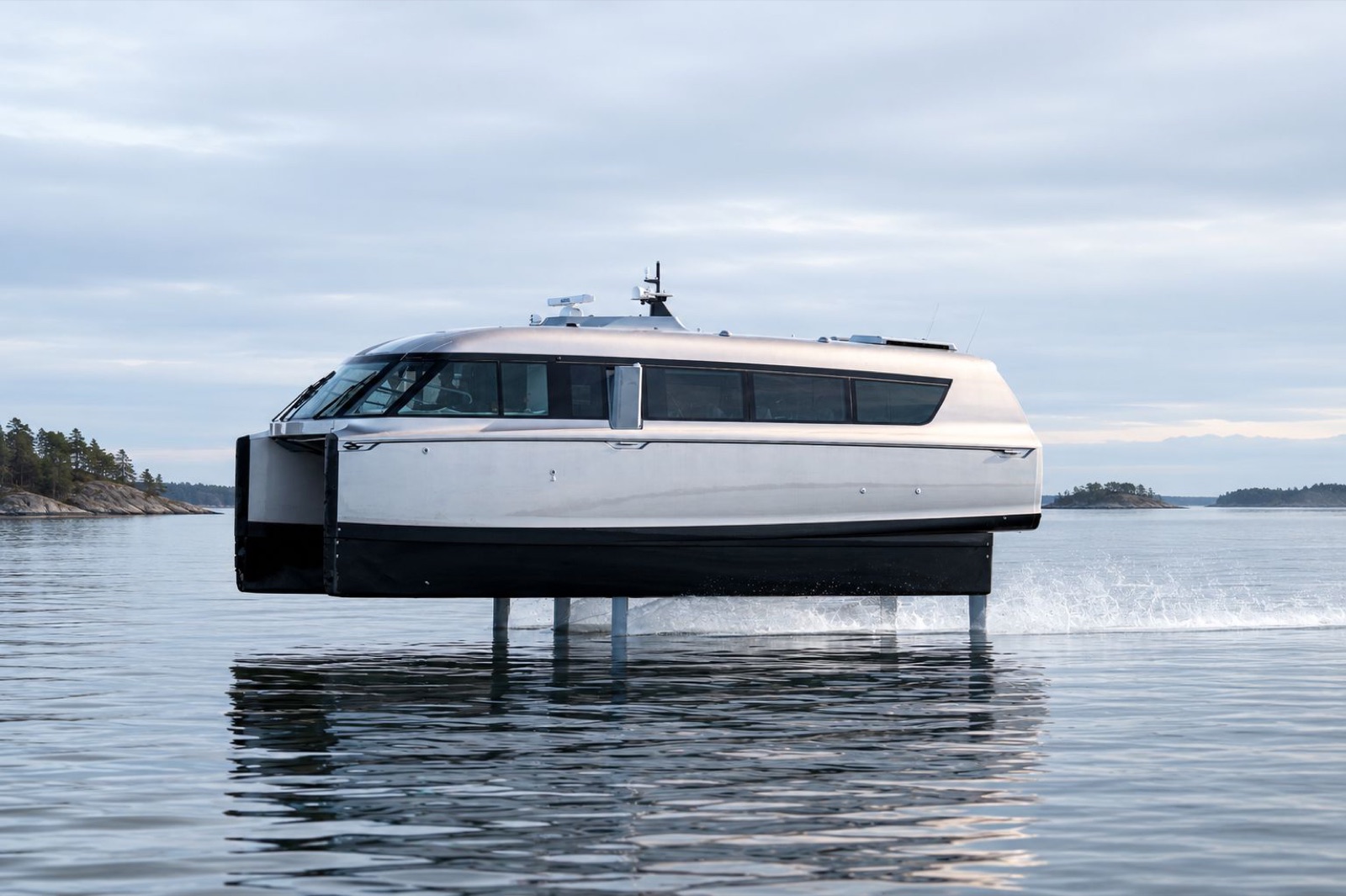
Candela P-12: the flying ferry
The P-12is the more significant of the two, as the world’s first electric hydrofoil ferry in scheduled service. The first vessel, named “Nova”, entered service in Stockholm on October 29, 2024, and covered the 15 km between Tappström and City Hall in roughly half an hour. That line was a pilot and ended in August 2025. In June 2026 Nova returned to scheduled service out in the archipelago, on Waxholmsbolaget's line 14X between Sollenkroka and Möja, as part of a research project with Region Stockholm. The Shuttle version carries 30 passengers, cruises at 25 knots and travels up to 40 nautical miles per charge. The battery holds 378 kWh, of which 336 are usable, and Candela says a standard DC fast charger recharges it in under an hour. The plusher Voyager variant is aimed at resort transfers and takes a maximum of twelve guests.
Orders are coming in from all over. Berlin is putting a P-12 on the Spree. Mumbai is getting a fleet of ten for urban water transport, and further projects are lined up in New Zealand, at Lake Tahoe and in Saudi Arabia. Battery ferries were nothing new: Norway's Ampere and others like it ran to timetables years before Nova. Among electric ferries that fly on foils, though, the P-12 was the first to carry commuters in regular service.
Why should a private buyer care about a ferry? Because a vessel in daily commercial service piles up operating hours far faster than a leisure boat ever will, and the P-12 racks them up on Candela's own foil control and C-POD motors, the technology family it shares with the C-8. The hardware differs in scale. The ferry runs two of the larger C-POD MAX units and two aft foils, where the C-8 has a single standard C-POD and one aft foil.
Candela on inland lakes
On paper, few boats suit protected water better. Plenty of inland lakes around the world restrict or ban combustion engines but still allow pure electric propulsion, and Candela has made range, the classic weakness of the electric boat, into its strongest suit. On its foils the C-8 goes further on less energy, and around fragile shorelines the quiet on board and the near total absence of wake work in its favor.
Shallow water calls for more care. Candela gives the C-8 a draft of 0.8 meters while foiling and 1.5 meters at low speed with the foils extended. Only in its shallow mode, with the foils retracted, does the boat draw as little as 0.5 meters. Rules vary by country, and often by individual lake or stretch of coast, so find out what is allowed on your stretch of water before you head out.
Charging is the practical snag. The C-8 takes up to 135 kW on a DC charger, but fast chargers at that power are still the exception in marinas, where slower AC pedestals are the norm. Our electric boat guide goes through what charging on the water looks like today. In some countries you buy a Candela through a local partner. In Germany you order a C-8 from the dealer Sealectric, which also runs the test rides. In France, Sud Plaisance on the Côte d'Azur calls itself the brand's main distributor. Where no partner covers your country, you deal with the yard's own sales team, which keeps C-8 demo boats in several countries in Europe and beyond and books viewings and sea trials itself.
How Candela compares
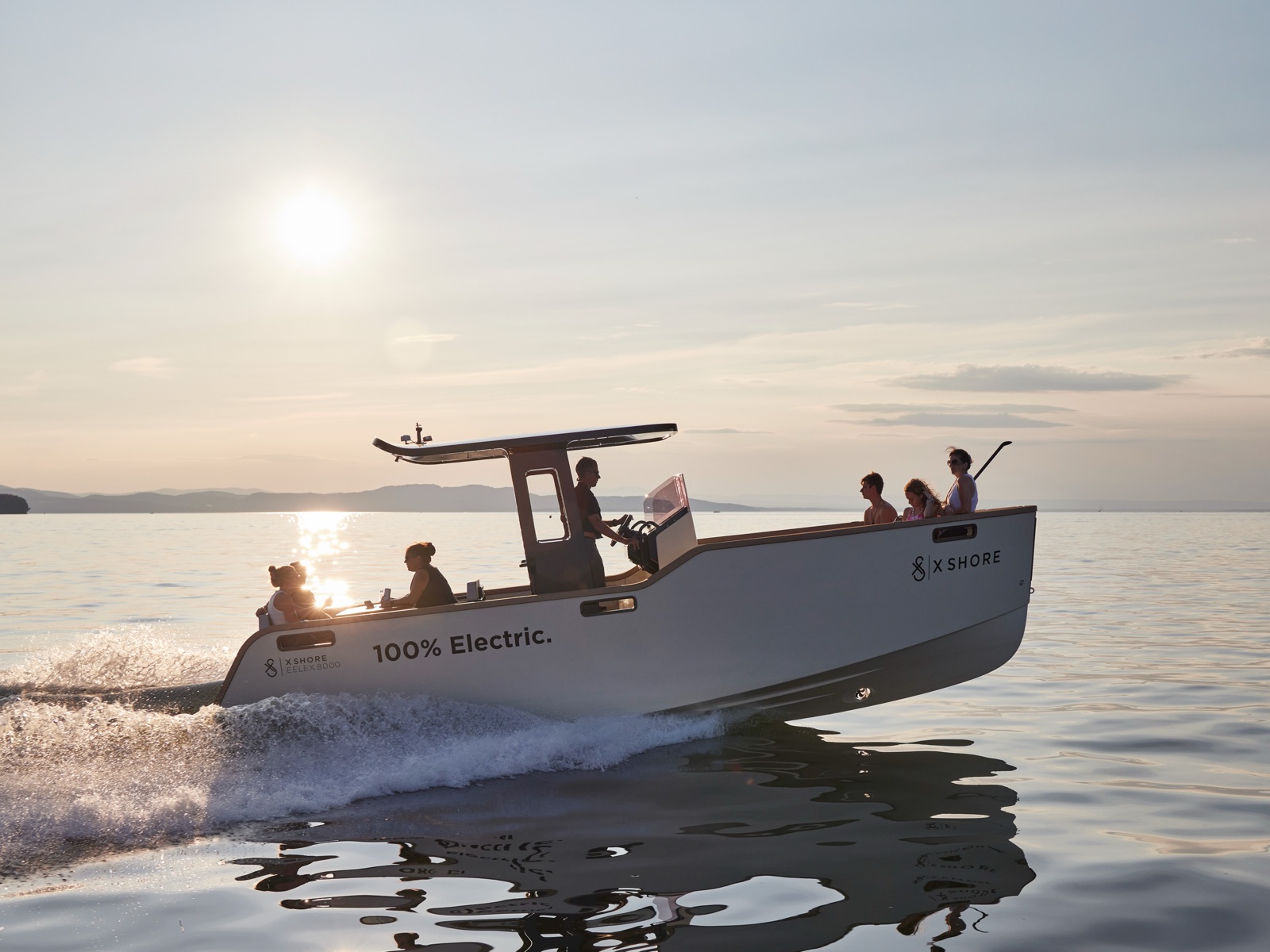
Candela is the technological yardstick of the electric boat market. Where most builders electrify a conventional hull, the Swedes went after the physics, and that gives the brand a different character from the other yards profiled on Foilfun. Fellow Swedish builder X Shore makes the pared-back electric dayboat on a conventional hull. Austrian yard Frauscher comes at it from luxury and traditional boatbuilding. Candela chases maximum efficiency and range by leaving the water altogether.
The C-8 sits in the upper third of the field on price. On technology it stands apart, since it flies on actively controlled foils, and Candela calls it the only hydrofoiling electric boat in serial production. Direct challengers, from Vessev to Navier, are compared on our page about electric foiling boats. For foiling hulls beyond this one brand, the hydrofoil boat guide introduces the rest of the field, while the electric boat page fills in the wider picture, from drivetrains to charging.