The brand
Alfastreet Marine is the former name of Alfastreet Yachts, a Slovenian boatyard that Pockaj d.o.o. runs from Sežana, a small town near the Italian border. The open ocean was never what the brand was after. Electric lake boats and day boats share the range with inboard and outboard models, and that focus on sheltered water shapes everything else about them. The yard calls its boats luxury; we would put them in the upper mid-range. Alfastreet is not competing for the top luxury tier the way Frauscher does. It sits a step below, with boats that are still finished to a demanding standard.
Lakes and quiet waters are where the yard pitches its electric versions, including those where combustion engines are restricted or banned outright. On water like that, a quiet electric drive is the only sensible way to go out. An older German-language page on the yard's former site tied the electric range to ever stricter rules for motorboats on inland lakes, and the Energy 18, one of the three boats in its 2014 fleet, already ran on electricity. Many countries limit engines in a similar way on reservoirs, drinking-water lakes and protected inland waters. The rules vary by country, and often by individual lake or stretch of coast, so learn the rules for the water where you plan to keep the boat before you fall for a specific model.
The label matters less than what an upper mid-range position buys you. You do not have to settle for a mass-produced entry boat, and you do not need the budget for something built around one owner’s wish list. Alfastreet works the ground in between, where materials, joinery and comfort are already a level up but the boat has not turned into a prestige object with a bespoke price tag. A lot of lake buyers want to be in that middle. It is harder ground to build on than either extreme, because someone has to decide which corners cannot be cut.
Between lake and sea, the yard itself draws no hard line. Its About page talks of the best experience on any body of water. The models in its electric series are all sold with a combustion engine as well, and the whole range on its site carries CE design category C, which covers wind up to force 6 on the Beaufort scale and a significant wave height of up to 2 meters. The 28 Cabin Electric sits on a displacement hull. A boat designed for calm lakes behaves differently from a sport boat built to punch through chop. With no sea state to fight, its priorities move to quiet running, comfort at cruising pace and low maintenance, which is also what most people are after when they finally get to the water at the end of a long week.
A day boat, if the term is new to you, is measured in hours and not in nights. It has seating for a group, a swim platform, somewhere to stow a cooler and towels, and no serious sleeping accommodation below. You take it out for an afternoon and bring it back to the berth you left from. Used that way, a day boat suits an electric drive very naturally. A day boat rarely needs the range of a cruiser, and it gets used in the places where engine noise is least welcome. Alfastreet's cabin models stretch that definition. The yard's configurator lists two cabin beds for the 23 Cabin Evo, and its 28 Cabin Electric page describes a king-sized bed and a private bathroom.
Alfastreet on the water
The clip comes from the yard's own Alfastreet Yachts channel and shows the 28 Cabin, which the maker lists at 8.6 meters (9.8 meters overall), 4,300 kg empty and up to 12 adults. Photographs and the rest of the lineup are on alfastreet-yachts.com.
Models
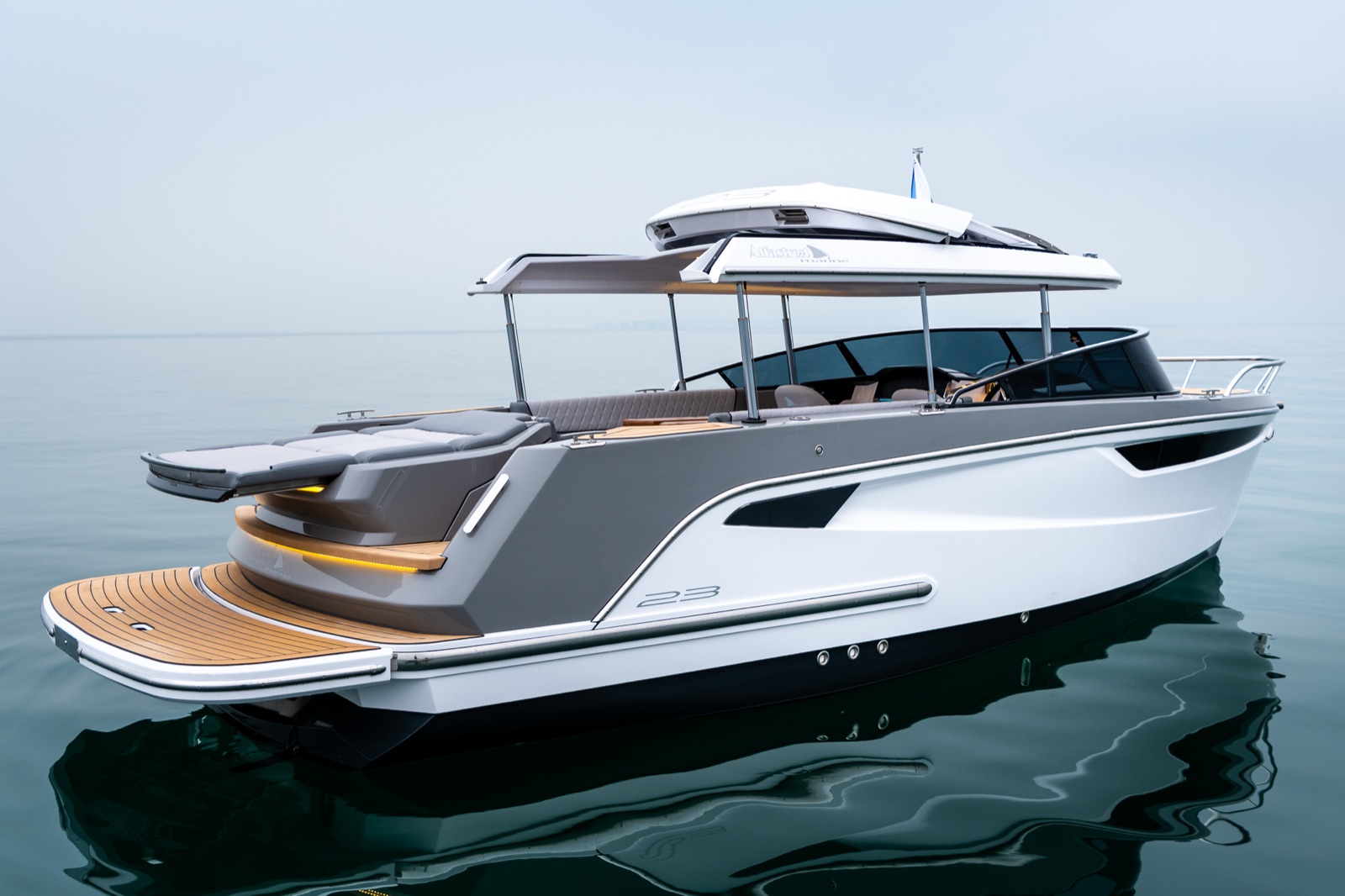
The yard's current site, alfastreet-yachts.com, has ten model pages from 6.6 to 10.1 meters overall, split into inboard, outboard and electric series. By the yard's own count, half the boats it has sold were electric, and four models make up the electric series: the 21 Open, the 23 Cabin Evo, the 28 Cabin and the 28 Open. The old domain is in a very different state. When we opened alfastreet-marine.com on 12 September 2026 it was parked and up for sale, a short script forwarding to a GoDaddy sales page, and neither alfastreetmarine.com nor alfastreet-marine.si resolved. The yard had moved, not closed. Archived captures show the old domain forwarding to alfastreet-yachts.com in January and March 2024, and the brand now trades there as Alfastreet Yachts from its old address in Sežana. The figures below come from that site, read on 5 October 2026, unless we say otherwise.
Two of the electric models stand out. At the small end sits the compact, open 21 Open Electric (6.3 m long, 6.6 m overall). The larger 23 Cabin Evo Electric (6.9 m, 7.8 m overall) adds a cabin, and between them the pair cover the two ways most people use a boat like this. The older 18 Open is no longer listed; the yard's 2019 specification gave it 5.4 m, or 5.8 m overall.
Swipe sideways to see all columns
| 21 Open Electric | 23 Cabin Evo Electric | |
|---|---|---|
| Length | 6.3 m | 6.9 m |
| Length overall | 6.6 m | 7.8 m |
| Beam | 2.3 m | 2.4 m |
| Empty weight | 1,600 kg | 2,100 kg |
| Max. persons | 8 adults | 8 adults |
| Cabin beds | None | 2 |
| Concept | Open day boat | Electric boat with a cabin |
| Typical use | Day trips, swim stops | Longer lake outings, more comfort |
We print no prices, and the reason is not the one we gave in July. At the time, the trouble was that the figures you could find in public contradicted one another. The reason now is simpler. Neither the yard's current site nor its online configurator shows a price (both read on 5 October 2026), so ask the yard, or a dealer who has sold the brand, for a written offer that lists motor, battery and equipment line by line. Among the electric boatyards we follow, RAND and X Shore printed prices across their ranges when we checked that day, and Marian showed a starting price on most of its German model pages. Alfastreet's old site did print starting prices in 2019, but they left out tax and the engine, so they are no guide to what a boat costs now. That leaves positioning, and even that is our own reading. We place the boats in the upper mid-range, while the yard sells them as luxury.
Ten model pages on the yard's current site is a lot to sort through, and one rule keeps it simple: shop by use, not by length. Short open boats are at their best on spontaneous, low-effort outings. The longer cabin models earn their keep on full-day programs, where protected space matters. Equipment also varies enormously between configurations, so one model can feel minimalist in one specification and lavish in another. An hour on board, in the configuration you are considering, tells you more than any spec sheet.
Stepping up a size class changes more than the number on the transom. A longer boat weighs more, needs a wider berth, is harder to move by road, and takes an extra pair of hands to dock comfortably in a crosswind. That is no reason to buy small, but check all of it against your marina and your towing vehicle before you sign anything. Measure the slip and the approach to it in advance, not on the day the boat is delivered.
Buy for the next few seasons, not for last summer. If two of you go out today but the family or the circle of friends is about to grow, a slightly larger model with more room is the easier long-term choice. It works the other way just as firmly: if your runs are short and light and rarely last past dinner, a simpler, smaller boat gives you more of what you enjoy, without paying for capability that looks good in the brochure and never gets used.
Open or cabin? How to decide
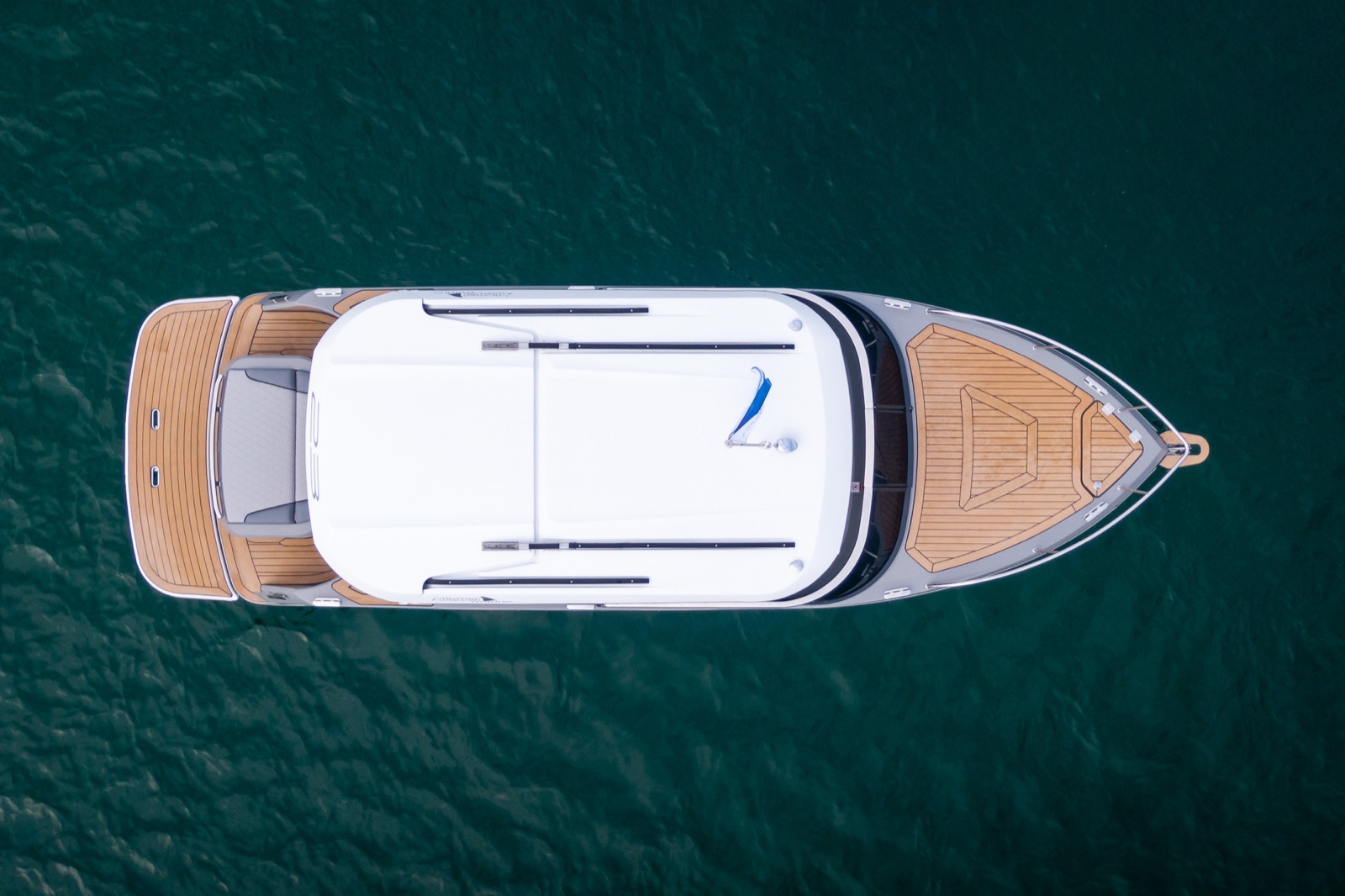
Most lake buyers choose between the two directions that the models above mark out: the open 21 Open Electric, and the 23 Cabin Evo Electric with its cabin. Size is rarely the real question. How you spend your days on the water, with whom and for how long, matters far more, and a few practical questions sort it out quickly:
- With a group of adults on board, the roomy open deck is the better fit every time; small children or a mixed-age crowd make shade and a sheltered corner count for far more.
- A few hours of swimming asks nothing of a boat beyond seating and a ladder. Stay out a full day, or into the evening, and a roof to retreat under starts to feel like a luxury you would rather not give up.
- If swimming and sunbathing are the point, the open layout fits better; through hot afternoons the covered space is where everyone ends up sitting.
- Storage and berthing are simpler with a shorter, lighter boat, which is also easier to move. The larger cabin model needs more room and often a bigger berth.
- More enclosed space and more equipment mean more comfort, and also more things that want looking after.
When your boating day is usually a short, unplanned hop between a beach and a quiet bay, the open boat suits you because there is so little to it: you step on, cast off, swim and come home. People who like whole days on the water, who now and then sit out a shower or just enjoy having a protected spot on board, will find the cabin version worth its extra cost.
No answer is right in the abstract. The right one comes out of your own habits on the water, so it pays to try both layouts before you decide. A few minutes on a demo ride usually tells you more than weeks of comparing photographs.
A day on board
On an ordinary summer day, the most obvious difference an electric lake boat makes is the quiet. With no engine drone and no smell of exhaust, the water, the wind and the reeds sound completely different. Plenty of people go to a lake looking for that very calm, and a quiet electric drive takes none of it away from them.
A typical day might start with a slow morning run and coffee across water still flat as glass, then an anchor stop at midday in a sheltered bay, with a swim and lunch on board. Late in the afternoon comes an easy crossing to the far shore, and at sunset a quiet return to the harbor. That is the rhythm a boat in the day boat class is made for. It is big enough for a full-day program and small enough that going out never turns into a project.
Nor do the days have to look alike. On a weekday morning the boat belongs to you and the silence. A weekend afternoon fills it with friends, and on a calm evening it makes a fine platform for a sunset run with guests. That flexibility keeps a well-chosen lake boat interesting over the years, because it is never locked into one scenario and changes with the season and with whoever is on board.
The quiet is not the only gain. On a lake, electric propulsion also means no fuel smell on deck, next to no vibration, and generally fewer moving parts asking for your attention. Charging is simpler than most people assume. If the boat lives where the power is, you plug in at the berth after the outing and let it charge there. How long a full charge takes depends on the battery and the charger. The yard's model pages and brochures give a figure for neither, so ask for both in writing before you order. Range is not a fixed figure. A charge lasts far longer at a relaxed cruising pace than at sustained full throttle, a split you already know from an electric car, and shorter runs on a lake are the profile these boats suit best. The electric boat guide breaks down what charging, range and day planning demand.
Where an Alfastreet fits
Sežana, where the yard has its headquarters, sits in western Slovenia just short of Trieste. That puts it inside the EU and within a day’s drive of a large part of central and southern Europe. For European buyers the location matters in daily life as much as at purchase, since a factory visit or a service question is a different proposition when the yard is a drive away and not an ocean away. Buying from further afield changes the shape of the question. Then what counts is a dealer or an authorized service partner within reach of your marina, not the distance to the factory. Ask that question before you pay the deposit, not after.
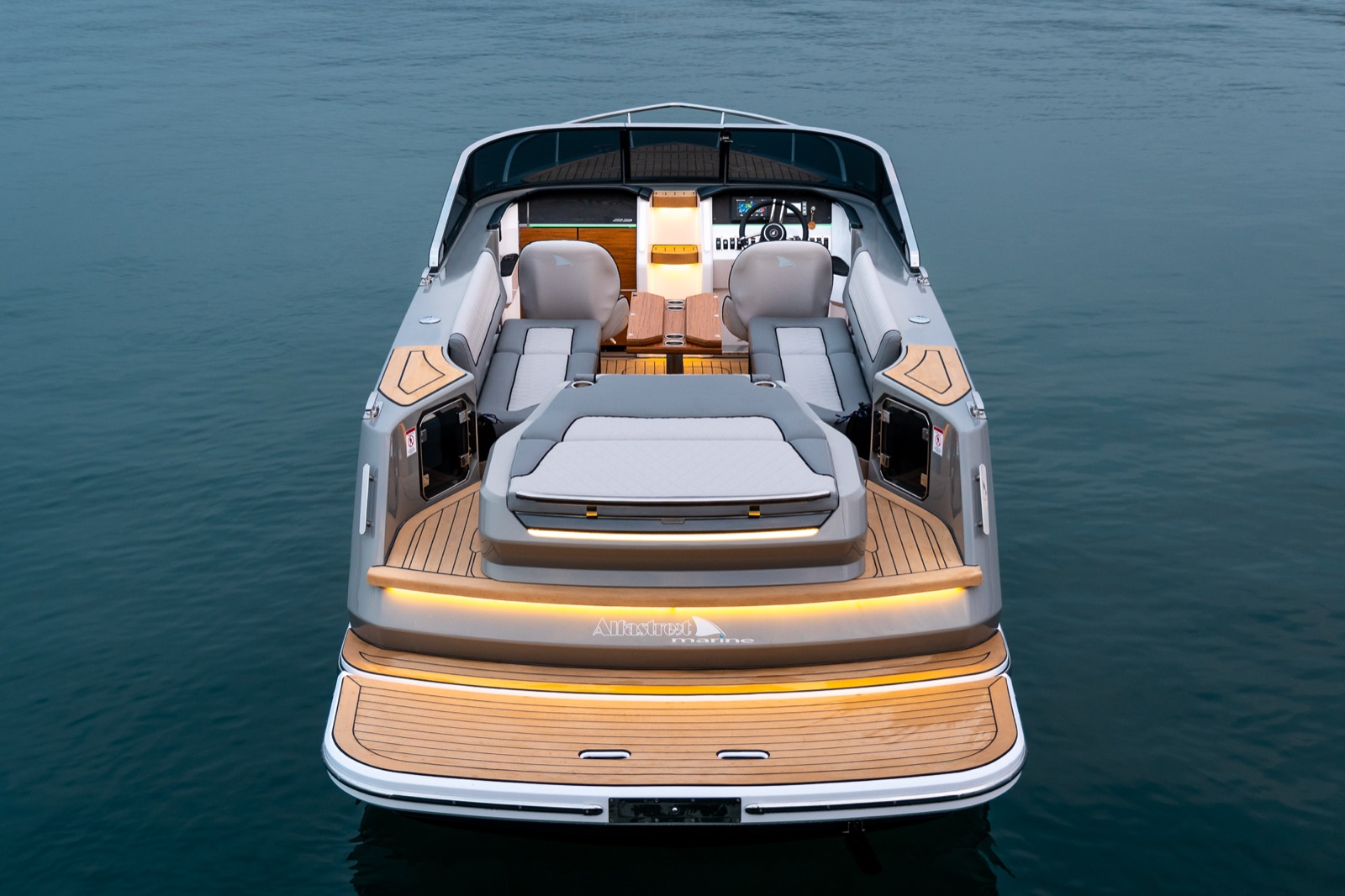
The current lineup runs from 6.6 to 10.1 meters overall, which puts it in the day boat class: not too small for a full family day and not so large that berthing or handling becomes the hard part of the outing. By the yard's figures the 21 Open, 23 Cabin Evo and 25 Cabin Evo take 8 adults, and the 28 Cabin, 28 Open and 32 Cabin take 12.
On a great many inland lakes, private boats with combustion engines are heavily restricted or not permitted at all, while electric drives have a far easier time getting approval. These boats grew up in that environment. Our electric boat guide collects what it means day to day and what to check before you buy. A builder that already had an electric boat, the Energy 18, among the three in its 2014 fleet, starts with a real advantage on that kind of water, and it has more than a decade of electric models behind it.
Buying, service and ownership
Get on board and drive the boat before you buy. That is the single most useful piece of advice, and also the simplest. In a few minutes a demo ride shows you what no photograph and no data sheet will: how easy the boat is to steer, how much deck space is left once people are sitting on it, how quietly it runs, and which layout matches your habits. Electric boat dealers and the bigger boat shows are where you get the chance. Take it.
Give support after the sale as much thought as the boat itself. A lake boat only earns its price if you can use it without worry for years, and that needs a reliable backstop of servicing, spare parts and someone competent to call. All three move faster and with less friction when the yard or an authorized partner is within real reach of where the boat lives. While you are looking at photographs of the deck, the point is easy to underrate, and yet it stays with you for the whole time you own the boat. If you are buying used, ask the seller for copies of the owner's manual, the motor and battery data sheet and the original warranty terms before you pay, and check anything missing with the yard, which lists a phone number and an email address on alfastreet-yachts.com. A seller who has the papers saves you weeks of searching. One who does not is telling you something about the boat's history.
Settle a few practical owner questions early. Where will the boat live, and how large does the berth need to be? Where and how will you charge, and does the pedestal at your slip have enough capacity for a boat in this class? What happens outside the season? Winter storage, maintenance and spring launch still apply to an electric boat, only on a slightly different rhythm, with battery care in place of the engine routine. Local dealers and the electric boating community will get you a long way on all of it, so you do not have to work it out alone.
If you are new to the subject, look wider before you commit and compare Alfastreet against other brands such as Marian and Greenline to see where the Slovenian yard sits in the market. If efficiency at higher speeds interests you, the foiling boats belong on the list as well. For the fundamentals, from drivetrains to the practicalities of ownership, our electric boat guide is the place to start.