A federal propeller ban, and why Ontario boards run on a jet
Any plan to eFoil in Ontario runs into one clause before it reaches a beach. Section 1006 of the Small Vessel Regulations (SOR/2010-91) is two lines long: “No person shall (a) tow themselves using a vessel that is operated by remote control; or (b) operate a propeller-driven surfboard-type vessel.” It is federal law and reaches every lake in Ontario. In the consolidation on the Justice Laws site, current to 30 September 2026 and last amended on 31 December 2025, the clause stands unchanged. As far as we can see, no other provision in those regulations names surfboard-type vessels.
Transport Canada repeats it in plainer words. Its Safe Boating Guide, TP 511E in the edition of March 2026, says that “Operating a remote-controlled vessel and a propellor-driven surfboard type vessel is illegal in Canada”. A classic eFoil with an open propeller under the mast is the board that sentence has in mind, and Fliteboard's own blog, in a post of 10 December 2024, agrees that open propeller boards are not allowed in Canada.
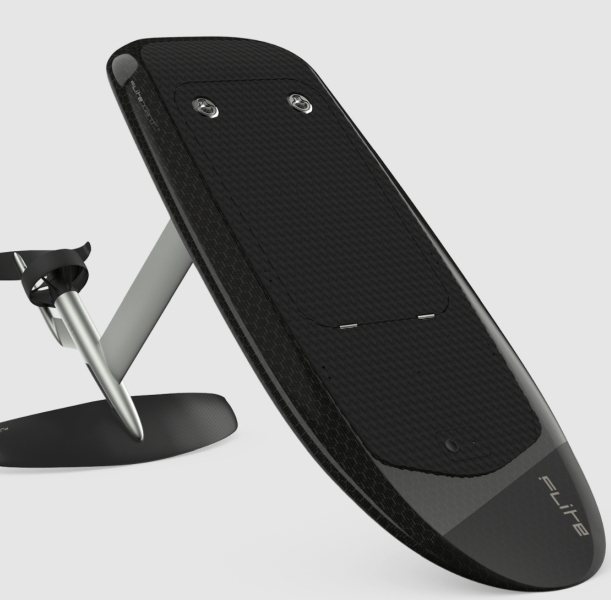
Jets are where it gets untidy. Section 1006(b) says nothing about jets, ducts or guards, so whether a jet or ducted eFoil falls outside it is an interpretation; that is our reading of the text, not a ruling. The two businesses with the most at stake lean toward the jet. E-Foil Sports Muskoka writes in its FAQ that “Currently Only Jet Propulsions Efoils Systems Are Legal To Operate On Canadian Waterways”, and that propeller modules “are subject to the authorities”. Fliteboard's post says Flite Jet boards are permitted, yet it also says the ban covers enclosed or ducted propellers and that a Transport Canada working group is reviewing it, with no timeline. Both are the views of companies that sell boards, not of the regulator.
Transport Canada consulted on propeller-driven surfboard-type vessels through its Let's Talk Transportation platform, and comments closed on May 13, 2022. The 30 September 2026 consolidation still carries section 1006 word for word.
Muskoka lessons from Port Carling on Lake Rosseau
Port Carling sits on the Indian River, where locks join Lake Muskoka to Lake Rosseau, and with so much of the township's boat traffic passing through it is known as the “Hub of the Lakes”. Lake Rosseau runs for about 18 km and meets Lake Joseph at the Port Sandfield narrows, with Port Carling, Minett, Windermere, Rosseau and Port Sandfield along its shores. Lake Muskoka, on the other side of the locks, spreads over about 120 square kilometers between Port Carling and Gravenhurst, ringed by cottages.
The eFoil school we could confirm here is E-Foil Sports Muskoka, run by E-Foil Sports Limited in Port Carling. It describes itself as “Muskoka's only official Fliteboard partner” and “the only Authorized Level 3 Fliteboard service provider in Ontario”. Those are its own claims. Fliteboard's Ontario location page lists the business as eFoil Sports Muskoka on Lake Rosseau, Port Carling.
Lessons, clinics and events run as walk in, private or group bookings, at three Flite School locations: SWS Boatworks in Port Carling on Lake Rosseau, Lake Muskoka, and the JW Marriott Resort and Spa, which the operator names as one of its sites. It also comes to a resort or to your own private dock. SWS Muskoka runs two marinas in Port Carling, one on Lake Muskoka and one on Lake Rosseau, with boat sales, service, storage, rentals and fuel, and it sells Fliteboard eFoils.
The booking system lists these sessions:
- one hour lesson, up to 2 people
- two hours, up to 3 people
- three hours, up to 6 people
- full day clinic, up to 7 people
- daily or long term rental of 8 hours on a Series 6 board with the Flite Jet 2 setup
Fliteboard's Ontario page describes the three hour and longer sessions as outings for groups of 4 to 8. It adds private cottage clinics where the instructor brings the boards, Flitescooter hire, and Flitecell battery and charger rental for riders who turn up with a Fliteboard of their own.
The school's FAQ wants riders aged 12 or older and under 265 lbs (120 kg). Its booking items say Ages 13+, so if your child is twelve, check before you book. Wetsuits and life jackets are provided, Fliteboard says.
Kelso and Oakville: eFoil rental on the Toronto side
Off-Water Efoil markets itself as eFoil rental for Toronto. Its site lists two addresses, 1380 Lakeshore Rd W in Oakville and 5234 Kelso Rd in Milton, and its lessons run at its school at Kelso Beach. About the Oakville address the site says nothing more, so ask before you drive there. Home visits are possible if you book in advance, and a life jacket and water shoes come with the session.
Kelso Conservation Area, 3.97 square kilometers run by Conservation Halton, lies near Milton on the Niagara Escarpment. Lake Kelso is a man-made flood control reservoir on Sixteen Mile Creek. In the warmer months the park rents canoes, kayaks, pedal boats and SUPs, and the beach has lifeguards and allows swimming.
The rental terms on Off-Water's GetMyBoat listing ask for renters aged at least 18 with a driver's license or other ID, and they describe the board as a Flite Pro S for one person. The boards take riders up to 265 lbs. What the listing and the board pages leave out is the drive. Given section 1006, whether a board turns an open propeller or a jet is the first question to ask.
Conservation Halton allows non-motorized boats at Kelso and Mountsberg, with boats driven by electric trolling motors as the one exception, and it welcomes your own non-motorized boat at Kelso. Read literally, a privately owned eFoil fits neither category. That is our reading of a boating page that never mentions eFoils, so ask Conservation Halton first.
Swipe sideways to see all columns
| Operator | Where | Session | Price |
|---|---|---|---|
| Off-Water Efoil | Milton (Kelso) and Oakville | Beginner Efoil Board, per hour | $199 |
| Off-Water Efoil | Milton (Kelso) and Oakville | Advanced Efoil Fliteboard, per hour | $249 |
| Off-Water Efoil | Milton (Kelso) and Oakville | Radinn jetboard (no foil), per hour | $200 |
| E-Foil Sports Muskoka | Lake Rosseau and Lake Muskoka | One hour lesson, up to 2 people | Booking calendar only |
| E-Foil Sports Muskoka | Lake Rosseau and Lake Muskoka | Full day clinic, up to 7 people | Booking calendar only |
| E-Foil Sports Muskoka | Lake Rosseau and Lake Muskoka | Rental, 8 hours, Series 6 with Flite Jet 2 | Booking calendar only |
Toronto waterfront, a harbor with its own speed limits
We could not confirm an eFoil school in downtown Toronto, and the harbor keeps a rulebook of its own. The Toronto Port Authority's Practices and Procedures, dated as at June 2000, were made under section 56(1)(b) of the Canada Marine Act, and not following them is an offence under section 59(1)(a) of that Act. They apply inside the port limits on chart 2085, which take in the Inner and Outer Harbours and the Toronto Island lagoons.
Item 14 of the practices sets the speeds:
- 5 knots (10 km/h) within 150 m of any shoreline or breakwater
- 10 knots (19 km/h) elsewhere in the Inner and Outer Harbours
- no wake in the Toronto Island lagoons, nor between the shore and the Western Breakwater
Item 16 bans reckless operation and excessive speed. Item 5 wants anyone running a power driven vessel to hold Transport Canada recognized marine certification or a Port Authority Operators Permit, item 6 says nobody under 14 gets that permit, and item 19 limits swimming to designated areas.
Whether an eFoil counts as a power driven vessel under these practices, the document leaves open. If it does, our reading is that anything above 5 knots belongs more than 150 m away from the shore and from every breakwater.
On the city's beaches, lifeguards and beach maintenance run from June to September, seven of the 10 supervised beaches hold the Blue Flag, and the city recommends swimming only while the lifeguards are on duty. Keep a motorized board well clear of all of them.
Ten km/h within 30 meters of shore, posted or not
Away from the harbor, the shore rule comes from the Vessel Operation Restriction Regulations (SOR/2008-120), in the consolidation current to 30 September 2026 and last amended on 13 August 2025. Section 2(7) caps speed at 10 km/h within 30 m of shore in the waters of Ontario. Section 2(8) lifts the cap for towing that runs perpendicular to the shore, for rivers under 100 m wide, for canals and buoyed channels, and for waters listed by name. Transport Canada's guide stresses that in Ontario the limit applies “whether it is posted or not”.
Our reading is that a board counts as a vessel under this rule. If it does, you leave the dock under 10 km/h, hold that until you are 30 m out, and come back in at the slow speed too.
Some lakes carry stricter rules on top. Sections 2(1) to 2(5) add bans and power or speed limits for the waters listed in Transport Canada's TP 15587, and section 2(3) names electric propulsion over 7.5 kW for the waters in Schedule 3. Look your lake up in TP 15587 before the first ride.
Proof of competency on an electric board, and young riders
The Competency of Operators of Pleasure Craft Regulations (SOR/99-53, current to 30 September 2026, last amended on 6 October 2020) apply under section 2(1) to motorized pleasure craft used for recreation in Canadian waters, everywhere except the Northwest Territories and Nunavut. Section 3(1) wants the operator to be competent and to have proof of it on board.
Proof of competency, Transport Canada's PCOC page says, “is required with all motor types (including electric trolling motors)”. It accepts the Pleasure Craft Operator Card itself, which you earn by passing a test with an accredited course provider (pass mark 75 per cent; Transport Canada's Course Provider Lookup tool finds one). Carry the original, because a paper or electronic copy is not acceptable. A Rental Boat Safety Checklist also counts, “good only for the rental period”, and visitors may show a document from their home country.
Under section 4(1) the renter and the rental agency both sign that checklist before the craft is used, and it is valid only for the rental, while section 8 lists what it must cover: how to operate the craft, the principal safety rules, and the geographic features and hazards of the area. Section 3(2) exempts a person under an instructor's supervision in an accredited course, a non resident whose craft has been in Canada for under 45 consecutive days, and the holder of a listed equivalent certificate.
E-Foil Sports Muskoka's FAQ takes a lighter line: no boating license needed, a PCOC recommended. We do not rule between the two; ask the school which document it will sign with you.
Age limits for motorized craft are set in horsepower. Under 12 and without direct supervision, Transport Canada allows up to 10 hp (7.5 kW); from 12 to 15, up to 40 hp (30 kW); nobody under 16 may drive a personal watercraft, and direct supervision means a person aged 16 or older in the boat. In our reading these limits were written with boats in mind, and nothing we read says how they apply to a board.
Section 3(2.1) says the person in charge may not let anyone else operate the craft unless that person is competent or exempt. In our reading, a friend asking for a go on your board is covered by it.
Readings marked as ours are interpretations of the texts named above. This page is not legal advice; Transport Canada and, in the port, the Toronto Port Authority give the binding answers.
Lake Ontario water temperature from May to October
Lake Ontario warms late and slowly. The long term surface averages from NOAA's Great Lakes Environmental Research Laboratory climb from about 4.3 °C on May 1 to a peak of about 22.2 °C in early August.
Swipe sideways to see all columns
| Date | Average | Date | Average |
|---|---|---|---|
| May 1 | about 4.3 °C | August 1 | 21.8 °C |
| June 1 | 10.0 °C | early August (peak) | about 22.2 °C |
| June 15 | 14.2 °C | September 1 | 21.2 °C |
| July 1 | 17.8 °C | September 15 | 19.3 °C |
| July 15 | 19.9 °C | October 1 | 16.7 °C |
| October 15 | 13.9 °C |
Transport Canada puts it in one line: “Canada's waterways are cold year-round. Wear your lifejacket.” In water under 15 °C it advises a PFD with thermal protection. On the averages above, that covers the lake until around mid June and again from mid October, so in our reading the comfortable stretch for a beginner runs from July to September.
E-Foil Sports Muskoka frames its lessons as a summer activity, and the winter riding it shows exists only in videos. We take that to mean there is no winter booking.
Drinks wait until the board is back on shore. Transport Canada's guide reminds readers that “The Criminal Code bans boating while impaired by alcohol, drugs, or a combination of both.”
Owning an eFoil in Ontario: drive, gear and import costs
The equipment rules in TP 511E apply to every pleasure craft, owned, rented or borrowed, and the guide names kiteboards, paddleboards and flyboards among them. Every craft type in its minimum equipment table starts with one lifejacket or PFD per person. eFoils do not appear in the guide, so there is no list written for them; our reading is that a board falls under the general equipment rules.
The drive decides if the board may be ridden here. With section 1006 in force, the boards the Muskoka school rents are Flite Jet configurations, and SWS Muskoka in Port Carling sells Fliteboard eFoils. Riding a propeller board bought abroad on Canadian water falls under the ban, wherever it was legal before. Our eFoil buying guide covers the wider choice; in Ontario, the drive comes first.
Shipping a board in has its own cost. E-Foil Sports Muskoka warns that duties, brokerage and other CBSA charges on a board sent into Canada can top $1,000. That is a dealer's general claim, not a quote. The eFoil price guide shows what the boards themselves cost.
Fliteboard lists Flitecell battery and charger rental in Muskoka for riders who bring their own board, so the battery does not have to travel with you.
The federal rules on this page hold across the country. Our Kelowna page applies them to Okanagan Lake in British Columbia.