What goes into a wing foil setup?
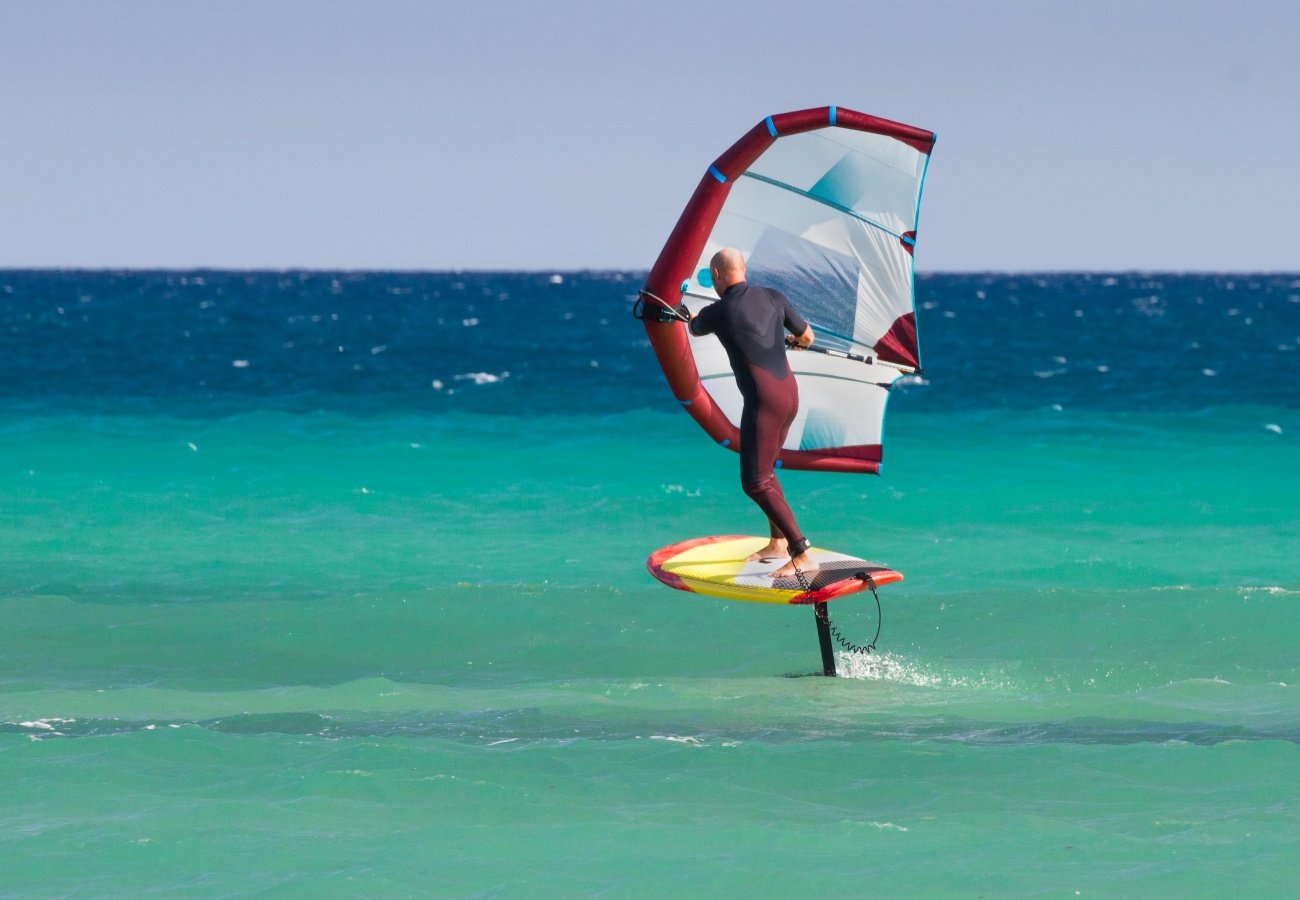
The gear you need for wing foiling comes down to three main parts. The wing is an inflatable handheld sail, measured in square meters. On the board, volume in liters is the number that matters most. The foil itself consists of mast, fuselage, front wing and stabilizer, plus the mounting hardware that holds it all together. On top of that you need a leash for the wing and one for the board (usually worn on the wrist and the ankle, though both also come as waist belt versions), a pump and a bag. Complete factory packages cover that whole list, and this is most of their appeal: you arrive at the water on day one with every piece you need already in the box.
The three parts control different things. The wing supplies your power in a given wind strength, so its size follows the conditions and your weight. The board carries you while you are still sitting on the water, before you fly, which is why beginners gain so much from extra volume. The foil runs the flight: the front wing makes the lift, the stabilizer keeps that lift steady, the fuselage sets the distance between the two, and mast length fixes how high above the surface you ride. Change any one of them and the setup feels different. That is why experienced riders upgrade one component at a time instead of buying a new package.
Two pieces of protection belong on a beginner's list from day one: a helmet and an impact vest. While you are learning, the board, the foil and the rider all end up in roughly the same patch of water more often than you would like. In GONG's own store a helmet starts at €29.95 and the brand's impact vests cost €89.95 to €109 (list prices read on 5 October 2026). Together they make the first few weeks far more relaxed. A harness can stay off the initial shopping list; it only becomes relevant at an advanced or race level.
Some smaller items never make it into a package description but still shape your first season. Wetsuit thickness depends entirely on where and when you ride, so that is a local call. A spare set of foil screws and the right hex keys belong in the bag, because a screw lost on a beach is the fastest way to end a session early. If you plan to travel with the gear, measure your board and mast before you book anything. A wing packs down small, and so does an inflatable board. A hard board never does.
Beginner sizing: board, foil, wing
On sizing, the major manufacturers agree with one another to a surprising degree, and their published rules of thumb are the best place to start. None of these numbers is a law of physics, but a first setup built on them will still be forgiving, not frustrating.
Board:take your body weight in liters and add 20 to 40 liters. F-One recommends the “body weight + 40 liters” rule, so a 70 kg rider lands on a board of about 110 liters. Duotone sets a lower floor, body weight plus at least 20 to 30 liters, which puts that rider on 90 to 100 liters or more. Nothing helps a beach start as much as volume: a board that stays under you while you find your feet, sort out the wing and wait for a gust. Riders who start on a small board tend to spend their first sessions swimming, not riding.
Foil: for learning, Duotone suggests a front wing of 2,000 to 2,500 cm², a fuselage of 66 to 74 cm and a mast of 70 to 80 cm. F-One points to its Gravity family as the learner foil and notes that a shorter mast also softens the crashes. A big front wing lifts early, flies slowly and forgives plenty. For your first meters above the water, that is the behavior you want. Small, fast wings come later, and by then you will know what you are asking them to do.
Wing: Ensis, in its own learning guide, puts a rider under 70 kg on roughly 4 m² for a first wing and a heavier rider on about 5 m², both figures calculated for moderate wind of 15 to 20 knots. Strong days call for something smaller, light days for something bigger, and over time most wing foilers end up with a quiver of two or three wings. Start with one. Learn how your local wind behaves, then buy the second wing to fill the gap you keep running into.
You will outgrow this first setup, and you are meant to. A big beginner board and a large front wing exist to get you flying, not to keep you happy in year three. Luckily, the next beginner browsing the used market wants exactly this sort of gear, so a sensible first purchase holds its value better than an ambitious one.
Price tiers in 2026: entry, mid-range, premium
The figures below are built from list prices read on 5 October 2026 in the makers' own web stores (GONG, Duotone, North and F-One). Armstrong's own store prices in US dollars only, so The Foil Shop in France stands in for that brand. Those shops list in euros, which is why the table does too; the one dollar figure comes from Naish's own store. Local distribution, shipping and import charges decide what you pay elsewhere, so read the table as a reference point and not as a quote for your country.
Swipe sideways to see all columns
| Entry | Mid-range | Premium (carbon) | |
|---|---|---|---|
| Typical build | complete factory package (e.g. GONG HIPE First: board + foil + wing + leashes + pump + bag) | branded components with an aluminum mast (e.g. Duotone Unit wing + Skybrid Air board + F-One Gravity / North Sonar foil) | full carbon (e.g. Armstrong / Axis foil, D/LAB-level wing, carbon board) |
| Price of the set | €999-1,199 (Naish Wingsurfer Package: $2,350.88) | €3,530-4,370 | from €6,800 |
| With safety gear | €1,120-1,350 | €3,650-4,510 | over €6,900 |
| Who is it for? | a first season, trying the sport out | committed regulars, planning on several seasons | advanced riders chasing performance |
At the entry level, the French brand GONG is the obvious first name to check, and its HIPE First complete package costs €999 to €1,199 depending on board size and holds everything you need to get on the water: an inflatable board, GONG's X-Over V3 foil, a Plus wing, both leashes, a pump and a bag. Naish, one of the larger brands, sells a ready-made Wingsurfer Package (a foil on a 75 cm aluminum mast, a 5 m² wing and a 112 or 122 liter board) for $2,350.88 in its own web store. F-One's and Duotone's own stores sell no such package. Paying more for a big name mostly buys you wider dealer support and easier resale.
In the mid-range you start assembling components yourself. A Duotone Unit 2027 costs €1,099 in 4 m² and €1,149 in 5 m². It ships without handles or a boom, so add €99 for Duotone's Fusion handle set. North's complete Sonar Prime Edition foil with an aluminum mast costs €1,329 (F-One's own store sells its Gravity foil only as separate parts). For the board, Duotone's inflatable Skybrid Air costs €999. The price of F-One's hard Rocket Wing climbs with volume, from €1,349 for the 47 liter board to €1,789 for the 140 liter one. Added together, those parts put you in the €3,530 to €4,370 band, with another €120 to €150 on top for a helmet and an impact vest. This is the tier most riders reach after a season, and they typically get there step by step, keeping the board they learned on and upgrading the foil first.
The carbon class is another budget entirely. An Armstrong foil alone costs from about €2,550 at The Foil Shop with the Mk II carbon mast and from about €3,320 with the Performance Mk II, and most riders at that level already own two or three wings. Above that, the ceiling is effectively open. The money buys stiffness and low weight, but not a shortcut to skill, so spending premium money before you can reliably fly is rarely a good trade.
Getting into wing foiling costs considerably less than getting onto an eFoil, as long as you live somewhere with enough wind. For anyone torn between the two, foil assist systems are the middle path, letting your wing gear fly on windless days as well.
Where to buy a wing foil setup
These days you can order wing foil gear online almost anywhere without much trouble. GONG sells direct through its own webshop, and specialist foil and kite retailers stock wings, boards and foils from the major brands in most regions. The price ranges further up this page come from the makers' own stores, plus one French retailer for Armstrong. The catalog barely changes from one country to the next. The fine print does: shipping costs, import duties on gear coming from another continent, and how quickly a warranty claim gets handled.
A specialist shop is still worth a visit, and not mainly for convenience. Sizing is the decision beginners get wrong most often. A shop that asks your weight, your local wind and your background in other board sports gives you more useful guidance than a spec sheet does. And if something goes wrong, one named contact in place of a support queue usually gets the problem sorted much faster.
Take a lesson or two before you spend anything. At most schools the gear for the sessions is supplied, so you get to feel what a 5 m² wing does in 15 to 20 knots and how a 100 liter board sits under your feet before you commit money to either. Demo days run by shops and brands do the same job. If the sport itself is still new to you, our overview of wing foiling explains how the riding works.
Used wing foil gear: where to look and what to pay
The second-hand market for wing foiling is unusually well stocked, because riders change sizes as they improve and put last season’s gear up for sale. There is no single global marketplace for it. Complete sets mostly change hands on the big general classified platforms in each country. Those markets are local and their asking prices change from week to week, so weigh a used set against what that gear costs new, not against a figure from another country. Brand and owner groups on social media carry a more international layer of listings. Surf and kite shops with a second-hand corner are another place to browse.
By our estimate, branded gear one or two seasons old sells for 25 to 50 percent below its new price. That discount is the real argument for buying used. If the gear is sound, paying entry-level money for mid-range components is a better deal than paying entry-level money for entry-level components.
Check the wing first, starting with the seams and the valves, then inflate it before you hand over any money; it should hold pressure for an hour. On the foil, look hardest at play in the connection between mast and board and at repair marks along the wing edges, since a badly patched leading edge changes how the foil flies. Loosen and retighten a couple of the mounting screws while you are there, because hardware that has lived in salt water can seize in place. On the board, check for delamination and any sign that water has found its way inside.
Then put two questions to the seller: how many sessions has the gear seen, and was it rinsed with fresh water after salt use? Neither answer can be verified, but the way somebody answers often shows you quite clearly how the equipment was looked after. Buying second-hand is a sensible route into the sport. You are going to outgrow that first setup in any case, and with less money tied up in it, the next purchase gets easier.