The brand
X Shoreis a Swedish yard that pairs the restraint of Scandinavian design with a modern battery drivetrain to build all-electric premium dayboats (daycruisers, in X Shore’s own word), boats made for a day out, where the number of berths matters far less than how the boat looks, how quiet it is, and what the hours on board feel like.
Among electric boat builders the name carries weight. Read enough about electric boats and the phrase “Scandinavian minimalism” tends to turn up; there is a good chance this is the brand behind it.
Fewer elements, each of them properly placed: that is the Scandinavian school in a sentence. Clean lines, a deck somebody has clearly thought about, and attention paid to your time on the water, not to an endless list of comfort extras. X Shore adds the electric drive, which feels nothing like a combustion engine underfoot. No drone, no exhaust smell.
You can hold a conversation at cruising speed, play music and hear it, or skip the music and listen to the hull and the water. That quiet, uncluttered character is what sets the brand apart in the premium segment and gives it a character of its own.
The company behind the name has changed hands. X Shore’s production company went bankrupt first, in October 2025; the parent company followed in January 2026. That same month the Norwegian investor Staale Reiersen bought the production company, X Shore Production AB, through his firm Fortivo AS. In April 2026 X Shore announced that the new ownership was in place and that production at its factory in Nyköping, Sweden, was fully operational. The name on its terms and conditions is Fortivo Operations AB, trading as X Shore.
X Shore in action
More official photography, and every model in the range, at xshore.com ↗
The premium dayboat format
Cast off in the morning, swim in a quiet bay, eat lunch on deck, cruise along the shoreline in the afternoon and be back in the harbor by evening. That is the day a dayboat is built for: it is an open boat with a generous deck, meant for days on the water and not for multi-day trips with a cabin, so the number of berths is beside the point. Deck comfort counts, and sunbathing space, and how pleasant many hours on board feel.
“Premium” brings a standard of materials and finish with it. In this class the details, the surfaces and the ergonomics are not extras sitting on top of the boat; they are the product. “Electric” brings the drivetrain: close to imperceptible next to a combustion engine, with no vibration and no smell. The drive is also mechanically simpler than a gasoline or diesel installation and has fewer moving parts to look after. Combined, the two give you a calmer day on board. Nothing drowns out the conversation, and the air around you stays clean.
The format suits people whose idea of a good day afloat is rest, company and quiet. A slow cruise into the sunset, a swim stop with friends, an unhurried family afternoon: those are the hours when an electric dayboat is at its best, and precisely the hours when the noise and fumes of a combustion engine would grate the most. If that sounds like the way you would spend a free Saturday, the category deserves a closer look.
Models
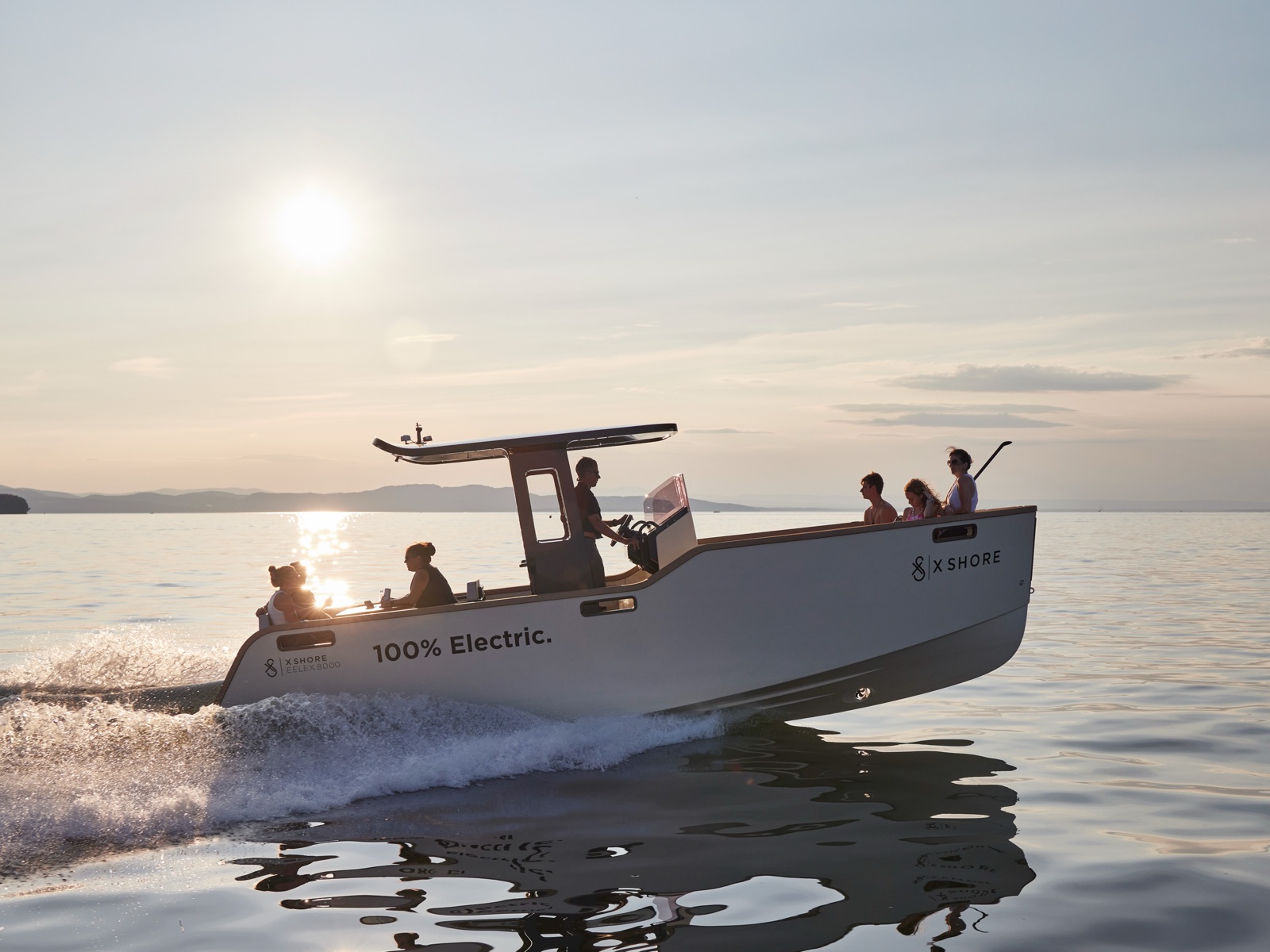
The flagship of the range is the Eelex 8000, and its numbers make the case on their own. A 170 kW motor draws on a 126 kWh battery, and the boat tops out at around 30 knots (56 km/h, roughly 35 mph). At 5 knots it has about 100 nautical miles (nm) of range, which works out to some 185 km or 115 miles. On X Shore’s spec sheet those figures come with a 3-year warranty on the battery, motor, hull and deck, and 1 year on other parts and components.
Pricing follows suit. On the European price list at xshore.com the Eelex 8000 starts at €249,000; the US site lists the same boat from $269,000. We read both pages on 5 October 2026. Neither page says whether tax is included. X Shore’s terms and conditions fill that gap: prices in its price lists generally apply exclusive of VAT and, unless agreed otherwise, ex works at its factory in Nyköping, Sweden. There is no note from the yard on how the euro and dollar figures relate to each other. Read both as starting prices, which grow once tax, delivery, specification and options are added.
Below it sits the X Shore 1, the brand’s more compact entry model. We left its price off an earlier version of this page because we had no confirmed figure to cite. Now the European site lists it from €129,000 and the US site from $139,000, again with no tax line. That puts the smaller boat at a little over half the price of the flagship, whichever of the two currencies you look at. If it interests you, ask the manufacturer for a fresh quote on the version you want.
Specs read differently once you hold them against an ordinary day afloat. A 30-knot top speed mostly tells you what the boat is capable of. An electric boat goes furthest at a relaxed, economical pace, and the 185 km rests on X Shore’s figure of 100 nautical miles at 5 knots, the pace its spec sheet calls slow speed. The same table drops to 32 nautical miles (about 59 km or 37 miles) at the 20 knots it lists as cruising speed, and to 28 (about 52 km or 32 miles) at the 30-knot top speed. All three figures include a slow-speed range extender that switches on below 10 percent battery.
Hold a high speed for long and consumption climbs steeply. Ease along quietly and the pack has enough left for a whole day out. On its own, the brochure number tells you little. Think about range in terms of the speed you will run and the day you have planned, not as one headline figure.
A third boat, the X Shore PRO, is pitched at maritime professionals as an electric utility boat. The PRO spec sheet repeats the Eelex 8000’s motor, battery and range figures, and its starting prices match the flagship’s: €249,000 on the European site, $269,000 on the US site.
The two leisure models answer different needs. The Eelex 8000 is the full-size premium flagship, built around outright power and the bigger deck. The X Shore 1 is the compact alternative for anyone who wants the brand a size down. When you choose, the bigger number matters less than which boat fits the way you actually use it. The crew you usually take out matters, and so does how far from the dock you want to get.
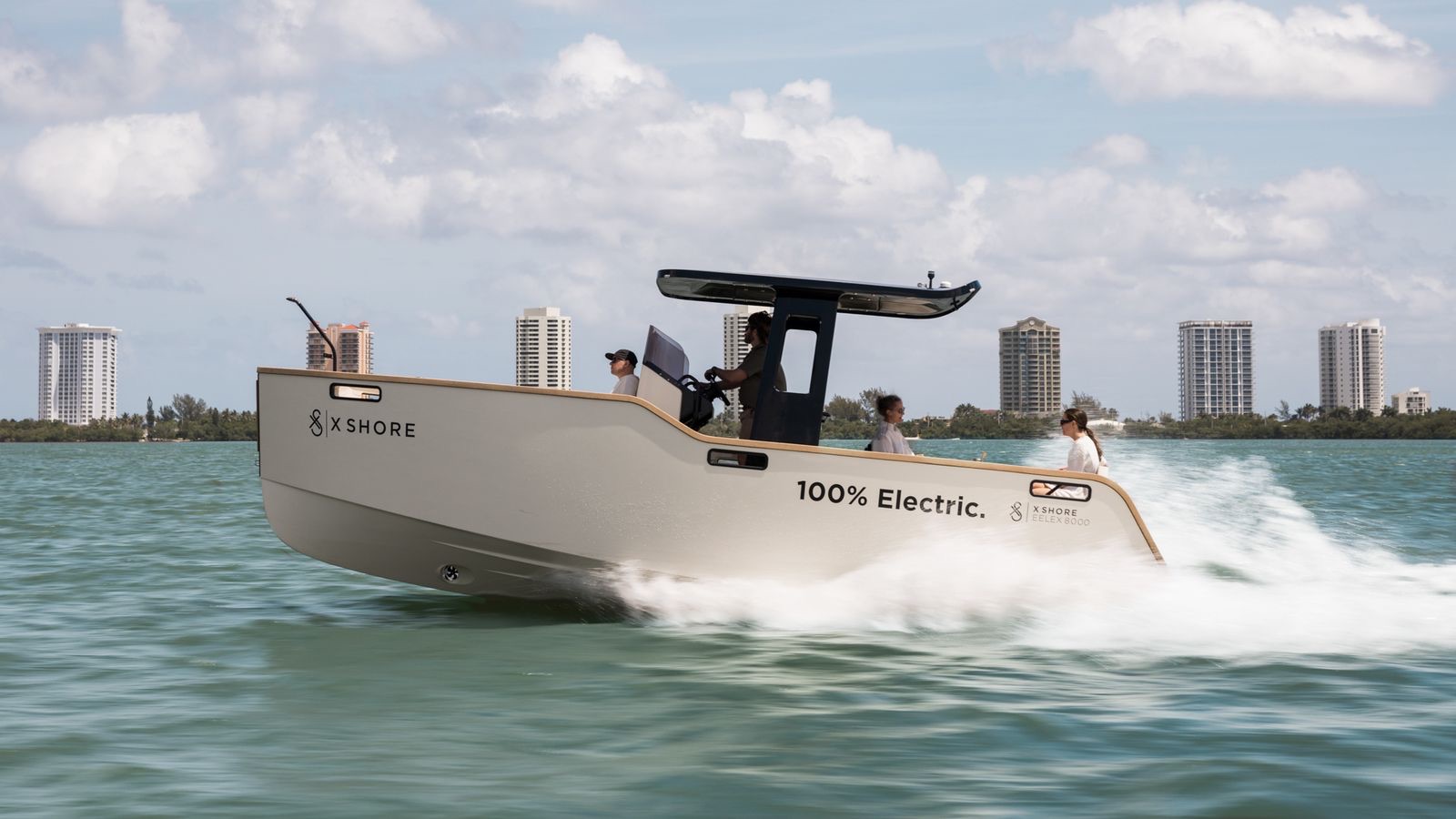
On lakes and calm bays
By size class, X Shore’s leisure boats belong in the dayboat category (X Shore calls them daycruisers, and the X Shore 1 also comes in cabin versions with two beds). That format works best on inland lakes and sheltered coastal bays. These are boats for sociable day trips, not offshore yachts. Flat water and calm shorelines suit a silent, emission-free drive, and the 185 km the Eelex 8000 manages at an easy pace is enough for a full day of easy cruising with range to spare.
Regulations also tend to favor the electric option. Plenty of lakes restrict or ban combustion engines while allowing electric boats. Not everywhere, though: rules differ by country and often by individual lake or stretch of coast, license requirements included, so check your local regulations before you buy or launch. For the wider picture on the category, see our electric boat guide.
Forget the fuel dock. With an electric boat, the infrastructure question is whether there is a charge point at your berth. X Shore says the Eelex 8000 can charge from almost any power outlet or harbor station. The spec sheet lists AC charging at up to 22 kW. Plug in a DC charger and the battery goes from 20 to 80 percent in one hour. If the idea of gliding above the surface appeals to you, our page on hydrofoil boats covers that side of the market.
What to think through before you buy
A handful of questions are best settled early if you are seriously considering a premium electric dayboat. None of them point to a weakness in the boat; what they show is whether this type of boat fits your plans and the way you use the water.
- How you will use it: Do you mostly picture short day trips, swim stops and guests on board? That is what the dayboat format is made for. Longer cruises with a cabin and overnight stays call for a different type of boat.
- Speed and range: Range moves with speed, so work out which distances you want to cover and at what pace. Quiet cruising carries you a lot further than a day spent at full throttle.
- Charging: Is there a suitable charge point at your home berth, and does topping up overnight fit the rhythm of your days?
- Budget: The premium class comes at premium prices. The flagship sits higher and the entry model is more attainable. For exact current figures, always go to an official source.
- Availability and service: Where can you see the boat, take it out for a demo and have it serviced later? With a boat in this price class, that matters at least as much as the choice of model.
You don’t need every answer straight away. The clearer your picture of your own boating routine, though, the easier it gets to decide whether an X Shore, or an electric dayboat in general, belongs in your boating life. Getting that clear is mostly a matter of one simple step.
See the boat in person, and take it out on the water if you can.
X Shore in the market
X Shore doesn’t have this market to itself, and it is not an easy one. In June 2025 X Shore’s chief executive, René Hansen, called it difficult. At least one rival works alongside a carmaker: Frauscher builds its Frauscher x Porsche boats together with Porsche. Against that field, X Shore’s design-led Scandinavian approach is what people tend to remember it by.
Foilfun covers several similar builders, so you can set the brand next to others. Austria’s Frauscher works in the same premium dayboat territory, and Denmark’s Rand offers another take, with crisply drawn electric leisure boats. To get the lay of the land first, start with our electric boat guide, which sets out what to look at before you commit.
X Shore is a well-defined brand, not a one-off curiosity, and after the bankruptcies of 2025 and 2026 it has new owners behind it. If you are thinking about a premium electric dayboat today, look at several builders before you settle on the one that matches your taste and your boating routine. Odds are that X Shore will be one of the names you end up comparing.