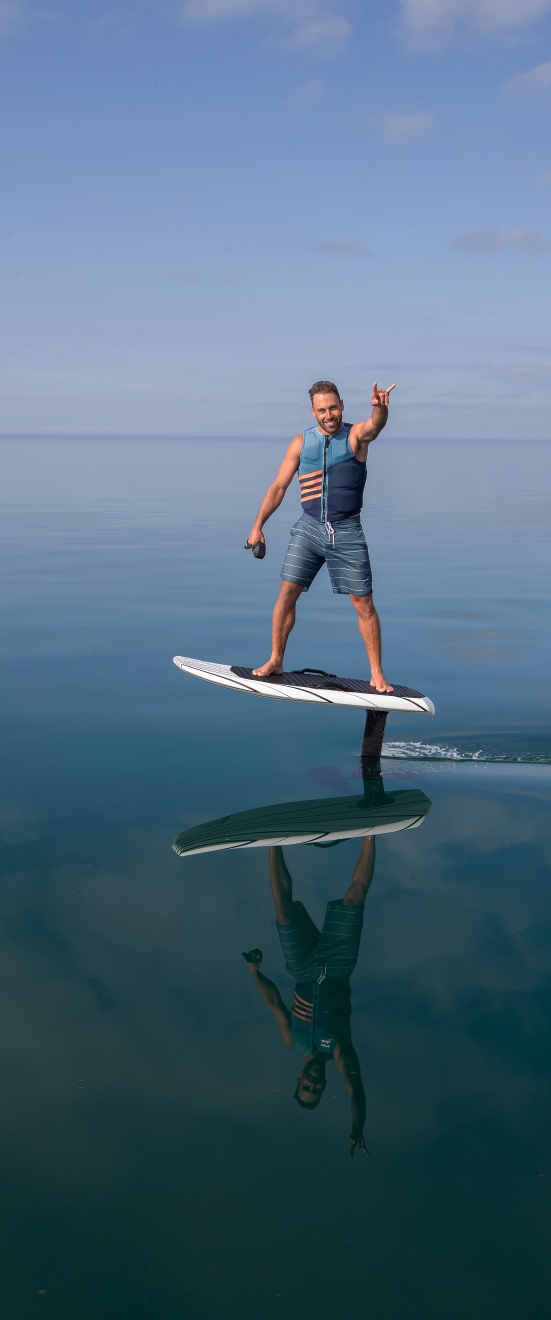
Tampa Bay eFoil schools, and the bridge they work from
Tampa Bay meets the Gulf of Mexico under the Sunshine Skyway Bridge, and most eFoil lessons on this coast begin within sight of it. Elite Watersports runs its shop from 3101 22nd Ave S in St. Petersburg, within 5 miles of the bridge and of St. Pete Beach, and meets eFoil students at Skyway Beach unless the school announces another spot. Its map pin, as far as we can tell, sits on the north (Pinellas) causeway of I-275, the side you reach from St. Petersburg.
Elite does not stay at the bridge. Its lesson page names Sarasota, Clearwater, Dunedin and Tarpon Springs among its other spots, while all five of its guided tour areas sit in Pinellas County, on the St. Pete side. When we searched on 24 October 2026 we found no other eFoil school with a base of its own in Tampa, Clearwater, Dunedin or Tarpon Springs. A lesson in one of those towns, as we understand it, means Elite driving the boards to you.
Sarasota, south of the bay mouth, has its own operator. Opua Adventures (the sarasotaefoil.com address leads there) teaches mostly at New Pass and Bird Key in Sarasota Bay and lists Lido Key, Longboat Key, Bird Key, Siesta Key and Anna Maria Island among the places it serves. Fort Myers and Naples sit farther down the Gulf coast and are covered in our guide to eFoiling in Florida, while Biscayne Bay has its own Miami page.
Both schools teach on Fliteboards. Opua, which also puts riders on the Flitescooter, calls itself an authorized Fliteschool.
What a lesson with Elite Watersports includes
Elite's eFoil page offers two lesson lengths, a 1.5 hour and a 3 hour private lesson. For a small extra fee the lesson becomes semi private. The school provides the life jacket and helmet, and your instructor follows you on an eFoil of their own or on a jet ski.
Booking online is a little different. The calendar offers a 60 minute or a 90 minute session, or a tour, so the 3 hour lesson, we assume, is arranged on request. The calendar lists the eFoil, helmet, life jacket and 20 minutes of instruction as included. Booties, a wetsuit for September to April, and photos and video appear there as add ons, while the website calls wetsuit and booties included, so settle that when you book.
Weather days move to another date at no extra fee. Every student must know how to swim, and 13 is the minimum age to ride alone. Elite publishes no eFoil lesson price on its own pages, so ask for the current figure when you book. If you own a helmet and a life jacket, the school asks you to bring them.
The shop handles eFoil diagnostics and servicing in house, which matters more to owners than to students. Elite also sells Fliteboard packages, listed as “Starting at $12,435” (list price, Elite Watersports, read 24 October 2026), and a buyer gets a free one on one lesson after the purchase. Our Fliteboard review and eFoil price guide set that figure against the rest of the market.

Alone, as a group, at your dock or on a tour
A family or a group of friends does not have to queue for one board. Elite books single board lessons, multiple board lessons with up to 4 boards on most days, and private parties or events. The lesson can also come to you: the school offers offsite training on request, for instance at a house on the water. In our view a vacation rental with a dock can work too, provided the water in front of it is deep and calm enough to fly.
Once you can fly, the guided rides open up. Elite takes riders through the back waters, canals and estuaries of Tampa Bay, and asks for a 1.5 hour lesson first. A ride lasts one hour, either on the school's gear or on your own board with one of its guides beside you. You pick the area when you book:
- St Pete Beach
- Maximo and South Pinellas
- Tierra Verde
- Sunset Beach and Treasure Island
- Downtown St Pete
Why an eFoil rental in Tampa or St. Pete ends up as a lesson
The hope behind an “efoil rental tampa” search is a counter where you hand over a card and walk off with a board. As far as our research reaches, nobody on this coast works that way. Elite's booking page says plainly that its boards cannot be rented. The word rental turns up in one place only, as an optional extra on its captained boat charter, so the eFoil goes out with a boat and a captain.
Opua in Sarasota has “rental” in a web address and still sells sessions with instruction; every format it lists includes a coach. On our reading, then, the search ends at a lesson or a guided ride in Tampa or St. Pete, never at walk up hire.
Owning one is the other route. A board you keep in Florida has to be registered with the county tax collector, which here means Pinellas, Hillsborough, Manatee or Sarasota. Lesson boards are the school's concern. Our eFoil buying guide and the page on used eFoils cover the purchase itself.
Sarasota Bay lessons, from Lido to Siesta Key
Opua Adventures usually teaches at New Pass or Bird Key. New Pass gives you protected water with downtown Sarasota in view; Bird Key is calm and shallow, with little boat traffic. Both sit, to our eye, inside Sarasota Bay or its passes, not on the open Gulf beach. The meeting point arrives by message the night before or on the day itself. For an extra fee the school brings the boards to Anna Maria Island, Longboat Key, Venice Beach, private docks and vacation rentals.
Unlike Elite, Opua publishes a price. It lists its eFoil experience as “Starting at $250” (list price, Opua Adventures, read 24 October 2026). A session runs up to 90 minutes in total. Into that go the safety briefing and equipment overview on the beach, the training on the water and, at the end, some free flying, on a Fliteboard or the Flitescooter with instruction included.
Siesta Key sits inside Opua's service area. A Fever listing for the business offers one to four people and three spots, Siesta Key Beach, Lido Beach or Sarasota Bay, and that listing is our only source for Siesta Key Beach as a launch. Opua takes riders aged 14 and up, to a maximum of 245 lbs, who can swim at a basic level.
Bad weather means a new date or a full refund. Under Opua's terms, changes and cancellations made 24 hours or more ahead get full credit or a refund.
Swipe sideways to see all columns
| Detail | Elite Watersports | Opua Adventures |
|---|---|---|
| Base | St. Petersburg, meets at Skyway Beach | Sarasota, New Pass and Bird Key |
| Travels to | Sarasota, Clearwater, Dunedin, Tarpon Springs, offsite homes | Anna Maria Island, Longboat Key, Venice Beach, docks (extra fee) |
| Lesson lengths | 1.5 h or 3 h private; 60 or 90 min in the calendar | Up to 90 min in total |
| Age | 13 to ride alone | 14 and up, max 245 lbs |
| Boards | Fliteboard | Fliteboard or Flitescooter |
| List price | None published on its site | Starting at $250 |
Learning water by the Skyway, and the beaches to save for later
Elite's own advice for a first session is to learn on the east side of the Skyway, where there are fewer things to hit, fewer people, no boats and deeper water. The school's kite spot guide calls Skyway Beach East shallow and calm behind a large sandbar, with plenty of parking and some deeper water at the edge where kite foilers and wingers practice. Skyway Beach West, in that guide, is calm, shallow and forgiving, with deeper water on the north side. Drift too far north, though, and there is no good place to get out.
The school names three more places. Pass-a-Grille Beach works on a calm day, outside the swim zone. Expect some chop there; Elite keeps it for more advanced riders. The St. Petersburg Pier gives you the city skyline. At North Shore Park the tide can mean a long walk out, so find out where the sandbars lie. Fort De Soto East Beach, from the kite guide, sits behind a large sandbar: you go a long way out before the water gets deep, and shells on the bottom call for booties.
Sorted our way, not the school's, the coast has three kinds of water:
- Bay flats and causeway beaches (Skyway, Bird Key, New Pass) give flat water for learning. They are shallow and grassy and often lie in manatee zones, so watch the tide and come off the foil wherever slow speed is posted.
- Gulf beaches (Pass-a-Grille, Siesta, Lido) bring chop and swimmers. They suit riders who already fly.
- The intracoastal and the canals carry boat traffic, idle zones at bridges and wakes. They make good guided tour water and poor practice water.
In summer the hour matters as much as the place. We would book a morning slot, before the sea breeze storms build.
Manatee zones, bridge zones and seagrass scars
Florida protects its manatees county by county. Chapter 68C-22 of the Florida Administrative Code holds a rule for each county on this stretch: r. 68C-22.013 for Hillsborough, .014 for Manatee, .016 for Pinellas and .026 for Sarasota. A posted slow speed zone matters more to an eFoil than to most boats, because r. 68C-22.002 defines slow speedas “fully off plane and completely settled into the water”. We take that to mean you cross such a zone with the board down on the water and the foil not flying.
The Pinellas rule (r. 68C-22.016, new 1-5-05, amended 1-18-16) sets year round slow speed zones in the Anclote River, Tarpon Bayou and Spring Bayou at Tarpon Springs, the Clearwater waters north of the Memorial Causeway, parts of the Narrows, Johns Pass and Boca Ciega Bay, and Mullet Key Bayou at Fort De Soto, among others. Seasonal zones start on 1 April and run to 15 November in places such as Safety Harbor and Old Tampa Bay north of the Courtney Campbell Causeway, or to 31 October at Redington Shores, Long Bayou and north of the Treasure Island Causeway. Skyway Beach is not named in the rule text, so check the FWC zone map for your water.
Across the bay, Hillsborough County's rule (r. 68C-22.013, new 3-19-79, amended 12-12-02 and 1-5-05) closes the discharge canal of the power plant at Apollo Beach from 15 November to 31 March, with an idle speed zone next to it for that period. The Little Manatee River and Bahia Beach are idle speed all year, and the slow speed zones include water off Apollo Beach and in Old Tampa Bay.
Sarasota County's rule (r. 68C-22.026, new 1-27-92, amended 12-12-02 and 6-24-10) lists year round slow speed zones in paragraph (2)(a) that include New Pass, City Island Lagoon, the Lido Key area, the Bird Key area and Roberts Bay, plus idle speed zones and a no entry zone in Pansy Bayou. By our reading, that puts both of Opua's usual spots in or next to slow speed water. The zone map draws the boundaries.
Bridges add their own zones. Under Fla. Stat. s. 327.46(1)(b), counties and cities may set slow speed, minimum wake areas within 300 feet of certain facilities and bridges. Sarasota County's r. 68D-24.005 (new 8-30-83, amended 1-1-06) puts idle speed, no wake zones on the Intracoastal Waterway at county bridges, including the stretch from 300 feet north to 300 feet south of the Siesta Key Bridge centerline.
Seagrass is the quieter risk. Fla. Stat. s. 253.04(3)(a) makes it a noncriminal infraction to operate a vessel outside a marked channel in a careless manner that scars seagrass in an aquatic preserve. Section 258.39 lists the Pinellas County Aquatic Preserve and the Boca Ciega Aquatic Preserve, so the rule reaches both. On an eFoil the danger, as we see it, is a mast and propeller dragged through a shallow grass flat after a fall or on a low tide.
Registering a board, and the boater card question
To the US Coast Guard an eFoil is a vessel. Policy Letter CG-BSX 01-22 of 26 August 2022 says so, and the board accordingly gets a Hull Identification Number and a state certificate of number, which goes with it whenever it is underway. A life jacket (PFD) is carried or worn as state and federal rules require, and the rider carries a sound producing device.
Florida builds on that. Under s. 327.50(1), every vessel carries the safety equipment the Coast Guard requires, and on a vessel under 26 feet a child under 6 wears a PFD while underway.
Florida Statutes s. 327.02 (2026) defines a motorboat as “a vessel equipped with machinery for propulsion”, and a battery board fits that, we think. A personal watercraft it is not, since the section ties that term to a water jet pump.
Registration follows s. 328.48(2): each vessel operated, used or stored on Florida waters must be registered, with exemptions that include non motor powered vessels under 16 feet. Section 328.72 puts a vessel under 12 feet in Class A-1, at $5.50 per 12 month period plus service fees. An eFoil board, by our reading, belongs there.
Then the card. Section 327.395(1) requires anyone born on or after 1 January 1988 to carry photo ID and a boating safety identification card to operate a vessel with a motor of 10 horsepower or more. We do not say here whether a given eFoil falls under that line. Ask the Florida Fish and Wildlife Conservation Commission (FWC) about your own board, or your school about its boards.
Our reading of the texts as published in October 2026, not legal advice. FWC, the county tax collector and the Coast Guard have the final word.
Sea breeze storms, hurricane months and 65 °F in January
The National Weather Service office in Tampa Bay dates the rainy season from 15 May to 15 October in Southwest Florida and from 25 May to 10 October for the rest of West Central Florida. Daily sea breezes drive the summer thunderstorms, and late May through June brings the most severe ones, with hail, damaging winds, waterspouts, heavy rain and frequent lightning. The season peaks from July through early September, and from mid September into early October it winds down.
Lightning and open water make a poor pair. On a summer day, read the NWS Tampa Bay forecast discussion for the sea breeze pattern and aim for the first slot of the day. The Atlantic hurricane season, which the National Hurricane Center counts from 1 June to 30 November, overlaps most of the rainy months.
Winter turns the problem around. NOAA's monthly averages put the water at St. Petersburg at 65.0 °F in January and 66.5 °F in February, at Clearwater Beach at 61.5 °F and 63.5 °F, and at Venice, south of Sarasota, at 64.2 °F and 65.5 °F. That is roughly 16 to 19 °C, cold enough for the wetsuit Elite offers from September to April. Miami's water averages 71.6 °F in January.
In high summer the NOAA averages at St. Petersburg climb to 88.2 °F in July and 88.6 °F in August. Water temperature is no concern then, and the storm that follows the sea breeze is what you plan the session around.
Wing, kite and towed foil lessons at the Skyway
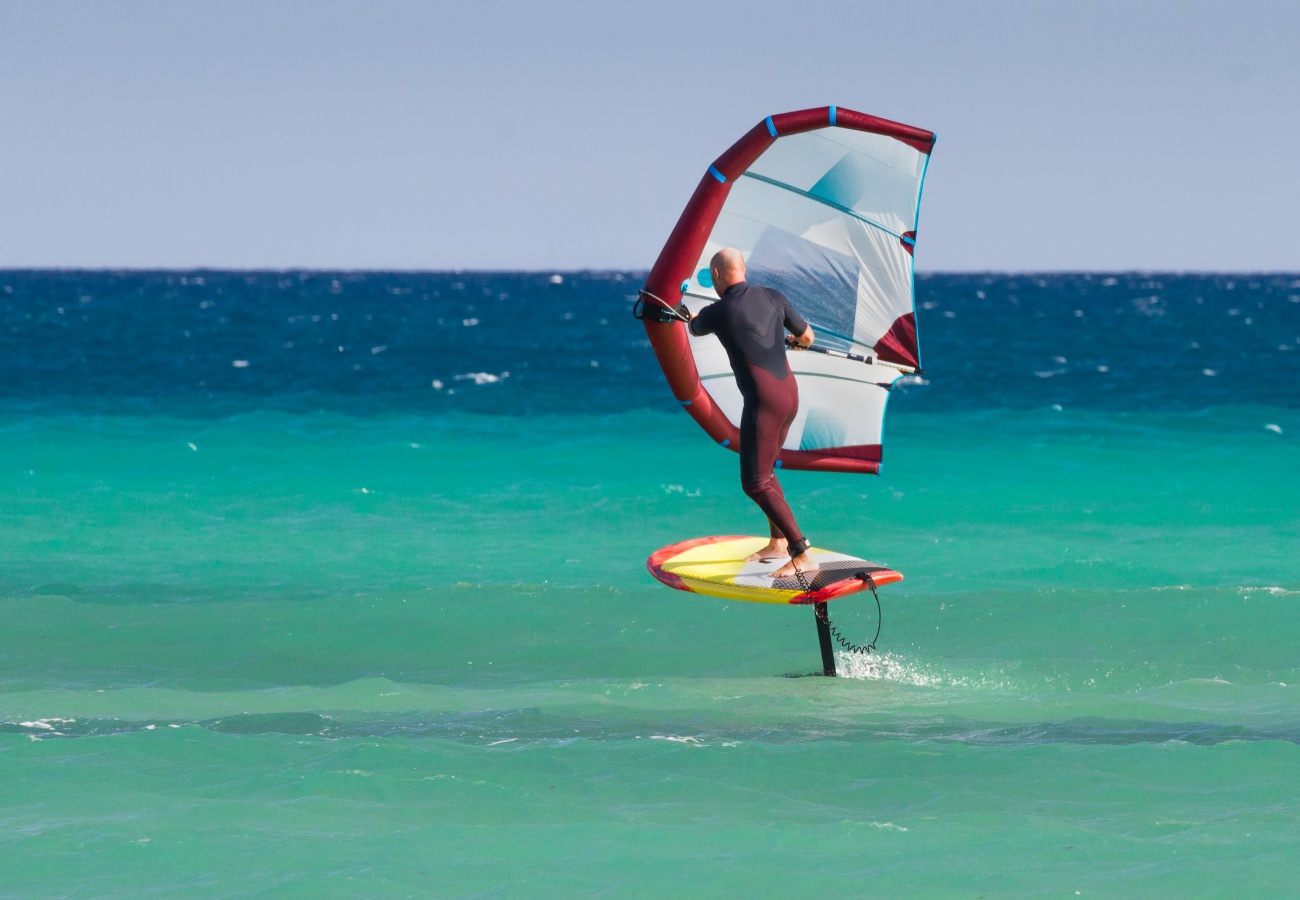
Elite is a general watersports school, and the eFoil is only part of what it teaches. Its location page also lists wing foiling, kiteboarding and kite foiling, wakeboarding and wake foiling. Wing foil and hydrofoil lessons meet at the Skyway Bridge in St. Petersburg.
The towed hydrofoil lesson runs behind a jet ski or a boat, jet ski first, and assumes you have been pulled on skis or a wakeboard before. Elite lists it at $110.00/hr (list price, Elite Watersports, read 24 October 2026). That is a towed foil price, not an eFoil price.
Wing and hydrofoil bookings come with their own cancellation terms. You cancel by phone only, 48 hours or more ahead, and the school does not accept a cancellation by text or email. Prepaid lesson time you do not finish moves to another day within 6 months.
An eFoil lesson lets you feel a hydrofoil lift under you with no wind and no tow rope to manage. A later wing lesson at the bridge then has one thing less to teach.