Why put an electric boat on foils?
The hard part of an electric boat has never been the motor. It is the water. Anything moving through it has to shove it aside and drag a wave system along, and the energy that goes into building those waves is gone for good. A displacement hull runs into a wall as it approaches hull speed, the point where its own wave swallows extra power without giving back much speed. A planing hull gets over that wall and then keeps paying for it in drag for as long as it stays up on the surface. With gasoline or diesel, the bill disappears into fuel that is cheap and energy-dense. An electric boat has no such cover. Every kilowatt-hour lost to drag comes straight out of your range, and the battery that would make up for it is heavy, expensive and finite.
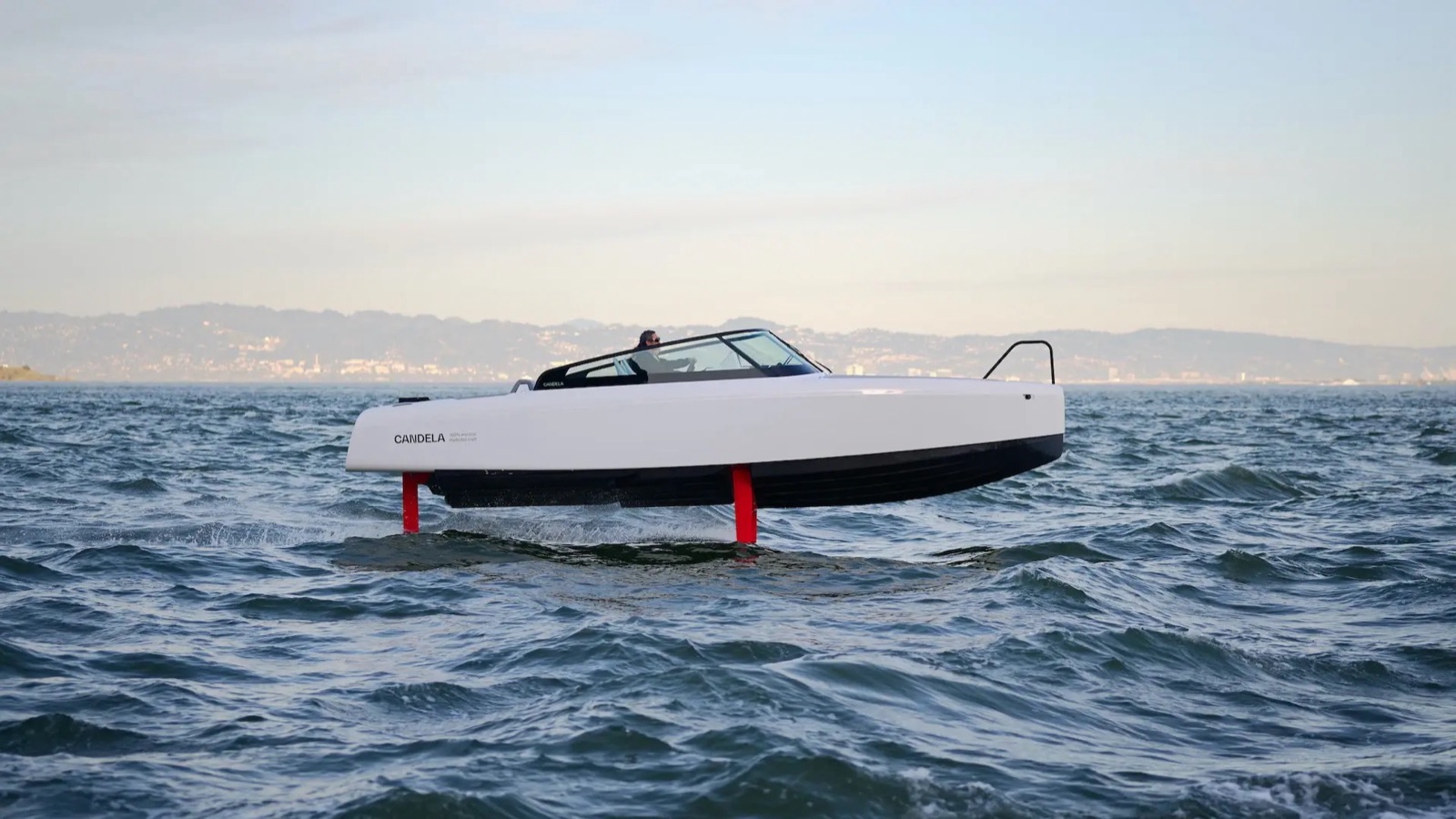
A hydrofoil goes after the problem at its source. Once the boat passes takeoff speed, the wings under the hull make enough lift to carry the whole boat. The hull rises clear, and the wetted area shrinks to the slim struts and the foils themselves. Drag falls away sharply, and the boat leaves far less of a wave behind it. Candela puts the saving at roughly 80% against a planing boat of its own size. Figures from real service come in lower, and they are still large. The Swedish Transport Administration’s official report on the P-12’s trial on a Stockholm commuter route, as Candela summarized it in February 2026, found 66% less energy use than conventional vessels and 94% less CO2 than diesel operation. An earlier count from Region Stockholm, published by Candela in April 2025, had put the saving at 84% per passenger-kilometer against the diesel vessels on that route. Navier, in California, quotes Forbes on its homepage crediting its hydrofoil with 90% less drag and running costs of 38 cents per nautical mile instead of $4.
Numbers like that change what an electric boat can be. You are no longer making a short hop with one eye on the state of charge. A single pack covers several times the distance, and at a real cruising speed. On inland lakes that restrict or ban combustion engines, going electric is the price of admission anyway; the foil decides whether it feels like a compromise or an upgrade. Premium buyers are also paying for the flight itself, which is quiet and free of vibration. The physics gets a fuller treatment on our page about hydrofoil boats, and the wider category lives under electric boats.
What changes once the hull leaves the water
Efficiency makes the headlines. Passengers notice something else first. Wave motion fades quickly with depth, so wings running a meter or so under the surface move through water far calmer than the chop on top, and the boat flies over short waves without slamming into them. There is no pounding, no sheet of spray and no engine noise, and you can hold a conversation at cruising speed. If a hard-riding planing boat makes you seasick, that difference alone can sell you on the whole concept.
The wake changes too. With almost no hull in the water, there is almost no wave to leave behind, and that matters more than it sounds. Wake unsettles swimmers, rocks moored boats and chews at shorelines; it is the reason so many harbors, canals and lake shores impose speed limits. A flying hull is a good neighbor in those places almost by default. It still has to obey the limits, like everything else on the water, but it is the rare powerboat that is not the problem they were written for.
Know the drawbacks too, before you fall in love with the idea. Below takeoff speed the boat is an ordinary hull. It maneuvers and docks like one, so harbor handling holds no surprises. Because the wings hang below the hull, shallow water, sandbars, weed, floating debris and standard launch ramps all become things you have to plan around. Retractable foils are the answer to that, and the ENVGO NV1, the Vessev VS-9 and the Candela C-8 can all raise theirs. Nor do the foils balance themselves. Sensors and a flight computer trim them constantly, up to fifty times a second on the Navier N30.
Hydrofoils themselves are an old idea. What arrived recently is cheap sensing, fast actuators and control software good enough to keep the flight steady and uneventful, which is exactly what you want on board.
Foiling does not buy you a legal shortcut. In the eyes of the authorities a boat like the Candela C-8 is a powerboat with its length, power and passenger count, and the licensing, registration and right-of-way rules tied to those numbers apply unchanged. The details differ enormously. Rules vary by country and often by individual lake or stretch of coast. In some places the thresholds that trigger a license are set nationally, in others state by state, and individual inland waters add their own emissions or access conditions on top. Find out what applies on the water where you intend to keep the boat before you sign anything, not after.
This overview is editorial background, not legal advice. Confirm the current requirements for your country and your home water before you cast off.
The 2026 field: who builds flying electric boats?
By 2026 the category has moved well past one-off prototypes. Boats from two builders have carried paying passengers, Candela’s in public transport and Vessev’s on sightseeing trips and charters. A Norwegian operator has ordered twenty P-12s, which Candela calls the world’s largest electric fleet to date. The builders below run in order of how much they matter, with the ones that dropped out, changed course or never went electric at the end.
Candela (Sweden): the one the others follow
Stockholm-based Candela is the builder the rest of the field gets compared with. It builds the C-8 daycruiser (8.5 m, a 69 kWh Polestar battery, 57 nautical miles or about 105 km at cruising speed) and the P-12 electric foiling ferry, which carries 30 passengers on 378 kWh for 40 nautical miles at a 25 knot service speed. Candela’s model pages give the P-12 only that service speed, but its FAQ puts the top speed at 30 knots, and its record release of February 2026 says the boat has exceeded 30 knots in trials (both read on 5 October 2026).
Momentum picked up in 2026. In April the Norwegian transport operator Boreal ordered 20 P-12s, by Candela’s count the world’s largest electric fleet to date. The lineup also grew, adding the P-12 Business for 20 guests and, in June, the P-12 Voyager, a luxury variant for 12 passengers. The P-12 Nova ran a daily timetable on Stockholm’s Route 89 from May 2025 and moved to an archipelago route in 2026. In February 2026 a P-12 covered 160 nautical miles from Gothenburg to Oslo over three days, with charging stops along the way, a trip Candela calls the longest ever made by an electric passenger ship. Candela’s plans also reach well beyond Scandinavia. Candela’s funding release of March 2026 counts a fleet of ten P-12s for Mumbai, which it says will cut the trip from Navi Mumbai Airport to the city center from around two hours to 35 minutes. The yard has also sold P-12s to operators in the Maldives and Berlin, and it names Thailand among its next markets.
Vessev VS-9 (New Zealand): the other one carrying passengers
The VS-9, from Auckland builder Vessev, is 8.95 m long, carries 10 guests on 105 kWh and cruises at 25 knots. Maritime New Zealand has certified it for commercial use, and since January 2025 it has carried paying passengers in the Fullers360 fleet, on sightseeing trips and charters that Vessev bills as the world’s first electric hydrofoiling tourism experience. Fully loaded, the battery is good for about 40 nautical miles (74 km). A leisure version, the VS-9 Skye, followed at the end of 2025. The first European boat was sold to a resort in Northern Ireland.
Navier N30 (USA): the Silicon Valley boat
California-based Navier builds the N30 at 30 feet (9.1 meters), with room for 9 people and a choice of an 86 or 114 kWh battery. On one charge it covers 70 nautical miles (around 130 km) at 20 knots, one of the best figures in the class. Its canard layout puts one foil forward to set pitch and ride height and two aft to steer, and the flight control software updates their aileron flaps up to fifty times a second. Navier handed over its first boat in October 2024. It sells through direct contact, not a price list. In June 2026 Navier and JIH Global Investment announced a partnership to deploy up to 100 Navier boats as water taxis in the Maldives, starting with five N30s.
Artemis Technologies EF-24 (UK): the heavyweight
Belfast-based Artemis Technologies works at the industrial end of the scale. The EF-24 Passenger is a 150-seat electric foiling ferry with a 34-knot cruising speed, up to 70 nautical miles of flying range and a full charge in under an hour. The first three vessels reached Belfast in January 2026 for fit-out and sea trials, one each for routes between Belfast and Bangor, from Kirkwall in Orkney, and between Southampton and Cowes. Artemis has also unveiled the EF-12 Pilot, which it calls the world’s first fully electric hydrofoil pilot boat. That one is a working vessel, not a passenger design.
Tyde x BMW (Germany): the luxury experiment
Tyde, based on Lake Starnberg in southern Germany, builds The Open together with BMW: a 14.7-meter open foiler with around 400 kWh of batteries, two 100 kW electric motors, a 25-knot cruise, 50 nautical miles of range and a solar roof. Tyde quotes an 80% energy saving, the figure Candela gives as well. The company is active and runs a configurator, but we found no public confirmation of customer handovers, so treat this one with some caution.
ENVGO NV1 (Canada): the newcomer
The NV1, built in Canada by ENVGO, is the sportiest boat in the group: 25 feet (about 7.6 meters), 6 people, 80 kWh and a top speed of 43 knots (about 80 km/h, roughly 50 mph), with retractable foils and DC fast charging. In June 2025 the company closed a US$2 million seed round, as BetaKit reported, and the boat flies at demonstrations, but we found no published record of series deliveries to customers.
Out, pivoted, or never electric
Some builders that once looked promising have since dropped out, changed direction or never built an electric boat at all. The Dutch company Edorado now leads with hydrofoil systems for maritime operators and an announced defense line. It still offers its fully electric 8S, but only as a limited-production yacht tender, and says just two or three will leave its workshop each year. France’s SEAir develops foil technology, but we found no battery-electric boat in its range. Its leisure tenders are sold on fuel savings, and its defense platforms drive electric pods from a diesel-electric hybrid plant. Since its 2019 update the Enata Foiler has used a 740 hp hydrostatic propulsion system, so it flies, just not electrically. Sweden’s Mantaray offers an interesting alternative in foils that regulate themselves mechanically. Its current M25, however, is optimized for standard gasoline engines, though an electric version of the earlier M24 was announced in 2023.
Electric foiling boats compared
Swipe sideways to see all columns
| Model | Country | Length | Passengers | Battery | Range | Top speed |
|---|---|---|---|---|---|---|
| Candela C-8 | Sweden | 8.5 m | 6 people | 69 kWh | 57 nm (about 105 km) | 27 knots (about 50 km/h) |
| Candela P-12 Shuttle | Sweden | 12 m | 30 people | 378 kWh | 40 nm (about 74 km) | 30 knots (about 56 km/h) per Candela's FAQ; 25 knots service speed (about 46 km/h) |
| Vessev VS-9 | New Zealand | 8.95 m | 10 people | 105 kWh | 40-50 nm (74-93 km) | 30 knots (about 56 km/h) |
| Navier N30 | USA | 9.1 m | 9 people | 86 / 114 kWh | 70 nm (about 130 km) | 30 knots (about 56 km/h) |
| Artemis EF-24 | United Kingdom | 24 m | 150 people | not published | up to 70 nm (about 130 km) | 36 knots (about 67 km/h) |
| Tyde The Open | Germany | 14.7 m | 8 people | about 400 kWh | 50 nm (about 93 km) | 30 knots (about 56 km/h) |
| ENVGO NV1 | Canada | 7.6 m | 6 people | 80 kWh | about 54 nm (100 km) | 43 knots (about 80 km/h) |
Buying one: availability, charging and what comes next
Getting hold of one is easier than most people assume, and still nothing like walking into a dealership. The first boats are out there. Candela has customer deliveries running on several continents, Vessev put a leisure version of the VS-9 on the market at the end of 2025, and Navier sells through direct contact with the yard. Nearly all of it happens through individual quotes, not published price lists, so budgeting turns into a conversation with the builder. Bring up service and spares early in that conversation. A flight control system is not something every boatyard has worked on.
The practical question is charging. Shore power is the norm at marinas, usually through a 16 or 32 amp connection, and what that socket delivers decides whether one night is enough. Candela quotes 6.5 hours to fill a C-8 at 11 kW AC, and about 12 hours for the smaller 42 kWh pack of its older C-7 on a standard 3.3 kW shore supply. The P-12’s 378 kWh pack, by contrast, is built for DC charging at up to 300 kW. DC fast charging for boats remains rare outside the commercial berths built for scheduled services and a few public networks, such as the Aqua SuperPower stations in Sweden that Candela used on its run to Oslo. In most places, then, the half-hour top-up a C-8 is capable of stays theoretical. For long days on the water, check how much power your home berth can actually deliver before you buy the boat, not after the first flat battery.
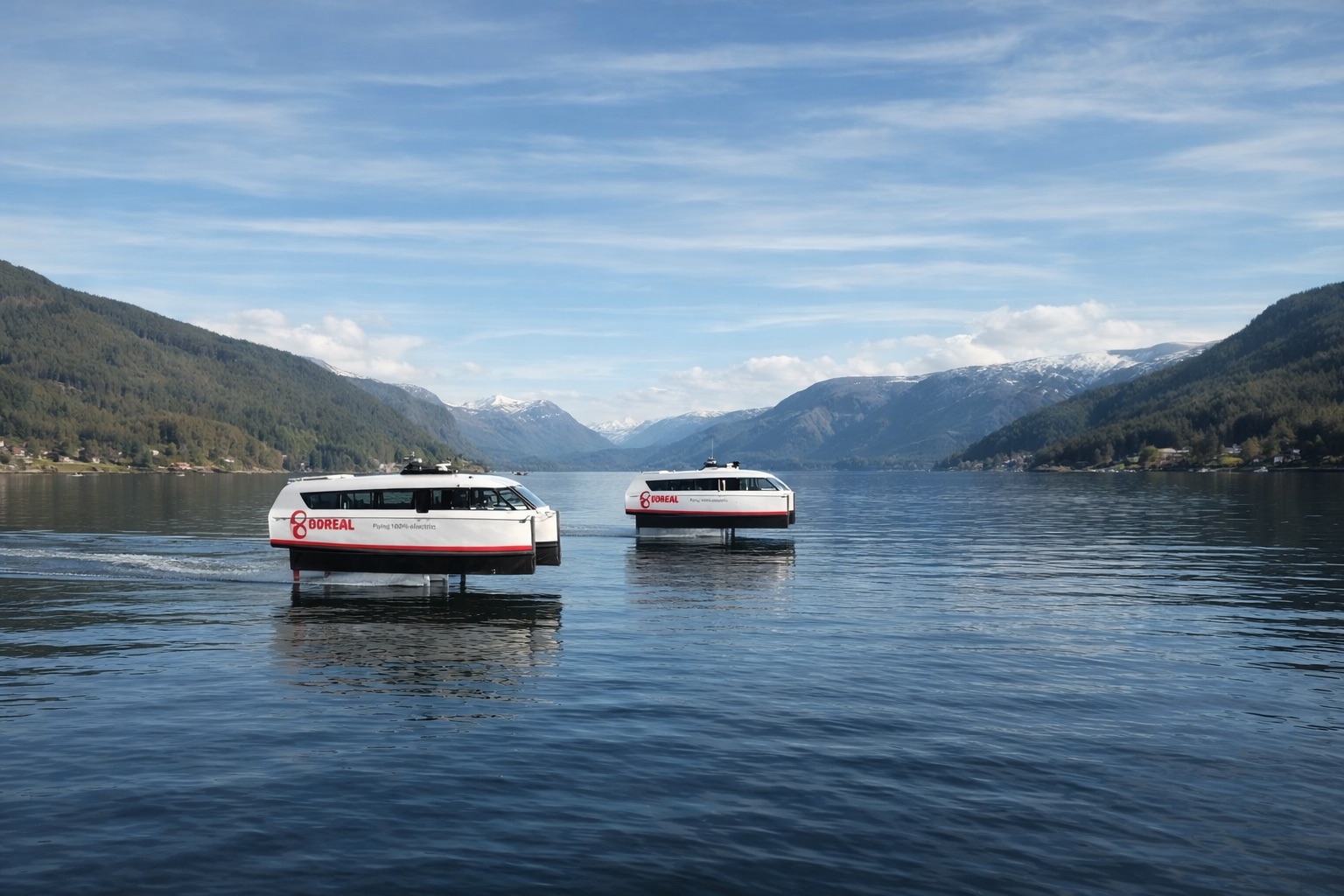
Public transport is the bigger story. A Norwegian operator has ordered twenty flying ferries, and the official report on the P-12’s Stockholm trial found the commute cut from 55 minutes to about 30, with lower operating and maintenance costs than the diesel ferries that serve that line. Artemis delivered three 150-seat foiling ferries to Belfast in January 2026 for routes around Belfast, the Orkney Islands and Southampton, and Auckland has been carrying sightseeing passengers on a Vessev since early 2025. The ferry routes among them are short crossings, which is the distance these boats are built for. Almost everywhere else, crossings like these are still run on diesel.
For private owners the timeline depends less on the boats than on the dock. Sheltered inland lakes and calm coastal bays come close to ideal terrain for this technology. Distances are short, the water is flat, and wake matters to everyone else out there. Many of those waters already restrict combustion engines, so the boats running on them are electric already. They just do not fly yet.