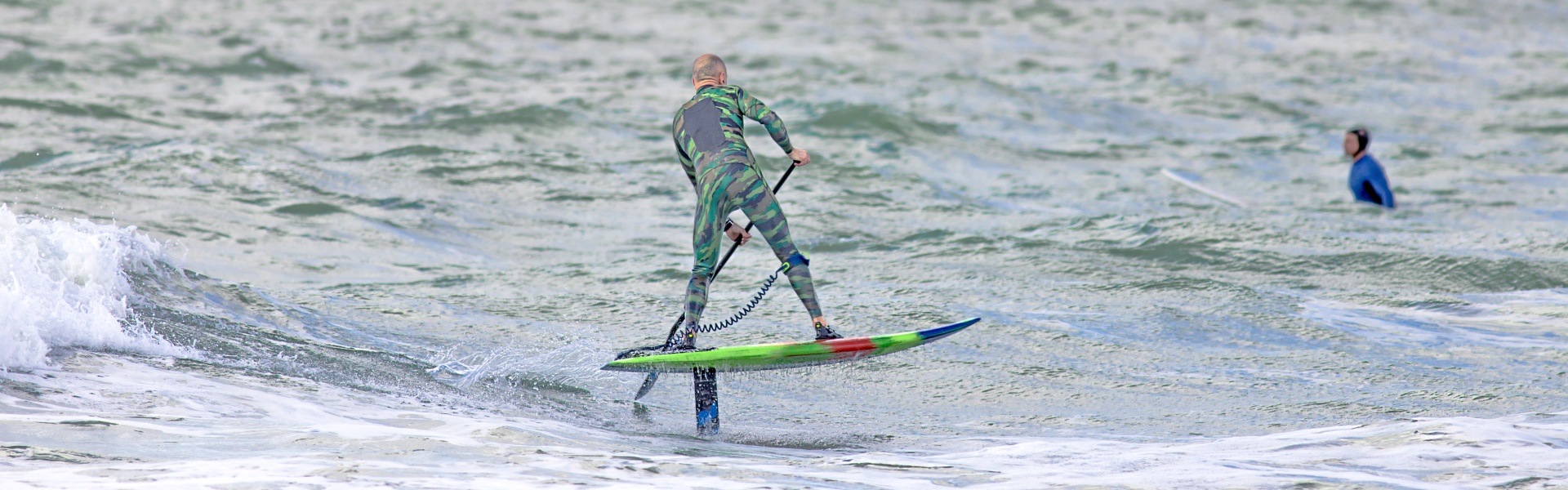
What is a SUP foil?
A SUP foil is a stand-up paddle board with hydrofoil technology underneath. As you pick up speed, a wing mounted under the board takes more and more of your weight, until the hull lifts clear and you glide above the surface instead of pushing through it. You may know the principle from kitefoiling or windfoiling. What changes here is where the power comes from. There is no kite and no sail here, only your paddle and whatever push a wave or a tow gives you.
The big gain is a huge drop in drag. With the board flying, only the mast and the wing still cut through the water, and the surface stops braking you. You can keep moving on swell far too small to ride on a normal SUP, and a short stretch of coast turns into a much longer ride. The speed and the feeling of hovering are worth the learning curve on their own.
The extra speed alone turns paddling into a completely different sport.
Unless you are a strong paddler on a big front wing, you need a wave, a swell bump or a boat to tow you before the foil will carry you. The wave gives you the first push. The front wing builds lift, and the board rises out of the water. After that, your balance and your paddle rhythm keep the flight going.
Every foil discipline rides on one set of hardware under your feet: a mast, a fuselage, a front wing and a rear stabilizer. Lift comes from the front wing, which also sets the character of the ride. Behind it, the stabilizer keeps the nose from pitching up or down uncontrollably. The mast decides how much clearance you have between the board and the water, and the fuselage sets how quickly the whole thing responds when you move your feet. For the physics behind all of it, our hydrofoil guide goes through these parts in more detail.
Somewhere after the first few sessions, riders usually discover what makes the sport addictive: pumping. You drive the board up and down with your legs while the foil is flying, which feeds energy back into the wing and holds the flight between waves. Pump well enough and you can link one bump to the next. That is the basis of downwind SUP foiling, where a rider follows open-water swell, sometimes covering kilometers in a single run, without the board touching the water.
The right spot, the right waves
For your early sessions, look for small, slow waves that roll in long and soft, with a break point you can clearly see. The more predictable the wave, the easier you will find it to time your take-off. A steep, fast-breaking one gives you a fraction of a second to get it right. Nobody learns on that.
Your body weight and the front wing you ride decide which wave size suits you. Heavier riders need more push behind them before the foil can build enough lift. A wave that lifts a light rider may not lift a heavier one on an identical wing, so the heavier rider has to go to either a bigger front wing or a bigger wave.
You want water at least 100 to 120 cm deep, and deeper still on a long mast, or the foil will end up hitting the bottom. Most masts are half a meter to a full meter long, and falls call for a generous margin on top of that. Currents change both your stability and the line you end up taking, so keep an eye on them. A crosswind makes balancing harder. A light tailwind, on the other hand, helps you get up onto the foil.
Before you paddle out, look at the bottom. A sandy one is far kinder to a carbon wing than reef or rock is, so while you are still crashing regularly, pick a beach break over a shallow reef pass. The crowd matters as well. A foil in a busy lineup is a hazard to everyone in it, and an empty corner is the better place to be, even if the waves there are less inviting.
Four ways to get the board flying
Every SUP foil session comes down to one problem: finding the speed that switches the wing on. There are four common answers, and they suit very different riders.
- Catch a small wave the way you would on a normal SUP. It is the classic route, and most beginners take it because the wave hands you the acceleration for free.
- Take a tow behind a boat or a jet ski at a gentle pace. Towing pulls the two skills apart, so you learn how the foil behaves in the air without having to read a wave at the same moment. Many riders find their first stable flight this way.
- Ride downwind swell in open water. You paddle onto a moving bump, get up on foil, then pump to reach the next one. This is the most rewarding form of SUP foiling and the most demanding one, because it takes fitness, a reliable pump and confidence a long way from shore.
- Paddle up on flat water with a big front wing. Here you have neither a wave nor a tow, only short explosive strokes until the board lifts. Strong paddlers manage it; most people leave it until later.
Build up in stages, whatever the route. Spend the first sessions on your knees and learn what the foil does before you have to stand on it. Next come short flights of a second or two, and you land the board on purpose instead of waiting for it to throw you. Long flights come from stringing short ones together. Hanging on for longer each time will not get you there.
Two failure modes tend to show up early. Lean back too far and the board climbs until the wing breaks the surface, loses its grip and drops you. That is ventilation, and the cure is less weight on your back foot. Rock between nose-up and nose-down and you get porpoising, which usually means your corrections are late and too big. Both go away with smaller weight shifts, made earlier.
Choosing the right gear
Put the board into the water upside down, with the foil pointing up, and wade out until you have at least 120 cm under you. Only flip it there. The wing then never scrapes the bottom, and it stays in one piece. Keep watching the depth through the session, especially if you drift toward a sandbar.
The baseline safety gear for SUP foiling is a leash, a helmet, booties and a flotation vest, and you should not go out without it. Never practice close to other people. Foil wings are sharp and heavy, and colliding with one can cause serious injuries.
The first real compromise comes with wing size. A large front wing makes getting up onto foil much easier and costs you top speed. A smaller wing is faster and looser, but the take-off is harder and balancing takes more work. Most people learn faster on more wing area than they think they need, and size down later.
Board length works much the same way. A longer board sits more steadily and picks up waves more easily, but it turns lazily. Width and thickness affect how stable the board feels, and a narrower board accelerates and responds more quickly. Then there is volume. A board with plenty of it lets you stand and paddle comfortably before you are moving, which matters enormously in the early sessions. Low-volume boards are built for riders who already know how to paddle up.
Mast length shapes the feel more than most people expect. A short mast keeps you closer to the surface. That is forgiving when the water is shallow and when the waves are small. A longer mast gives you room to ride higher and to survive chop and open-water swell without touching down. Aluminum masts cost less and take abuse well. Carbon masts are stiffer and lighter, and that stiffness shows up as more precise control over the board.
Match your setup to your skill level and your body weight rather than to the model a good rider is on. If you would like a motor to help, a foil assist takes care of the take-off, where most of the difficulty lies, and most systems fit the board you already ride. Once the board is flying, most riders carry on gliding and pumping without power. An electric SUP goes further and can hand the propulsion over to its motor entirely, with the paddle still on board as your backup.
Looking after the foil, and where you can ride
A foil is a set of precision surfaces bolted to a metal structure that spends its life in water. Rinse everything with fresh water after every session, and after a salt-water ride, never skip that step. Let the foil dry before it goes back in the bag. Now and then, take the mast off the board instead of leaving it assembled for a whole season.
Check the screws before you paddle out. Stainless fasteners sitting in an aluminum mast will seize over time through galvanic corrosion. Use a suitable anti-seize compound and undo the connections occasionally instead of waiting for a bolt to round off in a parking lot. When a foil starts to feel vague underfoot, a loose fuselage bolt is one of the common reasons.
In transit, the wings need protecting. Their leading and trailing edges are thin, and a chip in either one costs you real performance on the water and can turn into a delamination later. Wing covers cost little next to the price of a new front wing, and a foil left to rattle around loose in a car trunk usually picks up damage on the way.
Where you are allowed to ride has no single answer. Rules differ by country and often by individual lake or stretch of coastline, and some places treat foils differently from paddle boards. Check the local regulations for your spot before you go. The unwritten rules matter just as much: swimmers, surfers and other paddlers all deserve a wide berth from something with a sharpened wing under it.
Frequently asked questions
What is a SUP foil?
A stand-up paddle board with a hydrofoil mounted under the hull. Get it up to enough speed and the wing beneath produces enough lift to raise the hull clear of the surface, so you paddle on while flying above the water.
Do you need waves to SUP foil?
Not always, but something has to give you the initial speed. Usually that is a small wave or an open-water swell bump, though a tow from a boat or jet ski does the job as well. Strong riders on large front wings can paddle up onto foil on flat water, which is the hardest way to start.
Is SUP foiling hard to learn?
Harder than eFoiling. With no motor pushing you along, the speed comes from your paddle and the flight height from your body weight alone. Most riders spend their first sessions kneeling or on very short flights, and only then stand up and stay up.
How deep does the water need to be for SUP foiling?
At least 100 to 120 cm, and more on a long mast. Plan for more water than your mast is long, with a margin for falls added on top. Go shallower and the mast or the wing can touch the bottom, which can damage the foil and throw you off the board without warning.
What size front wing should a beginner pick?
A large one. More wing area gives you more lift at low speed, so you get flying earlier and the ride feels calmer. You give up some top speed, which is a good trade while you are learning.
What safety gear do you need for SUP foiling?
A leash, a helmet, an impact or flotation vest, and booties. Foil wings and their trailing edges are sharp. Keep your distance from other people on the water, and never practice inside a crowded lineup.