The Frauscher story
Frauscher is an Austrian boatyard that builds today in Ohlsdorf near Gmunden, and for generations the name has stood for a particular kind of quiet lakeside luxury. The timeline is what sets it apart from almost every other premium yard. Frauscher has been building electric boats since 1955, decades before electric propulsion became fashionable on the water. Today the yard builds premium day boats and sport boats, and the lineup keeps growing.
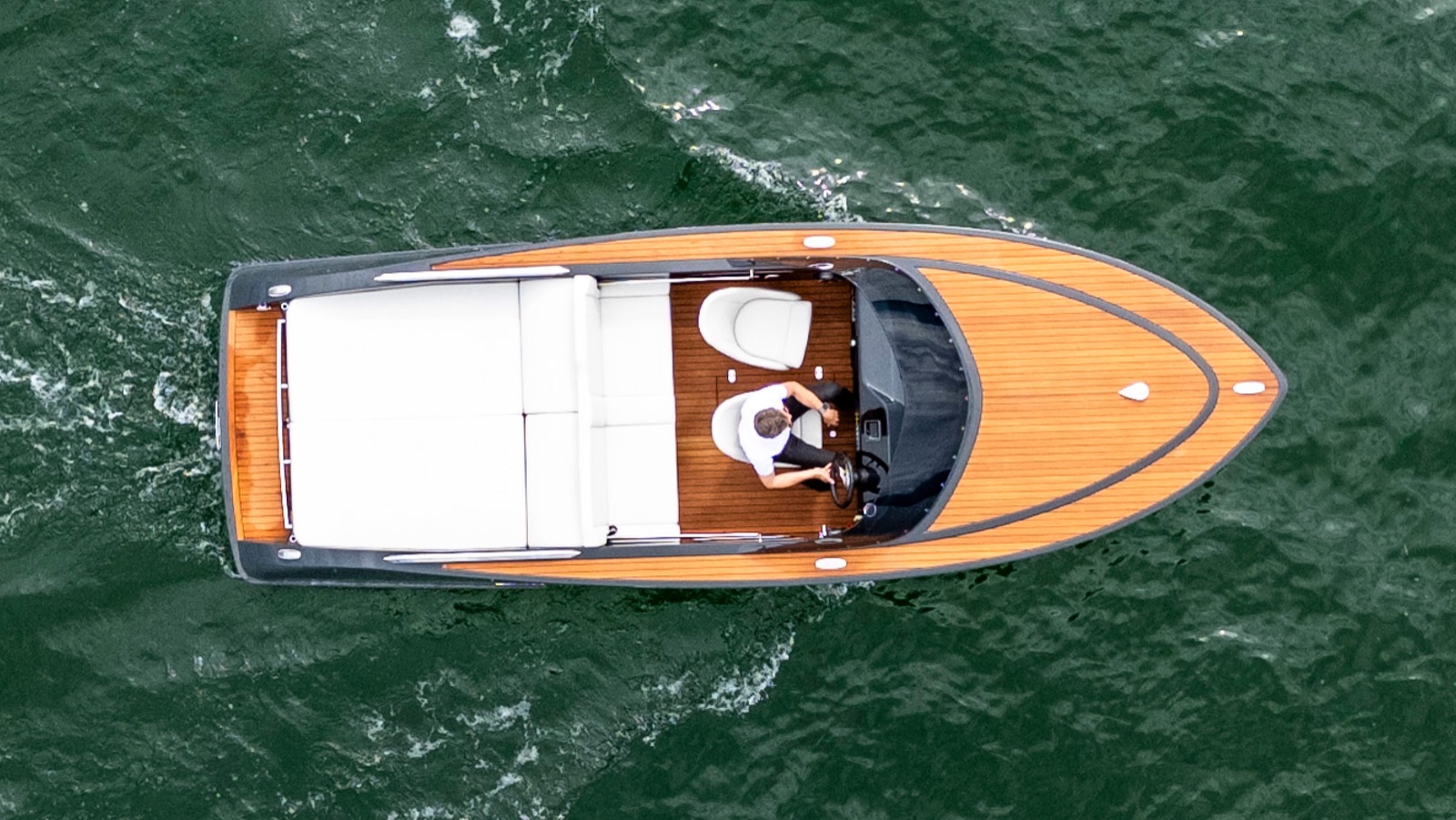
A day boat, if the term is new to you, is built for hours on the water rather than for nights aboard. It is open or mostly open, seats a group, has a swim platform and offers no real accommodation below. You take it out after work or for an afternoon, and in the evening it goes back to its usual berth. Electric propulsion suits that pattern well. A day boat rarely needs the range of a cruiser, and it spends its time in the very places where engine noise is least welcome.
On the Austrian lakes where the company grew up, combustion engines are restricted in many places. That constraint shaped the product long before it became a selling point. The kind of boating it produced travels well: short outings, an anchor stop for a swim in deep water, then an unhurried run back in the evening light with family or friends. Plenty of lakes and sheltered bays elsewhere work like that.
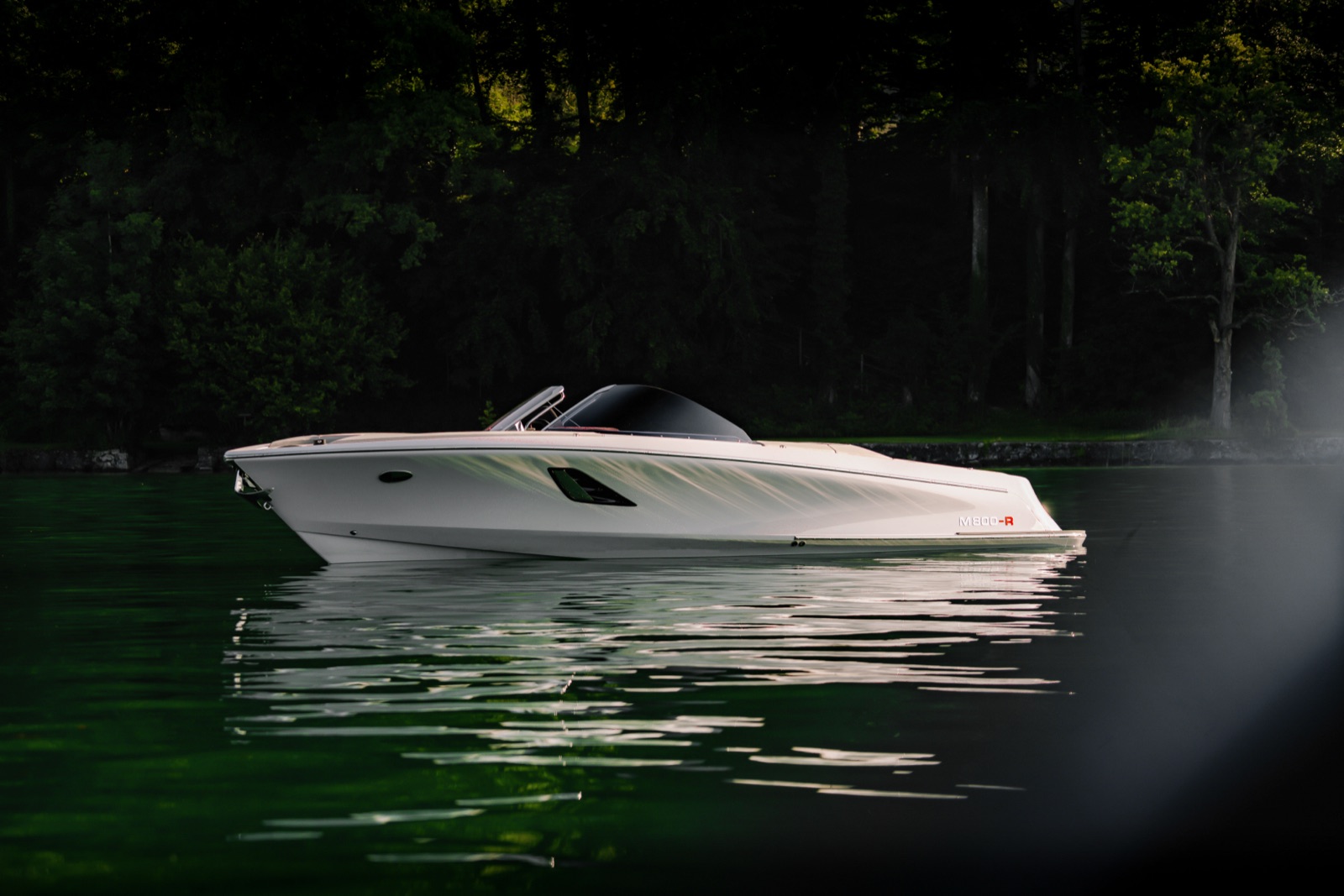
For the clearest measure of the name's standing, look at the car industry. Porsche developed its electric sports boats together with Frauscher, and the Frauscher x Porsche name now covers the 850 Fantom, the 850 Fantom Air and the 790 Spectre. ABT Sportsline went a similar way with Marian, another Austrian yard, and that partnership produced the M 800-R.
That long history carries real weight. Still, not every electric Frauscher began life on paper as an electric boat. Porsche says the 850 Fantom Air is based on the 858 Fantom Air, a day cruiser Frauscher sells with a MerCruiser V8, and keeps its 8.67 m hull almost unchanged on the outside. Frauscher's own timeline introduces the electric 740 Mirage in 2014 together with the 747 Mirage motorboat, and both are 7.47 m long. The 790 Spectre is different. Frauscher says it was engineered from the ground up around the Porsche electric drive, on a newly developed lightweight hull. A boat drawn that way has its hull, weight distribution and drivetrain matched to one another instead of an electric system pushed into a design laid out around a combustion engine. Underway you hear the water and the wind rather than a motor, and on a premium day boat that quiet is much of the appeal.
For a buyer, continuity matters. A brand that has been on the market for decades and keeps broadening its range is more likely than a newcomer to still have a service network, a parts supply and a working resale market ten years from now. At this price level, that weighs heavily in the decision.
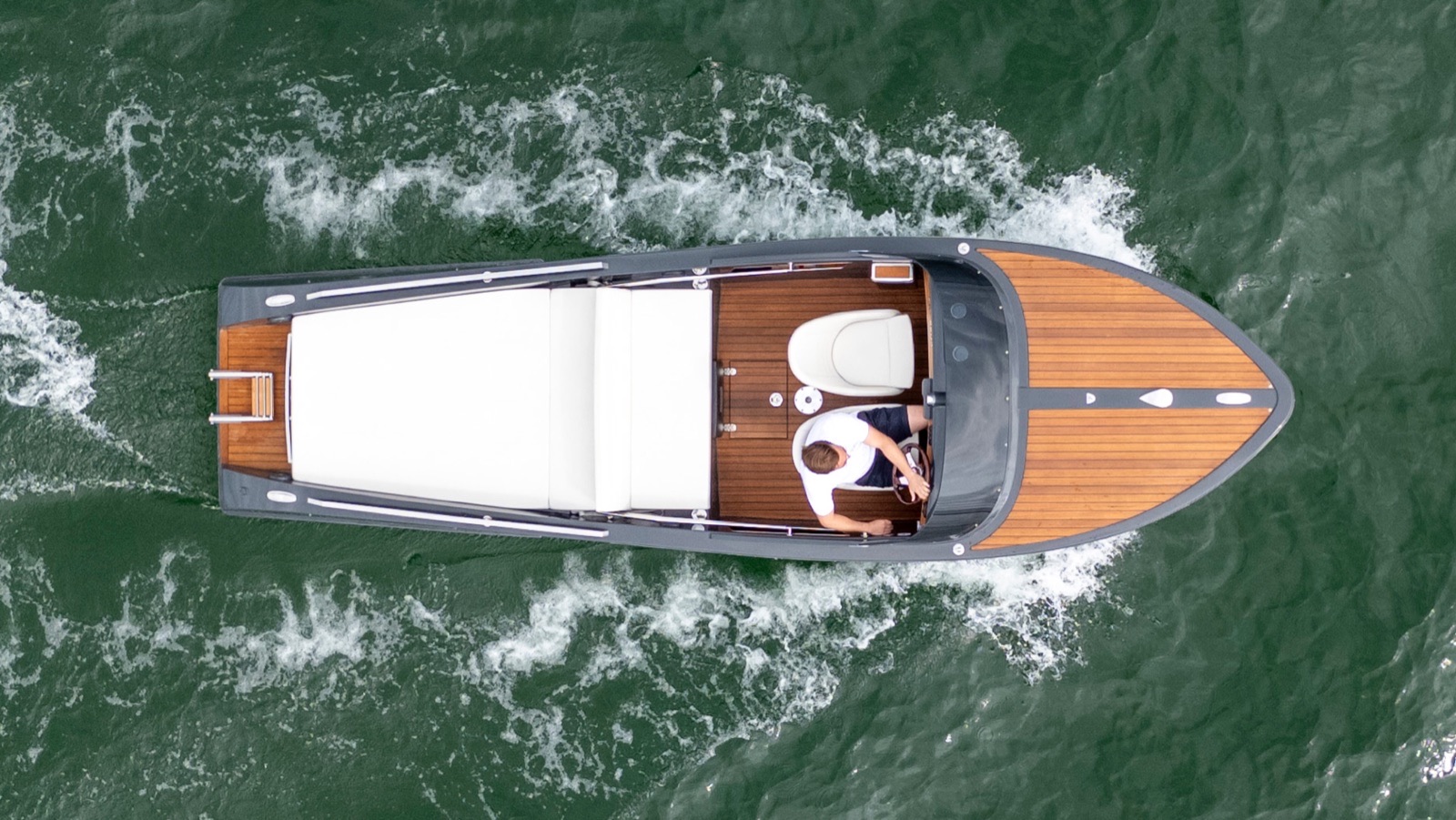
Frauscher in action
The yard's own photos and the complete lineup are at frauscherboats.com ↗
Models
On the electric side of the catalog, three boats matter most. The 650 Alassio is a classic, elegant lake day boat, and its model page prints no price (checked 12 September 2026). The electric range does not start there, because the compact 610 San Remo sits below it. Of these three, though, it is the least showy, and for a lot of buyers that is the appeal.
The 740 Mirage Air is the sporting side of the brand. Instead of a single value, Frauscher publishes a ladder for it: motor output from 50 to 137 kW and a battery of 48 to 63 kWh, per the model page read on 12 September 2026, and no price. That page names no drivetrain supplier, and so we do not name one. The configuration you order sets the boat's character. The bottom rung gives you 50 kW and 48 kWh. That is where the Alassio's own ladder (4.3 to 50 kW, 12 to 48 kWh) tops out, but here it moves a boat that starts at 2,000 kg against 950 kg for the Alassio. The top rung brings 137 kW and 63 kWh and keeps the open, center-console layout. Frauscher's range table on that page, read on 5 October 2026, gives the base version a top speed of 33 km/h and the strongest one 55 km/h, or 45 km/h on its 90 kW of continuous power. Acceleration is not on the page for either version.
At the top sit the Frauscher x Porsche 850 Fantom and Fantom Air. They run the drivetrain from the Porsche Macan EV: 400 kW of peak output (around 540 hp), 170 kW continuous and a 100 kWh battery, as frauscherxporsche.com lists them (read on 12 September 2026). The peak is for a burst. Over an hour at a steady speed, the continuous figure is the one that counts. Frauscher does not publish a price for these boats either. Porsche's launch releases put the Fantom Air First Edition from €561,700 net on 8 October 2023 and the Fantom from €572,934 net on 9 December 2024. Those are launch figures for two different versions, not a list price you could order from today. Using a production automotive powertrain was a deliberate choice. The battery, the rear-axle motor of the Macan Turbo and the control electronics arrive at the yard as pre-assembled modules, adapted for the water by a manufacturer that builds the underlying parts for the production Macan. That is a very different engineering problem from assembling a marine drivetrain from scratch.
Side by side, the three form a clear ladder: the 650 Alassio as the calm, elegant entry, the 740 Mirage Air as the sporting middle and the 850 Fantom as technology flagship and status symbol. The catalog does not stop there. The 790 Spectre, built with Porsche and shown for the first time in January 2026, measures 7.92 m and carries the same 170 kW continuous and 400 kW peak on 100 kWh, good for 95 km/h and 45 km at cruising speed by the maker’s figures. In July 2026 it set a new speed record at the Monaco Energy Boat Challenge, averaging 51.05 knots against the 49.84 knots the 850 Fantom had managed there in 2025. The 610 San Remo, which Frauscher calls the smallest model in its electric range, is one more electric day boat in the family. The 1414 Demon Air is not part of it; it belongs to the motorboat range and runs two 480 HP Volvo Penta D6 engines. Specification and availability change often. Treat the table below as a starting point, and check the current details with a dealer.
Swipe sideways to see all columns
| 650 Alassio | 740 Mirage Air (electric) | 850 Fantom / Fantom Air | |
|---|---|---|---|
| Character | Elegant electric day boat | Sporting luxury boat | Frauscher x Porsche flagship |
| Drivetrain | Electric | Electric, 50 to 137 kW and 48 to 63 kWh (the maker's ladder) | Porsche Macan EV drivetrain, 400 kW peak, 170 kW continuous, 100 kWh |
| Guide price | not published | not published | not published by Frauscher; Porsche launch releases: from €561,700 net (Fantom Air, October 2023), from €572,934 net (Fantom, December 2024) |
Which model fits you
“Electric day boat” is a catch-all phrase, and behind it sit three characters and three kinds of owner. Leave the price aside for a moment. Start with how, and with whom, you will spend your time on the water.
- If your family's season is built around swim stops, sunset cruises and a comfortable, unhurried pace, the straightforward 650 Alassio is the closest match. The more compact 610 San Remo is the one model below it in the electric range, and for many buyers the Alassio is where the search ends.
- Sporting performance is the next step up. If acceleration and handling matter to you as well, the 740 Mirage Air is the sportier route, with up to 137 kW in its strongest configuration, and the premium comfort stays fully intact on the way.
- For prestige and technology, when the brand experience and the engineering are the point, look to the top of the range. That is where the Frauscher x Porsche 850 Fantom sits, with its Macan EV drivetrain.
Taste is only part of the choice. What counts is how many people usually come along, how long your outings run and where the boat will live. A short afternoon of swimming asks for a different size than all-day touring. Berth dimensions settle more of this than buyers expect. Before you commit to a length, measure the slip, the approach and the height of any bridge on the way out.
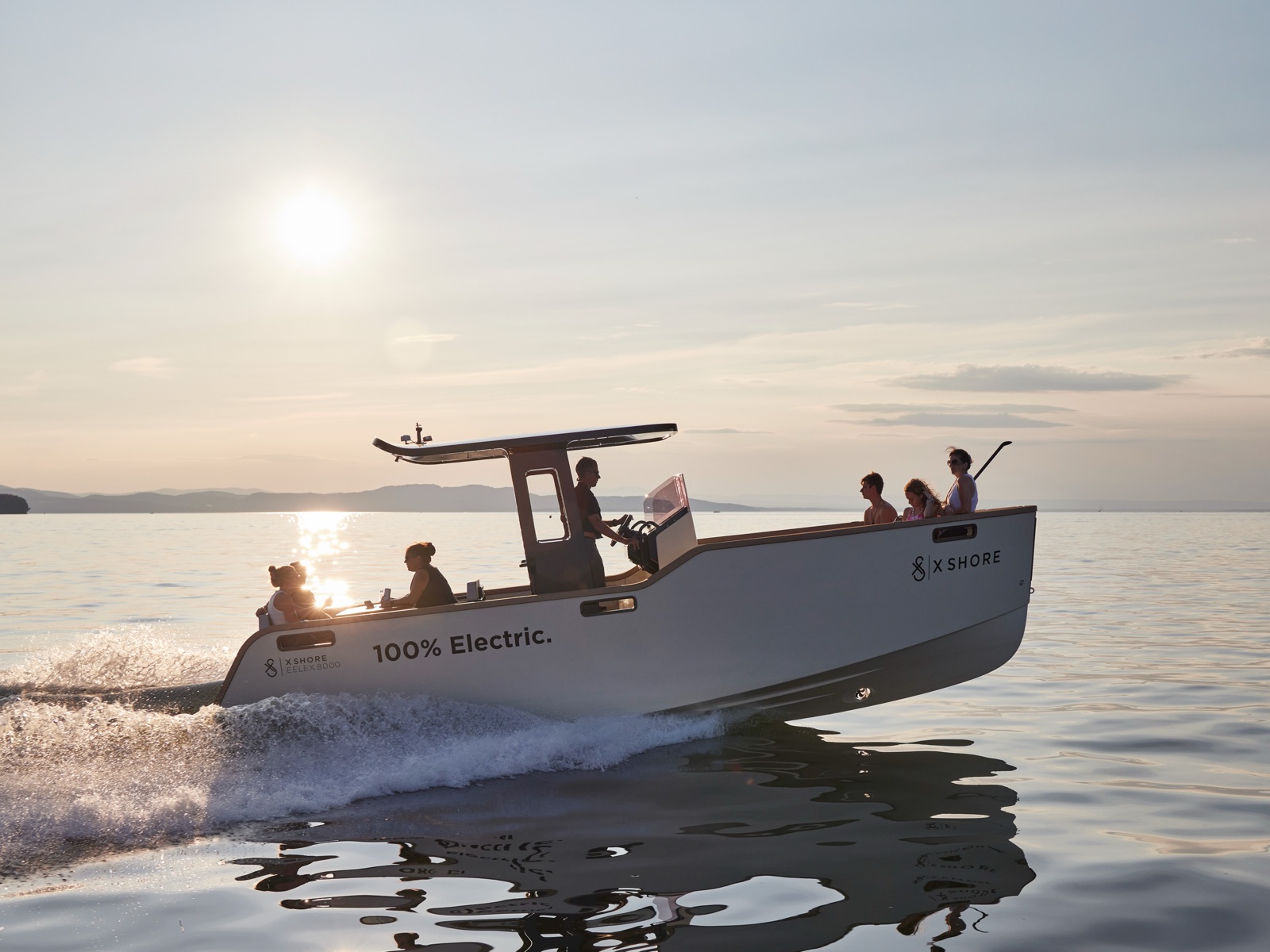
Think about trailering while you are at it. A boat you can put on a trailer opens up several bodies of water in a season. One that lives permanently in a marina gives you a simpler life but ties you to one place. When you compare brands, put the other premium electric yards on the list too, among them Sweden’s X Shore and Marian from Austria.
Charging and day-to-day ownership
Range and charging are the two things that shape daily life with an electric boat. Range is not a fixed number. Speed and the way you drive move it a long way, and a charge lasts far longer at a calm displacement pace than at sustained full throttle on the plane. An electric car shows a similar gap between city traffic and highway cruising. Ask the dealer for realistic figures for the model you want and the way you intend to use it.
Charging is easiest when the boat lives where the power is. Plugged in at the berth, most configurations fill overnight if the pedestal can feed the charger on board. Frauscher lists 9 kW charging for the 48 kWh Mirage Air and 6.6 kW AC for the 63 kWh version, and Porsche gives up to 11 kW AC for the 100 kWh Fantom. The slow case is a 48 kWh Alassio on its standard 3 kW charger, which needs about 16 hours from empty unless you order the 9 kW fast charging pack. Once that is settled, charging stops being something you have to plan around. Shore power is standard in a growing number of marinas, and dedicated marine charge points are spreading. Confirm in advance that your marina has enough available capacity at your berth for a boat in this class. An old pedestal sized for a fridge and a kettle will not do the job.
Electric propulsion is less work. No oil changes, no elaborate end-of-season engine routine, far fewer moving parts to wear. What needs your attention instead is battery care and a sensible winter layup, with a stable state of charge, a dry boat and a place where the pack is not sitting through hard freezes. Your dealer and yard can give you guidance that fits the specific model. Follow it, because that is what protects the largest single component in the boat.
Running costs look different from a gasoline boat's, but they do not vanish. Electricity is cheaper per hour than fuel in most places, and there is less scheduled work. Berthing, storage, hull cleaning, antifouling where you need it and insurance are unchanged by the drivetrain, and on a premium boat those are the line items that add up across a season.
Where a Frauscher fits
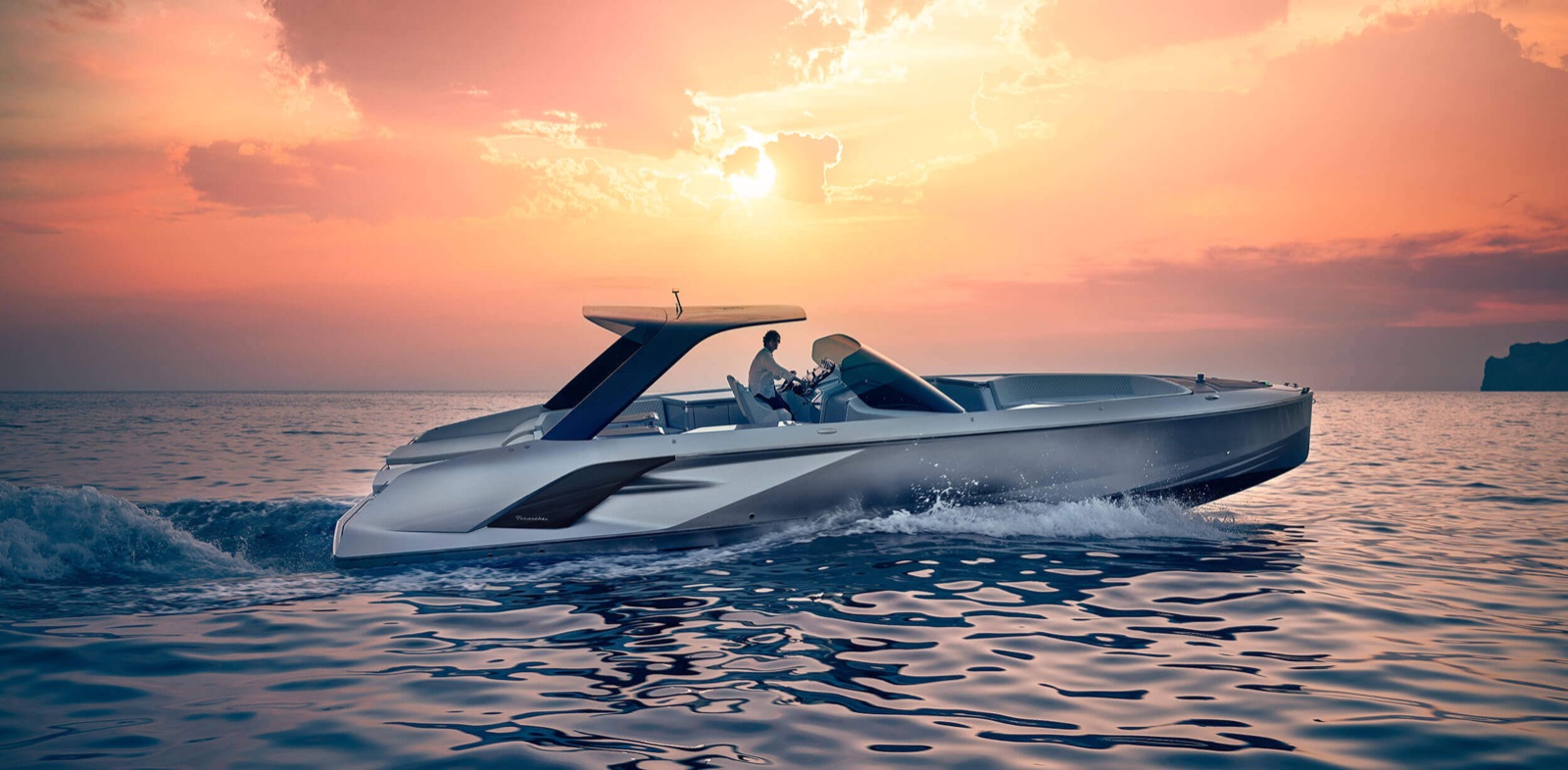
You can see in the proportions that these boats were designed for lake work. Their size, character and intended use carry over almost directly to inland lakes, reservoirs, wide rivers and sheltered coastal bays anywhere in the world. Regulation helps. A great many lakes restrict or ban combustion engines while allowing pure electric propulsion, so on that water an electric boat can be the only powered option there is. Our electric boat guide covers the wider market. On water like that, a premium electric day boat is simply the natural fit for the conditions.
Licensing is where the spread of power across the range starts to matter. Frauscher lists 4.3 to 15 kW for the 610 San Remo and 4.3 to 50 kW for the 650 Alassio, against 400 kW peak on the Porsche boats. So the configuration you order, as well as where you boat, decides if you cross the threshold where some kind of formal powerboat qualification is required. Requirements differ by country and often by individual lake or stretch of coastline, covering registration, insurance minimums, speed limits, no-wake zones and how close you may run to swimmers. They also change. Before your first outing, check the current rules for the water you plan to use. What you read here is general guidance, not legal advice.
On a lake, a Frauscher is completely in its element. You slip quietly past the swimming bays, anchor for a jump into the water and idle back to the harbor as the evening comes in. The yard has spent decades building boats for exactly that.
To see the boats close to where they are made, go to the Frauscher Marina in Gmunden on Lake Traun in Austria. It keeps an indoor showroom and test boats for the electric range, while the yard itself builds them away from the lake in Ohlsdorf, near Gmunden. Several major European airports are within reach of the area, and it makes a good stop if you are traveling in the region. Closer to home, dealers handle viewings and demos. Contacts and appointments run through the official site.
What to settle before you buy
A decision of this size starts on the water, not at the price tag. Go through these points before you commit to a model:
- Take a sea trial. In this class you decide on the water, and no spec sheet can do that for you. Go out in conditions close to the ones you normally boat in, get the boat up to speed and try the docking maneuvers you will do every weekend. The manufacturer and its dealers arrange the appointments.
- Match the model to your boating life. How many people come along, how long you stay out and where the boat lives all matter here as they did in “Which model fits you”, and of the three, berth dimensions are the one buyers most often check too late.
- Budget past the quoted price. Options, taxes, delivery, berthing, charging, winter storage and insurance all land on top, and they vary by model and by harbor. In some markets, import duties and registration fees add another meaningful layer.
- Check the service and dealer network. A reachable representative with a workshop in your region counts for a great deal on a premium boat. Ask who handles battery and drivetrain work, how quickly they respond in season and how warranty claims are processed where you are.
- Ask about the battery in writing. Warranty length, retained-capacity terms, what a replacement costs and who is certified to fit one. On an electric boat, few items on the order form matter more than these answers.
Compare widely before you sign. Frauscher is one of the defining names in premium electric day boats, but it is not the only one. For the wider market picture, start with our electric boat guide, and our article on hydrofoil boats explains the “flying” ride feel you get when a hull lifts clear of the water altogether.