Lake Travis, Lake Austin and Lady Bird Lake, from upstream down
Three dams stack Austin's lakes one after the other. Lake Travis lies above Mansfield Dam, one of the Highland Lakes on the Colorado River that the Lower Colorado River Authority (LCRA) covers with its own land and water regulations. Below Mansfield Dam the river becomes Lake Austin, which the city code defines as the water impounded by Tom Miller Dam within city limits. Below Tom Miller Dam comes Lady Bird Lake, held back by Longhorn Dam and still called Town Lake in the code, because the name only changed in 2007.
Only the upper two carry eFoils. Electric Surf Co, the Fliteboard school in town, teaches on Lake Austin and on Lake Travis. Lady Bird Lake is left to paddle craft: the city keeps nearly every motor off it and bans swimming in it, and we found nobody offering eFoil sessions there.
LCRA calls Lake Austin a pass-through lake, generally run within a small range of levels except in a flood. Lake Travis is a different kind of water, a supply reservoir built to rise and fall and to hold floodwater in its flood pool. We read that as docks and launch points on Lake Austin changing little through most of the year, floods and the occasional drawdown aside, while ramps and shorelines on Lake Travis follow the lake level up and down.
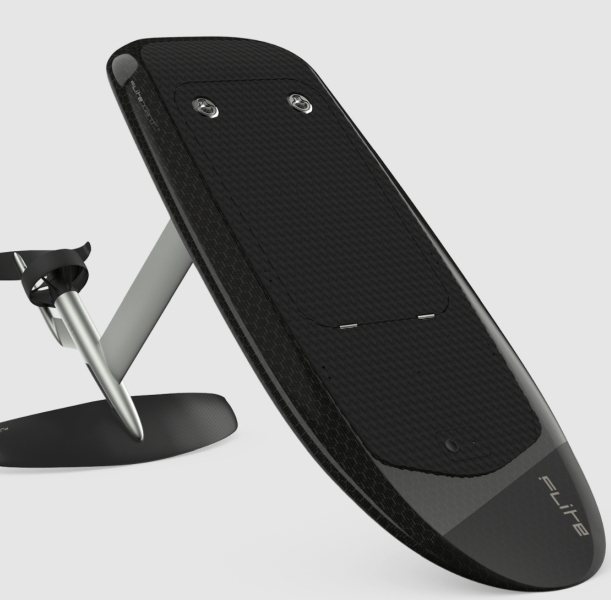
Jurisdiction follows the dams too. The City of Austin has jurisdiction over recreation on Lake Austin and Lady Bird Lake, LCRA regulations cover Lake Travis, and state law sits over all three. How the board itself works, from battery to mast, is in our guide to the eFoil.

An hour on a Fliteboard with Electric Surf Co
Electric Surf Co is an official Fliteschool location. Its guided lesson goes by the name Fliteboard eFoil Experience and lists at $299 per booking, the price we read in October 2026.
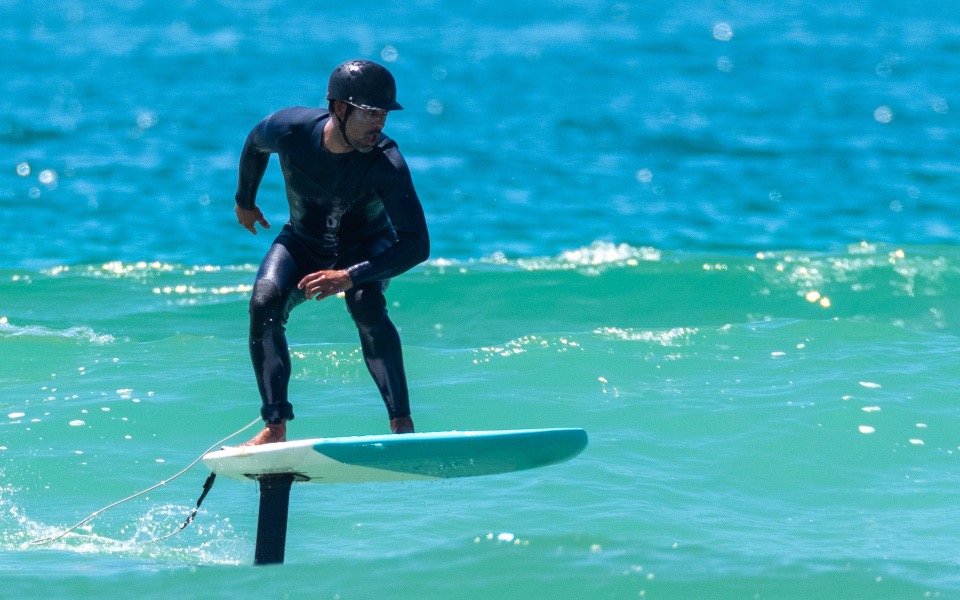
The session starts on land. Staff fit you with a life vest and a helmet, then give a lesson and a safety briefing on the dock. After that you get a full 60 minutes of riding time on the lake. A guide stays in your ear over a wireless headset and talks you from lying prone to kneeling, from kneeling to standing, and finally up onto the foil for the first flight.
For Lake Austin, Fliteboard gives the lesson location as 2215 Westlake Dr #106, Austin, TX 78746, with bookings by appointment. That street address is Lake Austin Marina's, a marina near Tom Miller Dam on the west shore with 168 covered slips and a ship store that sells fuel. We take that to mean the Lake Austin lessons start from this marina. For Lake Travis, confirm the meeting point when you book.
You have to be able to swim. The age limit depends on which page you open. Fliteboard's Austin page sets the minimum at 13, with minors accompanied by an adult, while Electric Surf's own page says solo lessons are for ages 18 and up. Our advice for anyone under 18 is to plan on an adult coming along and to settle the details when you book.
Bring swimwear, a towel and sunscreen. Vest and helmet are part of the booking.
The shop is at 2300 South Lamar Blvd, Suite 108, in South Austin, about 2 miles from downtown. Besides eFoils it stocks used eFoils, foil boards, e-bikes and Onewheels. Lessons run on Fliteboards, and the brand's models and battery options are on our Fliteboard page, and if a lesson leaves you shopping, the used eFoil guide explains what to check on a secondhand board.
Rentals, jetboards and group bookings in Austin
Fliteboard's listing for Electric Surf Co goes well past the single lesson. It names private lessons for up to 3 riders, gift vouchers, corporate and event sessions for up to 10 people, Flitescooter rental, and Fliteboard rental for pre-approved experienced riders, dockside or by the day. Riders who arrive with their own Fliteboard can rent a Flitecell, the brand's battery.
Electric Surf's rental page puts 2 hours dockside at $169 and 24 hours with pickup at the store at $399. Nobody walks in off the street and takes a board out. Rentals go only to pre-approved customers who have had a lesson with the company, or to experienced riders who own equipment themselves.
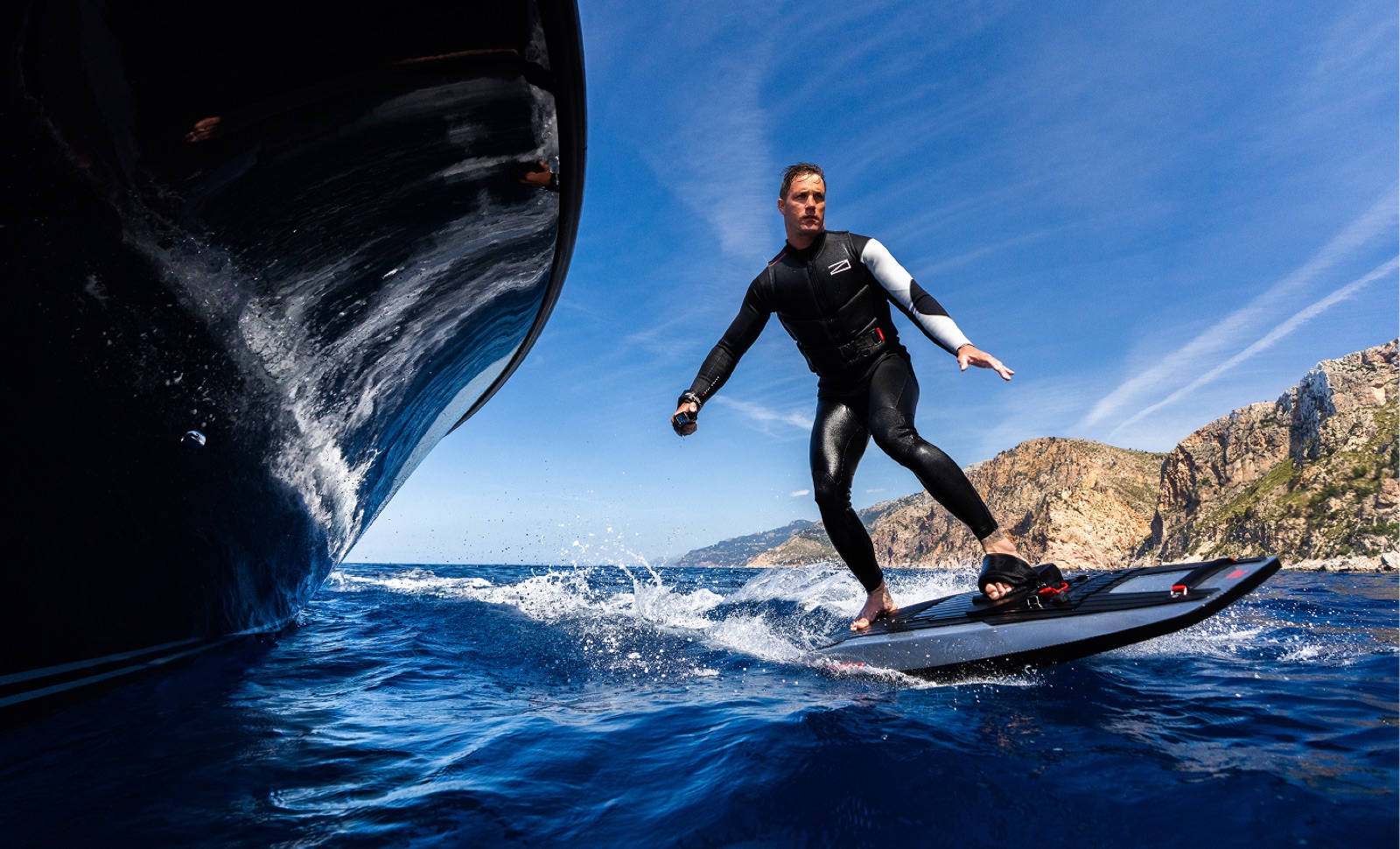
The shop also rents a Radinn jetboard, a motorized surfboard with no foil under it, and runs guided experiences on both eFoils and jetboards. Our electric surfboard guide sets the two side by side. The Texas boater education course classes both as personal watercraft.
On a guided lesson you ride the school's registered board. We read that as putting registration, boater education and the personal watercraft rules mainly on owners and on renters riding by themselves.
Swipe sideways to see all columns
| Offer | Where | What it includes | Price |
|---|---|---|---|
| Fliteboard eFoil Experience | Lake Austin or Lake Travis | Vest and helmet fitting, dock briefing, 60 minutes of riding | $299 per booking |
| eFoil rental, dockside | At the dock | 2 hours, pre-approved riders only | $169 |
| eFoil rental, store pickup | 2300 South Lamar Blvd | 24 hours, pre-approved riders only | $399 |
Texas law: an eFoil counts as a personal watercraft
Section 31.003 of the Texas Parks and Wildlife Code supplies the definitions. A vessel is any watercraft used or capable of being used for transportation on water. A motorboat is any vessel propelled or designed to be propelled by machinery, and a personal watercraft (subsection 14) is a motorboat designed to be operated by a person sitting, standing or kneeling on it, not inside it. A motor drives an eFoil and its rider stands on it, so as we read it the board fits that last definition.
The Texas boater education course material says so outright. It classes a mechanically propelled personal hydrofoil and a motorized surfboard as a PWC, to be registered and ridden under the PWC operating and life jacket rules. A foil with no motor is a vessel too, but it needs no state registration.
TPWD wants every motorized vessel on Texas public water registered, whatever its length, and that includes craft that only sit docked or moored.
Section 31.106 is the personal watercraft section, added in 1989 and last amended in 2011 by H.B. 1395. Its subsection (a) forbids operating a PWC
- unless every rider wears a USCG approved Type I, II, III or V life jacket (PFD)
- with the manufacturer's lanyard cutoff unattached
- between sunset and sunrise
- within 50 feet (about 15 meters) of any other vessel, person, platform, object or shore, except at headway speed
- by jumping another vessel's wake recklessly or unnecessarily close
- where state law or a local rule bans motorboats, under (a)(6)
The 50 foot rule does not apply on water less than 100 feet wide, under subsection (c). An operator under 13 needs a supervisor on board who is at least 18 and allowed to operate the craft, under (a)(5). TPWD adds that motorboats and personal watercraft must have an engine cut-off switch.
On top of registration comes boater education. TPWD requires a course for anyone born on or after September 1, 1993who operates a personal watercraft, a motorboat over 15 horsepower or a sailboat over 14 feet, taken online or in a classroom. Under Section 31.109(b) that rider carries a photo ID and either a TPWD boater identification card or proof of meeting the requirements for a USCG vessel operator's license. The card does not expire.
We found nothing in the statutes or on TPWD's pages that says whether a guide's supervision on a lesson meets that rule, so ask the school. Florida has its own rule set, and the Miami page covers it. This section is our summary of the statutes and TPWD pages as they stood in October 2026, not legal advice.
Austin City Code on Lake Austin and Lady Bird Lake
Chapter 8-5 of the Austin City Code adds the local layer, and the Austin Police Department's Lake Patrol enforces it on the three public lakes in the city: Walter E. Long, Lady Bird and Lake Austin. Section 8-5-1 counts a watercraft with an electric motor as a motorboat, and we take that to put a battery driven eFoil under the chapter's motorboat rules.
The holiday ban on Lake Austin
Section 8-5-81(A) bars anyone from using or even possessing a jet ski, wet bike, motorized surfboard or similar device on Lake Austin in three windows:
- sunset on the Friday before Memorial Day to sunrise on the Tuesday after
- sunset on the Friday before Labor Day to sunrise on the Tuesday after
- sunset on July 3 to sunrise on July 5
Lake Patrol applies the ban to personal watercraft, wet bikes, motorized surfboards and similar devices “designed to be operated by a person sitting, standing, or kneeling on the vessel”, and on Lake Austin only. We read an eFoil as a motorized surfboard or similar device under 8-5-81, which takes those three holiday windows off the Lake Austin calendar. Lake Travis is outside this city rule.
The rest of the year, motorboats keep to the right side of Lake Austin (8-5-81(B)), and no watercraft goes faster than is reasonable and prudent under the circumstances (8-5-81(C)). Buoys mark navigation control zones under 8-5-2(A). Among them are slow no wake zones, where your wake must not curl or break, and areas signed NO PROP BOATS, KEEP OUT or NO SKIING, with the zone map on file with the city clerk. All of Bee Creek and Bull Creek is a NO WAKE zone.
Lake Patrol notes that Lake Austin has no curfew. For a personal watercraft the state ban on riding between sunset and sunrise still applies, so our reading is that an eFoil session ends at sunset whatever the city permits. Lake Patrol also wants registration kept current, and a board registered in another state needs that registration in full force.
Floods close the water outright. Under 8-5-21 the fire chief may ban boating on all or part of a lake, river or creek when flooding is happening or likely. A posted ban runs out no later than the fifth day and can be issued again while the floods last. On July 7, 2025 the city extended such a ban over Lake Austin from Mansfield Dam to Tom Miller Dam and over Lady Bird Lake, naming motorized surfboards.
Why Lady Bird Lake is off the eFoil map
Section 8-5-82(C) keeps motorboats and houseboats off Town Lake, today's Lady Bird Lake, with a handful of exceptions: city duty, events the council authorizes, and boats other than houseboats with an electric motor of no more than five horsepowerbetween 5:00 a.m. and 10:00 p.m. From 10:00 p.m. to 5:00 a.m. nobody may occupy or operate a watercraft there (8-5-82(E)), and swimming in the lake is illegal. The city's own Lady Bird Lake page puts it more bluntly: no gas powered or electric motor vessel runs there without the city's permission.
Concessions such as Austin Rowing Club and Texas Rowing Center rent kayaks, canoes and SUPs, and the city lists its access points for paddling only. Every eFoil rider falls in sooner or later, and on a lake where swimming is illegal and motors stop at five horsepower, we see no practical way to run an eFoil lesson.
Lake Travis and the LCRA regulations
Above Mansfield Dam the LCRA Land and Water Use Regulations, effective April 1, 2022, take over. What they call LCRA Water covers the Highland Lakes on the Colorado River from Mansfield Dam upstream to Lake Buchanan, Lake Travis included, and their motorboat is any watercraft propelled or designed to be propelled by machinery.
The rule that shapes an eFoil session is section 20(e). Within 50 feet of the shoreline, structures, swimmers or restricted areas, motorboats go no faster than needed to keep steerageway and headway. Section 19 bans swimming within 50 feet of a public boat ramp. We read 20(e) and Section 31.106(a)(4) together as keeping an eFoil at headway speed inside that 50 foot band, so first flights happen further out.
No Highland Lake is kept at a constant level. Lake Travis was designed to fluctuate, and LCRA occasionally lowers the pass-through lakes for weed control and dock repairs. A ramp that met the water on one visit may not on the next, so we would confirm the meeting point before driving out.
Heat, rain and the good months in Austin
NOAA's 1991 to 2020 climate normals for Austin Camp Mabry put the July and August average highs at 96.6 and 97.8 °F (about 36 °C). May is the wettest month with 5.04 inches of rain, ahead of October at 3.91, June at 3.68 and September at 3.45. February (1.89) and July (1.96) are the driest.
January averages 62.5 °F by day (about 17 °C). Going by the table below, we would pick March to June and September to November as the comfortable eFoil months, and in July and August book the early morning slot. Winter air is mild, but it feels cool once you have fallen in a few times.
We have no water temperatures for these lakes, so ask the school what to wear outside summer.
Swipe sideways to see all columns
| Month | Average high | Average low |
|---|---|---|
| January | 62.5 °F | 41.8 °F |
| February | 66.5 °F | 45.8 °F |
| March | 73.3 °F | 52.2 °F |
| April | 80.3 °F | 58.9 °F |
| May | 86.9 °F | 66.8 °F |
| June | 93.2 °F | 72.9 °F |
| July | 96.6 °F | 75.0 °F |
| August | 97.8 °F | 75.1 °F |
| September | 91.4 °F | 70.1 °F |
| October | 82.5 °F | 60.8 °F |
| November | 71.5 °F | 50.5 °F |
| December | 63.9 °F | 43.4 °F |
Bringing your own eFoil: zebra mussels and papers
TPWD lists Lake Austin, Lady Bird Lake and Lake Travis among the 36 Texas lakes fully infested with zebra mussels. State rules require you to drain the water from boats and onboard receptacles when leaving or approaching public fresh water. For an owner we take that to mean rinsing and drying board, mast and foil between lakes and letting the water run out of board and bag before you leave the ramp.
For a visiting rider the paperwork is short: current registration, and a life jacket worn rather than packed. Anyone born on or after September 1, 1993 also carries a photo ID and the boater education card or its equivalent. If you fly in with a Fliteboard, Electric Surf Co rents Flitecell batteries, and our eFoil battery guide covers capacity and charging. What a board of your own costs is on our eFoil price page.