A river reach in the city, a marine park up the coast
Perth's eFoil scene is small and easy to map. One school teaches on the Swan River at South Perth, on the stretch of water between the foreshore and Elizabeth Quay, promising what it calls “stunning views of the city skyline.” A second operator rides from Pinnaroo Point at Hillarys, on the open coast north of the city inside the Marmion Marine Park. A third works further south in the South West, around Busselton, Dunsborough and Yallingup.
All three run Fliteboards, and so does every eFoil seller in Western Australia that we know of. The brand still signs its site as designed in Byron Bay, though it is now a division of Brunswick Corporation. Anyone meeting the board for the first time can start with our guide to how an eFoil works, which covers the basics, and the Australia overview lists the schools in the other states.
Perth's real difference is the paperwork. The Western Australian transport department names eFoils outright, and once a board's motor passes 4.5 kW the state counts it as a vessel, with registration numbers, a skipper's ticket and a daylight curfew attached. For a one off lesson that hardly matters. For anyone who buys a board, it decides how and when the board goes on the water.
Two words differ for visitors. Australians hire a board where Americans rent one, and they call a lifejacket a PFD.
The 4.5 kW line that turns a board into a boat
WA's Department of Transport and Major Infrastructure (DTMI) puts it in one line on its electric hydrofoil page ↗, last updated on 25 August 2025. An electric hydrofoil board with a motor of more than 4.5 kW (6 hp) is a vessel. It has to be registered, it must keep to speed limits and the collision rules, and whoever rides it needs a Recreational Skipper's Ticket, the RST.
The RST is the ticket anyone needs in WA to run a recreational vessel with a motor over 6 hp. It is a nationally recognised certificate of competency, you must be at least 14 to get one, and you carry it whenever you ride. Only the skipper needs it, which on an eFoil means only you. The assessment has a theory part and a practical part, a short boating trip that covers trip preparation and handling the vessel, and you have to pass the theory first. Visitors get a break. A skipper's ticket from another state or another country covers you for a stay of under three months, and after that WA wants its own.
At 4.5 kW or less the RST is not required, which is reason enough to make the motor rating the first number a WA buyer should look up. Take the figure from the maker and ask the seller to confirm it.
Other states draw lines too, so the 4.5 kW figure is not unique. New South Wales classes an eFoil as a personal watercraft with exemptions, registers boards from 4.0 kW as vessels and asks for a boat licence from 10 knots; our Sydney guide reads that order closely. Queensland has no eFoil specific rule. What sets Western Australia apart from the rest of the country is that it names eFoils above 4.5 kW as vessels outright and runs a dedicated exemption for them.
Exemption WAMA-2025-207904 and what it softens
A vessel in WA falls under the Navigable Waters Regulations 1958, and some of their general rules sit awkwardly on a board you stand on, which is the likeliest reason the exemption exists. So in August 2025 the department issued an exemption under section 115A of the Western Australian Marine Act 1982, instrument WAMA-2025-207904. It exempts electric hydrofoil boards above 4.5 kW from regulations 45B(7)(a)(i) to (iii), 50B(3) and 52A(2), revokes the earlier instrument WAMA-2024-206139 and stays in force until 1 August 2027 unless it is revoked sooner.
In return the exemption sets its own conditions, which the department repeats on its eFoil page. The registration number goes on the left and right sides of the board, above the waterline, in plain block digits at least 50 mm high and 12 mm wide. On a board whose background is not white, each digit needs a white border at least 7 mm wide. You ride only between sunrise and sunset. You wear a lifejacket of Level 50 or higher. The department itself notes that these requirements “differ slightly from those for other vessels as an exemption from the law has been granted.”
Plenty stays as it was. The Prevention of Collisions in State Waters Regulations 1983 still apply, and so do speed limits, the RST and the offshore rules on radios, distress signals and beacons. None of those is touched by the instrument.
Swipe sideways to see all columns
| When | What the department asks | Where it comes from |
|---|---|---|
| Always | Registration; speed limits; collision rules; RST for the rider | DTMI eFoil page |
| Every ride | Numbers on both sides, digits at least 50 mm high and 12 mm wide, a white border at least 7 mm wide on a board that is not white | Exemption WAMA-2025-207904; department eFoil page |
| Every ride | Sunrise to sunset only; lifejacket Level 50 or higher | Exemption WAMA-2025-207904 |
| Beyond 400 m from shore in unprotected waters | EPIRB or PLB (GPS enabled from 1 September 2028), plus at least 2 red and 2 orange hand held flares | Department eFoil page |
| Beyond 4 nautical miles | Marine radio | Department eFoil page |
One date sits further out. From 1 September 2028 an EPIRB or PLB must be GPS enabled, and 27 MHz radios are phased out by that day. If you are buying safety gear now, buy gear that still meets the rules after that date.
This is a summary of official texts. When it matters, the department's pages and the instrument itself decide.
Who needs a ticket for a lesson, and who for hire
Taken at its word, the guidance means a first timer booking a lesson does not need to sit an exam. The department's guidance on hire and drive craft, the boats you rent and skipper yourself, strongly recommends an RST for the driver of anything above 4.5 kW, then names the cases where the ticket is not necessary. One is a tour led by a suitably experienced and competent guide. Another is riding inside a well defined area in the owner's line of sight, with the area explained, rescue vessels or similar ready and a safety briefing on local hazards and how the craft handles and where its limits lie. On a river, where the rider is not always in sight, the owner also needs communication devices and a plan to call for help.
The South Perth lesson keeps to one stretch of the Swan River, and reviews on the school's own site describe the instructor following on a jet ski and calling out feedback. To us that looks like the guided and well defined area cases; ask the school about its permits when you book.
Hire is another question. No Perth operator offers unsupervised board hire on its own website, and every eFoil hire offer is a guided session. If a private owner or a future business does rent you a board above 4.5 kW to take out alone, you are the department's hire and drive case, and it strongly recommends you hold an RST. A visitor holding a ticket from another state or country needs no RST for a stay under three months.
The department's list for before any ride is short. Check weather and tide, make sure your safety gear is in date and working, and tell someone where you are going and when you will be back. For speed limits and activity zones it points riders to the free Deckee app.
Mill Point and the river school at South Perth
eFoil Australia runs its business under two web addresses, efoilwa.com and efoilaustralia.com, and describes itself as “an official Flite partner” on the South Perth foreshore and an authorised Fliteschool and Fliteboard partner. Flite's Australian school directory lists no school in Western Australia, so take that as the school's own description. The meeting point is the Miller Pool Carpark, Mill Point Close, South Perth WA 6151. Exact directions come with the booking, and the school promises easy access to parking.
A session lasts 1.5 hours on the Swan River “between the South Perth Foreshore and Elizabeth Quay,” which the school sells as “the most fun activity you can have on flat water.” You can arrive never having stood on a board, provided you can swim. The fleet is Fliteboard, with three boards “to suit different rider weights and needs.” Reviews on the site describe the order of things. A briefing on land comes first, then a larger inflatable board, then a smaller one, with the instructor following on a jet ski.
Riders must be 12 or older and weigh between 40 kg and 120 kg. Helmet, lifejacket, sunscreen and GoPro footage are included; a wetsuit costs $20 AUD extra. Whether a session goes ahead always comes down to the weather.
Swipe sideways to see all columns
| Session | Length | Price (AUD) |
|---|---|---|
| Flite Experience One on One (private) | 90 minutes | $229 |
| Flite Experience for Two | 90 minutes | $399 |
| Flite Experience for Three | 90 minutes | $549 |
The price per head falls with every rider you bring. Alone you pay $229, or $249 with the wetsuit. Two riders on the $399 session pay $199.50 each, $219.50 with two wetsuits, and three on the $549 session pay $183 each, $203 with wetsuits. The school lists the length of the session, 90 minutes, and not how long each rider spends on the board, so ask how a shared session is split before you choose it for the lower price. A first timer who wants as many attempts as possible is better served by the private session, where the instructor's whole 90 minutes goes to one rider.
Visitors staying in the city centre can leave the car behind. Transperth's ferry crosses the river from Elizabeth Quay Jetty to Mends St Jetty in South Perth. Check the walk from there to Mill Point Close against the directions the school sends with the booking.
A private rider who launches near Mill Point should know the river around it. Downstream of the Narrows Bridge, in South Perth, lies the designated PWC freestyling area, closed to every vessel except personal watercraft. It is the only place on the Swan and Canning where PWC freestyling is allowed, and the Narrows launching ramp is for PWCs alone. WA treats an eFoil above 4.5 kW as a vessel, so we would expect an owner to keep out of that area. The department's Swan Canning boating guide of November 2025 also marks a Perth high speed commercial water sports area on Perth Water, set aside for approved commercial activities, with 8 knots for everyone else. Open the guide for the boundaries before you ride your own board here.
On the Swan River
eFoil Australia
South Perth, Swan River, Australia
Miller Pool Carpark, Mill Point Cl, South Perth WA 6151
- Lesson: AU$229, 1 h 30 min
- Lesson: AU$399, 1 h 30 min, for 2 riders
- Lesson: AU$549, 1 h 30 min, for 3 riders
Updated November 2, 2026
Hillarys, Geographe Bay and the rest of the list
West Coast eFoil works from Pinnaroo Point Beach on John Wilkie Tarn, Hillarys, “just north of Hillarys Marina.” It offers private and group lessons and guided tours on Fliteboard in the Marmion Marine Park, with boards from beginner to elite setups and an inflatable Airboard it calls “a flying SUP.” Its pages publish no prices, so that is a question for the booking.
In the South West, eFoil Away calls itself the local authorised Fliteboard partner and teaches lessons “suitable for all skill levels” around Busselton, Dunsborough and Yallingup; a third party listing places them on Geographe Bay. Aqua Flights, part of Electro Nautic, sells guided sessions for riders with no eFoil experience but names no location, so confirm where you will ride.
King Wing Foil Centre, at Port Beach in North Fremantle and at Woodman Point, is a wing foil school. Its own site offers no eFoil lessons.
North of the city and down south
West Coast eFoil
Hillarys, Australia
Pinnaroo Point Beach, John Wilkie Tarn, Hillarys WA
eFoil Away
Busselton, Dunsborough, Yallingup, Australia
Updated November 2, 2026
Swan River flat water against the open coast
The school on the river calls its city reach flat water, and we think that is the easier start for a beginner. Hillarys rides the open coast inside a marine park. Both sit under one weather pattern. On hot days in summer and early autumn dry easterlies blow, and then, in almost every case according to the Bureau of Meteorology, the afternoon sea breeze locals call the Fremantle Doctor arrives from the southwest late in the afternoon and carries cooler air inland as far as the Darling Scarp. That breeze reaches the river and the coast alike, so a learner does well to take the earliest slot going.
Owners on the river should also know the 8 knot default. Unless signs say otherwise, it applies within 50 m of a river bank, a jetty, a moored vessel or a person in the water, within 15 m of a vessel underway, in water under 3 m deep, in mooring areas, under a bridge arch, and whenever the skipper is 14 to under 16.
Where a motorised board may not go on the rivers
Pupils at Mill Point never have to think about this, because the school picks the water. An owner launching a registered board does, and the document to open is the department's Swan Canning boating guide of November 2025. One of its notes closes all designated waters at Point Direction, Point Walter, Matilda Bay, Deepwater Point, Freshwater Bay and Preston Point to motorised vessels, and another does the same at Maylands, Cracknell Park, Ascot and Point Reserve. The notes give only the names, and only the map shows where each closed area begins and ends, so look there before you choose a launch spot near any of those places.
On the upper Swan the limit changes with the calendar. From the Windan Bridge in East Perth to the downstream edge of the Belmont water ski area the river is an open speed area, except from 10am to 5pm every Sunday between 1 October and 30 April, when 8 knots applies. Above the Middle Swan Bridge the guide calls the river not navigable for motorised boats.
The Canning has a lower limit. Upstream of the Canning Bridge the guide sets 5 knots for every vessel, except inside the Mount Pleasant water ski area between 9am and sunset, and it marks deep soft mud in Bull Creek, a bad place to step off a board. On either river, a reach narrower than 100 m falls entirely inside the 8 knot zone within 50 m of a bank unless signs say otherwise.
One definition in the guide decides what you carry. Rivers, estuaries and harbours count as protected waters in WA, and so does the first 400 m off the shore of open water. The EPIRB or PLB and the flares are needed only beyond 400 m in unprotected waters, so by our reading they never come into play on the Swan or the Canning, while off Hillarys they start at the 400 m line.
Twelve months of Perth wind and rain
The Bureau of Meteorology publishes long term averages for its Perth Metro station in the city. The figures come from a land station and carry no wind direction, so they cannot single out the sea breeze. They still show the daily rhythm a learner plans around. In every month of the year the mean wind at 3pm is stronger than at 9am, and the gap is widest from October to January, between 4.5 and 5.6 km/h. December and January have the windiest afternoons of all.
Swipe sideways to see all columns
| Month | Mean wind at 9am (km/h) | Mean wind at 3pm (km/h) | Days with 1 mm of rain or more |
|---|---|---|---|
| January | 13.9 | 19.0 | 1.6 |
| February | 14.0 | 17.9 | 1.2 |
| March | 13.0 | 15.9 | 2.6 |
| April | 10.4 | 14.3 | 4.7 |
| May | 9.6 | 12.5 | 8.5 |
| June | 9.6 | 13.0 | 11.7 |
| July | 9.7 | 13.3 | 14.6 |
| August | 10.6 | 14.3 | 13.1 |
| September | 12.4 | 16.6 | 10.6 |
| October | 13.6 | 18.1 | 6.1 |
| November | 13.8 | 18.7 | 3.8 |
| December | 13.9 | 19.5 | 1.8 |
Winter turns the planning around. May, June and July have the calmest afternoons in the table, 12.5 to 13.3 km/h, yet July averages 14.6 days of rain against 1.6 in January, and the Bureau's mean maximum at that station falls from 31.4 °C in January to 18.5 °C in July (1994 to 2026). In the cool months rain is the likelier spoiler, so keep a second date free. eFoil Australia's terms let the school postpone a session for the weather and offer another date.
Spring asks the most of a beginner. October and November average 18.1 and 18.7 km/h at 3pm in the Bureau's table, and the sea is close to its yearly low then, 18.7 °C in October and 19.4 °C in November on the seatemperature.org averages. A late afternoon session in those months means wind over cool water, so the $20 wetsuit makes sense.
Sea temperature off Perth, warmest in March
Seasons run opposite to Europe's, with summer from December to February. The open sea peaks in March and bottoms out in September and October. These are sea figures, and the Swan River will differ.
Swipe sideways to see all columns
| Months | Average °C |
|---|---|
| January, February, March | 21.7, 22.6, 23.2 |
| April, May, June | 22.6, 21.9, 21.1 |
| July, August, September | 19.7, 19.2, 18.7 |
| October, November, December | 18.7, 19.4, 20.7 |
With averages between about 18.7 and 23.2 °C all year, eFoil Australia lists the wetsuit as a $20 extra; going by its price list, the suit is an option and no part of the standard kit.
eFoil for sale in Perth, and the registration that follows
Every WA seller named here deals in Fliteboard, and dealers of other brands may exist too. West Coast eFoil in Hillarys calls itself an approved Fliteboard Service Centre for repairs, warranty claims, servicing and parts, runs an online store for hulls, wings and chargers, and offers test rides. eFoil Away sells, services and demos Fliteboards in the South West, around Busselton, Dunsborough and Yallingup, with click and collect in WA. Compare models in our buying guide and the Fliteboard review.
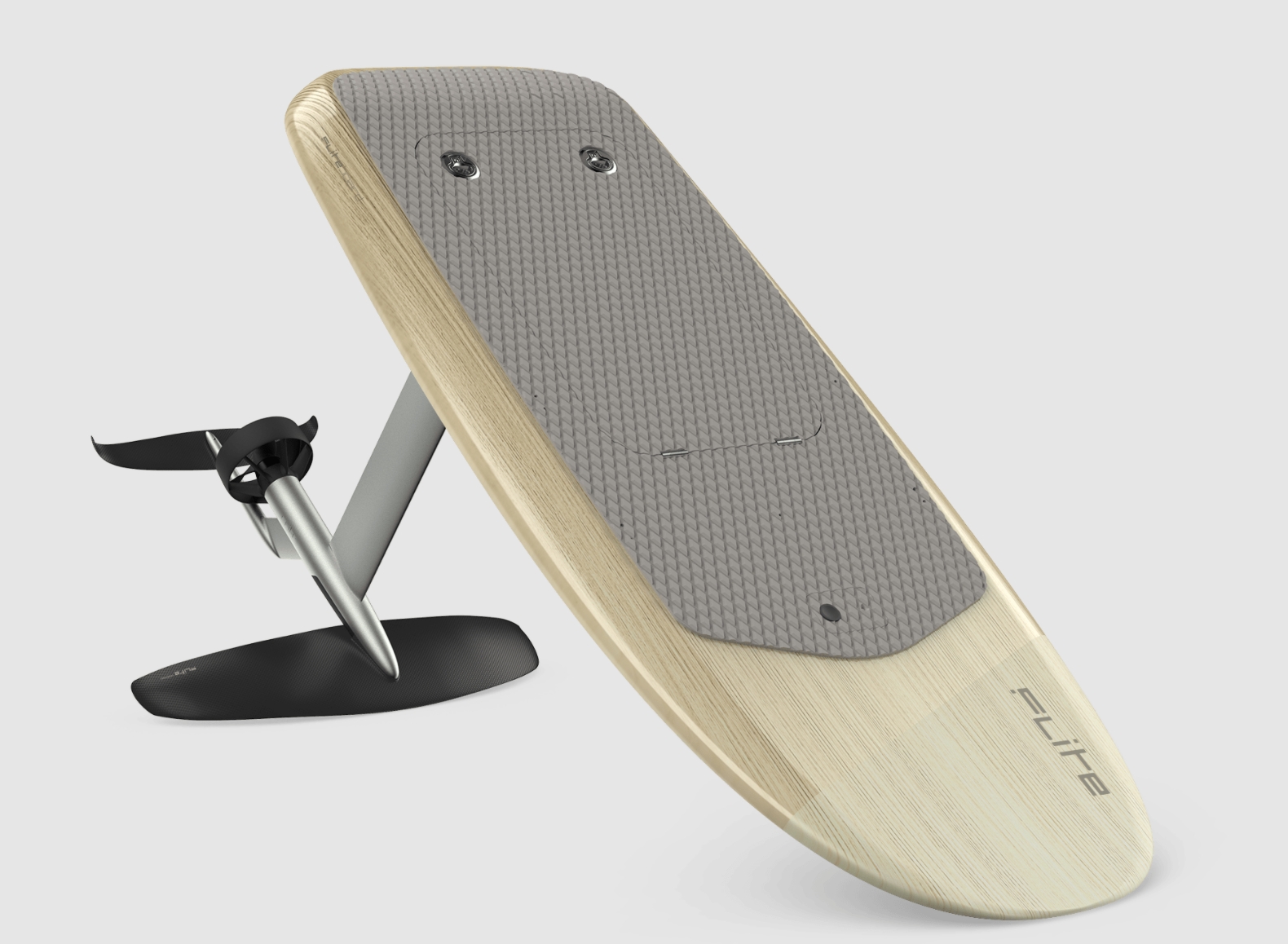
Flite also sells straight to Australian buyers from its own store in Australian dollars. Its complete sets start at $13,499 for the AIR ICON and AIR PRO, $16,499 for the ICON and PRO with a Soft Top 2 or fibreglass board, $17,999 for the Flitescooter and $18,999 for the carbon ICON and PRO. The store gives no tax basis on the product itself; its shipping policy aims at a flat $200 including GST for delivery in Australia. A board bought from a dealer in Hillarys or the South West keeps the test ride and the servicing a drive away.
Set those prices against the lessons. The cheapest set costs about as much as 59 private sessions at South Perth. Someone who rides a few times a year gets more for the money from lessons and guided sessions. Ownership starts to make sense for the rider who would be out on most calm weekends, and that rider also takes on the registration and the RST below.
Flite's own FAQ says only that some Australian states exempt the board from registration while others register it as a vessel, leaves the checking to the rider and prints no motor output figure. Ask the seller for the rating from the maker's documents, in writing, together with the HIN, because those two details decide whether the board needs numbers and whether you need a ticket.
Pull the department's pages together and a board above 4.5 kW leaves the shop needing this, as best we can tell:
- Registration in person at a service centre or regional agent, with the HIN certificate, proof of identity and an invoice showing your name, the HIN and the date of sale
- Numbers on both sides of the board, sized as above
- A Level 50 lifejacket and daylight riding only
- An RST, or a recognised ticket for a stay under three months
- EPIRB or PLB and flares if you go beyond 400 m from shore in unprotected waters
Registration carries a fee plus annual fees, and we quote no amounts here; renewals and transfers run through DoTDirect. Registration lasts 12 months and has to be renewed every year for as long as the board goes on the water, and the department counts it an offence to use or even keep an unregistered vessel in navigable waters. Below the line the paperwork disappears. The department's registration page lists electric hydrofoil boards with a motor whose output is less than 4.5 kW among the craft that need no registration, alongside surfboards, body boards and stand up paddle boards.
Bringing a board from interstate or buying one used
A board already registered in another state can ride in WA for a while on its old numbers. It has to be registered with the WA department within three months of its first use in WA waters, or within 30 days if it comes from the Northern Territory, and it goes through the steps for a new vessel, with the interstate registration papers in your name as proof of ownership. A board brought from overseas by an owner who does not live in WA permanently counts as a foreign pleasure vessel, and after 30 days in WA waters it must be registered as one.
The thresholds of the two states do not match, which can work for you. New South Wales registers eFoils from 4.0 kW, WA only above 4.5 kW, so by our reading a board rated between the two carries NSW numbers but needs none in WA.
A used board that already carries WA numbers changes hands by transfer. The seller has 7 days from the sale to lodge it, through DoTDirect, where the seller starts the transfer, or on the red seller's copy of the boat transfer form. The buyer then has 15 days to hand in the purchaser's papers at a service centre or regional agent. A board above 4.5 kW that has never been registered goes through new registration instead. If the proof of purchase is a private seller's handwritten receipt, it has to show the full name, date of birth, address and signature of both seller and buyer, the HIN and the date of sale.
Anyone moving a board between states should read the other side's rules too; the Australian eFoil guide takes them state by state.