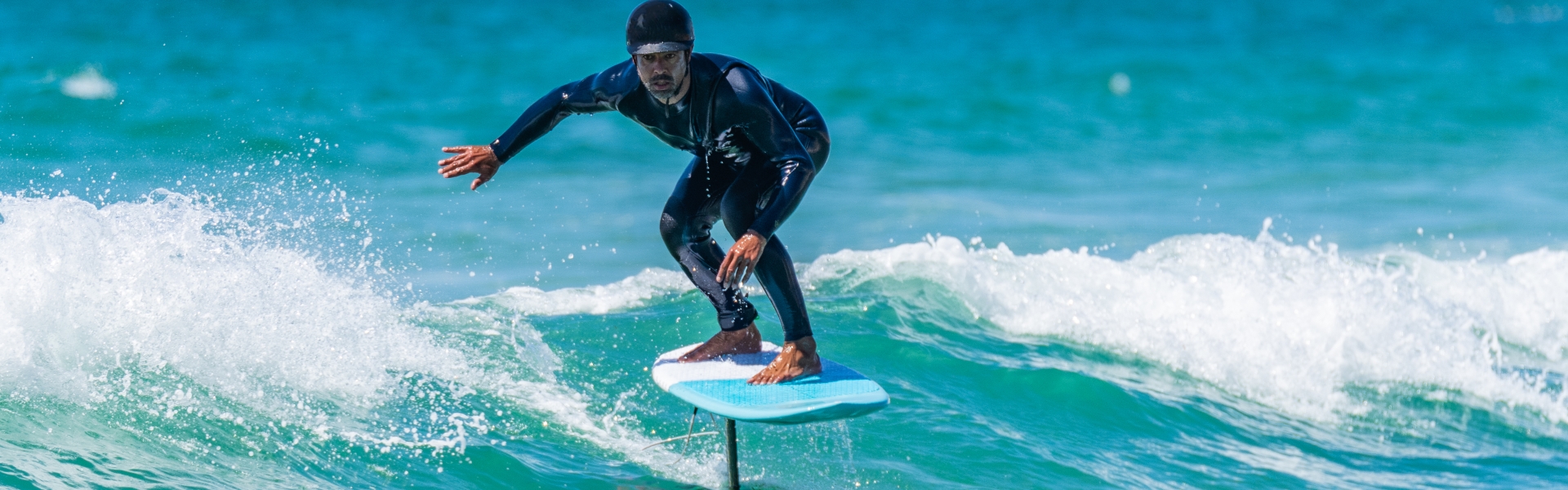
What is surf foiling?
In surf foiling, a hydrofoil takes the place of the fins under the board. The wing below you runs through the water, generates lift and carries the whole board clear of it, so you “fly” above the surface and stop plowing through it. With only the foil left in the water, drag collapses, you go faster, and turns take far less effort than they do on a conventional shortboard.
People put up with the learning curve for the sensation. A board skipping over chop buzzes and chatters under your feet; on a foil you get near silence and a long, weightless arc, and your first proper flight is the moment that noise switches off.
The idea dates back to 1997, when Laird Hamilton and a few fellow tow-in surfers on Maui started experimenting with the AirChair, a seated hydrofoil towed behind a boat. Hamilton went on to build the first stand-up version for wave riding, with boots and bindings on a small board, and it was not long before the riders were getting towed into the swell behind a jet ski. The gear has been getting better ever since.
Stick with surf foiling and it pays you back with something between surfing and snowboarding, with flight on top, and nothing else comes close to it.
The wave runs out, and that is where one of the biggest advantages shows up. Once you can pump, you don't paddle back. You keep gliding on the foil, and that alone changes how a whole session goes. You can ride breaks that never made sense for regular surfing, from swell that is barely knee high to swell far bigger than anything you'd want to take off on with a shortboard.
A foil runs on the energy in the swell rather than on the breaking lip. The wing sits well under the surface and draws on the push traveling through the water, so it has no need for the steep face a surfer depends on. Soft, shapeless swell that you would write off as a wasted session becomes rideable. So do rolling lines that never stand up, reforms inside the bank, even the whitewater behind a wave that has already closed out. The foil keeps flying on any of it.
What it asks for in return is space. Foiling wants room, and the worst possible place to be learning is the crowded peak at a popular reef break. Most riders go looking for the empty stretch of beach next door, the slow outside bank nobody bothers with, or the mushy day when the lineup empties out. Small and gutless is what this equipment likes, and so a lot of surf foilers end up riding on days they would once have stayed home for.
Surf foiling: pros and cons
Flying above the water
A quiet, weightless glide over the surface
New spots open up
Tiny and oversized swell both work
Longer rides
Pumping links one wave to the next
More speed
Almost no drag left to slow you
Surf experience required
Not a beginner's sport
Sharp wings
Serious injuries are possible
Keep your distance
Never ride close to other people
Long learning curve
Balance, strength and patience
Safety when surf foiling
To take up surf foiling you need solid surfing experience, plus a very good sense of balance, some strength and a lot of patience. The wings of a hydrofoil are thin and sharp, so surf foiling can be dangerous: a bad fall can cause serious injury.
Never ride close to other people. The hard edges under your board are a risk to everyone around you and not only to you, so keep a generous margin from surfers, swimmers and anyone else in the water. After a fall a loose board keeps drifting, its wings hidden under the surface where nobody else can see them.
A helmet, an impact or flotation vest, booties and a leash go on every session. Together they cut the injury risk substantially, and they make it far easier to climb back on after a fall. Experienced riders also work on how they crash. Fall flat and away from the board, put your arms over your head as you come back up, and keep track of where the foil went before you surface.
Some beaches, breaks and inland spots restrict foiling or ban it, and the access rules differ by country and often by individual lake or stretch of coastline. Check the local regulations before you go, and read the lineup once you get there. And where riding is legal, dropping a foil into a busy peak is still the fastest way to make the sport unwelcome.
The other foil sports
Surf foiling is one member of a whole family of foil disciplines. They all share one hydrofoil technology, and what mainly sets them apart is the power source: eFoil (electric motor), kitefoil (kite), wingfoil (handheld inflatable wing), SUP foil (paddle) and windfoil (windsurf sail). They all feel different to ride, but the principle never changes. The wing generates lift and pulls the board out of the water.
A lot of riders practice more than one of these, and time on one discipline carries over to the others. Flight time is the scarcest thing when you are learning, and wingfoiling in particular hands it to you without a wave; on a SUP foil, a tow behind a boat does that job. Some surf foilers also fit a foil assist motor. It gets them onto foil and lets them link swells on days when paddling in would be hopeless, and once they're flying they ride the wave under their own power.
The parts and how they work
A hydrofoil is built from four main parts: the mast, the fuselage, the front wing and the rear wing. The mast connects the board to the wing system running below the surface. The front wing produces most of the lift, and the smaller rear wing, often called the stabilizer, keeps the whole thing steady so it behaves the way you expect.
Every one of those parts is something you tune. A short mast keeps you closer to the water and is more forgiving when you breach; a longer one buys clearance in bumpy conditions. A large front wing lifts early and flies slowly, which is what a beginner wants. A smaller one needs more speed but turns tighter, and a high aspect outline gives up some of that snap for glide and top speed. Board volume follows that logic. Riders learning to paddle into waves usually start on a floatier board that catches swell easily and drop volume as their timing improves.
The whole assembly behaves like an aircraft under water. Shift your weight back and the front wing increases its angle of attack, the board starts to climb, and you have taken off. To land, you move your weight forward until the board settles back onto the water. Nobody sets flight height once and forgets it. You hold it with constant small corrections through your feet, much as a snowboarder trims an edge.
In the first sessions two mistakes come up again and again. Too much weight back and the foil breaches, the wing loses its grip on the water, and the board drops out from under you. Too much weight forward and the nose touches down hard, which stops the board while you keep going. Both are normal, and they stop happening once your feet learn the range, and they hurt much less in small surf than in anything with power behind it.
When flight becomes reliable, the next skill is to pump, a rhythmic up and down loading of the wing that keeps a foil flying with no wave under it at all. Pumping turns one short ride into a long one. You carry speed off the end of a wave, cross the flats, and meet the next line before it arrives. Of all the skills it takes the longest to learn, and nothing shows more clearly that someone has put real hours in.
So can you foil surf without waves? Partly. Once you can pump, the foil keeps flying with nothing under it but flat water, and that is how riders cross the gaps between sets. Getting up is another matter. You still start from a small wave or an open-water swell bump, or from a tow behind a boat or jet ski. Strong riders on large front wings can paddle up on flat water, but that is the hardest way to start, and most people leave it until much later.