Three reservoirs on the Catawba
Most eFoil sessions near Charlotte start on Lake Norman, about 15 miles north of the city. Cowans Ford Dam holds it back, and with 32,510 acres and roughly 520 miles of shoreline it is the largest man made body of freshwater entirely within North Carolina. Cornelius sits at its south end. That is where the boards usually go in.
A lake that size draws boats. The one eFoil school our search found around Charlotte sends riders who want to avoid “the Cornelius boat traffic” to Lake Norman State Park at the north end, and it calls Mountain Island Lake “a quieter, scenic alternative to Lake Norman”. Mountain Island Lake lies west of Charlotte and is small by comparison, about 3,281 acres with 61 miles of shoreline. Its main job is drinking water for Charlotte and Mecklenburg County, Mount Holly and Gastonia.
Lake Wylie, south of the city, straddles the state line. Its 13,400 or so acres and 325 miles of shoreline belong to York County in South Carolina and to Gaston and Mecklenburg counties in North Carolina, and the school launches from either side.
Timing does more for a first session than the choice of lake. Around midday the boat traffic off Cornelius is at its busiest, and a learner on the knees feels every wake. Set the school's traffic notes beside its early morning and early evening slots and we land on dawn or dusk for Lake Norman, with Mountain Island Lake for anyone who wants less company. Riders new to the sport altogether can start with our eFoil guide, a short read on how the board lifts and what the remote is doing while it does.
Swipe sideways to see all columns
| Lake | Size | Where | Launch for a session | Traffic |
|---|---|---|---|---|
| Lake Norman | 32,510 acres, about 520 miles of shoreline | About 15 miles north (Cornelius, Mooresville) | Ramsey Creek Park, Cornelius; Lake Norman State Park at the north end | The busy one; the school points to Cornelius boat traffic |
| Mountain Island Lake | About 3,281 acres, 61 miles of shoreline | West of Charlotte | Agreed when booking | Less boat traffic, says the school |
| Lake Wylie | About 13,400 acres, 325 miles of shoreline | South, on the NC and SC line | Either side of the state line | No note from the school |
One mobile school and its Waydoo fleet
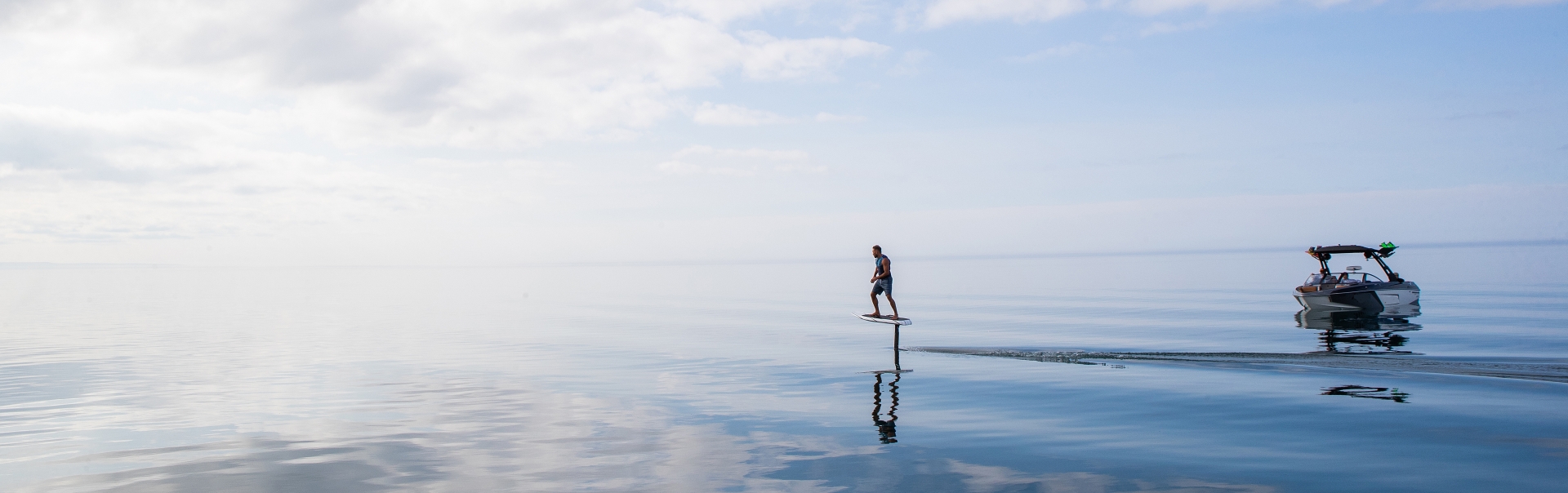
CharlotteEfoil brings its boards to a launch that suits you and calls itself “the only mobile eFoil rental business in the Charlotte area”. It runs private lessons, full day family outings and corporate sessions. It is also a Waydoo dealer, selling the boards and running purchase demonstrations.
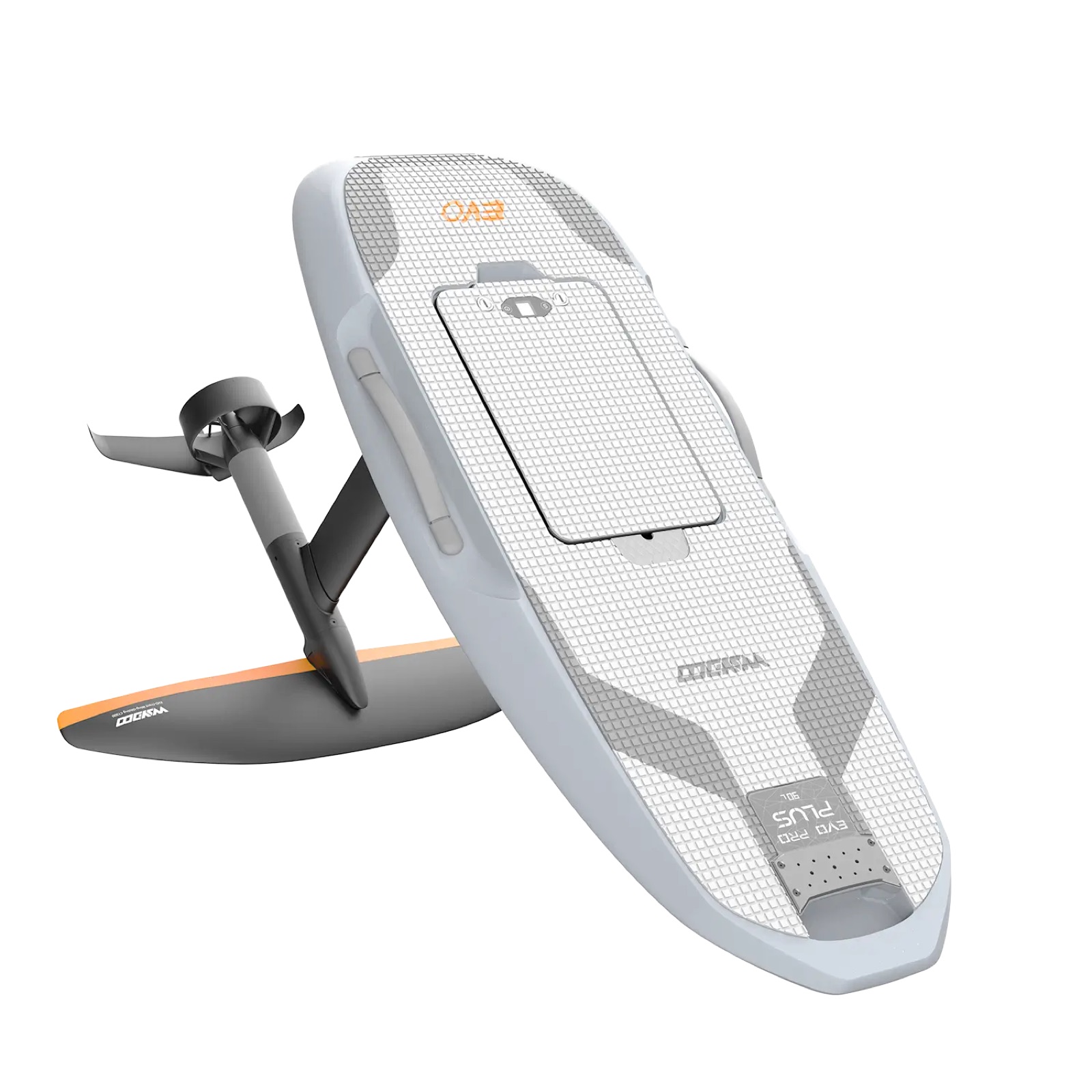
The fleet is Waydoo's Flyer EVO series with Smart Flight Assistance. First flights go on the EVO Max Plus, a 130 liter board with 6000 W; the EVO Pro Plus and the EVO Lite carry 90 liters, the Lite with 4000 W. Our Waydoo page covers the brand and its range.
Sessions last at least 90 minutes and run seven days a week, weather permitting. One person, one board; nobody shares time on a board. Booking starts with a request, and the school calls back to settle the day and the place. Nothing is confirmed until the documents are reviewed and signed. If conditions turn unsafe, you reschedule at no charge.
Look for an eFoil rental here and you end up at a lesson. The reservation page describes rentals as these guided 90 minute sessions, and no unguided hire is listed, so a rental around Charlotte means, in practice, a guided private session and nothing looser.
The reviews come from one place. On October 24, 2026 the school's home page showed “Rated 5.0 from 19 Google reviews”, and the quotes it chose praise patient coaching that is easy to follow and first timers “up and flying quickly”. Nineteen is a small sample, and the operator picked the quotes.
It suits a first timer who wants a coach alongside, a family that wants the whole day on the water, a team outing of up to 10 people (the cap follows the pontoon's capacity) and anyone weighing a Waydoo purchase. Own a lake house? The session can start from your dock, as long as a walkable path leads down to the water. Farther afield, the school travels up to 6 hours one way, as far as Myrtle Beach or Lake Murray.
Swipe sideways to see all columns
| Booking | Length | Price |
|---|---|---|
| Private lesson, one student | About 90 minutes | $150 |
| Second rider on their own board | About 90 minutes | $100 |
| Group of 3 or more, up to 10 riders, instructor rotation | By arrangement | Price by phone |
| Travel outside the normal launch area | Per hour of travel | $50 |
Ninety minutes, from lying down to flying
Arrive about 30 minutes early with a swimsuit and a towel. You sign a waiver before the first flight, and you need to be able to swim. Life jackets and helmets are required; the school provides both, or you bring your own. Riders must weigh under 250 lbs and be 18 or older, or ride with a parent.
The session opens with about 15 minutes of safety instruction at the launch. Then the lesson climbs in four steps.
- On your stomach, learning the hand controller and how the board turns.
- On your knees, still low on the board.
- Standing up.
- True foiling, where power, weight and foot placement lift the board clear of the water.
Lying on the board has a second use at Ramsey Creek. Lake Norman has its own no wake rule for the water around launching areas, which by its wording covers the first 50 yards from the ramps. So you leave the launch prone or kneeling, at idle.
Ride LKN in Mooresville: foiling behind a boat
Ride LKN Wake & Surf Co, at 114 Bowfin Cir. in Mooresville, is the other Lake Norman business on our list. It runs wake boat and pontoon charters, lessons and kids' summer camps on the lake. The coaching covers wakeboarding, wake surfing and foiling behind its boats, with a licensed USCG captain at the wheel, gear and fuel included, and a price set by the time booked, not by the head. It will also teach on your own boat.
Its site lists no eFoil. We read Ride LKN as a towed foil or wake day, a fit for a group that wants an afternoon on a boat or for a rider curious about foiling on a boat's wake. It is not where you learn on a battery board, and our search found no other eFoil school or rental on Lake Norman, Lake Wylie or Mountain Island Lake. A search can miss one, of course.
Ramsey Creek Park and the other launches
The school's preferred launch is Ramsey Creek Park, at 18441 Nantz Rd in Cornelius, and a session there carries no travel fee. By the operator's count it is about 30 minutes from uptown Charlotte. The county park has four boat ramps, a playground, picnic shelters and an ADA fishing pier.
Mecklenburg County lets only approved rental companies launch at Ramsey Creek and at Blythe Landing, and CharlotteEfoil is on the approved list for the 2025 season. Launch fees apply, and season passes are sold. Blythe Landing Park in Huntersville is the larger site, with six ramps and 218 trailer spaces, and Lake Norman Community Sailing, a nonprofit, works from there too.
The county rule names rental companies and nobody else, which leaves a private owner to guess. We would pay the launch fee like any boater and ask the park before the first launch.
Lake Norman State Park, 759 State Park Road in Troutman, is the north end option. It charges no day use fee, and its boat ramp has 24 hour launch access through the St. Johns Road entrance. There is a swim beach, and the park rents paddle and pedal craft but nothing motorized. On the other two lakes the county parks are smaller. Copperhead Island Park on Lake Wylie has four boat ramps, McDowell Nature Preserve on Lake Wylie a paddle launch, and Latta Nature Preserve on Mountain Island Lake two paddle launches.
Registration, life jackets and age limits in North Carolina
The Wildlife Resources Commission (WRC) wants all motorized vessels on public waters registered. Only craft moved by oars, paddles or the current, and vessels used only on a private pond, are exempt. Its form VL-1 (10/2026) adds that a boat with an electric trolling motor needs registration too, for 1 or 3 years. The word eFoil appears nowhere in these texts or in any other North Carolina rule we read, so each step below that applies one of them to a board is our interpretation.
Without a title, a craft under 14 feet that is not a PWC costs $38 for 1 year or $102 for 3 years, plus transaction fees. We put an eFoil in that bracket. A board registered in another state has to move its registration to North Carolina after more than 60 consecutive days here.
The harder question is the personal watercraft law. G.S. 75A-13.3(a) describes a PWC as a small vessel with an outboard or propeller driven motor (or a jet pump inboard) as its main power, ridden by a person sitting, standing or kneeling on it. G.S. 75A-2(1e) leaves an electric only motor out of “propulsion machinery” for motorboats, and the WRC names no eFoils anywhere. We think an eFoil fits the 75A-13.3 wording, and riding by the PWC rules keeps you on the safe side. Those rules, in short:
- No PWC between sunset and sunrise (75A-13.3(a)).
- A USCG approved PFD on every rider, inflatable ones excluded, and a factory fitted kill lanyard attached (75A-13.3(d)).
- No operator under 16; 14 and 15 year olds only with an adult 18 or older on board or with proof of age and boating safety education (75A-13.3(b), (c)).
- Rental businesses carry $300,000 of liability insurance per occurrence and brief each renter; weaving through congested traffic and jumping a wake within 100 feet count as reckless operation (75A-13.3(c1), (c3), (e)).
The night rule touches one booking option. The school offers sunrise and sunset sessions on request. Under our PWC reading the board belongs off the water between sunset and sunrise, so plan a sunset session to finish by sunset and a sunrise one to start after it.
Boating safety education under G.S. 75A-16.2 applies to motors of 10 hp or more, with exemptions for a rental agreement naming the operator, direct supervision by a compliant adult of 18 or older, and anyone born before January 1, 1988. By our conversion the school's 4000 W and 6000 W boards come to about 5.4 and 8 hp, both below the 10 hp line. Separately, the WRC requires children under 13 to wear a life jacket while underway on boats under 26 feet.
On the South Carolina half of Lake Wylie, South Carolina law applies, and this page does not cover it. Schools on the Outer Banks work under the same North Carolina statutes, and our Outer Banks page looks at them from the coast.
What stands above condenses the General Statutes on ncleg.gov, the WRC pages and form VL-1 as read on October 24, 2026. It is a summary, and no substitute for legal advice.
No wake water on Lake Norman, Mountain Island and Lake Wylie
Lake Norman has a statute of its own. G.S. 75A-14.1 sets no wake speed within 50 yards of any launching area, bridge, dock, pier, marina or vessel storage or service area on the lake, and G.S. 75A-2(1f) defines no wake speed as idle or slow speed that leaves no appreciable wake. For a foil board that translates, in plain terms, into staying off the foil, prone or kneeling and slow, until the 50 yards are behind you.
The PWC section adds its own distances. Under G.S. 75A-13.3(a1) a PWC stays at no wake speed within 100 feet of anchored or moored vessels, docks, piers, swim floats, marked swim areas, swimmers, surfers, anglers and paddle craft, and within 50 feet in a narrow channel, which (f1) puts at 300 feet wide or less.
Each lake also has marked zones in the state code. For Lake Norman it is 15A NCAC 10F .0307, amended effective February 1, 2026, which covers 50 yards off the Jetton Park shoreline, Bluff Point Cove in Cornelius and the cove north of the Hager Creek inlet. The Lake Norman Marine Commission places the markers, and its site keeps the regulations and notes on navigating the lake. The same rule makes liveries inspect safety gear and brief every renter, with a signed record kept for two years.
Mountain Island Lake has 15A NCAC 10F .0353 (readopted effective October 1, 2018). It lists coves such as Duck Cove and Gar Creek and 50 yards either side of the NC 16 and NC 73 bridges.
Lake Wylie falls under 15A NCAC 10F .0333 (amended effective February 1, 2025). Its zones sit in several coves, at the Buster Boyd and NC 27 bridges and within 50 feet of other NC bridges, plus 50 yards around the South Point Boating Access Area and the Joyner's Marina docks. The rule also bars entry into the roped swim area at South Point, Belmont.
April to November in the Catawba
Two USGS gauges supply these figures, each with about a decade of monthly readings, one just below Cowans Ford Dam and one below Mountain Island Dam. River water below a dam is not the surface of a swimming cove, but it shows the shape of the year. July and August come in at 83 to 85 °F.
Swipe sideways to see all columns
| Month | Below Cowans Ford Dam | Below Mountain Island Dam |
|---|---|---|
| April | 62 (16.4) | 63 (17.2) |
| May | 70 (21.1) | 71 (21.9) |
| June | 77 (25.1) | 79 (26.0) |
| July | 83 (28.5) | 85 (29.2) |
| August | 84 (29.1) | 85 (29.5) |
| September | 82 (27.6) | 81 (27.3) |
| October | 74 (23.5) | 73 (22.5) |
| November | 65 (18.5) | 63 (17.0) |
May to October is the comfortable stretch for a rider in the water, and April and November call for a wetsuit. The school names no closed season. It books early morning or early evening sessions, and on a hot weekend we would expect those to be the calm hours as well.
Before any session, check for a county No Swimming advisory. In May 2023 a damaged pipe leaked about 460 gallons of sewage into a Lake Norman cove. The advisory issued on May 28 was lifted after lab results on May 31 showed safe bacteria counts. Advisories like that one strike us as local and temporary, and Mecklenburg County sends them by text. For anyone thinking past the lesson toward a board of their own, our eFoil price guide sets out what one costs.