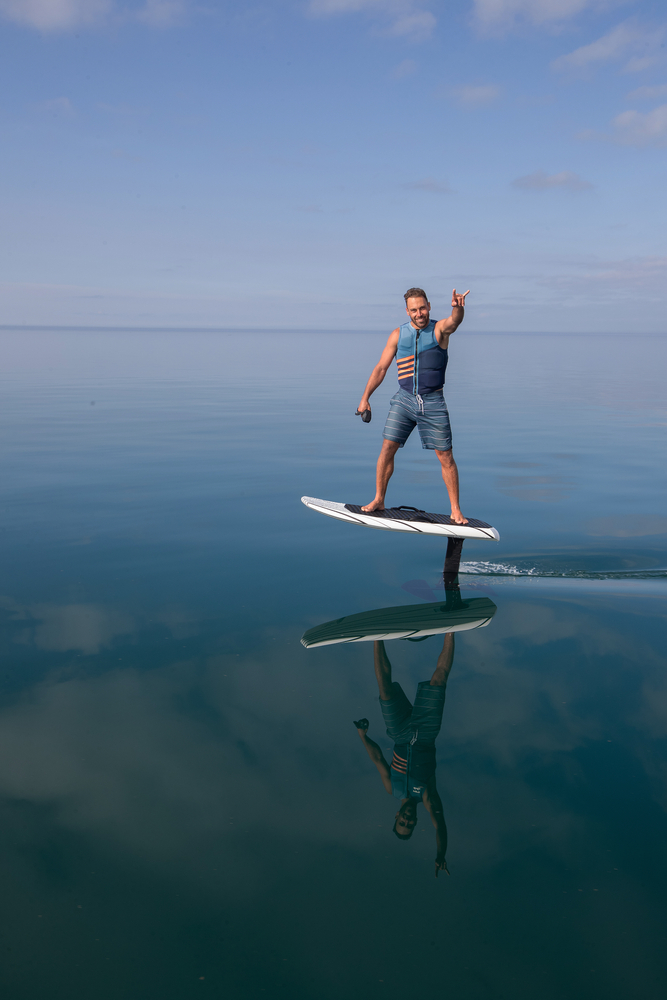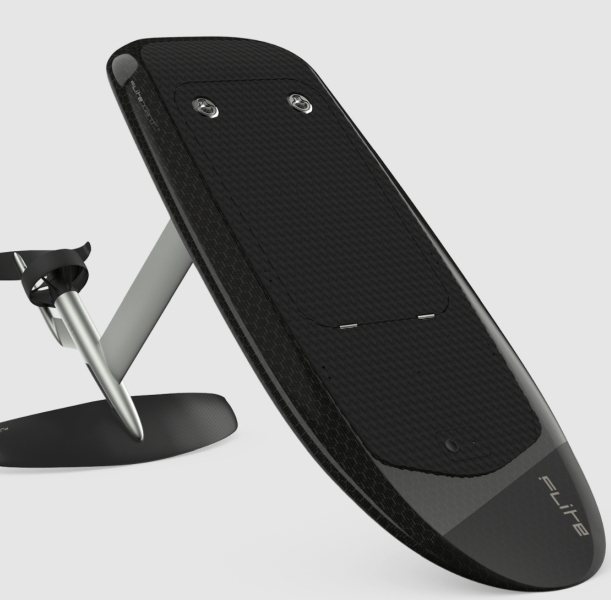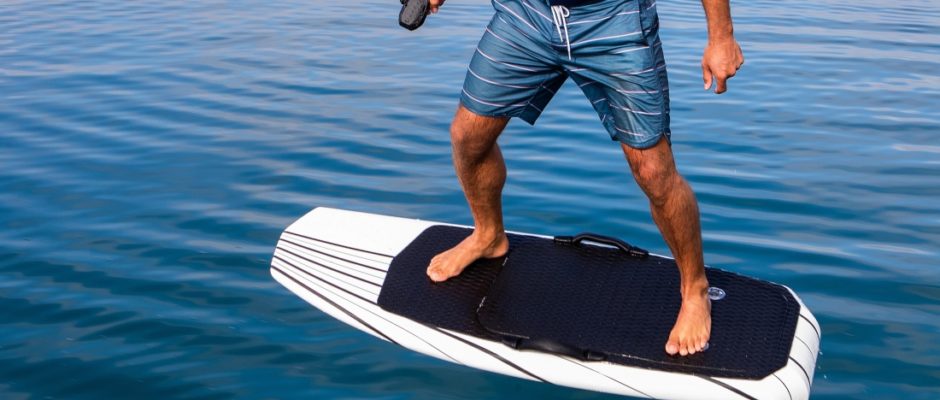
A board brought to your beach, and two places to fall back on
On Grand Cayman the eFoil is brought to you. Cayman eFoil Ltd., the operator this page follows (we checked its own site on 23 October 2026), rides Lift Foils boards and calls itself a certified Lift Foils partner and a verified EASI operator. Most of its riding happens along Seven Mile Beach, and if your hotel, condo or villa sits on that stretch, the instructor can often launch from the sand in front of it. Deliveries go island wide, and the exact launch spot for each booking is settled by text or WhatsApp.
Seven Mile Beach is a west coast beach, open to whatever the wind does there. On rough days the operator falls back on the Cayman Islands Yacht Club, Dock C2, which it says typically has flat water. Rum Point, over on the North Sound side, is the third choice, and there a travel fee of US$100 is added once per booking (list price, read on 23 October 2026).
Riders log their sessions in the EASI app, which later matters for renting. The boards are Lift eFoils, which Cayman eFoil says are manufactured in Puerto Rico. Private groups and corporate events can book a full day, sunrise to sunset, or half a day built around a demo or a lesson.
Why every first ride on Grand Cayman is an Introductory Demo
Owning a board at home changes nothing here. Cayman eFoil puts every first time customer, experienced eFoil riders included, through its Introductory Demonstration. It is a full ride on a Lift eFoil lasting up to 2 hours, with personal instruction on handling and safety and on the rules set by the Cayman Islands and the Cayman Islands Coast Guard.
After the demo comes the Cayman eFoil Certification, an in house clearance earned by showing safe board handling. The operator says plainly that it is not recognized globally. Experienced riders may be certified on evaluation right after their demo. Lessons are open to anyone who has ridden the demo, while sessions need the certification.
Riders must be at least 12, with consent from a parent or guardian. The weight limit is up to 300 lb (136 kg), depending on which board you are put on. Each eFoil goes out with one battery per ride, and the operator does not run a battery below 20 to 15 percent (more on packs in our eFoil battery guide).
Grand Cayman eFoil prices, from the demo to a week of rental
Every newcomer starts with the Introductory Demo, US$475 for one rider, and the rest of the list builds on it. The figures come from Cayman eFoil's own pages, read on 23 October 2026. Demo, lesson, session and package prices carry the label 2025/26 rates; the rentals page shows no season label. Everything is quoted in US dollars and subject to change. KYD (CI$) is accepted at a factor of 0.82, so the US$475 demo comes to CI$389.50.
Swipe sideways to see all columns
| Booking | Length | List price |
|---|---|---|
| Introductory Demo, 1 rider | Up to 2 hours | US$475 |
| Introductory Demo, 2 riders on 1 eFoil | Up to 2 hours | US$550 |
| Introductory Demo, 2 riders on 2 eFoils | Up to 2 hours | US$850 |
| Introductory Demo, 9 riders | Up to 2 hours | US$1,500 |
| Lesson, 1 rider | Up to 2 hours | US$375 |
| Lesson, 2 riders on 1 eFoil | Up to 2 hours | US$450 |
| Lesson, 2 riders on 2 eFoils | Up to 2 hours | US$700 |
| Session, 1 rider | Up to 1 3/4 hours | US$315 |
| Session, 2 riders on 2 eFoils | Up to 1 3/4 hours | US$605 |
| Four rides incl. the demo, 1 rider | 4 rides | US$1,360 |
| Four rides after a demo | 4 rides | US$1,275 |
| Rental, half day | 6 hours | US$650 |
| Rental, 1 day | 1 day | US$750 |
| Rental, 7 days | 7 days | US$3,125 |
| Battery only | 1 day | US$400 |
The rows follow the operator's own sequence. Lessons come after the demo, sessions are for certification holders, and rentals and the battery go to EASI verified riders only. Four ride packages are paid up front. Rum Point adds its US$100 travel fee once per booking. A week of rental at US$3,125 can be set against the cost of owning a board with our eFoil price guide.
Renting a board without an instructor
Solo rentals exist, but only for EASI verified renters. The route there runs through the Introductory Demo with Cayman eFoil, and the rides you then log in the EASI app are what clear you. Rentals themselves are arranged on WhatsApp.
The board is dropped off in the morning and picked up in the evening, with a charger in every rental. Riders who travel with their own Lift eFoil can rent just a battery, under the same EASI rule.
Cayman eFoil's house rules (its wording, not the law): ride from sunrise to sunset, stay 200 yards offshore and within 1 mile of shore, and keep under 18 mph. Its resident pass terms put the 200 yard rule down to Cayman law. The text of the Port Regulations is a little different, a five knot limit inside 200 yards (reg. 30(5)). Either way we would keep to one habit: leave the beach slowly and only fly once you are well past the line.
Residents, with proof of Cayman residency, can buy passes instead. Every pass session is instructor led (“we ride with every client, every time”), with board, remote, safety jacket and headset included.
Off Seven Mile Beach: swim buoys and a slow first 200 yards
Despite the name, Seven Mile Beach is about 5.5 miles long, by the Department of Tourism's count. Most of the designated swim areas lie along this beach, and boats and jet skis are kept out of them. Under regulation 147 of the Port Regulations, whoever controls a beach may set aside a buoyed swim area within 200 yards of the shore with Port Authority approval. No vessel may enter one except for a rescue or an emergency, and even then only where no swimmer is put at risk.
Outside the buoys the distance from the sand decides your speed. Within 200 yards of the shoreline (about 183 m) no vessel may go faster than five knots, unless it is inside a watersports area designated under regulation 146 and marked by buoys; that is reg. 30(5). Seven Mile Beach is not on the list of designated areas in Schedule 8. Reg. 30(6) adds that no vessel may travel parallel to the shoreline unless it is more than fifty yards from it. What we take from the pair: the way out is a slow, fairly direct run away from the beach, and cruising up and down the coast belongs well offshore.
Swimmers can be farther out than you expect. Reg. 145(2) lets those who show the float or marker of Schedule 5 go beyond 200 yards between sunrise and sunset, and reg. 143(3) tells every vessel to keep clear of swimmers and divers. The Department of Tourism's visitor summary says 5 mph near the shore; we go by the regulation's five knots.
The sheltered side of the island: North Sound and Rum Point
The North Sound covers 35 square miles of water protected by the reef. The Cayman Islands Yacht Club, reached from Yacht Drive in the heart of Seven Mile Beach, calls it “a shallow sheltered body of water” and lists Stingray City, the Sand Bar, Rum Point and Cayman Kai as a short boat ride away.
Rum Point also sits differently in law. It lies inside one of the watersports areas designated in Schedule 8 of the Port Regulations, described as running from the north west tip half a mile south east along the coast and out to the reef. Inside such an area, as long as it is marked by buoys, the five knot limit of reg. 30(5) does not apply. We take the exemption to cover the area the Schedule describes and nothing beyond it, so the rest of the north coast stays under the ordinary 200 yard rule.
Not all of the Sound is open water for a board. The navigational channels listed in Schedule 9, among them the North Sound main channel, Bic Channel and Conch Point, are closed to diving and swimming except as authorized under regs. 144(1) and 145(1). On an eFoil every fall is a swim, so we would keep the board out of those channels altogether. Stingray City lies in 12 feet of water and the Sandbar is 2 to 4 feet deep. Both are listed as wildlife interaction zones under the marine parks rules.
How the Port Regulations catch a board they never name
Boat traffic near the shore is governed by the Port Regulations (2025 Revision), made under the Port Authority Act (2025 Revision). They were published as Supplement No. 4 with Legislation Gazette No. 12 of 11 February 2025, revised as at 31 December 2024. Neither the Act nor the Regulations mention eFoils, hydrofoils or motorized surfboards by name.
Section 2 of the Act defines a “vessel” as a device capable of being navigated in water by any means by a crew of one or more persons. Our reading is that a ridden eFoil fits that definition, so the rules written for vessels apply to it. Regulation 2 then defines a “power boat” as a vessel that can be propelled by something other than, or in addition to, sail or manpower “to an extent in excess of 5 B.H.P.” Whether a particular eFoil is a power boat therefore turns on its motor rating. We found no official statement either way. It matters because reg. 31(5) gives all other vessels right of way over power boats.
Other rules an eFoil rider may meet:
- Reg. 30(1): within 200 yards of a divers down flag or light, no more than three knots, a lookout at the bow for divers and swimmers, and visual or radio contact with the lookout of the vessel flying the flag.
- Reg. 30(4): no more than five knots within fifty yards of any vessel at anchor.
- Reg. 30(3): keep at least one hundred yards from an anchored fishing vessel showing a white flag, unless it gives permission.
Reg. 143(1) says nobody may let out a vessel for reward for a recreational activity until satisfied that every user has a life jacket of a kind approved by the Director, that the vessel is seaworthy, and that at least one person competent in handling it is in the crew. We take that to be the rule behind instructor led rentals with a buoyancy vest.
The Coast Guard has acted on the shoreline limit. In a notice of 29 August 2022 it reported stopping four vessels the day before for exceeding five knots within 200 yards of the shoreline, and it reminded boaters to keep to no more than 5 knots (no wake) that close in.
The readings on this page are ours, made from the published texts on 23 October 2026. They are not legal advice; the Port Authority and the Coast Guard have the final word.
Marine parks, and why Little Sound is different
The Department of Environment says the marine parks network, first set up in 1986, was enhanced in 2021 to cover around 50 percent of coastal waters; the Department of Tourism gives “over 48%” of Grand Cayman's territorial waters. Zone boundaries and rules for all three islands are in the DoE's Cayman DoE app.
The rules come from the National Conservation (Marine Parks) Regulations, 2021 (SL 19 of 2021), made by Cabinet under section 50 of the National Conservation Act, 2013 (Act 24 of 2013) and published as Supplement No. 1 with Legislation Gazette No. 21 of 12 March 2021. The DoE's site also links a “Marine Parks Regulations 2024” file that we could not open, so later amendments are possible. What follows is the 2021 text as made.
Schedule 1 lists GC Seven Mile Beach and GC North Sound among the marine reserve zones of Grand Cayman. In a marine reserve zone, reg. 5(1) forbids taking any specimen or anchoring a vessel, though a vessel up to 60 ft may anchor in sand without touching coral (reg. 5(3)). We found nothing in these regulations that bars riding an eFoil through a marine reserve; the speed limits come from the Port Regulations.
Little Sound is another matter. It is part of the North Sound and the only Grand Cayman environmental zone in Schedule 2. Regulation 6 bans, among other things, entering the water there, anchoring, mooring or grounding a vessel, and operating a vessel faster than five miles per hour. In our view that rules out eFoiling in Little Sound, because a board only flies above that speed and a fall means entering the water.
Stingray City Sandbar and Stingray City Deep appear in Schedule 3 as wildlife interaction zones. Regulation 7 bans taking specimens, selling fish food from a vessel, certain kinds of anchoring, and wearing footwear in water under four feet. Breaches can bring a fine and imprisonment, the Department of Tourism warns.
Winter Northwesters and the calmer summer months
The Cayman Islands National Weather Service describes a tropical marine climate with two seasons: warm, rainy summers from mid May through October, and relatively mild, dry winters from November to April. The wet season averages 84.6°F (29.2°C), with daily highs around 89.1°F; the dry season averages 80.3°F (26.8°C). The sea follows suit, averaging 78°F (about 26°C) in winter and up to 85°F (about 29°C) in summer, by the Department of Tourism's figures, and the prevailing trade winds cool the islands.
Winter belongs to cold fronts, from late October through early April. The stronger ones bring strong north to northwest winds and rough seas, especially along the western and northern coasts, and locals call them Northwesters. Seven Mile Beach faces west. That is our explanation for why it can turn too rough in winter while the North Sound or a sheltered marina stays rideable, and why the operator keeps a backup at the Yacht Club.
In summer, tropical waves pass from late May through November; the stronger ones bring a day or two of heavy showers, then strong southeast winds. Hurricane season runs from 1 June to 30 November.
Cayman eFoil's own pick overlaps the start of that season. It names the summer slow season, roughly June to August, as the best months, when the water along Seven Mile Beach is generally calm. Through the day, the calmest water usually comes in the morning and the evening. On a winter trip, then, we would book a morning slot for the first ride and keep the Yacht Club in mind as plan B.
If Grand Cayman is one stop on a longer warm water trip, we have mapped the schools and rules in Turks and Caicos and on Miami's Biscayne Bay.