Choose the water before the school
Dutch eFoil schools mostly teach on lakes, and they are spread from Texel in the north to the Maasplassen near Roermond in the south. Staying in Amsterdam, you can pick a lake on the edge of the city, the wide open IJmeer and Markermeer to the east and north, or a day trip to a lake farther inland. The rules follow the water. There is one national speed line at 20 km/h, a stricter license for the big lakes and the Waddenzee, and on a few lakes a local limit well below the national line.
Some schools charge per person and some per group, so check which one a price means before you set two lines side by side.
Swipe sideways to see all columns
| Operator | Water | Entry price |
|---|---|---|
| Flying Fish Amsterdam | Nieuwe Meer, Amsterdam | €269, three 40 min lessons |
| Amsterdam Watersports | Amsterdam | €109, one person |
| Letsfoil | Westeinderplassen, Aalsmeer | €125 p.p., 1.5 h |
| WingXperience | IJmeer, Marina Muiderzand, Almere | €129 private, 60 min |
| Foiladventure | Markermeer, Hoorn | €149.95 private, 60 min |
| The Foilers | Himpenser Wielen, Leeuwarden | €149 private, 1.5 h |
| Texel Active | Waddenzee, De Hornt, Texel | €99 p.p. |
| GEARfreak | Valkenburgse Meer, Leiden | intro lesson from €99 |
| Rodewave | Vlietland, Leidschendam | €180 for two, 1 h |
| Natural High | Brouwersdam, sea side | €95 p.p., 1.5 h course |
| Foil School Nederland | Brouwersdam | €75 p.p., duo |
| Wave & Wheels | Grevelingenmeer, Port Zelande | €95 private |
| EFOIL TWENTE | 't Grasbroek, Bornerbroek | €129.95, one to one |
| SUP & SURF Nijmegen | Nijmegen | €90 p.p., 60 min |
| Flyfoil | Noorderplas, Slijk-Ewijk | €59 trial, 30 min |
| E-Flow | De Grote Hegge, Thorn | from €85 p.p., group hour |
| eFoil Tilburg | Blauwe Meer, Tilburg | €149.95 private |
| eFoil Brabant | WINPUT lake, Hooge Zwaluwe | €120, 1 to 1.5 h |
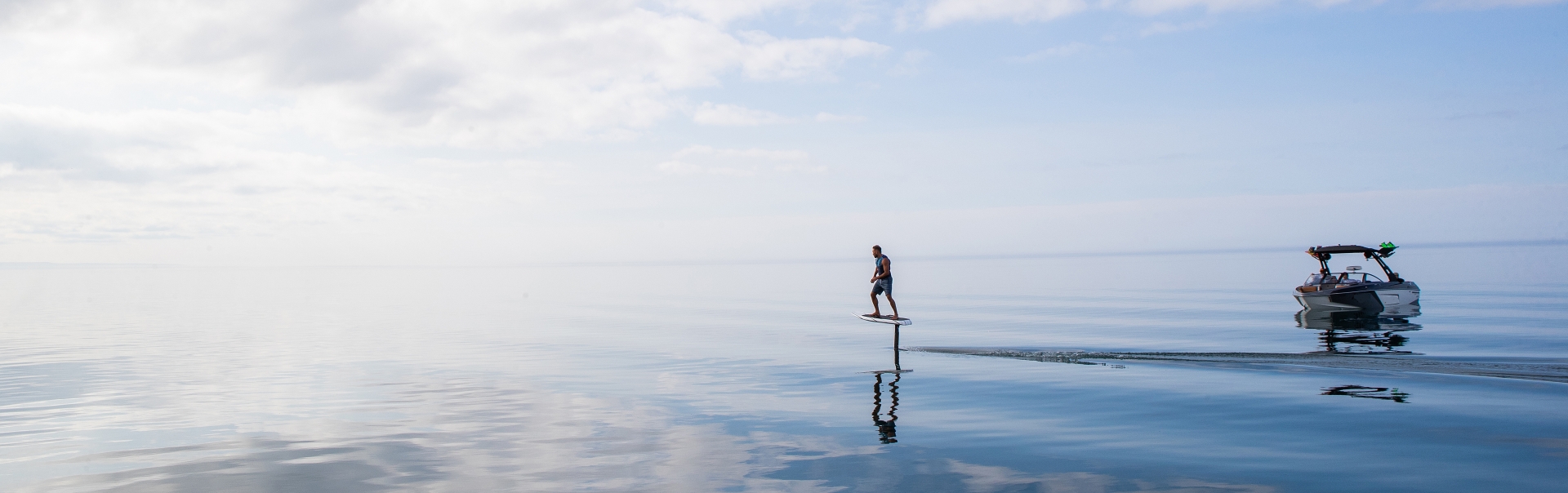
Plan on a lesson for your first ride. Several schools, among them Flying Fish, GEARfreak and E-Flow, rent boards only after a course or a lesson, so the lesson doubles as your ticket to a solo session later. Flying Fish and Foiladventure include a helmet and an impact vest. An eFoil needs neither wind nor waves, as Flying Fish points out, so a calm, gray morning is a perfectly good lesson day.
Amsterdam and the lakes around it
Flying Fish runs a small network of eFoil bases, on the Nieuwe Meer in Amsterdam and at Loosdrecht, Heeg, Hoorn and Monnickendam. On the Nieuwe Meer the way in is a pack of three 40-minute lessons for €269. The certificate you get at the end lets you rent a board and ride on your own, from €60 an hour. A regular lesson takes five people at most. Helmet and impact vest cost nothing extra, and the boards are Waydoo.
Amsterdam Watersports prices its sessions in the city per booking, not per head: €109 for one person, €179 for two, €259 for three and €339 for four. Groups of 5 to 10 pay €79 each.
On Amsterdam's own inner waters, the binnenwater, offering a craft for use for anything other than free needs a permit (Verordening op het binnenwater 2010, art. 2.4.1(1)(b), in the version in force from 1 January 2025). A craft rented out without crew, onbemande verhuur, may go “niet sneller dan 7,5 kilometer per uur”, no faster than 7.5 km/h (Regeling op het binnenwater 2020, art. 2.2.2(a), in force from 25 September 2025). We assume the same limit holds for an eFoil hired out without staff, and the rule covers the binnenwater, not any one lake.
Flying Fish Loosdrecht, which its page places at “Loosdrecht, Noord-Holland”, shows no prices. Its house rules set a weight limit of 105 kg and a minimum age of 16, younger in consultation with a parent. The Besluit Motorboten Loosdrechtse Plassen 2023 of the municipality of Wijdemeren, in force since 19 June 2024, counts as a motorboat “ook nieuw op de markt komende producten, zoals een e-foil”, new products such as an e-foil, by name. It caps speed at 12 km/h, 9 km/h on the Stille Plas (art. 2) and 6 km/h within 100 m of a bank (art. 3). Article 6(1)(c) bans riding jet skis, water scooters “of een soortgelijk apparaat”, or a similar device, and article 9 allows exemptions.
South-west of the city, the Westeinderplassen lie between Aalsmeer, Kudelstaart and Leimuiden, linked through the Ringvaart with De Kaag and the Nieuwe Meer. Letsfoil teaches there in front of the Kempers Watersport harbor, at €125 a person for 1.5 hours, three people at most, on Fliteboard boards. Westeinder Water Experience, the same offer under another name, sells a two-hour lesson from age 18 (a house rule).
Aalsmeer's Beleid snelvaren Westeinderplassen 2013, which rests on a decision of the mayor and aldermen of 7 March 1995, allows 6 km/h “binnen 50 meter van de oever”, within 50 m of the bank, and 12 km/h beyond. Its speedboat lane needs an exemption, given only to “gebruikelijke speedboten”, ordinary speedboats, never to water scooters or jet skis. We read that to mean a private eFoil rider cannot count on one, which leaves 12 km/h as the ceiling everywhere outside the lane. If you book a lesson there, ask the school how it fits its sessions into that policy.
Almere and Hoorn, on the IJmeer and Markermeer
WingXperience teaches at Marina Muiderzand in Almere Poort. The marina sits on the IJmeer, which, as the school puts it, “grenst aan het Markermeer”, borders the Markermeer. Lessons run on SiFly boards. A private hour costs €129 and a duo pays €99 each, while groups of four or more start at €65 a head for 90 minutes. The €295 pack adds two hours of rental to a private hour, and it is the only way to rent a board there.
Hoorn has two eFoil offers on one town beach. Flying Fish rides from Strandpaviljoen Reuring, “boven het Markermeer”; its Hoorn page shows no lesson price. A standard lesson takes 45 minutes to an hour with the briefing, and the house rules ask for an age of 16 and “een redelijke zwemvaardigheid”, reasonable swimming ability. Flying Fish puts the town beach about 15 minutes on foot from Hoorn station, and parking there is paid.
Foiladventure works from that town beach too, and from De Schelphoek, also in Hoorn and also on the Markermeer. A private hour costs €149.95, two riders pay €109.95 each, three pay €99.95 and four €89.95. Its minimum age is 18, younger by arrangement or with supervision, and it is a Waydoo dealer. The two Hoorn schools are separate businesses with their own booking, not partners.
Flying Fish Monnickendam takes groups only, from 12 people, on a quote, and its page names no water.
Rijkswaterstaat gives the IJsselmeer 1,100 km², “het grootste zoetwatermeer van Nederland”, and the Markermeer 700 km². Dutch license law treats them as waters of a maritime character. The Binnenvaartregeling (art. 7.11b(2)) lists “het IJsselmeer, het IJmeer en het Markermeer met uitzondering van de Gouwzee” among them, with the Waddenzee. So, as we understand the list, a board that can pass 20 km/h needs klein vaarbewijs part II at Hoorn and at Muiderzand, not part I.
Fast riding is allowed on parts of these lakes (Regeling snelle motorboten Rijkswateren 1995), never “binnen een afstand van 250 m uit de oevers”, within 250 m of the shore (art. 1(1)(e) for the IJsselmeer and Markermeer, art. 1(1)(g) for the IJmeer). On the IJsselmeer and Markermeer the buoyed channels are excluded as well. We take that to mean a lesson off the Hoorn beach or the Muiderzand marina that keeps inside the 250 m strip also keeps at or below 20 km/h.
Friesland lakes and a Texel beach
Friesland is lake country, and two of its schools show how differently the license question can land. Flying Fish Heeg is live and bookable on the Heegermeer, from Camping Lân & Mar in Heeg. Near Leeuwarden, The Foilers ride the Himpenser Wielen at Zuiderburen on SiFly boards. A private session there costs €149 for 1.5 hours, of which about 45 minutes is foiling. Two riders sharing one board pay €85 each, two on two boards €110 each, and a group of six comes down to €55 a head. The Foilers take riders from 16 and up to about 125 kg, and they go out in anything up to wind force 4.
Their FAQ states: “Het e-foil board is ingesteld op maximaal 20 km per uur en valt daarmee onder de pleziervaartuigregeling”. In English, the board is set to 20 km/h at most and so falls under the rules for ordinary pleasure craft, and on that basis the school says no vaarbewijs is needed. That is a statement about its own capped boards. It is not a general Dutch rule, and it does not cover a board that can go faster.
EFOIL Friesland took the other road. Its site now reads “Vanwege gewijzigde regelgeving zijn wij gestopt”, we stopped because of changed regulations, and claims that a valid vaarbewijs is now compulsory. That is the school's own account.
For anyone faster than the line, the province of Fryslân allows fast sailing only inside the yellow-buoyed snelvaargebieden on the Heegermeer, Tjeukemeer, Fluessen, Slotermeer and Sneekermeer, by day and within a legal window the province sets.
Off the mainland, Texel Active offers eFoil from Waddenstrandje De Hornt at Oudeschild on Texel, at €99 a person from one rider. Groups of more than five pay €75 each for 1.5 hours, two riders to a board. The minimum age is 16 and the weight limit 100 kg. The Waddenzee is maritime water for license purposes, and its fast-water zones lie only “binnen de betonning in de vaargeulen”, inside the buoyed channels of listed routes (Regeling snelle motorboten Rijkswateren 1995, art. 1(1)(b)). The 20 km/h limit should therefore apply off De Hornt.
Leiden and The Hague, then south to the Brouwersdam
Leiden has GEARfreak on the Valkenburgse Meer, riding Lift3 boards. The intro lesson starts at €99 and a three-lesson starter course costs a fixed €267, with lessons of 45 minutes or 1.5 hours. The school takes riders from 14. Rental starts at €100 an hour plus €45 for each extra half hour, and only for riders with lesson experience who are 16 or older.
Rodewave rides Vlietland at Leidschendam, about 370 ha of open water south-east of Voorschoten, on JetWave boards and from age 9 by house rule. Prices are per group: two people pay €180 for one hour or €315 for two hours, four people €300 or €520. A rider on their own can book only the two-hour slot, at €170.
At our check no bookable eFoil school worked inside Rotterdam or on the Den Haag coast. The city's APV (art. 5:41(1)) bans keeping a vessel on the beach at Scheveningen and Kijkduin and being “met een vaartuig in zee tussen de strandhoofden”, at sea between the groynes. From The Hague or Rotterdam, the nearest schools are on Vlietland, the Valkenburgse Meer and at the Brouwersdam.
At the Brouwersdam, Natural High teaches on the sea side with Lift Foils. Its one-day course costs €95 a person for 1.5 hours, two riders to a board and four at most; a duo hour is €115 each and a private hour €140. Riders with experience can rent at €75 an hour. Foil School Nederland names its boards “Audi Aerofoils” (the Audi foil) and asks for a swimming diploma, with a duo at €75 a person and a private lesson at €150. On the beach side, both municipalities ban vessels within 100 m of the low-water line on designated sea stretches (Goeree-Overflakkee Aanwijzingsbesluit gebruik stranden art. 3; Schouwen-Duiveland APV art. 5:30d(1), which names a snelle motorboot outright).
Behind the dam, Wave & Wheels teaches on Fliteboard at Marina Port Zelande on the Grevelingenmeer, which Rijkswaterstaat calls “het grootste zoutwatermeer van West-Europa” (140 km²). Prices there are €95 private, €85 each for a duo and €80 each for three. A decision of the Minister of Infrastructure and Water Management of 8 May 2025 (Staatscourant 2025 nr. 17058) sets 15 km/h on the Grevelingenmeer and the Veerse Meer, unless a sign or a shipping notice says otherwise. Outside the buoyed fast areas, that should keep you below the 20 km/h line.
From Twente down to Limburg and Brabant
EFOIL TWENTE rides 't Grasbroek, a 30 ha lake just outside Bornerbroek in the municipality of Almelo. It is also a swimming water, so you share it with swimmers, divers and anglers. One to one costs €129.95 for about 45 minutes on the water, a duo €89.95 each and a group €79.95 each. Lessons start at 12 by house rule, and rental is supervised. We found no municipal boating rule for the lake. Its own house rules admit jet skis only on set evenings, with an original vaarbewijs and registration.
Around Nijmegen, eFoil Nijmegen rides the Lentse Plas and the Spiegelwaal on Fliteboard, for riders from 12 and under 130 kg. Its pages show no prices, and a rental certificate comes after at least three lessons or proven experience. SUP & SURF Nijmegen gives 45 minutes of riding in a 60-minute lesson, at €90 a person for one or two, €80 for three or four and €75 for five or six; rental only follows a lesson.
Between Nijmegen and Arnhem, Flyfoil rides the Noorderplas at Slijk-Ewijk. A 30-minute trial costs €59 and a full hour €120 for one rider, €99 each for two and €85 each for three.
In Limburg, E-Flow teaches at De Grote Hegge in Thorn, one of the Maasplassen, which a Thorn resort describes as “an area of 3,000 hectares”. Lessons are from 16, up to 100 kg and with a swimming diploma. An open group hour starts at €85 a person with six at most, a private lesson is €149 and the three-lesson course starts at €275. Rental (€60 for 50 minutes) comes only after the course, from 18. At Beaver Creek Wake in Roermond, Efoil Watercoach Club, a German company with German booking pages, sells lessons “ab 199 €” plus 19 % VAT.
We found no local speed or zone rule for the Maasplassen, so check with the school what applies on its lake. Lessons stay on the recreation lakes. The Maas itself carries commercial shipping, and Rijkswaterstaat warns that inland vessels often have “een dode hoek van wel 350 m”, a blind spot of up to 350 m.
In Brabant, eFoil Tilburg rides the Blauwe Meer near Tilburg, at €149.95 private or €99.95 each for two, with 60 minutes of riding. eFoil Brabant uses the WINPUT lake at Hooge Zwaluwe in Drimmelen, near Breda, where one rider pays €120 for 1 to 1.5 hours. Flying Fish no longer teaches in Tilburg; its page there says so in as many words.
What changes above 20 km/h
One number runs through all of it. The Binnenvaartpolitiereglement (BPR, art. 1.01 sub 17°) calls a small craft a snelle motorboot when its own power lets it go “sneller dan 20 km per uur ten opzichte van het water”, and its definition of a ship includes a craft without displacement. We take the test to be what the board can reach, not how fast you ride it.
Above the line, the duties stack up. Binnenvaartbesluit art. 16(1)(d) requires a klein vaarbewijs; part I covers rivers, canals and lakes, part II all inland waters (Binnenvaartregeling art. 1.1), and Rijkswaterstaat says part 1 is enough on most of them. The rider must be 18 (BPR art. 1.09(1)). The board must be registered in the owner's name (art. 8.01), and the RDW says plainly that an e-foil faster than 20 km/h has to be. Article 8.03 asks for sound steering, a kill switch that stops the drive when you lose control, a life jacket within reach for everyone aboard and a fire extinguisher, and a standing rider wears the life jacket (art. 8.05(5)). Above 20 km/h the board may only ride in designated fast areas (art. 8.06). On state waters those are listed areas, open by day only, and never within 20 m of the bank, within 50 m of a swimming or mooring facility, inside a harbor or within 100 m of a harbor mouth (Regeling snelle motorboten Rijkswateren 1995). Swimming inside them is banned (BPR art. 8.08(2)(f)).
A board that cannot pass the line gets off far more lightly. For a board “begrensd op 20 km/uur”, the national boating safety campaign Varen doe je Samen says the ordinary motor craft rules apply and a life jacket is “sterk aanbevolen, maar is niet verplicht”, strongly advised but not compulsory. The minimum age then looks to be 16. The campaign also writes that some e-foils reach up to 30 km/h.
Most schools do not state their boards' top speed. Some, The Foilers and Aquaventure among them, cap theirs at 20 km/h and say no license is needed for them. For a rider under 18 that cap decides everything, because, as we understand the rules, only a board that cannot pass 20 km/h is open to a 16-year-old.
Laws and local rules are quoted from official Dutch government sources, mainly wetten.overheid.nl and lokaleregelgeving.overheid.nl, as read between 21 and 25 October 2026. What you read here is our interpretation, not legal advice; for a board of your own, ask the waterway authority.
Foreign licenses and how cold the water gets
A license from home may already cover a fast board of your own. The Netherlands accepts several foreign ones in place of a klein vaarbewijs (Binnenvaartregeling art. 7.11(1), bijlage 7.1). The RYA International Certificate of Competence, the ICC + coastal, the German Sportbootführerschein-See and the Belgian brevet yachtman count on all inland waters. The ICC inland, the ICC inland + coastal, the Sportbootführerschein-Binnen and the Belgian beperkt stuurbrevet count on rivers, canals and lakes only. Registration papers from Belgium, Germany or the UK are valid in the Netherlands too, according to the RDW.
Heading south to ride, our eFoil France page has the French side, and our eFoil Austria page shows why most Austrian lakes are closed to boards.
Water temperature decides what you wear. Our monthly means from Rijkswaterstaat readings in the middle of the Markermeer in 2025 ran 12.1 °C in April, 15.8 °C in May, 18.9 °C in June, 21.3 °C in July, 20.1 °C in August, 16.8 °C in September and 12.5 °C in October. The Brouwersdam sea station read 13.4 °C in May, 20.5 °C in July and 14.7 °C in October. That is one year, not a norm.
Flying Fish and Foiladventure have wetsuits, so bring swimwear, a towel and dry clothes. Strong wind is what cancels lessons. Foiladventure says eFoiling is almost always possible “behalve als er echt heel veel wind staat”, unless there is a great deal of wind, and WingXperience lets you reschedule in consultation when conditions are too poor, usually up to 48 hours ahead. If you drive, the ANWB notes that the Netherlands has no toll roads, only a few tolled tunnels and one toll bridge. More on the sport itself is on our eFoil guide.