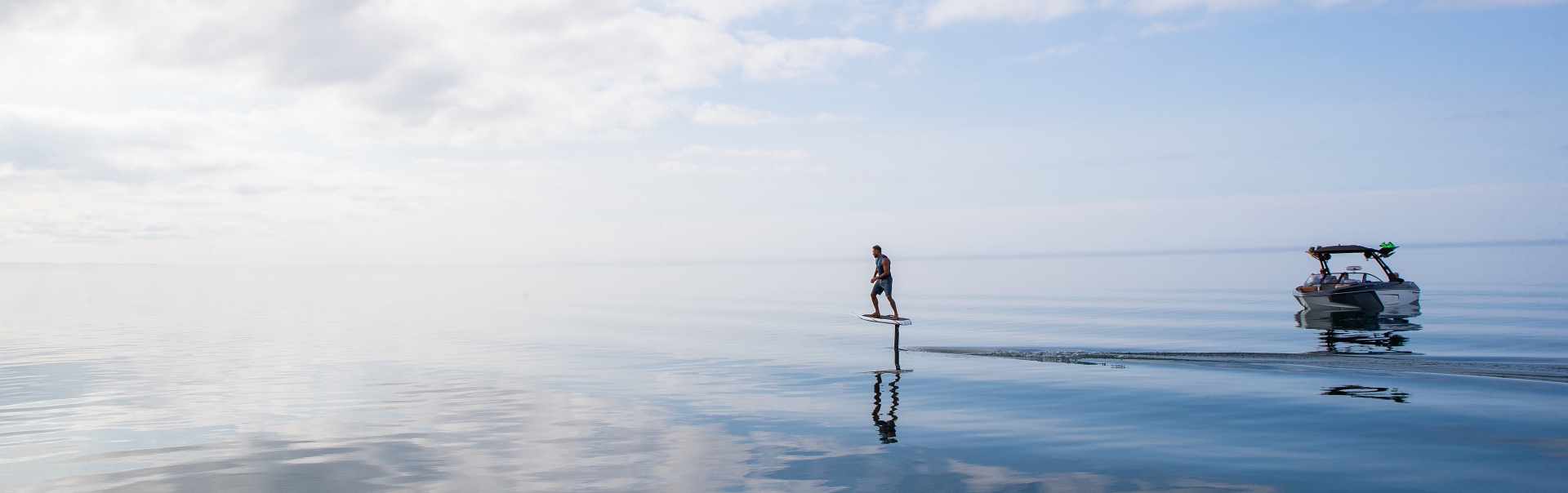
What is an eFoil?
The eFoil is a young watersport that takes the best of surfing, kitefoiling, and snowboarding and mixes it with the feeling of flight. What sets it apart is how quickly many people pick it up: with a little talent you may be gliding above the water after just 20 minutes.
Our advice is to take your first hour with an instructor. You'll skip most of the crashes that way, and after that first hour you can simply enjoy every session.
An eFoil combines the ride feel of classic surfing with the speed rush of motorized watersports.
Technically, an eFoil (electric hydrofoil) is a surfboard with a propeller-driven wing mounted underneath it. Past a certain speed, that wing generates enough lift to raise the board out of the water. Watch from the shore and the rider seems to hover over the surface.
Kiters, windsurfers, and surfers also love putting foils under their boards. The eFoil is especially practical on lakes and calm bays, because it needs neither wind nor waves, and its electric drive is quiet and emission-free. The rules on where you are allowed to ride change from country to country and even from lake to lake, so it pays to learn them for the spot you have in mind before you head out.
Riding a foil is like flying over the water, and the sensation stays with you long after you come back ashore.
How does an eFoil work?
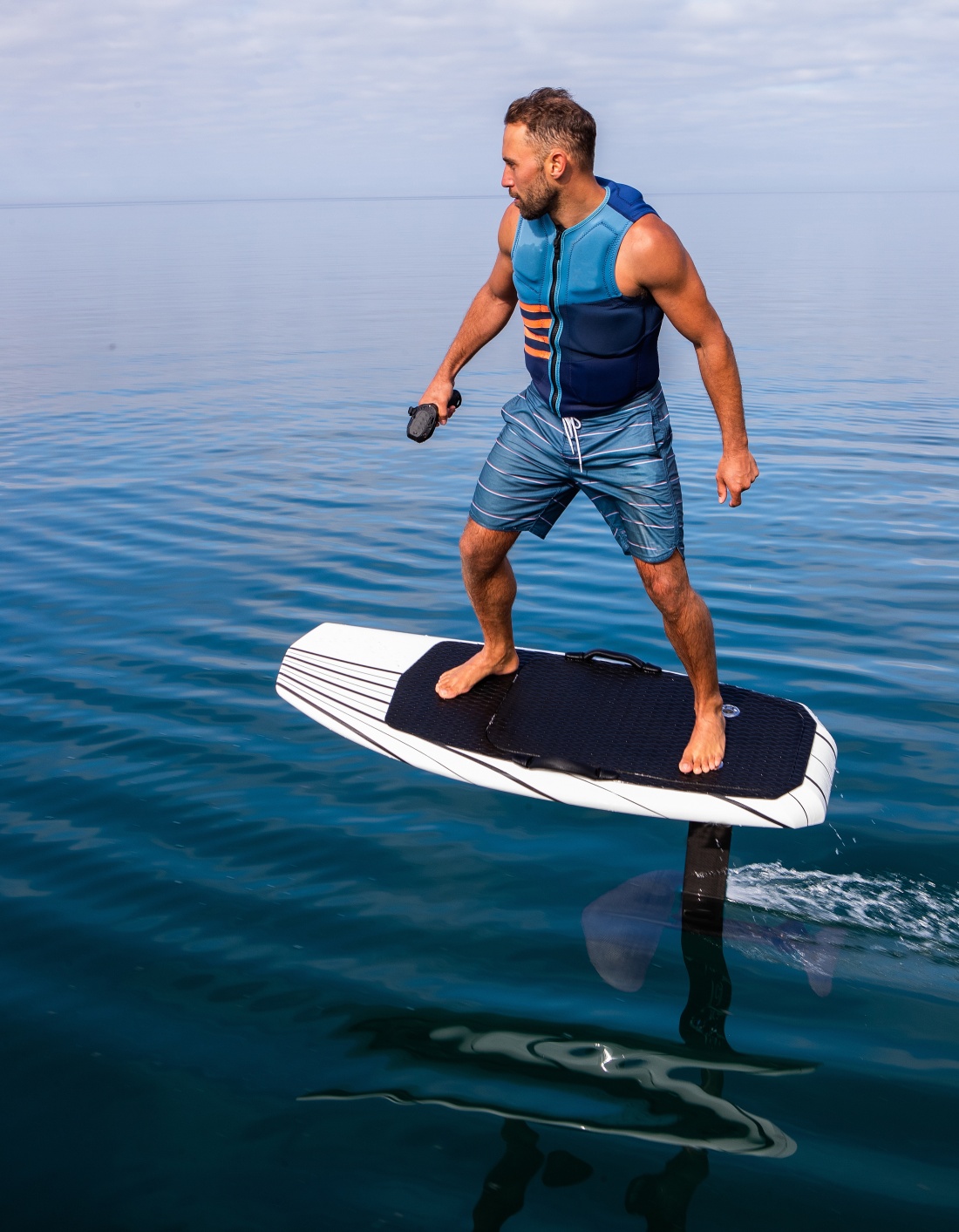
The base is a high-quality surfboard. Underneath it, a mast carries a powerful electric motor with a propeller, and the wing sits at the foot of the mast. The propeller pushes the board up to speed, and from that point the foil generates enough lift to raise the board out of the water. Hydrofoil boats work on the same principle. The higher the speed, the stronger the lift.
Think of the foil as a small airplane under water. Shift your weight back and the front wing starts to climb, which is your takeoff. Landing works the other way around: you bring your center of gravity forward until the board settles back down. Speed is set with a Bluetooth remote.
Makers quote top speeds from about 35 to 60 km/h (roughly 22 to 37 mph), depending on the model and the wing. Awake, for instance, gives 45 km/h (≈ 28 mph) for its VINGA Carve.
eFoil boards
Ready to ride, a carbon eFoil with a full-size battery weighs around 30 kg. Lift's LIFT5 Cruiser, for example, comes to 31.98 kg: 10.7 kg of board, 13.8 kg of battery, and the rest in mast, motor, and wings. Lighter builds such as Lift's LIFTX stay near 20 kg, while Aerofoils' big inflatable sets pass 40 kg with the larger battery. Premium boards are mostly carbon fiber, which is stiff yet light. Many entry models go with EPP foam or fiberglass, and some manufacturers also offer inflatable versions, which are easier to transport.
The motor is almost silent, so you can ride without disturbing the quiet around you. Ride time depends on the pack. For the battery that comes with the board, makers quote anywhere from 45 minutes to two and a half hours. Rider weight, speed, and wing choice all change how long a pack really lasts, so treat the quoted times as the upper end. A single hour of riding is enough to leave your legs properly tired.
The foil itself consists of a mast, fuselage (the central body), front wing, and stabilizer. Wing size sets the character. Small wings make the board faster but take more control. Large wings are more stable and easier to learn on, and you give up some top speed for that. Within one maker's range, price mostly follows the build. Lift's carbon LIFT5 costs more than the fiberglass LIFT5 F, although both run on one shared system. HydroFlyer likewise asks more for its carbon CF than for the fiberglass AL, yet fits both with a 6,000 W motor and a 2.4 kWh battery.
Paying more does not guarantee a longer session. Lift's lightweight LIFTX is rated for up to 45 minutes per charge, while several cheaper boards from Waydoo, SiFly, and HydroFlyer are rated for about two hours.
To see the models side by side, open our eFoil comparison, which brings the current models from the seven brands we cover together in one place, with prices, ride times, and a note on who each board is for.
How to learn eFoiling
The sport is not hard to pick up. Go through the steps below in order, and you'll be flying across the water sooner than you think:
- Whatever you do, put on a helmet and vest. As a beginner you are certain to fall in more than once.
- Find a suitable spot to practice, with no swimmers or other water users within 100 meters and smooth water without waves. The water also has to be deep enough, because the foil is delicate.
- Pull yourself onto the board the way you would climb onto a surfboard, but never use the foil or the motor as a step. Keep your feet as far away from the motor and the wings as possible.
- Set the remote to level 1, the beginner mode.
- Lie down on your stomach and throttle up.
- Unlike on a normal surfboard, the nose rises as you accelerate. Counter it by moving your center of gravity forward, pulling yourself a little toward the nose with your hands while you apply throttle.
- Keep your speed up, or the nose digs into the water and the board gets twitchy.
- Ride a few laps lying down. That is how you get to know the board, and how you get used to the speed and the turns.
- After that, try a few laps on your knees.
- Next comes standing up, the step most beginners look forward to. Take it slowly, and hold your speed while you get to your feet.
- Find a comfortable stance and ride a few laps, not too slowly, or the nose will start climbing again.
- Learn how to fall properly. If the board gets twitchy, use the last stable moment to jump off. Never jump forward. Always go to the side or backward, and as far away from the foil as you can.
- Once you're standing solidly on the board, you can start flying, step by step. This is the hardest part. At the right speed your feet move back and your upper body leans forward, which keeps your center of gravity where it was. From there, shift your weight back and the eFoil lifts off. Ride height comes purely from your center of gravity, not from the remote. Keep your first flights short and touch back down soon, then stretch your flight time bit by bit.
- The right foot position takes some practice to find, and how far back you stand depends on your weight. Front to back, place your feet slightly wider than shoulder width, which leaves you room to shift your weight. Side to side, slide them out to shoulder width too. That improves your balance and gives you more room to steer.
- How long it takes to learn varies from person to person. Most riders feel at home on the electric hydrofoil after about 4 to 5 hours of practice. If you already have watersports behind you, it sometimes takes no more than 20 minutes before you are up and flying. Complete newcomers settle in fine, and in most cases people learn eFoiling faster than surfing or kiteboarding.
Frequently asked questions
What is an eFoil?
An eFoil (also written e-foil) is an electric hydrofoil surfboard. Once you reach a certain speed, the wing mounted under the board lifts it clear of the water, so that you end up practically flying above the surface.
How long does it take to learn eFoiling?
Plan on 4 to 5 hours of practice before you feel confident on an electric hydrofoil. People who already do other watersports are sometimes up on the board and flying within 20 minutes.
What equipment do I need to eFoil?
An eFoil board with its wing, mast, electric motor, battery, and remote, plus a charger for the battery. Wear a helmet and a vest every time, because in the early sessions you'll end up in the water a lot.
Is eFoiling hard to learn?
No, many people learn it faster than surfing or kiteboarding. You go in stages, lying down first, then kneeling, then standing. Flying comes once you stand solidly, and it is the hardest part.
Where can I ride an eFoil?
Anywhere with deep enough water and no swimmers or other water users within 100 meters, provided the local rules allow it. Those differ by country and even by lake, so check the local regulations before you ride.