The propeller ban that leaves Canada to jet boards
Canada writes the board straight into its boating law. Section 1006 of the Small Vessel Regulations (SOR/2010-91) reads, in full, “No person shall (a) tow themselves using a vessel that is operated by remote control; or (b) operate a propeller-driven surfboard-type vessel.” We read the consolidated text on Justice Laws, current to September 30, 2026. The regulations were last amended on December 31, 2025, and paragraph (b) came through that amendment unchanged.
Our reading is that a propeller eFoil is a propeller-driven surfboard-type vessel, guarded or not. Section 1006 carries no wording about prop guards, rentals, lessons or exemptions. It is also silent on jet drives, and that silence is where jet boards fit. Breaking s. 1006(b) is a ticketable offence under the Contraventions Regulations (SOR/96-313, Schedule I.1, Part II, item 61), and the amount is $350. Every price and fine on this page is in Canadian dollars.
Fliteboard came to a similar view in a December 2024 blog post. Open propeller eFoils cannot be used in Canadian waters, the brand wrote, while its Flite Jet boards can, and the ban also takes in enclosed or ducted props. A Transport Canada working group was reviewing the rule, with no timeline given.
Boating Industry Canada had got there two years earlier. In April 2022 it called these boards “banned in Canada since 1999”, “regardless of whether the propeller has a guard or not”, and reported that Transport Canada was looking at updating the rules to remove the ban. Its Let's Talk Transportation consultation on the boards closed for comments on May 13, 2022. Four years on, paragraph (b) still reads exactly as it did.
Treat all of this as our reading of the federal texts on October 23, 2026, not as legal advice. In practice it comes down to one question for any school, asked before you pay: which drive do the lesson boards use? If the sport itself is new to you, the eFoil hub explains how the board lifts off the water.
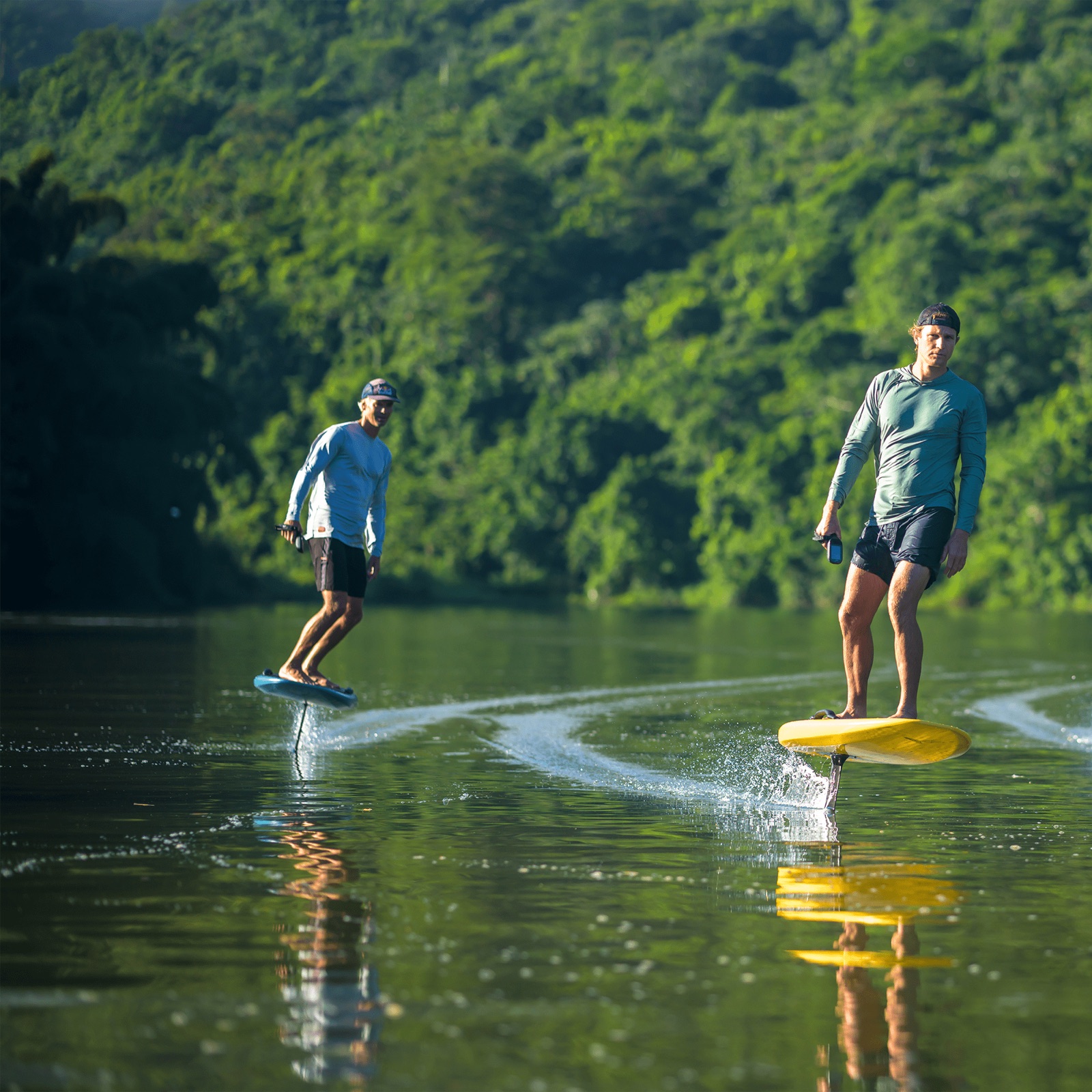
What a jet drive changes on the board
Fliteboard developed its jet option with Mercury Marine, and on the Flite Jet the impeller is completely shielded. The brand does not pretend the swap is free. In a January 2023 post it says the Flite Jet 2 draws more power than its propeller systems, so a rider gives up some efficiency and some thrust.
E-Foil Sports Muskoka sums up its own position in a single line: only jet eFoils are legal on Canadian waters. The school's workshop services Lift Foils, Waydoo and MSLR boards next to Fliteboard.
Importing a board adds a bill at the border. Boards shipped into Canada pay duties, brokerage and Canada Border Services Agency charges, and the Muskoka dealer puts the total for one board at more than $1,000. That is a dealer's figure, not an official one. Nor does clearing customs make a propeller board legal on the water; as we see it, it still may not be ridden.
Proof of competency with an electric motor
The second federal text is the Competency of Operators of Pleasure Craft Regulations (SOR/99-53, last amended October 6, 2020). Under s. 2(1) they apply to motorized pleasure craft used for recreation anywhere in Canadian waters except the Northwest Territories and Nunavut. Section 3(1) asks for two things, competency and proof of it on board. Transport Canada's page on the Pleasure Craft Operator Card (PCOC) leaves no room on motors: proof of competency is required “with all motor types (including electric trolling motors)”. A paper or electronic copy of the card does not count.
Section 4(1) lists what makes you competent. You can pass the test with at least 75 per cent and hold the card, show a course completed before April 1, 1999, or, on a rented craft, sign a rental boat safety checklist that stays valid for the rental period. The test has 36 questions (s. 7(4)(a)). You sit it after a course, in person or online, and only a provider accredited by Transport Canada can run both. Each provider sets its own fee. Fail, and you can try again as often as you need, though not more than once in 24 hours.
Schools and regulator do not line up on this point. E-Foil Sports Muskoka tells customers no boating license is needed and recommends a PCOC anyway. Transport Canada's wording on electric motors points the other way. As we read it, an owner riding a private eFoil should carry the card itself, a rider on a rented board is covered by the signed checklist, and s. 3(2) exempts a pupil on an accredited course under an instructor. Whether a given eFoil lesson counts as such a course is a question for the school.
Visitors get two openings. Section 3(2) excuses a non-resident whose own craft has been in Canada for less than 45 consecutive days, and s. 4(2) lets a non-resident show a document from their home country. We read the 45 day rule as covering only a boat the visitor brought in. Someone who rents goes through the checklist or the home document, and s. 1006(b) binds visitors and residents alike.
Nobody under 16 may drive a personal watercraft. The Small Vessel Regulations, though, define a personal watercraft (s. 1) as a vessel under 4 m driven by an internal combustion engine through a water-jet pump. A battery eFoil has no such engine, so in our reading it is not one, and the PWC age line does not reach it. Transport Canada's power limits for young operators are another matter, and we think they do apply. Without direct supervision, meaning someone 16 or older on board, a child under 12 may run up to 10 hp (7.5 kW) and a teenager of 12 to 15 up to 40 hp (30 kW).
Ten km/h within 30 meters of shore
Section 2(7) of the Vessel Operation Restriction Regulations (SOR/2008-120, last amended August 13, 2025) bars any power driven vessel, or one with electrical propulsion, from going faster than 10 km/h (about 6 mph) within 30 m of shore. It applies in the waters of Ontario, Manitoba, Saskatchewan and Alberta, in the rivers and lakes of British Columbia and of Nova Scotia, and on the Nitinat River, Nitinat Lake and Bras d'Or Lake. Québec is not on the list.
Section 2(8) carves out towing on a course away from and perpendicular to the shore, rivers under 100 m wide, canals, buoyed channels and the waters in Schedule 5 of TP 15587. Where a vessel has to keep to another speed limit set under the Canada Shipping Act, 2001 or the Canada Marine Act, s. 2(9) lets that limit apply instead. We read the 30 m rule as covering any legal jet eFoil on Ontario waters and on British Columbia's lakes and rivers, Alouette Lake included. The launch at Vanier Park and the water at Port Moody are sea, so we would put them outside s. 2(7). Go too fast too close and the ticket is $200.
Section 1007 of the Small Vessel Regulations forbids operating carelessly, without due care and attention or without reasonable consideration for others. Near docks, swimmers and paddlers, that line is easy to cross.
Swipe sideways to see all columns
| Offence | Rule | Fine (CAD) |
|---|---|---|
| Operating a propeller-driven surfboard-type vessel | SOR/2010-91, s. 1006(b) | $350 |
| Careless operation | SOR/2010-91, s. 1007 | $350 |
| No proof of competency held | SOR/99-53 | $250 |
| No proof of competency on board | SOR/99-53 | $250 |
| Letting an unqualified person operate | SOR/99-53 | $250 |
| Non-resident without proof of residency | SOR/99-53 | $250 |
| Over 10 km/h within 30 m of shore in listed waters | SOR/2008-120, s. 2(7) | $200 |
Port Carling and the Muskoka lakes
As far as our checks went, Ontario has one fixed eFoil school, and it is in Port Carling. The village sits on both Lake Muskoka and Lake Rosseau, and Lake Joseph is the third of the Muskoka lakes. Fliteboard lists a single Ontario location, hosted by E-Foil Sports Muskoka in Port Carling and riding on Lake Rosseau. The shop calls itself Muskoka's only official Fliteboard partner and the only authorized Level 3 Fliteboard service provider in the province.
Its Flite School runs from three places. One is SWS Boatworks in Port Carling, a family owned business with two marinas in the village, one on Lake Muskoka and one on Lake Rosseau. Another is on Lake Muskoka, the third at the JW Marriott Resort and Spa. Walk in sessions, private lessons and group clinics are open to anyone 12 or older, and the instructors will also come to your own dock.
Fliteboard's Ontario page breaks the offer into a long list of formats. There are Flite Experience group sessions, private one hour lessons for up to two, sessions of three hours or more for groups of four to eight, full day clinics, corporate events and cottage clinics at your dock, plus Flitescooter hire. Visitors with their own board can rent a Flitecell and charger. No prices are published. The school's own site adds a weight limit, and riders must be under 120 kg (265 lb).
Kelowna and Okanagan Lake
Kelowna e-Foil Adventures presents itself as Canada's LIFT e-Foil headquarters. It teaches on Okanagan Lake with all the gear included, says most first timers are flying by the end of their first lesson, and sells LIFT 5 and LIFT 5F boards. Lesson prices sit behind an online booking calendar. Its pages do not say which drive the teaching boards use, and with s. 1006(b) in force that is the first thing to settle when you book. More on the lake and the school is on our Kelowna page.
The International Lake Environment Committee's World Lake Database gives Okanagan Lake 351 km², a maximum depth of 230 m, a mean depth of 76 m and 270 km of shoreline, with a regulated water level. Long term surface records from 1977 to 1988 give 11 °C in May, 14 °C in June, 20 °C in July and 22 °C in August, falling to 18.8 °C in September and 15 °C in October. The whole lake has frozen over only three or four times in a century. Being a British Columbia lake, it also comes, we believe, under the 10 km/h limit inside 30 m of shore.
Vanier Park, Port Moody and Alouette Lake around Vancouver
X-Foil Vancouver teaches on three very different waters, and every lesson is on a Fliteboard eFoil. The main hub is Vanier Park, next to BC Waterbikes. The other two are Rocky Point in Port Moody, which is tidal, and Alouette Lake in Golden Ears Park, which the school describes as calm and open. No experience is needed.
The list price for an individual private eFoil lesson was $269 CAD for two hours when we read it on October 23, 2026, with the equipment, a helmet and a PFD included. The site names the brand but not the drive, so the jet question is one to put to X-Foil directly. On Alouette Lake, as we read SOR/2008-120, the shoreline speed rule applies; at the two sea spots it does not.
Squamish belongs to the wind
Nobody teaches eFoil in Squamish that we could find. The town runs on wind. Squamish Watersports teaches kiting and wingfoiling on Howe Sound. The Squamish Windsports Society, a non profit with more than 1,000 members, runs shuttle and safety services at Pepahím̓ island in the Squamish estuary on windy days between May 15 and September 15.
The safety kit list is shorter for wind riders. Under s. 219(1) of the Small Vessel Regulations, a sailboard or kiteboard whose rider wears a PFD needs to carry only a sound-signalling device, plus a watertight flashlight after sunset, before sunrise or in restricted visibility. Wingfoil boards are not named in that section. Without a motor no operator card is needed, and the PCOC FAQ says so for every non-powered craft.
Québec's confirmed eFoil school is on the Magdalen Islands
For a lesson in Québec, look far out in the Gulf of St. Lawrence. Plein Vent les Îles, in Havre-Aubert on the Îles de la Madeleine, is an official Fliteboard partner and teaches on the Flite Air (110 L) or the Flite Scooter, both with the Flite Jet 2. The kit comes with a full battery, a 5/4 wetsuit, a lifejacket, neoprene boots and a two way headset so you can talk to the instructor while you ride. A beanie, gloves and a neoprene hoodie are added if needed. We take that list as a sign of how cool the sea stays out there.
Here the prices are public. A two hour training costs $250 plus tax, for riders 14 and over who can swim. Once you have trained, or if you already foil, a 1h30 rental with about 60 minutes on the water costs $170 plus tax, from 18, with an instructor on site. A package of one training and two rentals is $500 plus tax, also from 18. Groups never exceed two students. Those are list prices from the school and Tourisme Îles de la Madeleine, read on October 23, 2026.
The islands escape the shoreline speed rule, since Québec is not on its list, but s. 1006(b) and the operator card rules apply there all the same.
Why Toronto riders drive north
None of Toronto, Ottawa, Calgary or Montréal has a fixed eFoil school that we could confirm. Toronto comes closest, with sessions that turn up on booking marketplaces and meeting points west of the city. Searches for the other three turned up no school at all.
From Toronto the realistic plan is a drive north to Port Carling. From Montréal the confirmed option is the Magdalen Islands, which makes it a trip and not an afternoon. Our pages on eFoil in California, Austin and Miami cover the schools and the rules south of the border.
Swipe sideways to see all columns
| Operator | Where | Boards | Published price |
|---|---|---|---|
| E-Foil Sports Muskoka | Port Carling, Lake Rosseau and Lake Muskoka, Ontario | Fliteboard; says only jet eFoils are legal | none, booking only |
| Kelowna e-Foil Adventures | Okanagan Lake, British Columbia | LIFT, drive not stated | booking calendar |
| X-Foil Vancouver | Vanier Park, Rocky Point (Port Moody), Alouette Lake | Fliteboard, drive not stated | $269, private, 2 hours |
| Plein Vent les Îles | Havre-Aubert, Magdalen Islands, Québec | Flite Air or Flite Scooter, Flite Jet 2 | $250 plus tax, training, 2 hours |
Summer water, and winter sessions on Lake Muskoka
eFoil in Canada is a summer sport on open water. No school we found publishes fixed opening or closing dates, so think in seasons. On Okanagan Lake the long term means only reach 20 °C in July and August.
On the Magdalen Islands a 5/4 wetsuit is standard kit. At Squamish the windsports society runs its estuary shuttle on windy days from mid May to mid September.
Only in Muskoka does the calendar stretch further. E-Foil Sports Muskoka shows winter sessions on Lake Muskoka on its site, something no other Canadian school we found does. Water conditions and the gear you will need are the things to clear with the school before you plan one.