Michigan eFoil spots: one huge lake and a great many small ones
Four of the five Great Lakes touch Michigan. The state counts about 3,288 miles of Great Lakes coastline and more than 10,000 inland lakes and ponds, according to the introduction of the DNR's boating handbook. For a sport that wants flat water, that is a generous map. Lake Michigan is the one that draws the eye. It is the second largest of the Great Lakes by volume and, as the EPA puts it, the only one lying wholly within the United States.
The lessons we could confirm do not happen out on the big lake. MACkite Boardsports Center in Grand Haven, on the West Michigan shore, teaches on Pottawattomie Park Lake, a protected stretch of water in town. Lake Life Efoils is based on Lake Leelanau in Northern Michigan and drives its boards to inland lakes and bays from the Traverse City area up toward Petoskey.
Neither of them rents a board for solo riding. So for a visitor the way onto an eFoil here is a lesson of about two hours with an instructor close by, booked in advance. Registration, boater certificates and the personal watercraft rules only come into play once you own a board. If the sport is new to you, our eFoil guide explains how the board, the foil and the remote work together.
One search trap. “Efoil Michigan City” points to Michigan City in Indiana, on the south shore of Lake Michigan across the state line, which this page does not cover.
Grand Haven lessons on Pottawattomie Park Lake
MACkite Boardsports Center is a board sports shop in Grand Haven and a school for kiting, wing foiling and eFoiling. Its eFoil lessons skip the open Lake Michigan beach. They run at Pottawattomie Park, on Pottawattomie Park Lake, which the school describes as “a protected area that works well for controlled learning”. Kite and wing foiling lessons are held elsewhere, at Pere Marquette Park in Muskegon.
A lesson takes two hours in all. Fifteen minutes go to setup and fifteen to instruction on the beach, leaving an hour and a half of ride time. On land you go through the riding area and its safety points, the remote with its throttle and its way of stopping, body position, and how to fall safely. Once afloat you lie prone or kneel, stand up at low speed, learn to accelerate under control, and only then lift onto the foil. Most students are up and riding in their first lesson, MACkite says.
MACkite lists $299 for one person and $200 for each additional person (list prices as published in October 2026). The age floor is firm at 16 or older, with a valid driver's license. All lesson equipment is provided, so you bring a swimsuit, a towel, water and sunscreen. The school names no board brand for its lessons. Its shop, though, sells complete eFoils from several makers.
Booking runs online and needs at least 48 hours' notice. The night before, a confirmation or a weather update arrives, and a lesson cancelled for unsafe conditions can be rescheduled. MACkite does not rent eFoils, “due to insurance and safety requirements”, and its boards are ridden under an instructor's supervision for as long as the lesson lasts. Questions about lessons go to 616-215-1686 or Lessons@mackite.com.
No wind is needed. That makes a lesson easy to fit into a short trip, and the school says it works with visitors from Chicago and from across the Midwest, naming the Coast Guard Festival among the reasons people come to town.
Lake Leelanau, Torch Lake and the other northern inland lakes
Lake Life Efoils is an official Lift affiliate on Lake Leelanau, selling boards as well as teaching. It runs one to one and group lessons on its home lake and travels for some groups, bringing lessons, group sessions and on-water demos to lake houses, Airbnbs, private docks and waterfront properties. Its service area covers Leelanau, Grand Traverse, Benzie, Antrim and Charlevoix counties, centered on Traverse City and Lake Leelanau, with Petoskey added when travel allows. Most lessons last two hours.
The school names its usual spots: Lake Leelanau, Torch Lake, Glen Lake, Crystal Lake, Walloon Lake, Elk Lake, Grand Traverse Bay and Suttons Bay, or another inland lake. Not every dock qualifies. A spot needs enough depth, safe launch access and calm water. Lake Life also names what rules one out: heavy boat traffic, shallow water at the dock, wind above a safe threshold, or poor access from the shore. Those four points decide whether the dock of a rented cottage will do.
Gear travels with the instructor. Lake Life brings the eFoils, helmets, life jackets, BB Talkin headsets and other safety gear, plus wetsuits or cold water gear when the lake calls for it. A Northern Express report from August 8, 2026 filled in the teaching side: prop guards on the boards, a whistle for every student, land training before anyone gets wet, and an inflatable training aid called a Blowfish, which adds buoyancy. Lessons start on the knees.
That report also says the school teaches on Lift and, since 2026, on Waydoo boards. The boards pictured on Lake Life's site are Lift4 and Lift3 models, and the school says an eFoil rides for up to about two hours on a charge. Take that as the operator's figure; our eFoil battery page explains what moves run time up or down.
Children are a case by case decision here. Lake Life takes them depending on age, size, conditions and the instructor's approval, so a family with a twelve year old should ask this school first. Lake Life's phone is 231-866-1504.
Michigan eFoil lesson prices, school by school
MACkite charges a full rate for the first rider and a lower one for each rider who joins. Lake Life works on a sliding group scale: $250 alone, $500 for two, and from there each extra person adds $150, up to $1,400 for a group of eight.
Swipe sideways to see all columns
| Operator | Where | Lesson | Price |
|---|---|---|---|
| MACkite Boardsports Center | Pottawattomie Park Lake, Grand Haven | 1 person, 2 hours | $299 |
| MACkite Boardsports Center | Pottawattomie Park Lake, Grand Haven | Each additional person | $200 |
| Lake Life Efoils | Lake Leelanau, travels for some groups | 1 person | $250 |
| Lake Life Efoils | Lake Leelanau, travels for some groups | 2 people | $500 |
| Lake Life Efoils | Lake Leelanau, travels for some groups | 4 people | $800 |
| Lake Life Efoils | Lake Leelanau, travels for some groups | 8 people | $1,400 |
Two riders pay $499 at MACkite and $500 at Lake Life, a dollar apart. A family of four pays $899 in Grand Haven by our arithmetic and $800 up north.
Both schools sell boards, should the lesson end in a purchase. Lake Life is a Lift affiliate and also teaches on Waydoo. MACkite's shop sells complete eFoils of several brands and handles the title transfer paperwork for Waydoo boards. Before you sign anything, our eFoil price guide and the notes on buying a used eFoil help you judge an offer. A board you own needs Michigan registration as a personal watercraft, on our reading of the rules below.
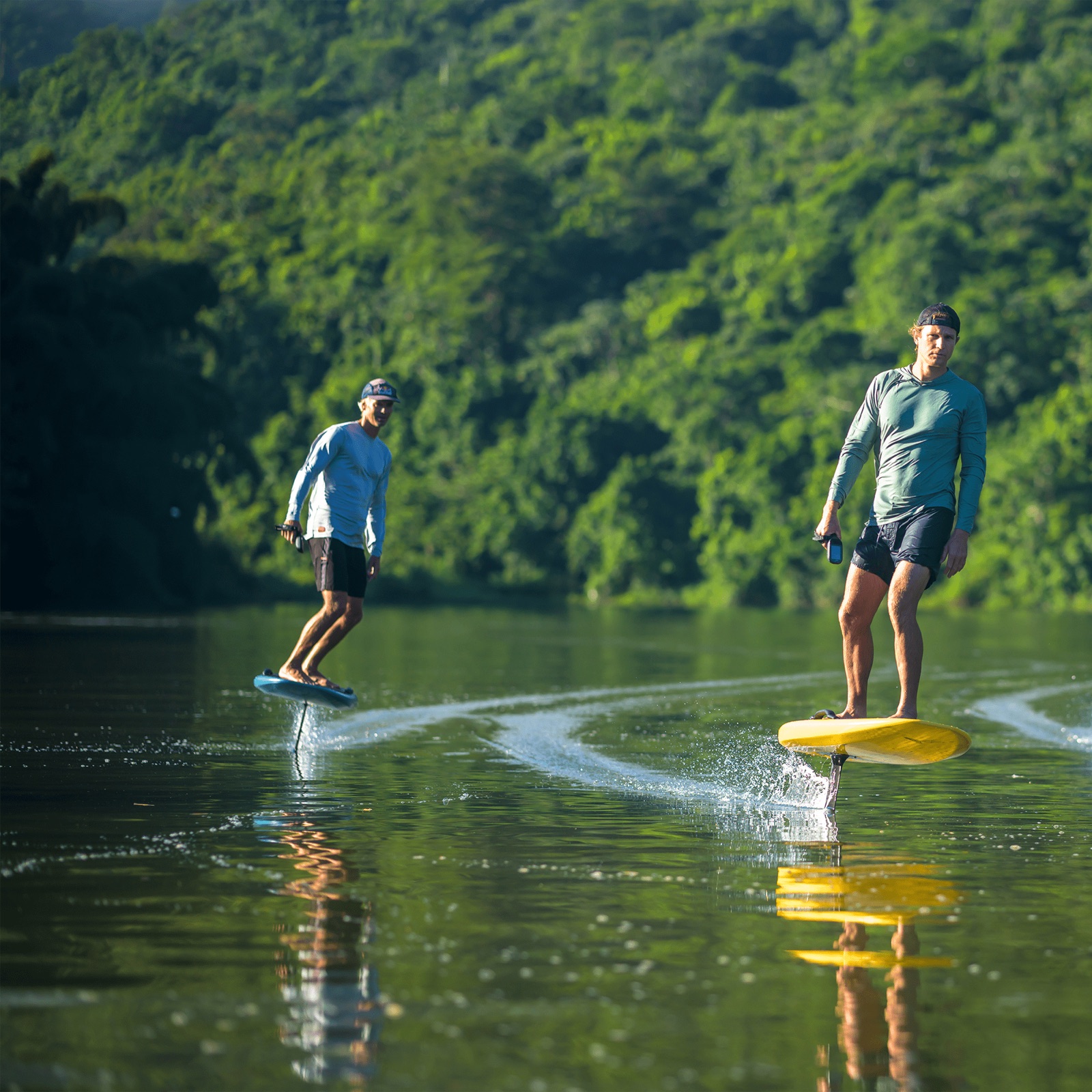
Michigan registers an eFoil as a personal watercraft
Whether a board with a propeller counts as a boat was settled at federal level first. In Policy Letter 01-22 of August 26, 2022 (CG-BSX), the US Coast Guard wrote that eFoils and jetboards “have been determined to be vessels”, subject to every rule for recreational vessels propelled by machinery, and noted that the boards are capable of more than 35 mph. Numbering is left to the state of principal operation, which may list the boards as “Personal Watercraft” or “Other” once the hull identification number has been validated (para. 4.a). Under para. 4.e an owner carries the certificate of number, carries or wears a life jacket as state and federal rules require, carries a whistle or another sound device and follows the Inland Navigation Rules in 33 CFR 83, lights included. The Coast Guard frames all of this as guidance; the letter creates no rule of its own.
For Michigan, the clearest statement we found comes from a sheriff's office, not from the state itself. A WTHD report from June 13, 2026 quotes the Branch County Sheriff's Office, which says that after talks with the Michigan Secretary of State and boating safety officials, eFoils are registered in Michigan as personal watercraft. They must be registered, the rider wears a life jacket, and riding in low light or at night is out.
The paperwork follows the Handbook of Michigan Boating Laws and Responsibilities, 2026 Edition from the Michigan DNR, whose legal basis is Parts 801 and 802 of Public Act 451 of 1994. Page 21 says that every watercraft with a motor must be registered, electric ones included. The certificate of number stays on board, and the number is displayed on both sides of the bow. A boat registered in another state is exempt for up to 60 days on Michigan waters. Certificates and decals come from any Secretary of State branch (1-888-SOS-MICH, michigan.gov/sos). They expire on March 31 every three years and can be renewed online (p. 22).
None of that lands on you for a lesson. The schools ride their own boards under supervision and deal with their own registration, so certificates and age limits start to matter when you buy or bring a board. That is our reading of the operators' terms set against the handbook.
DNR personal watercraft rules, applied to an eFoil
As we read the handbook, its personal watercraft section applies to any board registered as PWC. Several of those rules shape a Lake Michigan session far more than any speed limit. Page numbers refer to the 2026 edition.
- Age (p. 26). Nobody under 14 may operate a PWC. At 14 and 15 you need a boating safety certificate and a parent, guardian or designated adult aged 21 or more on board or within 100 feet. Anyone born after December 31, 1978 and aged 16 or older needs the certificate; anyone born on or before that date does not.
- Life jacket and lanyard (p. 42). Everyone wears a USCG approved wearable life jacket, and inflatable ones are not allowed. The engine cut-off lanyard attaches to the operator, the clothing or the life jacket. No child under 7 rides unless a parent, guardian or designee comes along.
- Hours (p. 42). No operation from sunset to 8:00 a.m., with sunset as the National Weather Service sets it.
- Great Lakes shore (p. 42). Within 200 feet of a Great Lakes shoreline only slow, no wake speed, heading perpendicular to shore. In water under two feet deep only slow, no wake speed, or when docking or launching. Slow, no wake as well when crossing within 150 feet behind a vessel that is not a PWC.
- National parks (p. 42). PWC are prohibited inside Sleeping Bear Dunes National Lakeshore and Isle Royale National Park, and Pictured Rocks National Lakeshore has restrictions too, under 36 CFR Part 3.
Other rules bind every boat on the water. Above slow, no wake speed you keep 100 feet from shoreline in water under three feet, from moored or anchored vessels, docks and rafts, from marked swimming areas and from people in the water, and you travel counterclockwise where no channels are marked (pp. 36 to 37). The speed limit is 55 mph unless you are a mile offshore on the Great Lakes or Lake St. Clair (p. 36), and children under 6 wear a USCG approved wearable life jacket on the open deck of any vessel underway (p. 27).
Two of these change a day at the beach. A launch from a Lake Michigan beach means, under our reading of the 200 foot rule, a slow, straight run away from the shore before you think about foiling.
Early risers and evening riders both run into the hours rule. On a board registered as PWC, if our interpretation holds, there is no session after sunset and none before 8:00 a.m.
This is our reading of official texts and a news report, not legal advice. The Michigan DNR and the Secretary of State can confirm what applies to your own board.
Great Lakes water temperature and the eFoil season in Michigan
Cold water sets the calendar. We averaged NOAA GLERL's GLSEA surface temperature data for 2015 to 2023 across the whole of each lake. Lake Michigan comes out at 6.6 °C (44 °F) in May and 13.1 °C (56 °F) in June, climbs to 19.9 °C (68 °F) in July and peaks at 21.7 °C (71 °F) in August. September still holds 19.5 °C (67 °F). By October the average has dropped to 14.6 °C (58 °F).
Swipe sideways to see all columns
| Month | Lake Michigan | Lake Huron | Lake St. Clair |
|---|---|---|---|
| June | 13.1 °C | 12.0 °C | 19.1 °C |
| July | 19.9 °C | 18.6 °C | 23.3 °C |
| August | 21.7 °C | 20.6 °C | 23.7 °C |
| September | 19.5 °C | 18.7 °C | 21.1 °C |
Shallow Lake St. Clair warms far sooner, at 19.1 °C in June against 13.1 °C for Lake Michigan, and Lake Huron runs a little cooler than Lake Michigan all summer. On Lake Michigan the realistic eFoil months are June to September, with a wetsuit at either end. Lake Life packs wetsuits or cold water gear, and MACkite sends its weather update the night before.
Warm water does not settle it. Both schools teach on sheltered water such as Pottawattomie Park Lake, away from the open Lake Michigan beach, and a breeze can still rule a spot out on the day.
Grand Haven's beach information page gathers the useful links in one place: a pier lighthouse camera, a view of the beach flags, NOAA beach conditions, Ottawa County beach advisories and a West Michigan beach forecast. Offshore, NOAA buoy 45161 Muskegon, run by NOAA GLERL, reports the water temperature at 1 m depth off the Muskegon and Grand Haven shore. The National Weather Service asks everyone to check the local beach forecast before leaving for the beach, and it publishes videos on Great Lakes rip currents.
Across the border, the Canadian shore of the lakes has its own rules and schools, covered on our Ontario eFoil page.