Cotuit Bay or Provincetown: one school, two kinds of water
eFoil Cape Cod started in Barnstable, launching from Ropes Beach in the village of Cotuit. In 2025 it added a second location in Provincetown, where the Chamber of Commerce lists it at 333 Commercial Street. Travel lessons take the boards further still, to private docks and beaches around the region.
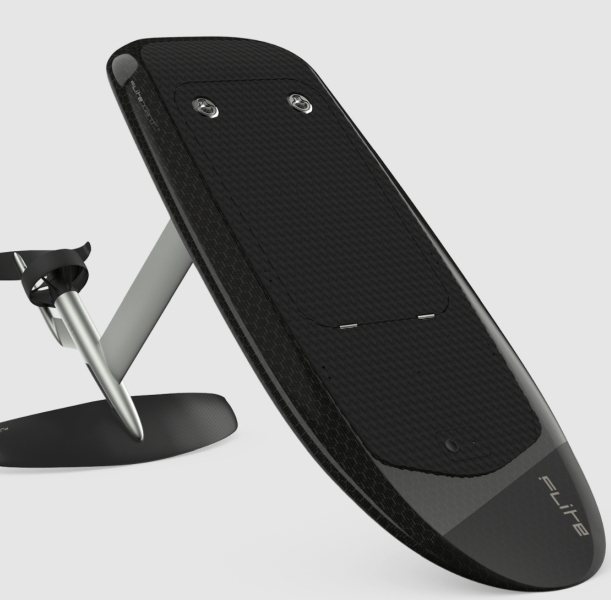
The school describes itself as a registered affiliate of two makers. For Lift it is a demo partner and reseller, for Fliteboard a Fliteschool and reseller. Our pages on Lift eFoils and on Fliteboard cover the models, and the eFoil basics guide covers the sport itself.
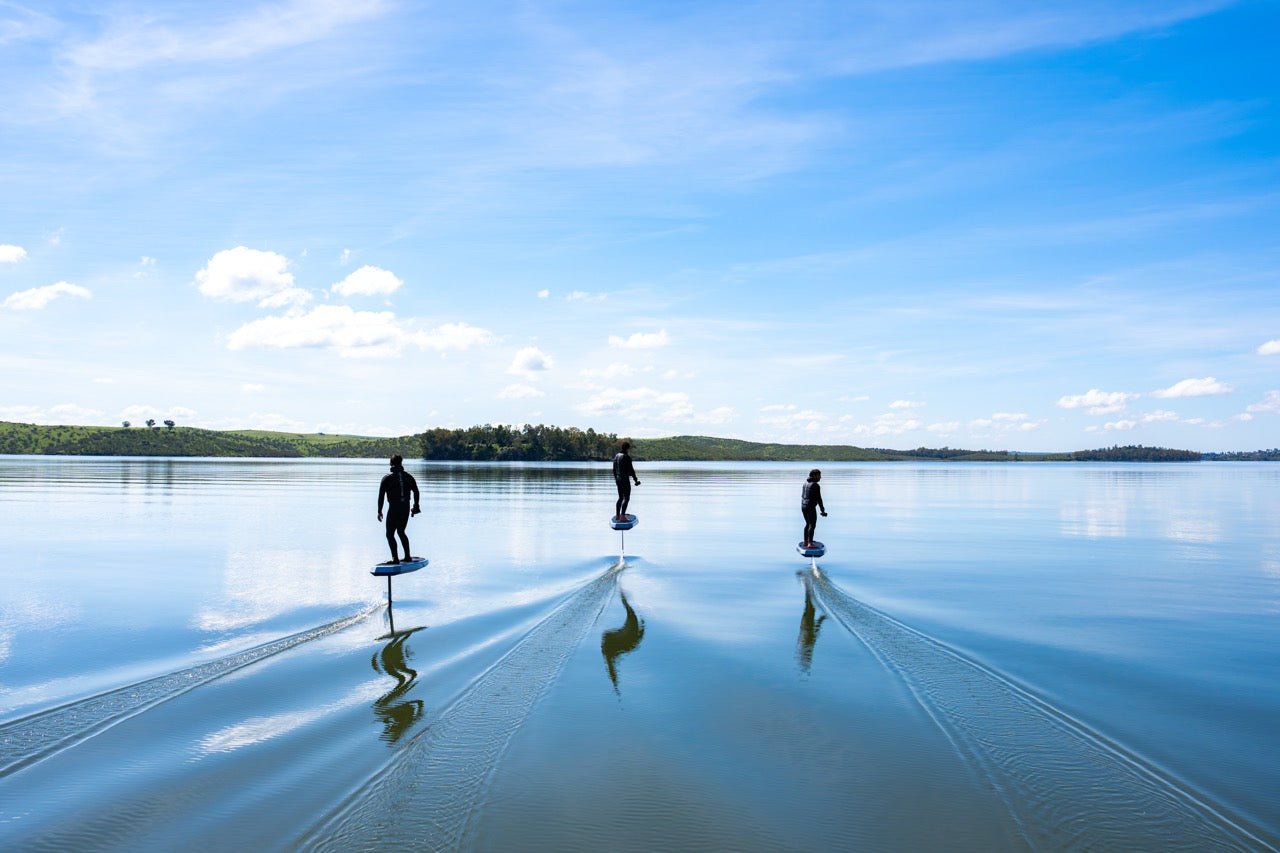
Cotuit Bay is the gentle option. The school calls its Barnstable water warm, calm and protected by the bay, at 70 to 80°F through the summer, and lessons cross to open water clear of moorings and boat channels.
Provincetown asks a little more of you. The school says it built this base for group lessons and events, and that wind counts for more at the tip of the Cape because the waves get bigger. A nervous first timer, we think, will usually have the easier day in Cotuit.
Ninety minutes off Ropes Beach
Ropes Beach, one of the ways to the water listed by the Town of Barnstable, puts you straight onto Cotuit Bay, and the school has private parking there. There is no bathroom on site, so plan the drive with that in mind.
About ten minutes of instruction on land come first. Then the group crosses the bay to open water away from the moored boats, and most of the riding happens out of sight of the beach. Your instructor rides alongside or follows in the boat, for most lessons a 13 ft Whaler, which has room for up to two passengers who only want to watch.
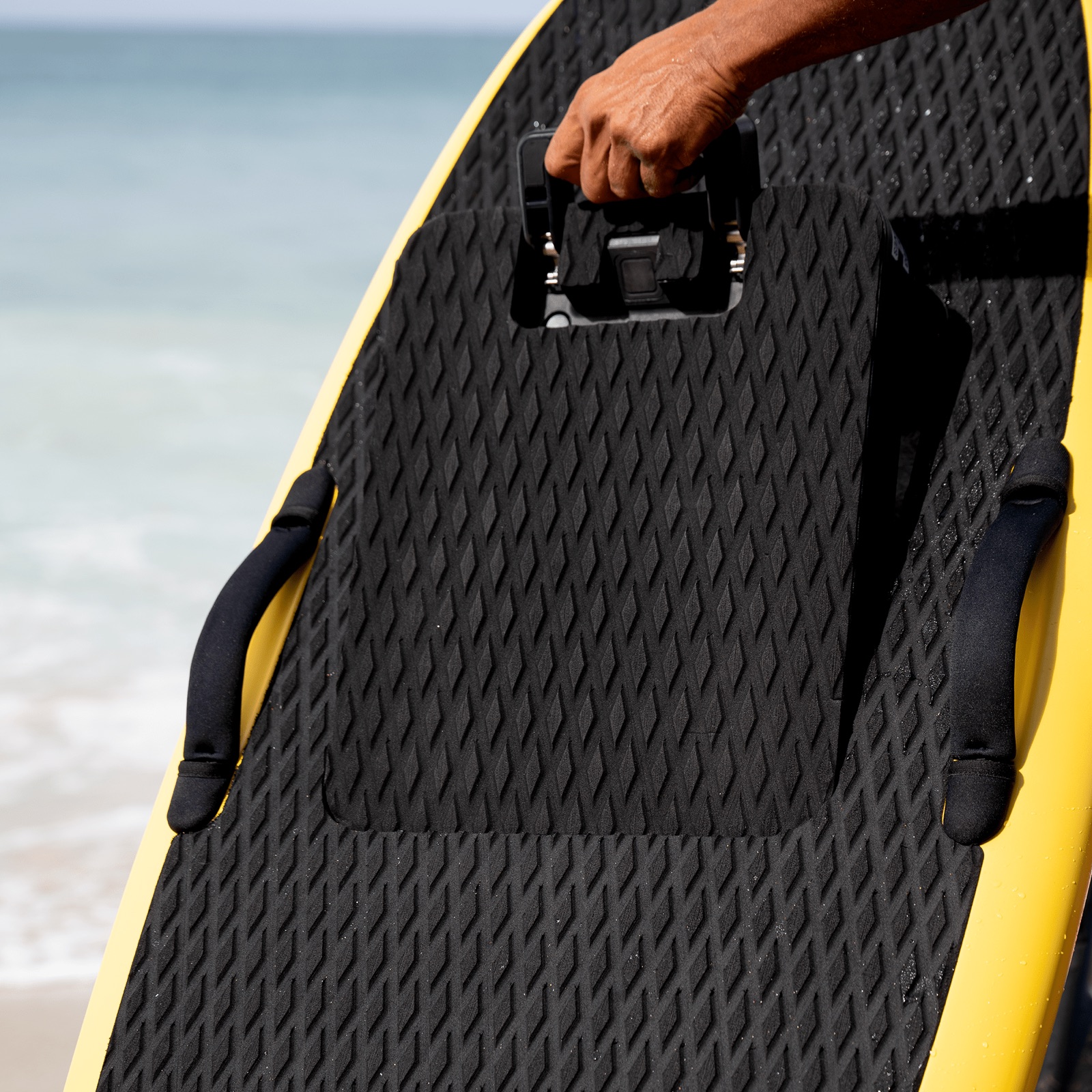
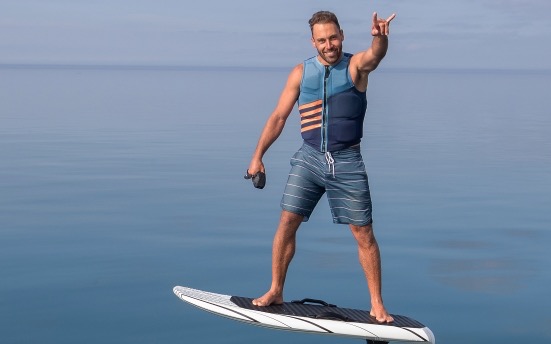
First flights use the larger, steadier boards, often with an inflatable attached. You lie on your stomach, move to your knees, stand, and only then add speed until the foil lifts the board clear of the surface. One rider gets one eFoil; two to four riders share two, and a third can be requested. The price per person drops as the group grows.
Life jackets and helmets are provided, the propellers run inside shrouds, and phones and wallets can ride in the boat. A towel, dry clothes and plenty of water beforehand are all you need to bring. Skip the beer at lunch, since the school may turn intoxicated riders away. Next Level Watersports on Nantucket puts a typical battery at about 1.5 hours, depending on rider weight and use, close to the length of a lesson.
Online booking for Barnstable closes 24 hours before the start. Too much wind or any lightning means a new slot or a full refund, while light rain or a breeze is usually ridden through. Cancelling is free up to 12 hours ahead; after that, or for a no show, the school may charge $200 in Barnstable and $250 in Provincetown.
Provincetown lessons from the beach by MacMillan Pier
In Provincetown the lessons start from the beach next to MacMillan Pier or, when conditions call for it, from the Harbor Hotel. A safety boat goes out with every session, and wetsuits are part of the safety gear, for good reason. Set the NOAA averages side by side and, as we see it, the water off the tip of the Cape runs several degrees cooler in high summer than at Woods Hole or in Nantucket Sound.
The booking options follow the school's own description of this base as a place for groups. Once everyone has had a lesson, a group can reserve eFoils for two hours with no limit on riders taking turns. Events on site run two hours for up to six people, or three hours for more.
You can reach it without a car. The Chamber of Commerce calls MacMillan Pier the major transportation hub of Cape Cod: seasonal fast ferries from Boston (Bay State Cruise Co. and Boston Harbor City Cruises, May to October) take about 90 minutes, and Captain John Boats sails from Plymouth. Driving from Boston on Route 6 takes about 2 hours 15 minutes. There is also the short flight to Provincetown Municipal Airport, open year round and ten minutes from the center, with Cape Air flying to Boston all year.
From a $250 lesson to a week of rental
The table below gives eFoil Cape Cod list prices as read on its own pages. Provincetown prices its 90 minute lesson by group size, so three friends pay $550 between them, a little over $183 each.
Rentals are only for people who already ride eFoils; everyone else books a lesson first. Every rental includes one or two batteries, a charger and delivery.
Travel lessons bring the boards to a private dock, beach or waterfront property up to two hours from Cotuit, priced by distance, riders, boards and length. The school also sells shareable bundles of three 90 minute lessons, valid at both locations, and gift certificates.
Swipe sideways to see all columns
| Where | What | Length | Price |
|---|---|---|---|
| Barnstable (Cotuit) | Private lesson | 90 minutes | from $250 |
| Provincetown | Lesson, 1 rider | 90 minutes | $300 |
| Provincetown | Lesson, 2 riders | 90 minutes | $400 |
| Provincetown | Lesson, 3 riders | 90 minutes | $550 |
| Provincetown | 2 eFoils after a lesson, any number of riders | 2 hours | $650 |
| Provincetown | 3 eFoils after a lesson, any number of riders | 2 hours | $800 |
| Your dock, up to 2 hours from Cotuit | Travel lesson | varies | $500 to $1,500 |
| Delivered | Rental, 1 eFoil | 1, 3 or 7 days | $450, $1,200 or $2,450 |
| Delivered | Rental, 2 eFoils | 1 or 2 days | $800 or $1,500 |
Next to a week of rental, buying looks less far fetched. Our eFoil price guide shows what new boards cost, and the page on buying a used eFoil covers secondhand boards. Owning one in Massachusetts, as we understand the statutes, also means a registration number and a boater safety certificate.
The Hanson Milone Act and the Massachusetts boater card
Chapter 350 of the Acts of 2024, the Hanson Milone Act on boater safety, was approved on January 8, 2025 and amends chapter 90B of the General Laws. Its new section 9E(a) says anyone operating a motorboat or a personal watercraft must have a boater safety certificate on board. That took effect on April 1, 2026, with penalties under section 9B from September 1, 2026; people born on or before January 1, 1989 have until April 1, 2028.
The act lists exemptions: an operator under the direct supervision, on board, of a certificate holder aged 18 or over; non residents with a certificate from another US state, a territory, the District of Columbia or Canada; and people operating in a boater safety education program. We doubt that supervision on board can work on a board that carries one person, so ask the school how your lesson is covered. Section 9E(b) lets children under 12 operate a motorboat only with a certificate holder aged 18 or over on board and supervising.
The Massachusetts Environmental Police (MEP) answer the practical questions in a FAQ on mass.gov. Renters need a certificate too, and MEP is considering temporary certificates for rentals of lower power motorboats. Non residents may use a certificate from another state, a US territory or Transport Canada; Massachusetts residents may not. Courses run online or in person (about 10 to 12 hours including the exam), the minimum age is 12, the state does not currently charge for its own courses, and a NASBLA approved certificate does not expire.
Chapter 350 also adds section 5(m): a lanyard engine cutoff fitted by the manufacturer must be attached to the operator, their clothing or their life jacket. Nothing in the text, as far as we can see, says whether the wireless remote of an eFoil counts as a lanyard type switch.
Surf jets, motorboats and chapter 90B
No Massachusetts statute uses the word eFoil. Section 1 of chapter 90B defines a motorboat as any vessel propelled by machinery, whether or not that is its main propulsion, and a personal watercraft as a vessel with a water jet pump or other machinery as primary motor propulsion, operated sitting, standing or kneeling on it, surf jets included. A surf jet is “a surfboard propelled by machinery and designed to travel over water”. An eFoil, in our view, very likely fits.
Section 2 says every motorboat on Massachusetts waters must be numbered. Among the exceptions is a boat numbered in another state or federally that spends no more than sixty consecutive days in Massachusetts. We would expect a privately owned eFoil kept in the state to need one; MEP can confirm.
Section 9A is the one that shapes a day on the water. It says that no jet ski, surf jet or wetbike may be operated:
- by anyone under 16;
- within 150 feet of a swimmer, the shore or a moored vessel, except at headway speed;
- on waters of less than 75 acres;
- without a personal flotation device worn by the operator;
- between sunset and sunrise.
We take this section to cover eFoils as well, though no official ruling says so. If it does, ponds under 75 acres are closed to the board, and pond sessions are best left to the school. The age floor also differs from the school's policy, which lets riders aged 12 to 15 operate an eFoil with the Massachusetts certificate. The MEP FAQ sets 16 for personal watercraft whatever certificate the operator holds, and nobody under 18 may supervise.
Our guess is that the school treats the eFoil as a motorboat rather than a personal watercraft. Booking for a teenager? Confirm with the school and with MEP first. This section is our reading of the statutes on malegislature.gov and the MEP FAQ on mass.gov, not legal advice; the Environmental Police have the final word.
Provincetown harbor regulations and the Barnstable code
Town rules sit on top of state law. Chapter 3 of the Provincetown Harbor Regulations was adopted on December 13, 1993, took effect on January 1, 1997 and was last amended on May 9, 2022. Section 3-1-4 defines a personal watercraft as a machine propelled vessel operated by someone sitting, standing or kneeling on it.
Under section 3-4-2, anchorage and mooring areas are no wake, at no more than 5 mph or steerage speed, whichever is less. Section 3-1-5 adds a no wake zone along the inner harbor breakwater, from the Provincetown Inn bulkhead to the Ice House beach steps, and within 1000 feet of the water's edge east of the Ice House at Howland Street.
For a private rider, section 3-4-4 matters most. It bans personal watercraft in the harbor west of the Provincetown/Truro line out to Long Point Light, except for passage through the marked Federal Channel and headway speed to a ramp, boat yard, fuel dock, marina or rental business. Launching is allowed only from those ramps, after registering with the Harbormaster, and rentals need qualified escorts.
That definition could cover an eFoil, in our view, and we found no written position from the Harbormaster either way. With your own board, talk to the Harbormaster before you put it in the water. Lessons are a different case: the school launches from the beach by MacMillan Pier or from the Harbor Hotel, and a safety boat stays with the group.
In Barnstable, the Harbormaster refers boaters to 323 CMR 1, 2 and 4 and to three chapters of the town code: 32 (Beaches and Waterways), 40 (Boats) and 430 (Vessels on Town Property). Read those before launching a private board into Cotuit Bay, and ask the Harbormaster when they leave a question open.
Water temperature around the Cape, month by month
The water around the Cape is not one temperature. In NOAA's monthly averages Woods Hole bottoms out at 34.7°F in February and peaks at 72.6°F in August. Nantucket Sound runs a touch warmer. The station 9 nautical miles north of Provincetown is the cold one, and the table shows how far it trails the Sound in July and August.
Swipe sideways to see all columns
| Month | Woods Hole | Nantucket Sound | 9 NM north of Provincetown |
|---|---|---|---|
| May | 54.8 | ||
| June | 64.0 | 64.0 | 57.7 |
| July | 71.2 | 73.0 | 63.0 |
| August | 72.6 | 74.6 | 64.7 |
| September | 69.4 | 70.1 | 64.1 |
| October | 61.7 | 61.6 | 58.1 |
Chatham, at Lydia Cove, reads 68.7°F in July and 68.8°F in August, and Nantucket Island 74.9°F in August. To us those numbers square with the school's 70 to 80°F for Cotuit Bay and with the wetsuits in its Provincetown kit.
We would put the realistic season at June to September, with water near 70°F in July and August at the warmer stations and a wetsuit for May and October. Our guide to eFoil batteries explains what decides flight time, and the hydrofoil explainer shows how the wing lifts the board.
Lessons on Nantucket and at your own dock
Across Nantucket Sound, Next Level Watersports teaches eFoiling on Nantucket alongside kiteboarding, wakeboarding, wing foiling and hydrofoiling. Its sessions follow a different pattern from the Cape school. An eFoil lesson lasts two hours, up to three people share one board and take turns from the boat, and the coach stays alongside. If the battery still has charge, a third hour can be added for an extra fee, and advanced riders can book harbor tours. Boston Magazine's Best of Boston 2025 named Next Level the Best Family-Friendly Activity on Nantucket.
On the mainland, eFoil Cape Cod lists past travel lessons in Boston, Provincetown, Newport and Tiverton in Rhode Island, Woods Hole, Wareham, Duxbury, Truro, Wellfleet, Brewster, Chatham, Dennis and Buzzards Bay, plus ponds and lakes on the Cape.