The brand
Greenline Yachts belongs to the Slovenian SVP Yachts group, and few names in boatbuilding are tied as tightly to the hybrid idea. The yard has built cruising yachts with hybrid drivetrains since 2008, which puts it among the pioneers of the segment. Hybrid propulsion was where the company started, not something added later on, and the first hybrid yacht appeared in the very year the yard opened its doors.
Settle one point before anything else. Greenline does not compete in the day boat class. The range runs from the Greenline 39 to the Greenline 58 and consists of cruising yachts only. The model numbers are names, not lengths. On greenlinehybrid.com the spec pages give 11.99 m overall for the 39 and 19.08 m for the 58 Fly, so the range spans roughly 12 to 19 meters. Few people ever handle anything close to that much boat on an inland lake or in a small coastal marina. This page is written above all for readers who already think in yacht sizes.
The yard has close to two decades of hybrid building behind it, so the hybrid layout here has a long development history. That layout remains an option, because every model can also be ordered with plain diesel engines, but the yard has kept refining it since 2008, and it sits at the core of the brand identity. A current Greenline is not a first-generation experiment but shows where a concept stands once it has had time to mature, and in electric boatbuilding that counts for a lot. The yard even puts a number on it: the H-Drive hybrid is now in its sixth generation.
The cruising yacht as a category matters just as much. A day boat exists so you can spend a few hours on the water and head home afterwards. A cruiser exists so you can live on the water, for days and sometimes weeks. That one difference shapes the whole boat, from its size and the layout below deck to the energy its systems draw and the way you run it. Buying a Greenline does not mean buying a bigger boat; it means buying into a separate category, one that rewards a different way of thinking about what a boat is for.
That distinction is also why the hybrid idea and the cruiser format suit each other so well. A boat you take out for an afternoon has little use for a second drivetrain, because there is no long passage to cover and no night at anchor to power. A boat you sleep on, cook on and anchor off for a week needs quiet running, and it needs onboard power that does not depend on a machine hammering away in the background. Here the two halves of the concept were designed together from the start.
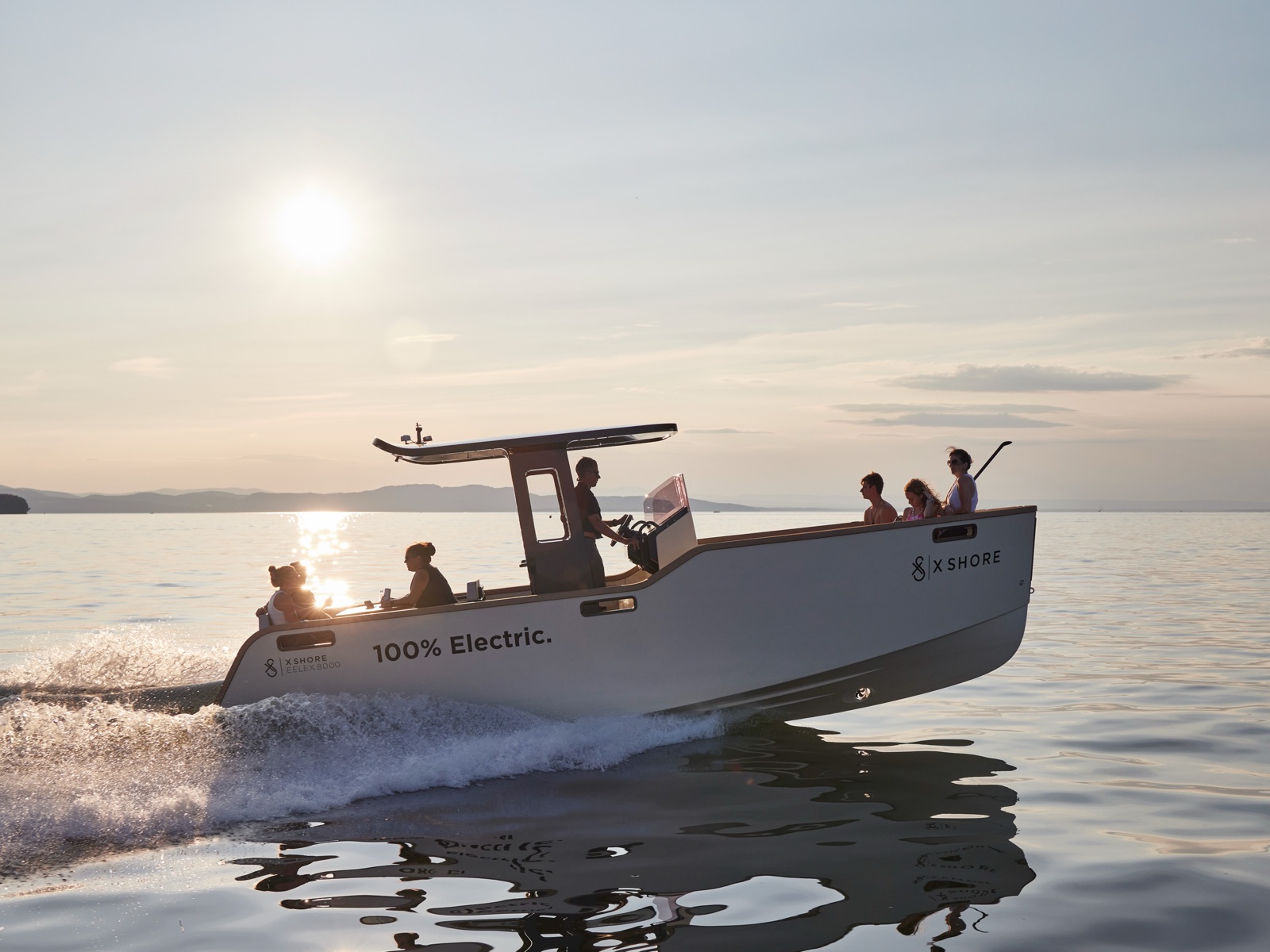
Greenline on the water
Official photography and the complete model range: greenlinehybrid.com ↗
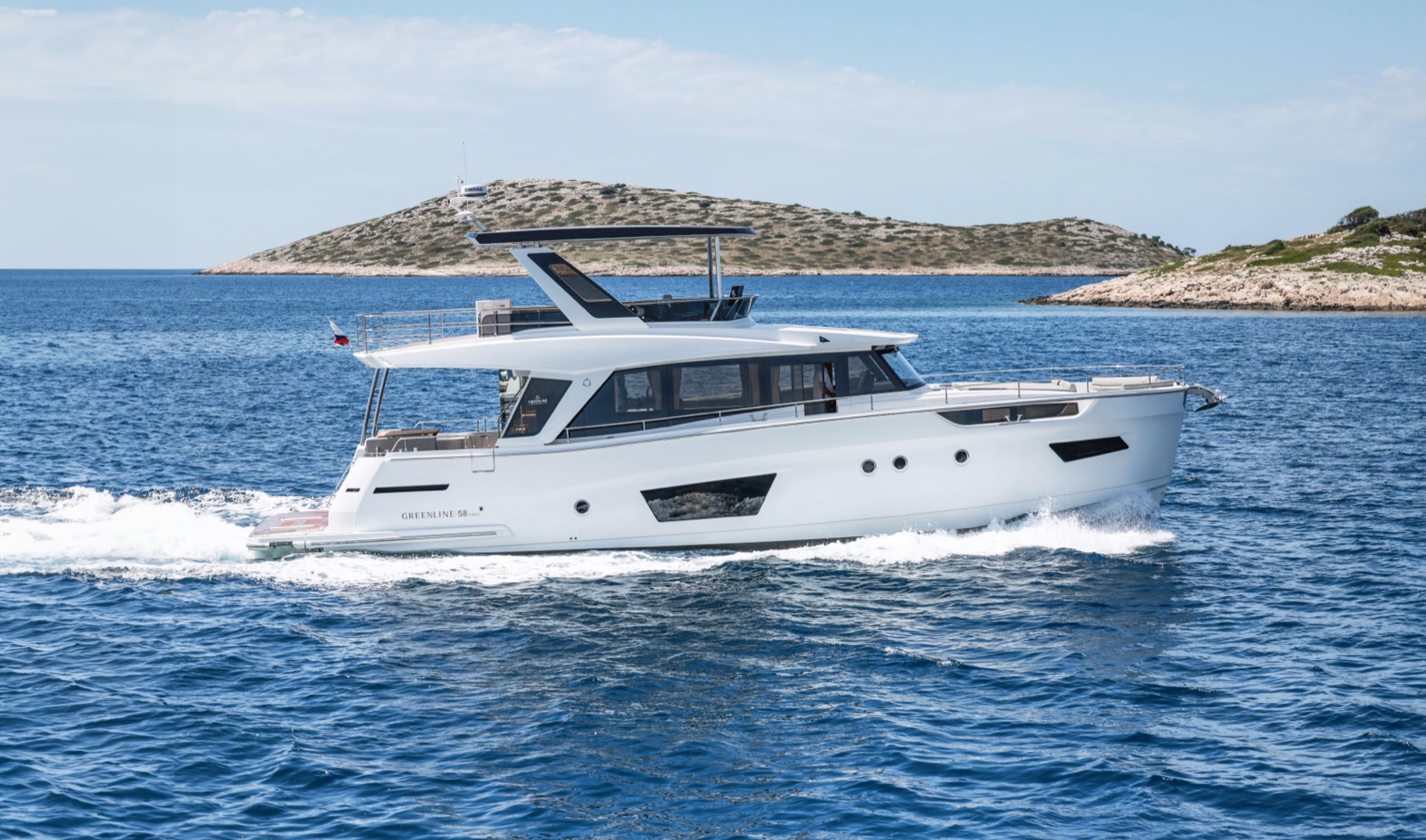
The range and the drivetrain
The whole range, from the Greenline 39 up to the Greenline 58 flagship, can be ordered with the drivetrain the brand is known for, a hybrid with a full electric mode, and also with a full electric drive or with plain diesel engines. On electric power alone the H-Drive hybrid reaches 7 knots on most models, about 13 km/h or roughly 8 mph, almost silently and with no exhaust. The yard's own model pages give 6.5 knots for the 42, 6 for the 58 Fly and 7.5 for the 58 Coupe. The Greenline experience is built around that mode, for maneuvering inside a marina, for dropping the anchor in a bay and for a slow lap after dinner.
Two of the three drivetrains on offer can run on electric power alone. H-Drive is the hybrid, with electric motors for the slow work and diesel engines for the passages, one of each on the 39 and two of each on the larger models. E-Drive is the full electric layout. The propulsion page on greenlinehybrid.com, opened on 5 October 2026, shows the Greenline 39 first and rates its E-Drive at 11 knots under electric power, four more than the hybrid. The model pages give 10 knots for the 40, 12 for the 58 Coupe and 13 for the 45 and the 50 Fly. Neither column on that propulsion page sends the diesel ashore. For the 39 it lists a 14 kW generator in the diesel mode of the H-Drive and a diesel generator as range extender in the E-Drive column, so onboard power on either boat does not rest on the battery alone. New models do arrive now and then, as the 42 and the 50 did in 2026, so for specific models and equipment levels, check what the yard and its dealers are offering.
The idea behind a hybrid drivetrain is simple, and the whole strength of the concept comes from it. You get one boat with two characters. The electric side owns the quiet moments, from the harbor maneuver and the approach into an anchorage to the slow run after sunset. Once a longer passage is on the plan and covered distance is what counts, the combustion side takes over. You do not have to decide anything in advance; the situation settles which face the boat shows, every time.
Seven knots looks modest on paper. There is a reason the figure sits where it does. A displacement hull asks far less of its motors at low speed, and the relationship is steep rather than linear, so a few knots less cuts the power draw sharply. Electric running on a boat this size is useful only because it stays inside that efficient band. Push a heavy cruiser to planing speeds on batteries and the numbers stop working. That is the wall the combustion side is there to get past.
A day of hybrid running
Follow a typical day aboard and the hybrid concept stops being abstract. You leave the berth in the morning on electric power, and the maneuver runs quietly, with no cloud of exhaust and no jerk in the throttle. In a tight marina that is a real advantage. Nobody in the neighboring cockpits gets a lungful of fumes, and you can feel precisely how the boat answers the helm. Close work of this kind is where the electric mode earns its place.
Out in open water, with a longer leg to the next bay ahead of you, the combustion side of the drivetrain takes over. Distance and passage time matter now, and the silence can wait until the next anchorage. The boat shows both faces in a single day, and you read the situation to decide which one is up.
At the destination the electric mode takes the lead again. Near an anchorage you move slowly and carefully, and that is when it helps to have nothing rumbling below you. Swimming fills the middle of the day and the afternoon belongs to the water. A quiet lap after sunset closes it out at an unhurried 5 knots or so, which is the speed at which the yard quotes the hybrid's electric range.
Night brings the quietest part of a hybrid trip. At anchor the fridge, the lights and the rest of the load draw on the batteries, and as long as they hold, nothing hums below deck. The standard solar panels top the batteries up by day, and for the hybrid 39 the yard quotes up to 3 days at anchor on battery and sun. The diesel still stays in the specification, though. The hybrid keeps its diesel engines, with a 14 kW generator listed under diesel mode on the 39, and the E-Drive carries a diesel generator as a range extender. The silence lasts as long as battery and sun keep up, and no longer. In time that becomes a planning habit. You put the long, fast legs where the combustion side is needed anyway and save the silent electric running for the places where quiet is the entire point. Learning to plan a day that way is a skill you build up with a hybrid cruiser, one season at a time.
The route itself starts to read differently. In place of one continuous passage plan you end up with a rhythm of loud and quiet sections, and after a season or two you find yourself choosing anchorages and departure times around it. What changes most in the end is not the hardware in the engine room but how an ordinary day on board is put together.
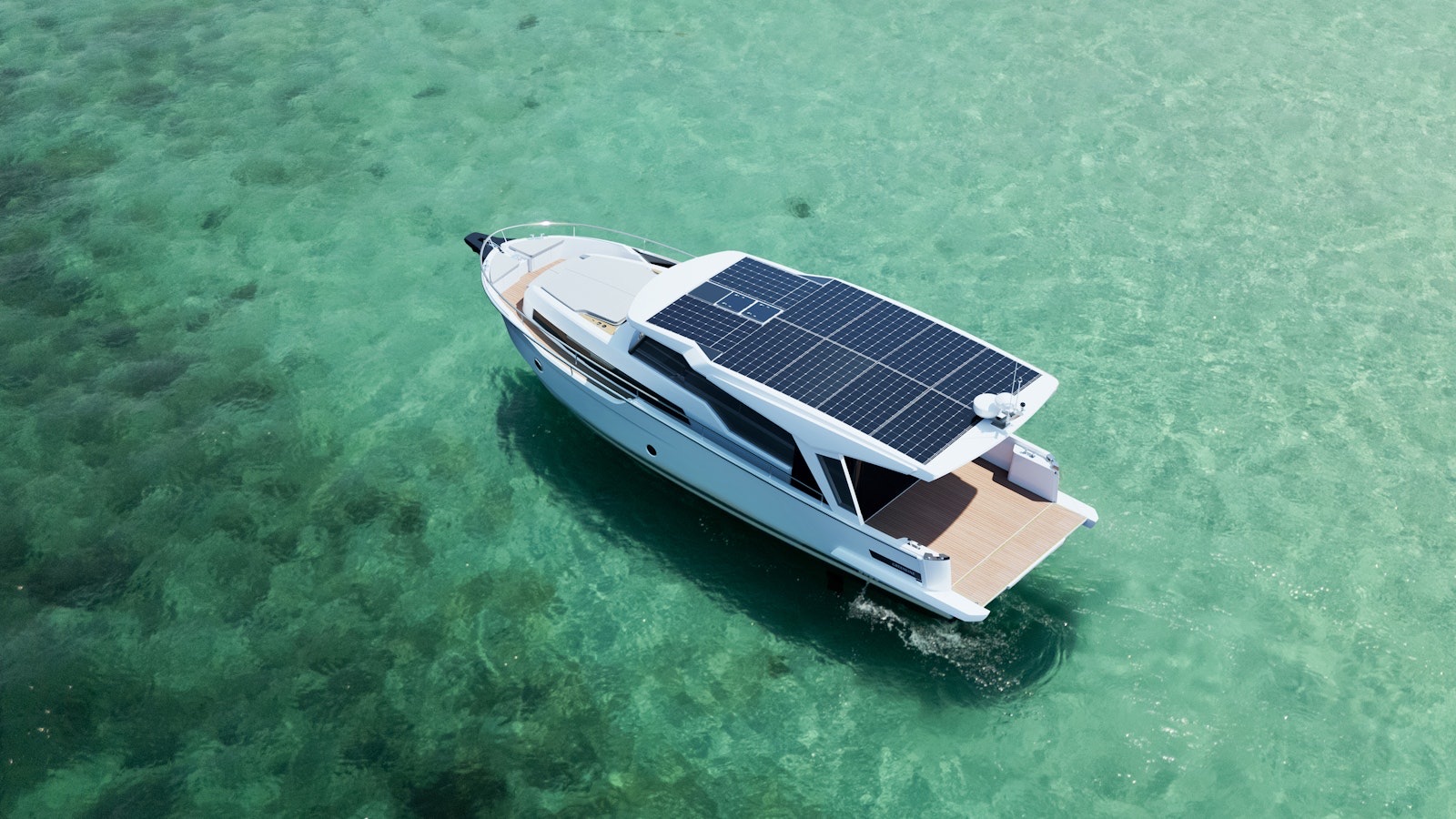
Who it suits, and who it doesn't
A Greenline is no mass-market product, so it is all the more important to check honestly whether it fits the way you use a boat. The yacht is built for people who go out on the water for days or weeks rather than a few hours, and for whom the boat is accommodation, kitchen and living room in one. If waking up in a different bay from the one you anchored in the night before appeals to you, you are in the right place.
Anyone who puts silence and emission-free running first, and goes out looking for calm rather than speed, will find it fits just as well, and it becomes most interesting for owners planning a berth in a cruising ground with anchorages within a day's run. There a cruising yacht that can also travel on electric power alone is a logical choice, quiet in the marina and quiet in every bay you stop in.
The Greenline is the wrong boat for anyone after a nimble day boat of a few meters for an afternoon swim or for watersports. For that job it is simply too big, and too much boat to run for a couple of hours on the water. People who get on the water rarely, and then only for a few hours at a time, would hardly ever use the thing a cruising yacht is built for. The same goes for anyone whose goal is speed or cheap, carefree running. All of them are better served by another boat. A Greenline is the right decision when you actively want slow, quiet days on the water that go on for a while. If you would only be putting up with that pace, it is the wrong one.
Cruising grounds and the size question
Plainly put, a 12 to 19 meter cruising yacht is far bigger than what most people run on their home water, and a Greenline will not be a realistic option for everyone. For an elegant 6 to 8 meter day boat, the class Frauscher builds in is a better fit. The equally Slovenian Alfastreet builds boats in that class as well. The old domain, alfastreet-marine.com, was parked and offered for sale on 5 October 2026; the yard now trades as Alfastreet Yachts at alfastreet-yachts.com, so ask there first. Greenline comes into the picture once you are already shopping at this size, or once you are planning a base in real cruising water: sheltered bays, short hops between islands, marinas where a quiet approach is appreciated rather than merely tolerated.
The yard itself sits inland, in Begunje na Gorenjskem in the Slovenian Alps, and has a test center in the marina at Portorož on the Slovenian coast. Wherever you keep the boat, you want protected water and enough anchorages within a day's run, whether that means island chains, calm coastal stretches or the larger inland lakes. Many of those lakes and protected areas restrict combustion engines or ban them outright. The yard's own panels show a diesel aboard in every layout, as the main engines of the hybrid or as the range extender of the E-Drive. Being able to run on electric power alone therefore does not settle whether the boat may go there. Rules differ by country, often by individual lake or coastline, and cover registration, speed and noise limits as well as engine type. Check your local regulations before you commit to a berth.
Our overview of electric boats covers what builders are doing across the market and gives the wider picture of where the segment is heading. If the flying kind of hull draws you more than a cruiser that stays in the water, start with the hydrofoil boat guide instead. Both are chasing efficiency, and they answer that question in two different ways. One lifts the hull clear of the water to cut drag. The other keeps the hull in the water (a superdisplacement shape, in the yard's own words, which runs in displacement mode at 4 to 7 knots) and adds a second, quieter way of driving it. Hybrid and electric boats also show up at the major international boat shows, still the fastest way to compare hulls side by side.
What to sort out before you buy
Once you are far enough along to be considering a Greenline seriously, answer a handful of questions honestly before you commit. The aim is not to put you off but to make sure nothing catches you out later, because on a boat this size, careful homework matters more than how keen you are.
- Berth and winter storage: a 12 to 19 meter yacht needs a proper marina berth, and you need a plan for the summer mooring as well as for winter storage. Putting a small day boat on a trailer is a different league altogether.
- Realistic use: be straight with yourself about how many days a year you would spend on the water. A cruising yacht pays back when you travel with it, not while it sits in the marina from one month to the next.
- Get a quote: public list prices are rare, so always ask for a quote on the specific model with its equipment. New models arrive only now and then, but the options list is long and every full electric boat is a semi-custom project. What the yard and the dealer quote for your boat is the only reliable reference.
- See it in person: photos and layout drawings only take you so far. Walk the deck, sit in the cockpit, and if you can, run a berthing maneuver on electric power. A boat rarely feels on board the way it looks on paper.
- Expectations of the electric mode: the 6 to 7.5 knots the hybrid reaches on electric power, depending on the model, are meant for maneuvers and quiet laps, not for getting anywhere quickly. Get that clear in your head before you try it, not after.
- Rules and running: wherever the boat will live, clarify licensing, registration and the local regulations for that water through official sources first. Requirements vary widely between countries and even between neighboring lakes.
A boat of this size is a commitment measured in years, not an impulse buy. Work through those points beforehand and you sit down at the negotiating table with a clearer head, knowing what you need from the boat and what you are ready to take on. Owners who arrive at the purchase calm and well prepared tend to get the most out of a Greenline.