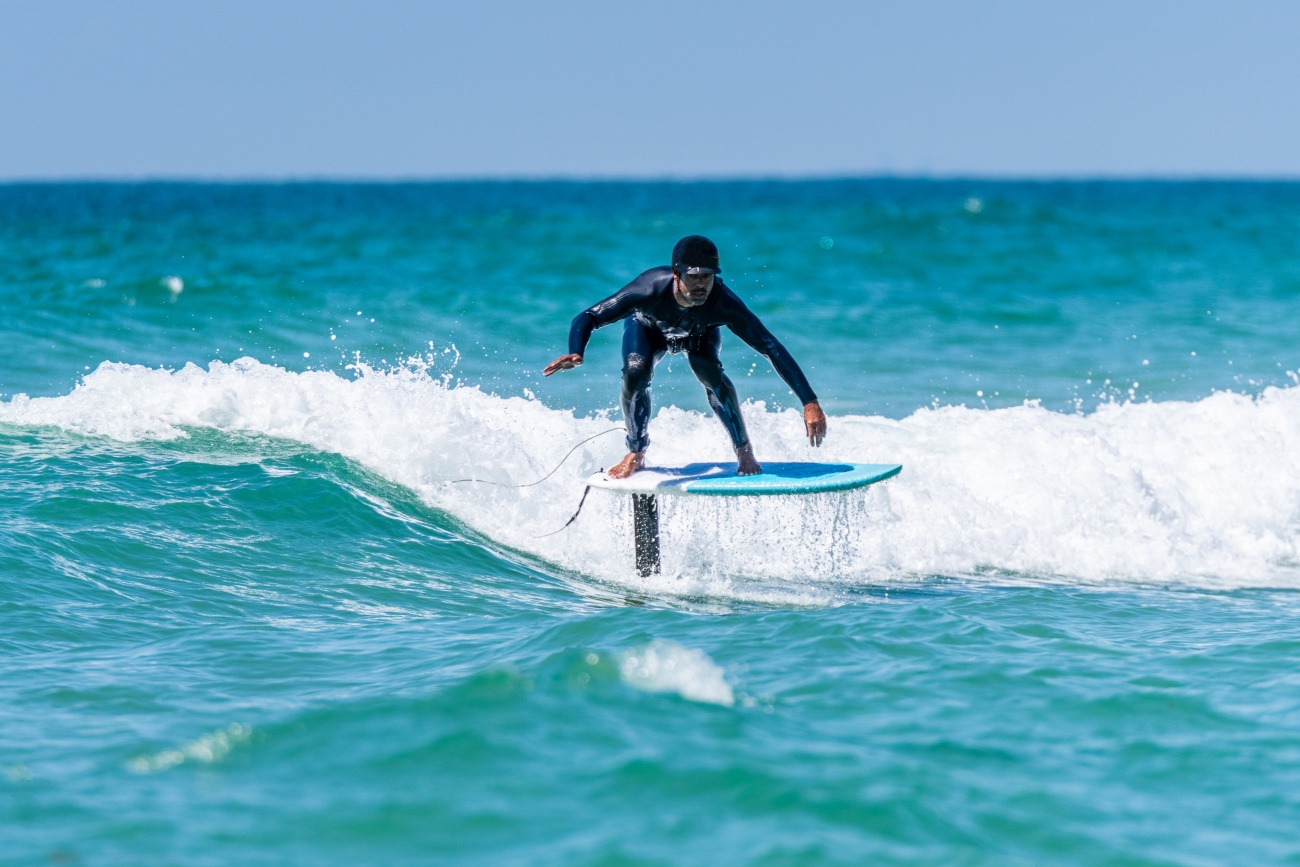
West Beach and the West Winner sandbar
Hayling Island hangs off the south coast between Portsmouth and Chichester, around an hour and a half's drive from London by the local school's estimate. Nearly all the eFoiling starts at West Beach. You leave the car in the pay and display car park on the front and launch to the left of the Inn on the Beach or from the far right corner of the skate park, with toilets, a café and the pub close by. Left of the Inn, a swimming zone marked by yellow buoys is “strictly out of bounds for all electric and wind powered water sports”, in the school's words. No rule is cited for it. A motorised board has no business among swimmers in any case.
What makes the beach good for learning lies offshore. At mid to low tide the West Winner, a sandbar stretching more than a kilometre out to sea, shelters the front from westerly and south westerly winds, and the water behind it goes flat. In places it also goes very shallow. A mast hanging under the board does not forgive that.
The beach faces south, so the flattest water usually comes with a light offshore breeze of around 10 knots, anywhere from west north west round to east north east. Give it more than 10 knots from the east round to the south and the front turns choppy. A good ground swell at high tide does something else again. It sends foiling waves along the sandbar and a big shore break onto the beach. Those are the conditions for the school's Wave Rider session, which runs on Hayling only, is not for beginners and is aimed at unpowered surfing, a short step from surf foiling.
When the front is too lumpy, lessons move round the corner into Langstone Harbour. That short move crosses a boundary. Under the Hayling Island Off-Shore Byelaws, Chichester Harbour ends on a line at 84° from the beacon on the groyne at Eastoke Point, Langstone Harbour on a line at 86° from Eastney Point, and the Dockyard Port of Portsmouth's north eastern limit runs at 120° from Eastney Point. We read that as putting Hayling's south beach between three harbour authorities, with Portsmouth to the west, Langstone at the west tip and Chichester at the east tip. Havant Borough Council adds a plain warning: “The sandbanks and strong tidal flow at the harbour entrances can be dangerous. There are no lifeguards patrolling this area.”
Lessons on Hayling, in Southampton and off the New Forest
Two names turn up on Hayling. EFoil London teaches at the Queen Mother reservoir in Datchet and on Hayling Island, on LIFT and Fliteboard eFoils. E-Foil Hayling Island offers lessons and demos on Hayling or at Datchet, on both makes, “with the whole of the seafront at our disposal”. Venues, packages and prices match line for line, and both move to Langstone when the sea chops up. We take them for one business or two linked brands. Either way, Hayling has one eFoil school.
A lesson includes the board, one to one tuition, life jacket, insurance and a helmet with a built in intercom. “We do not provide wetsuits”, the London site says. The Introduction Course costs £200 for up to two people and needs no watersports background. Neither site gives a lesson length. A booking can move if conditions are not suitable. The £400 private half day doubles as Try Before You Buy for anyone close to buying a first board, and the Hayling business also runs demos and training for Lift eFoil products along the South Coast and as far as Kingston upon Thames, and sells the LIFT5 and LIFTX.
Up the water in Southampton, the Lift affiliate South Coast eFoil calls itself “based next to the New Forest” and rides the Solent. Here the wetsuit is part of the deal, along with boots, life jacket, helmet and gloves. No launch beach is published; the meeting point comes with the booking. Group Flight is the cheap way in. The catch is that three people share one board and each gets 20 to 30 minutes on it, against 80 to 90 minutes in the full lessons.
Cadland Fliteschool's Solent Safari Day is a premium charter. You get a boat, a captain and a Fliteboard coach for a full day from Cadland's Beach Huts on the New Forest shore, with a picnic or a beachfront restaurant stop on the Isle of Wight. Refreshments, a changing area, insurance, board hire and safety kit are included. The group needs at least four people, all aged 16 or over.
Swipe sideways to see all columns
| Operator | Where | Session | Price |
|---|---|---|---|
| E-Foil Hayling Island (EFoil London) | West Beach | Introduction Course, up to 2 people | £200 |
| E-Foil Hayling Island (EFoil London) | West Beach | Private half day (Try Before You Buy) | £400 |
| E-Foil Hayling Island (EFoil London) | West Beach | Advanced or Wave Rider | £150 |
| South Coast eFoil | Southampton | Beginner Flight, 2 hours, own board | £260 |
| South Coast eFoil | Southampton | Just You, one to one | £320 |
| South Coast eFoil | Southampton | Group Flight, 3 per board | £90 per person |
| Cadland Fliteschool | New Forest shore | Solent Safari Day, 4 people minimum | from £2,500 for 4 |
What is missing tells you as much. Surfs SUP at Bracklesham Bay had its eFoil course marked as not running when we checked; it still teaches wing foiling. The SUP Company lists wing foil demos at Calshot and a two hour Foil Drive Gen 2 experience coached from a safety boat, and calls Lymington its demo centre for foiling and electric watersports, but we could not confirm a bookable eFoil lesson at either. Foil Drive, for the record, is a foil assist, not an eFoil. The Isle of Wight drew a blank for eFoil schools and hire (Wight Water at Lake teaches wing foiling), and so did Portsmouth, Gosport, Southsea, Lee-on-the-Solent, Cowes, Emsworth, Bosham and West Wittering.
Chichester Harbour, Langstone and the Hayling beach byelaws
The local rules are scattered across notices to mariners, byelaws from 1973, 1990 and 1994, and a page of harbour charges. Where we say a reading is ours, that is FoilFun's interpretation and not the authorities' words. None of this is legal advice. Before you ride a board of your own, ask the harbour office concerned.
Chichester Harbour: written permission first
Chichester Harbour Conservancy's Local Notice to Mariners No. 02 of 2026, dated 5 January 2026, allows wind propelled foiling craft at item 11 if they keep sea room and avoid busy channels, anchorages and moorings. The same item goes on: “Electric Hydrofoil Boards are not permitted to be used in Chichester Harbour without the written permission of the Harbour Master.” Item 1 sets an 8 knot speed limit for the whole harbour, Byelaw No. 4 asks for care and caution, and items 8 and 9 warn of strong tides near the entrance, underwater obstructions and heavy traffic. Kite surfing, item 10 says, is incompatible with the 10,500 other vessels that regularly use the harbour, and kite surfers may be directed to stop under sections 4 and 89 of the Chichester Harbour Conservancy Act 1971.
How that permission is granted is not spelled out anywhere we looked. For 1 April 2026 to 31 March 2027, jet skis and other personal watercraft register with the Conservancy and pay £200 a year for registration, launching and dues, with insurance documents (Conservancy list price, read on 23 October 2026). Whether an eFoil takes that route is an open question, and the 2024 Information for Mariners Guide listed eFoiling as not permitted. Our advice, and it is only our reading: have the Harbour Master's answer in writing before you launch.
Langstone Harbour: the jet ski question
Langstone Harbour Board makes using a jet ski without a Licence an offence. The Licence needs an RYA PWC Proficiency or PB2 or another STCW compliant certificate, plus a Permit showing the data tag number and third party insurance of up to £3,000,000 per claim, and under 12s may not take charge of one. The Board's pages never mention eFoils, but its 1994 Byelaws define a jet ski as a craft carrying people standing, kneeling, sitting or prone, driven by a jet engine “or other motive power” and steered by a handlebar linkage “and/or by altering the relationship between the body weight” of the rider and the craft. An eFoil appears to fit. That is our reading, not the Board's, which has said nothing either way; ask the Harbour Office before you ride.
Byelaw 6 sets 10 knots over the ground, and 5 in the Langstone Marina approach channel, unless the Harbour Master agrees otherwise. Byelaw 53(1) keeps jet skis out of the Run, the channel from Eastney past the Mulberry Harbour wreck to a point 30 yards east of the Ferry Point pontoon on Hayling, except to pass straight to or from the sea at 10 knots or less.
The beach: Havant's Off-Shore Byelaws
The Hayling Island Off-Shore Byelaws, made under section 76 of the Public Health Act 1961 and in operation since 1 March 1973, protect bathers and beach users from the seashore out to 500 yards beyond the low water mark of ordinary spring tides. Byelaw 3 caps a pleasure boat at ten knots through the water from April to September, except at a Council approved event or in the 100 yard corridor off Alexandra Avenue; byelaw 4 bans dangerous or careless driving. The byelaws never define “pleasure boat”, so in our reading you should treat 10 knots as the summer limit for an eFoil inside those 500 yards. A separate seashore byelaw of 1990 forbids letting anything for hire on the seashore without an agreement with the Council or another lawful right, which in our reading covers hiring boards from the beach.
West of the Langstone line lie the Dockyard Port of Portsmouth and, further up the Solent, Southampton. In both, read the harbour authority's current directions first. Associated British Ports said in March 2023 that whoever lets others use a craft is responsible for their actions, and that it works with the Hampshire Marine Unit to educate, enforce against and prosecute reckless or dangerous users.
The Watercraft Order 2023 and a Solent eFoil
The Merchant Shipping (Watercraft) Order 2023, SI 2023/35, in force since 31 March 2023, defines a watercraft in article 3(1) as a craft capable of moving under its own mechanical power, used in or on water and able to carry one or more persons. Guidance note MGN 684 (M) says at paragraph 1.4 that electric vessels of any size, “including, for instance, eFoils”, count. Article 6 then applies section 58 of the Merchant Shipping Act 1995: a deliberate act, a breach of duty or being “under the influence of drink or a drug” that causes or risks serious damage, death or serious injury is an offence. In England that means a fine on summary conviction, or up to two years in prison, a fine or both on indictment. Schedule 2 brings in the 1996 collision regulations, and MGN 684 adds at paragraph 3.1 that breaking them is a criminal offence for the user (an instructor, for example) and for the owner.
Article 11(1) applies the harbour direction powers of sections 40A to 40D of the Harbours Act 1964 to watercraft, and MGN 684 tells riders at paragraph 5.3 to follow the harbour authority's rules inside harbour limits. As we read it, the UK asks for no licence, national registration or national insurance for an eFoil, and where you may ride is decided locally. On Hayling, locally means three harbour authorities plus the council's beach byelaws. The UK eFoil guide follows this Order around the other coasts.
For orientation only, not legal advice.
Double high water, south westerlies and a cold spring sea
Most of the British coast gets two high and two low tides a day. Southampton is different, with a double high water, and Cowes has one near springs; away from springs the stand at the top of the tide lasts a good while. The biggest springs come around the equinoxes. On Hayling the tide decides whether the West Winner is up to shelter the front and how hard the harbour mouths run. In the entrance to Portsmouth Harbour the streams are strong, standing waves can form, and small craft must keep to the Small Boat Channel on the western side. Leave the entrances alone.
The Met Office puts Southern England among the more sheltered parts of the UK. Depressions are strongest from December to February, exposed South Coast spots see about ten gales a year, and sea breezes set in from late spring through summer. The prevailing wind is south westerly. On our reading of the school's notes, that is the wind the West Winner blocks at mid to low tide, and an easterly or southerly over about 10 knots is what sends lessons into Langstone.
Hayling has no sea temperature station. Cefas means for 1971 to 2000 at Bournemouth give about 6.8 °C in February, 18.4 °C in August and 14.2 °C in October, and Eastbourne and Shoreham are much alike. Our estimate for Hayling is roughly 6 °C in February and 18 °C in August. None of the Solent schools publishes a season or a winter closure. Water temperature alone makes summer the main season; a winter session is something to settle with the school before you drive down.
A board of your own on Hayling water
A school handles the permissions. A private owner with a board in the boot handles them alone, and around Hayling they change within a short paddle. Our summary:
- Chichester Harbour: written permission first, then 8 knots.
- Langstone Harbour: 10 knots, and a Licence and Permit regime that appears to cover eFoils, unconfirmed by the Board.
- Hayling beach waters: 10 knots from April to September.
- Portsmouth and Southampton: the harbour authority's directions.
Ride in daylight. No Solent authority we read says anything about night riding, but Poole's personal watercraft permit allows use only between sunrise and sunset, and the Port of London Authority's code says not to go afloat in the dark or in fog. Cadland sets a minimum age of 16; the other two publish none. A wetsuit is your job on Hayling, while Southampton supplies one.
For anyone close to buying, a half day on the school's Lift or Fliteboard is a fair way to find out which suits you before the money goes. The eFoil buying guide walks through the choice and the eFoil price overview sets out what boards cost.