Made in Stockholm
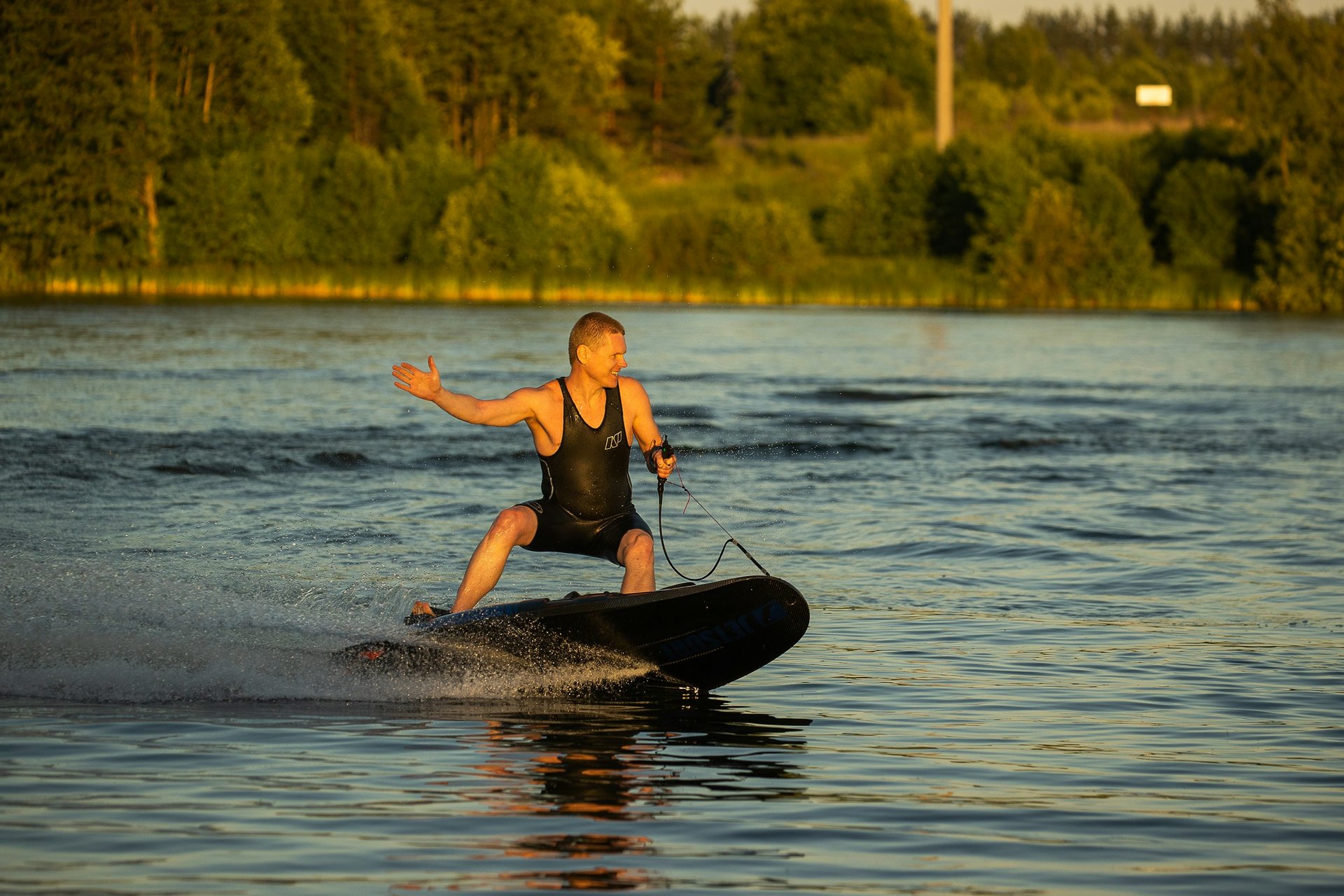
From the beach a LIND looks like an ordinary white surfboard with a wooden stripe down the middle. It carries no foil and needs no wave. A water jet in the tail pushes it across a lake or a calm bay at up to 60 km/h, about 37 mph, and the rider sets the power with a handheld trigger. LIND calls it an electric surfboard. Red Dot's entry calls it an electric jetboard, the usual name for this kind of board, and it belongs with the jetboards in our electric surfboard guide.
The company behind it is LIND Art & Technology AB in Bromma, Stockholm. It was registered in Sweden in 2021, and a US company of the same name, LIND Art & Technology Inc., is based in San Francisco. LIND says every board is made and shipped from its headquarters in Stockholm, and that only a few hundred LIND motors have ever existed, all of them built by hand there.
The name belongs to Alexander Lind, one of the Swedish co-founders. According to Outside magazine, his first electric boards came out under another company, Radinn. His partners at LIND are Anders Dellson, the chief executive, and Mattias Söderhielm, who runs technology and operations.
Red Dot and TIME
The LIND Canvas won a Red Dot Award: Product Design in 2025, in the water sports category. The jury praised its elegance and the way it puts current electrical engineering inside the timeless look of a classic surfboard. In October 2026, TIME gave the LIND Electric Surfboard a special mention in its Best Inventions of 2026, describing a board that carries surfers across the water when there are no waves to ride.
Canvas Edition in two sizes
The Canvas Edition is the standard LIND, sold as a complete unit with board, battery and jet. Both sizes are 15 cm (6 inches) thick. What changes is length, width and volume, and with them how the board feels under you.
Swipe sideways to see all columns
| Shortboard | Midlength | |
|---|---|---|
| Length x width x thickness | 191 x 53 x 15 cm (6′3″ x 21″ x 6″) | 206 x 60 x 15 cm (6′9″ x 24″ x 6″) |
| Volume | 66 liters | 88 liters |
| LIND's description | Sporty and agile, for deep carving and rail-to-rail surfing | More volume, more stable and easier to stand up on |
LIND's own advice leans toward the bigger board. It recommends the midlength unless you have board sports experience, are younger than 60 and weigh less than 90 kg (200 lb). Miss any one of those three and the midlength is the one to order. LIND built the shortboard for deep carving and rail-to-rail surfing, which suits riders who already handle a board well.
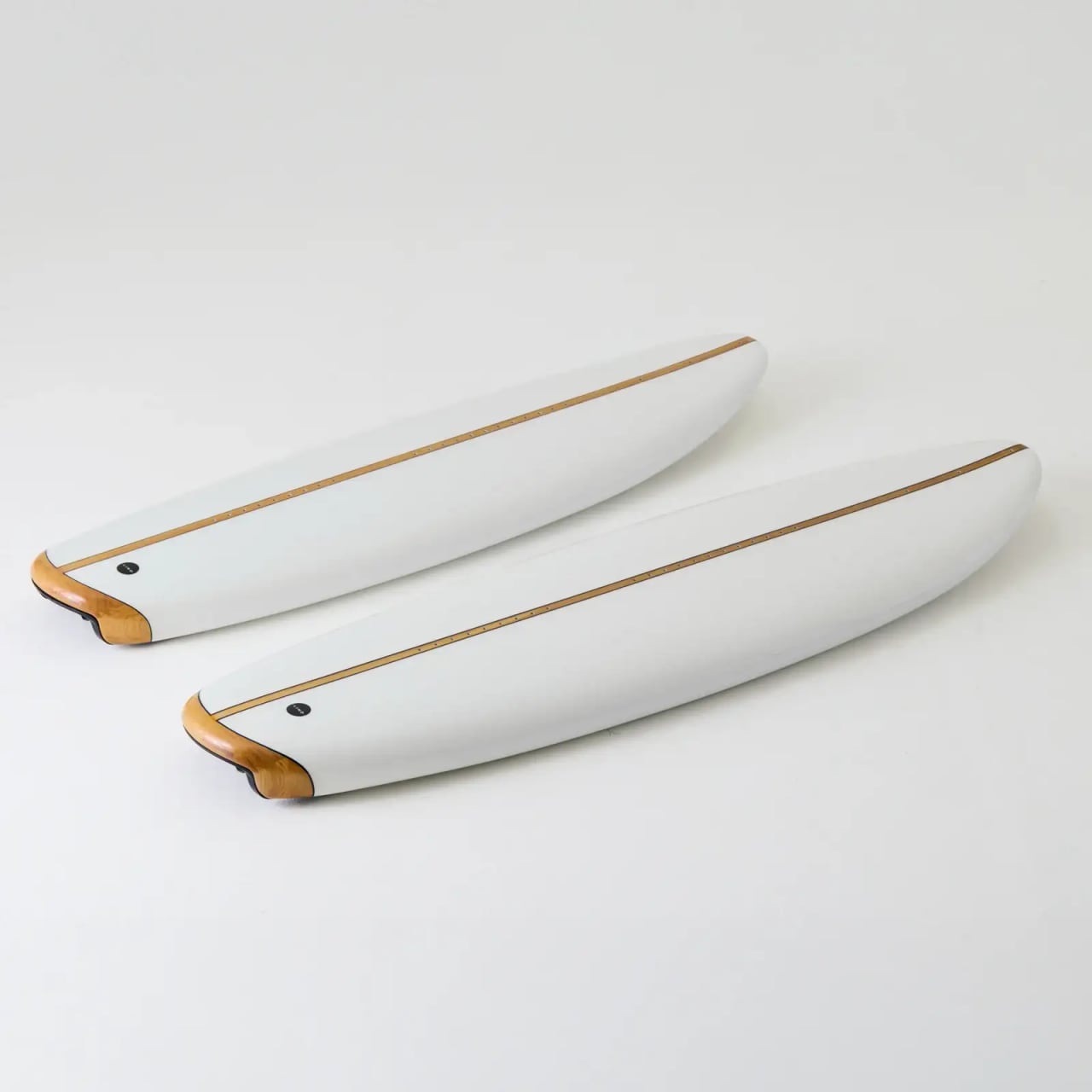
The board itself is light for what it does. LIND's manual gives 7 to 8 kg (15 to 18 lb) for the board alone. Wallpaper* describes an epoxy build with an oak stringer and an oak tail block, and Robb Report names an EPS foam core under the epoxy. The design was done in house; Wallpaper* credits Marcus Ivarsson, LIND's head of product and branding, with leading it.
LIND × RIVA and custom boards
Two editions sit above the Canvas. LIND × RIVA is a wooden board made with the same mahogany that Riva uses on its Aquarama boats. It lists at $33,950 in the US and €29,950 plus VAT in Europe.
Custom boards are the other route. LIND says it has made more than 30 of them so far: wooden boards, boards with resin art or printed art, longboards and high performance shortboards. A custom build costs $5,000 to $15,000 more than a Canvas board, or €5,000 to €15,000 in Europe, depending on what you ask for.
The jet and the remote
LIND designs its own drive and calls it the LIND Jet. Two electric motors turning at 30,000 rpm feed a gear reduction, and together they put out 20 kW, about 27 hp. Outside, which rode the board in Stockholm, reports that the two motors work in parallel on a single impeller through a multi-stage gearbox and that LIND makes the impeller itself. The jet unit weighs 10 kg (22 lb). LIND's own image for its flow is a bathtub emptied in two seconds.
The 20 kW is the only power figure LIND publishes. There is no continuous rating, which matters in countries that set their license limits by continuous output, as Germany does.
You hold the power in your hand. The wireless remote is waterproof, has a trigger and offers 15 power levels. The manual groups them into four modes: slow (levels 1 to 4), medium (5 to 7), fast (8 to 11) and pro (12 to 15). A beginner of average weight on a midlength should stay between levels 1 and 5, says the manual. The remote's small screen shows the power level and the battery percentage. It does not show speed, so Outside's tester could only estimate that he was doing 25 to 30 mph at level 10.
Outside also counted six microcontrollers in the board and a 4G connection for telemetry.
The 3.1 kWh battery
The battery holds 3.1 kWh (nominal) in 192 lithium-ion cells. Forty-eight temperature sensors watch it, and it is water cooled through an aluminum plate. It weighs 17 kg (37 lb), half of what the whole board weighs ready to ride.
On one charge LIND promises 30 minutes on the water, and TIME printed the same figure. A few reviews and the Red Dot entry quote a longer time, but half an hour is what the maker stands behind, so plan your sessions around it.
The charger delivers up to 3,200 W, and you can turn it down. The manual lists power settings from 0.7 kW to 3.2 kW and says the top setting fills the battery in about an hour; LIND quotes one to two hours overall. Robb Report writes that it charges fully in an hour from a 230-volt outlet. For a second session without the wait, LIND sells a spare battery.
Swipe sideways to see all columns
| Item | LIND Canvas |
|---|---|
| Drive | LIND Jet, two electric motors with gear reduction driving a water jet |
| Power | 20 kW (27 hp), no continuous rating published |
| Top speed | 60 km/h (about 37 mph) |
| Battery | 3.1 kWh nominal, 192 Li-ion cells, water cooled |
| Ride time | 30 minutes |
| Charging | Up to 3.2 kW, 1 to 2 hours; about 1 hour at full charger power |
| Weight | Board 7 to 8 kg, battery 17 kg, jet 10 kg; about 34 kg (74 lb) in all |
| Maximum rider weight | 140 kg (310 lb), one rider only |
| Minimum water depth | 1.5 m (5 ft) |
| Assembly | Without tools, in under a minute |
On the water, by the manual
Getting a LIND ready takes seconds. The battery and the jet go into the board without tools, and a board bag and a backpack come with it for the trip to the water. Wallpaper* put the typical riding speed at around 20 mph. Outside found it quieter than a jet ski and called it a board for flat water, not for waves.
LIND's manual sets the limits plainly. One rider at a time, never two, and no more than 140 kg (310 lb). The water must be at least 1.5 meters (5 feet) deep. LIND built the board for adults and says it is not for anyone under 14. A helmet and an impact vest or a life jacket belong on every ride.
When you fall, let go of the trigger, which stops the motor. Coming in to a beach, cut the power at least 30 meters out and paddle the last stretch.
Against an eFoil and a Jetsurf
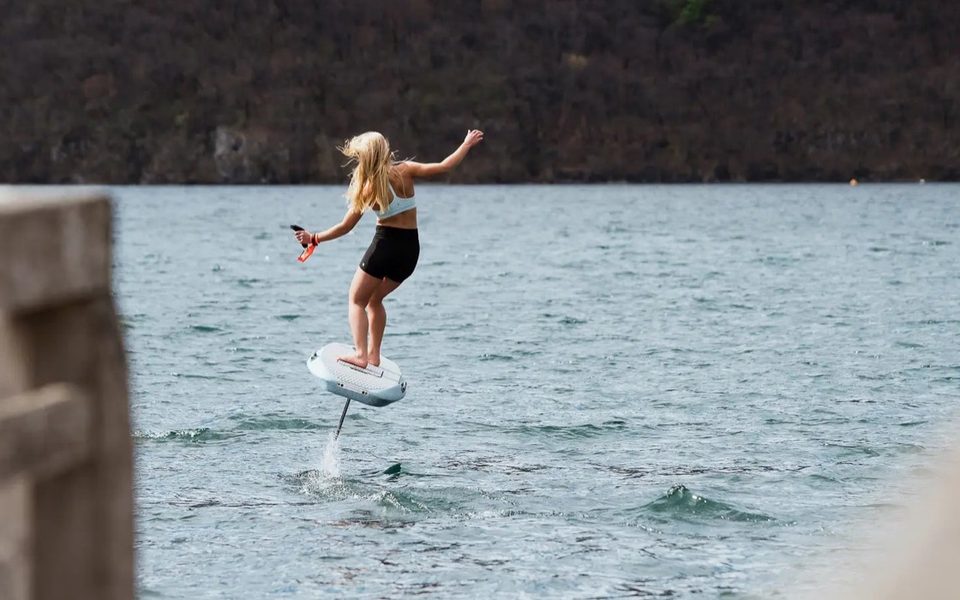
An eFoil is a different ride. By the definition of Lift Foils, the company that says it built the first commercial one, it is an electric board with a hydrofoil underneath and a motor on the mast, and once it gets going the board lifts clear of the water. A LIND never leaves the surface. It planes like a fast surfboard, carves with spray, and has its drive tucked inside the tail, so the two feel nothing alike under your feet. The Berlin dealer E-SURFER notes that eFoils have outsold jetboards since 2021, with gas and electric jetboards still sold alongside them.
The law can also tell the two apart. Germany's waterways authority classes a jetboard as a personal watercraft whatever its power, and it does not treat an eFoil board that way.1 For a LIND rider in Germany that narrows the map of legal water.
Closer competition comes from Jetsurf, the Czech maker that builds both gas and electric jetboards. Its gas boards run on small two-stroke engines and weigh around 20 kg. Its ELECTRIC 2 is the closest match to a LIND.
Swipe sideways to see all columns
| LIND Canvas | Jetsurf ELECTRIC 2 | Jetsurf gas boards | |
|---|---|---|---|
| Drive | Electric, 20 kW | Electric | Two-stroke gas engine |
| Weight | About 34 kg | 32.9 kg | 18.5 to 20.5 kg |
| Top speed | 60 km/h | Up to 55 km/h | 55 to 64 km/h |
| Energy | 3.1 kWh battery | 3 kWh battery | Fuel tank, 2.8 l on the ADVENTURE 2 DFI |
| Ride time | 30 minutes | 25 to 55 minutes | - |
| Maximum load | 140 kg | 100 kg | 120 kg |
| Board size | 191 or 206 cm long | 180 cm long | 180 cm long |
| Price in Europe, excl. VAT | €19,950 | €12,490 | €9,990 to €12,990 |
On paper the LIND costs more than any Jetsurf and weighs about the same as the electric one. It takes a heavier rider, 140 kg against 100 kg, and comes in two proper surfboard lengths. The gas boards are far lighter to carry, and the TITANIUM DFI SL reaches 64 km/h, but they run on gas mixed with two-stroke oil. For prices across every brand, see the electric surfboard price guide.
Prices in dollars and euros
LIND sets one price for the Americas, one for Europe and one for the rest of the world, and its site shows the one that matches your location. Only the European price is quoted before VAT. Buyers in the UK see the European price in euros; LIND lists no price in pounds.
Swipe sideways to see all columns
| Item | Price |
|---|---|
| Canvas Edition, complete unit | $26,950 US · €19,950 plus VAT Europe · $24,950 rest of the world |
| LIND × RIVA, complete unit | $33,950 US · €29,950 plus VAT Europe · $33,950 rest of the world |
| Custom board, on top of a Canvas | $5,000 to $15,000 · €5,000 to €15,000 in Europe |
| Extra Canvas board, board only | $6,980 US · €5,190 plus VAT Europe · $6,490 rest of the world |
| Extra battery | $8,490 US · €6,290 plus VAT Europe · $7,860 rest of the world |
In Germany, the dealer Sealectric sells the board at €23,740 including 19% German VAT, with shipping on top. That is the European list price plus VAT, and Sealectric says it charges what LIND charges directly. The spare battery alone costs almost a third of a complete unit, so think about how often you will want more than half an hour at a stretch before you add one.
What you get, and the warranty
A complete unit arrives ready to ride. LIND lists what comes with it:
- the board, the battery and the jet
- the wireless remote and its own charger
- the battery charger
- a fin, foot straps, a deck pad and a board handle
- a board bag and a backpack
LIND gives a two-year warranty on everything it sells. For the battery, the period ends after two years or 600 charge cycles, whichever comes first. A repair or a replacement does not restart the clock. On a valid claim LIND pays the shipping, and opening or tampering with the hardware voids the cover. Each buyer gets a named contact at LIND, which the company calls a Relationship Manager.
An unused board in its original packaging can go back within 14 days of delivery. You pay the return shipping unless the board was faulty or not what you ordered.
Where to try one
LIND marks the partners where you can test a board:
- Sweden: the LIND headquarters and Electrosurf, both on Gustavslundsvägen in Bromma, Stockholm
- Germany: Sealectric in Altenholz, which lets you try both sizes
- Poland: eSurf Poland at Marina Dąbie in Szczecin
- Slovakia: KOIFER in Bratislava
- France: LIND France in Cannes, by appointment
- Italy: Porto Cervo Luxury Sport at Liscia di Vacca, Sardinia
- Türkiye: Hergele Life in Istanbul
Naizur Yachts in Palma, Mallorca, also appears on LIND's partner list, but not as a test ride location. The current list is on LIND's partner page. A test ride is the best way to settle the shortboard or midlength question before you spend this much.
License rules in the UK and Germany
United Kingdom
British rules for watercraft cover any craft that moves under its own mechanical power and carries a person.2 The government's guidance adds that the kind of power does not matter, so electric craft are included.3 A LIND falls under them by that wording. There is no national license for riding a private personal watercraft. Harbors and councils set their own conditions instead, from permits and registration to minimum ages and RYA training. Crouch Harbour, for example, counts “power boards” as personal watercraft that need its permit.4 Ask the harbor authority before your first launch.
Germany
Germany exempts an electric drive from the boat license only up to 7.5 kW of continuous output. LIND publishes 20 kW and no continuous figure, so a LIND rider should expect to need the Sportbootführerschein, the German boat license. Sealectric tells its customers the same. That license is issued from age 16, with a parent's consent under 18.5
The bigger limit is where you may ride. The federal waterways authority classes every jetboard as a personal watercraft, and on federal inland waterways those may only ride in areas released by an E.22 sign.1 6 Before a trip, ask Sealectric or the local waterways office where a LIND may run.
Sources
- [1]GDWS, Kleinfahrzeugtabelle KFT-G version 8.0 (as of 1 September 2024)
- [2]The Merchant Shipping (Watercraft) Order 2023, SI 2023/35
- [3]MGN 684 (M), Safety of powered watercraft
- [4]Crouch Harbour Authority, Byelaws: Personal Watercraft
- [5]Sportbootführerscheinverordnung (SpFV) of 3 May 2017, BGBl. I p. 1016, 4043
- [6]Wassermotorräder-Verordnung (WasMotRV) of 31 May 1995, BGBl. I p. 769