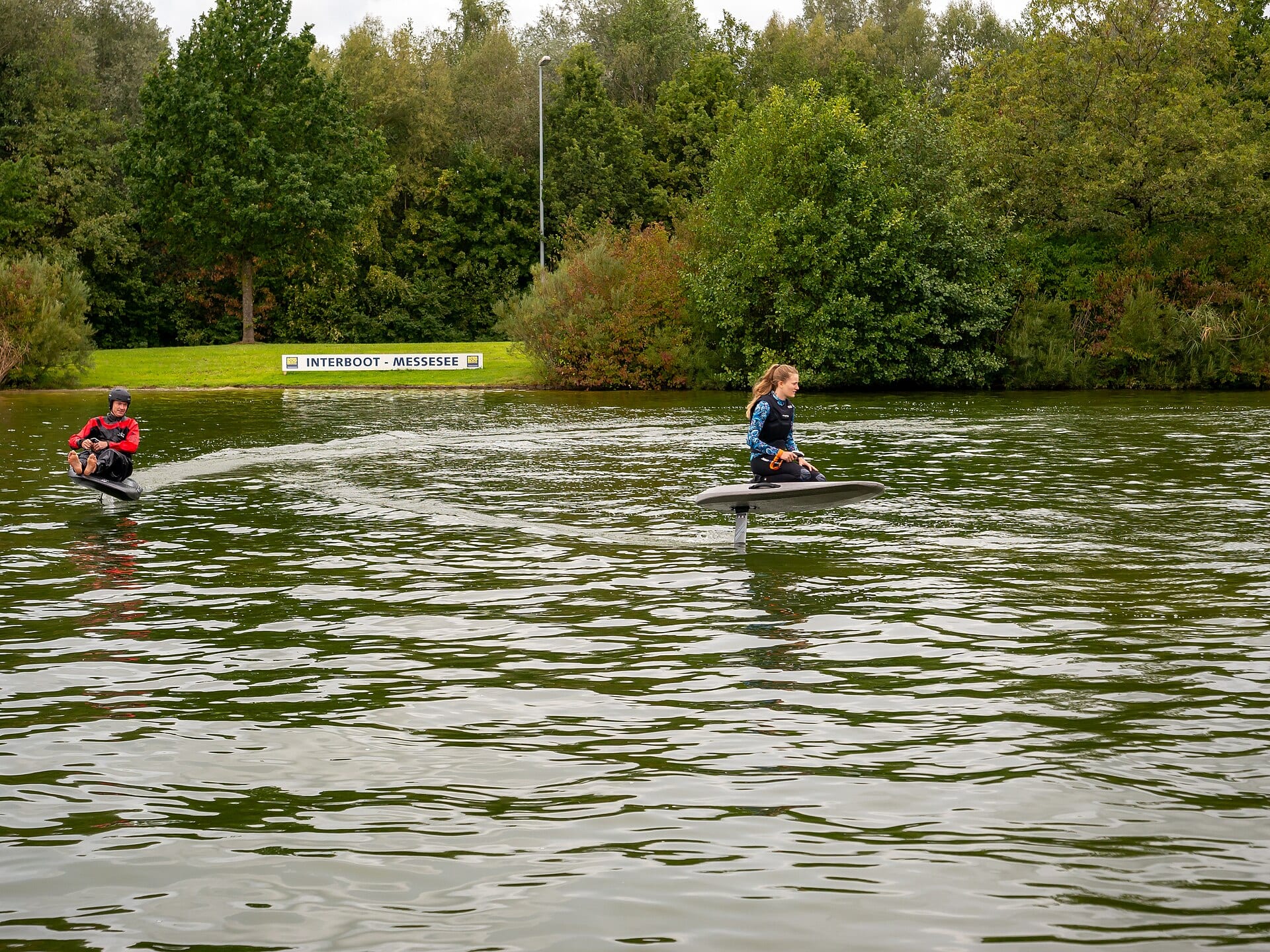
The best eFoil for most buyers is a Fliteboard ICON
For a rider up to 120 kg who wants one board for lakes and sheltered bays, the Fliteboard ICON is the eFoil to buy. Fliteboard files it under Beginner to Intermediate and calls it the best all-rounder for any level of experience and riding style. The 100 liter board ships on a 1,529 cm² Cruiser Jet wing, the Prop drive carries riders up to 120 kg, and the European store lists it from €10,919 including VAT. Behind it stands a locator that covers every EU state, Norway, Switzerland and the United Kingdom, and a two-year warranty whose unexpired part passes to the next owner.
That verdict moves for a budget under about €7,000, for a rider over 120 kg, for a buyer who already foils, for a board that has to travel, and for a buyer who wants Lift's carbon flagship whatever it costs. Lessons, age limits and used warranties are on the beginner page.
Which eFoil to buy: a two-minute self-test
Take the first line that describes you.
- Under about €7,000 for the complete set. SiFly Rider+ first, Waydoo Flyer EVO Max Plus second.
- Over 120 kg in a wetsuit. SiFly Rider+, Lite+ or Stellar R, rated to 140 kg. The Waydoo Max Plus is rated to about 130 kg, with a warranty clause to read first.
- You already foil and want swell, surf or speed. Lift LIFTX, Fliteboard ULTRA L3 or an Aerofoils Performance.
- The board travels with you. Fliteboard ULTRA L3 at about 18 kg or LIFTX at about 20 kg, by car or as freight. No eFoil battery flies in passenger luggage.
- One board for the family, serviced close to home. Fliteboard ICON, with the Prop drive if anyone in the house weighs over 100 kg.
- The best build, money no object. Lift LIFT5 for the carbon board and the GPS hand controller, or a Fliteboard ICON Carbon.
What each price class buys
The field splits at about €7,000 and again at about €10,000. The budget class is SiFly and Waydoo. SiFly sells from Bulgaria and lists its prices before VAT; the Waydoo figure here is the US list price before sales tax. The middle class is a Fliteboard with an inflatable board, a HydroFlyer from Canada and the Manta Volt 4. Everything from Lift, Aerofoils and Awake, and every rigid Fliteboard, sits above €10,000.
Swipe sideways to see all columns
| Class | Model | List price | Board and rider limit |
|---|---|---|---|
| Budget | SiFly Rider+ | €5,199 to 6,099 excl. VAT | 130 L, 40 to 140 kg |
| Budget | Waydoo Flyer EVO Max Plus | $6,599 before sales tax | 130 L, about 130 kg |
| Budget | SiFly Lite+ | €6,999 excl. VAT | 170 L, inflatable outer sections, 60 to 140 kg |
| Middle | Fliteboard Flite AIR | from €8,967 | Inflatable, 120 kg with Prop |
| Middle | HydroFlyer AL | $9,995 excl. VAT | Cruiser 160 L or Sport 129 L |
| Middle | Manta Volt 4 Explore | $9,395 | 100 L |
| Premium | Fliteboard ICON | from €10,919 | 100 L, 120 kg with Prop |
| Premium | Lift LIFT5 F | $10,999 excl. VAT | 4'9 100 kg, 5'4 Cruiser 113 kg |
| Premium | Aerofoils Airfly | €11,799 | 150 L, 110 kg |
| Premium | Awake VINGA Carve | €12,990 to 13,990 excl. VAT | 77 L |
| Premium | Lift LIFT5 | $14,999 excl. VAT | Carbon, 4'9 100 kg, 5'4 Cruiser 113 kg |
Under €7,000, buy the SiFly Rider+, or the Waydoo Max Plus when a dealer with a demo board is nearby. Between €7,000 and €10,000, the Flite AIR, because an inflatable Fliteboard still rides on Fliteboard's wings, drives and warranty, or the HydroFlyer AL for a 160 liter board and about 120 minutes on its 2,400 Wh pack. Above €10,000, the ICON for most, the LIFT5 F for a buyer who wants into Lift's system at its entry price. The price page has every model and the running costs behind the list price.
Board volume carries your weight, the wing comes second
Fliteboard recommends the ICON and the Flite AIR up to 120 kg with the Prop drive and 100 kg with the Jet, the PRO to 100 kg and the ULTRA to 90 kg on a Prop, with a warranty limit of 120 kg on every setup except the ULTRA and RACE boards. Lift rates the 4'9 LIFT5 and LIFT5 F to 100 kg and the 5'4 Cruiser to 113 kg, or 129 kg with the Blowfish inflatable rails, a $599 accessory. The LIFTX is rated between 79 and 100 kg by size, so it is out for any rider over 100 kg, however well they foil. SiFly, Waydoo and Aerofoils go higher.
Swipe sideways to see all columns
| Model | Rider limit | Board volume |
|---|---|---|
| SiFly Rider+ | 140 kg | 130 L |
| SiFly Lite+ | 140 kg | 170 L |
| SiFly Stellar R | 140 kg | 120 L |
| Waydoo Flyer EVO Max Plus | about 130 kg | 130 L |
| Waydoo Flyer EVO Pro Plus | about 130 kg | 90 L |
| Lift LIFT5 5'4 Cruiser | 113 kg, 129 kg with Blowfish rails | - |
| Aerofoils Adventure | 120 kg | 103 L |
| Aerofoils Hyperfly | 120 kg | 230 L |
| Fliteboard ICON, Prop drive | 120 kg | 100 L |
| Aerofoils Performance | 110 kg | 83 L |
| Aerofoils Airfly | 110 kg | 150 L |
One Waydoo clause needs a dealer's signature. The warranty terms exclude damage above “its maximum load weight (100KG)”, while the product pages rate the Max Plus and Pro Plus to about 130 kg. A rider above 100 kg should have the 130 kg rating confirmed in writing before paying.
Volume carries you at rest and in the first seconds of a start; the wing carries you in flight. Fliteboard writes that larger wings give more lift and stability, for beginners, heavier riders and longer rides, smaller wings are faster and more manoeuvrable. Lift names its 270 Camber Pro as the wing for heavier riders and new foilers and fits it as standard on the 5'4 Cruiser. Over 100 kg, that points to a SiFly Rider+ or a Fliteboard ICON with the Prop. Over 120 kg it points to a SiFly, or to the Waydoo Max Plus with the dealer's confirmation in hand.
Flat lake, choppy sea, shallows and weed
Lift's first-ride guide asks for calm, flat water at least 1.2 meters deep so the foil cannot hit bottom, and Waydoo's warranty excludes damage from riding in less than 1.2 meters. Anyone whose home water is a reed-lined lake, a tidal estuary or a harbor with weed in it should take the drive choice seriously.
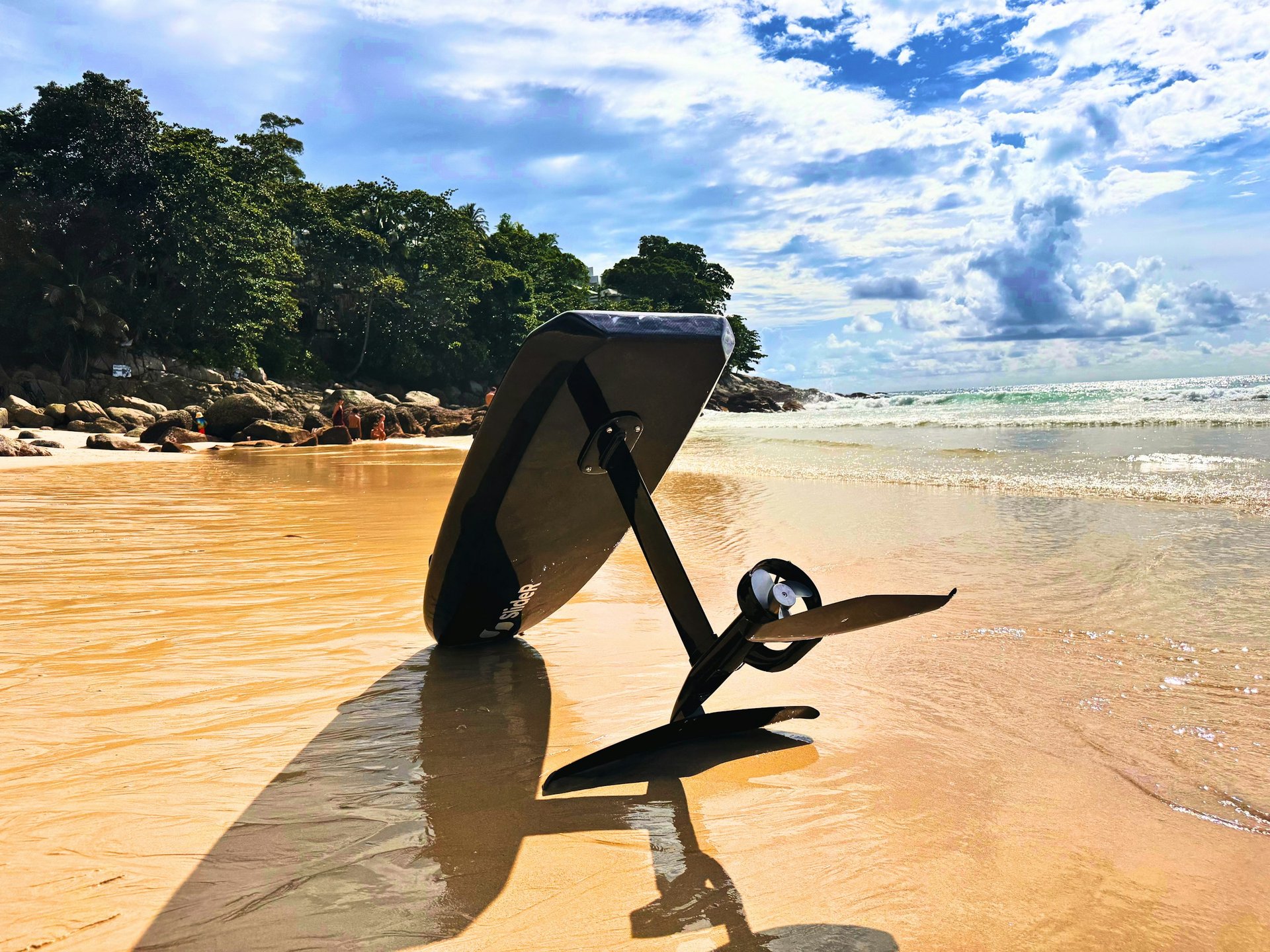
Shallow, weedy or busy water, or a first board, means a shielded jet: a Fliteboard with the Jet 2, any Aerofoils set or a LIFT5. Fliteboard calls its Jet 2, a fully shielded impeller developed with Mercury Marine, the pick for most riders. Every Aerofoils set runs a direct-drive jet built into the mast, with no exposed blades and no separate guard to check. The LIFT5 ships with the LCS Jet on all stock setups, and Waydoo sells its EVO Jet Drive as a $499 accessory, €623 in the European store, on top of the stock propeller.
Heavier riders and wave riders want a propeller, on a Fliteboard or a SiFly for the weight and on a LIFTX for the waves. The Flite Prop runs through a gearbox that quadruples the motor's torque and lifts the ICON's recommended rider weight from 100 to 120 kg. SiFly quotes its range with an open propeller, and the LIFTX runs a 55 mm folding propeller that folds flat off the throttle, built for a surf-assisted feel in swell. Fliteboard's Folding Prop also folds for wave riding and does not fit the jet.
Salt water changes the evening routine more than the choice of board. Fliteboard asks for a fresh-water rinse of every component after each ride, inside the mast too, and the maintenance page has the routine. Lift names water through a compromised hatch seal and salt corrosion as the most common eBox failures.
A first board, or a board to grow into
The makers sort their own ranges by level. Fliteboard lists the ICON and the Flite AIR as Beginner to Intermediate, the PRO and the RACE as Intermediate to Advanced and the ULTRA L3 as Advanced. Lift calls the LIFT5 F its entry price point, the LIFT5 the flagship and the LIFTX powered foiling for riders already on a foil. SiFly puts the 110 liter Rider in front of riders looking to progress and the 75 liter carbon Stellar X under Advanced, and Awake calls the 77 liter VINGA Carve the all-round eFoil built for progression.
A first board does not have to be a slow board, because the controller holds the rider back. The Flite Controller carries rider modes for learning and for precision control later, a Waydoo Max Plus rider switches Flight Assist off and moves up the gear settings once the starts are clean, and Awake's app sets a power level from experience, weight and product. Fliteboard puts take-off at around 20 km/h.
Ambition shows in the wing box. The ICON ships on a 1,529 cm² Cruiser Jet wing, the PRO on an MN 1300 and the ULTRA L3 on FLUX wings between 707 and 1,010 cm², roughly half to two thirds of the area. Maker top speeds run from the HydroFlyer FF at up to 60 km/h and the Fliteboard RACE and Aerofoils Competition at 55 down to the SiFly Lite+ at 40, and Lift publishes none. The speed page lists them by model.
A first board that is still the right one three years on is an ICON, a SiFly Rider or a LIFT5 F, each with a smaller wing bought later. A rider who already foils and wants swell buys a LIFTX; one who wants small, fast wings on a lake buys an ULTRA L3 or an Aerofoils Performance; one who wants more than 50 km/h buys a Waydoo Pro Plus, a Fliteboard RACE or an Aerofoils Competition. The pages on Lift, Awake and Audi e-tron foil by Aerofoils go through each range one board at a time.
Set weight, batteries and the service map
Complete sets run from about 18 kg to 44 kg. The Fliteboard ULTRA L3 with the Flitecell Nano is the lightest rigid set at about 18 kg, the LIFTX about 20 to 21.5 kg, the other Fliteboards with the Nano 24 to 30 kg. A LIFT5 Cruiser 5'4 comes to about 32 kg with a 13.8 kg battery, the SiFly sets 34 to 36 kg, and Aerofoils sets 26 to 44 kg by board and battery.
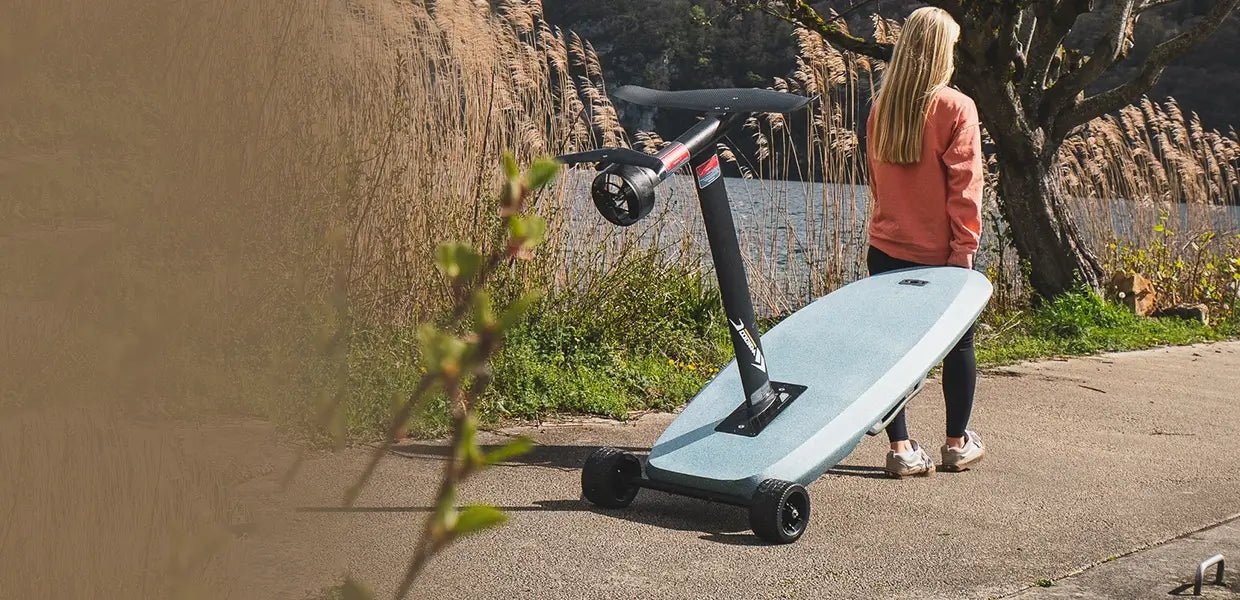
Flying with an eFoil is off the table. The airline industry's passenger battery chart allows lithium batteries up to 100 Wh, up to 160 Wh with the airline's approval, and anything above that travels as cargo under the dangerous goods regulations. The smallest pack among these sets, the LIFTX Light, holds 540 Wh, the Flitecell Nano 806 Wh and Awake's Flex XR 4 2,550 Wh. Fliteboard states that Flitecells cannot be carried on passenger aircraft and move by cargo air or sea freight through a certified dangerous goods shipper. Lift approves one case, the Zarges Battery Case, for air transport; it is a shipping case, and in our reading the battery inside it still travels as dangerous goods cargo. A holiday board goes by car, by ferry or by a freight forwarder, and the lighter the set, the easier the car.
Modularity matters for the years after the purchase. Lift's LCS links eBox, propulsion and battery so each can be swapped, a LIFT5 F mast can be upgraded to the 32 inch carbon one, and Aerofoils owners replace individual components. A second Flitecell costs €2,440 (Nano), €2,806 (Sport) or €4,026 (Explore) in the European store, so the battery you buy first is the one you will ride for years.
Product pages say least about the service map. Fliteboard's European locator has an entry for each EU state and for Norway, Switzerland and the United Kingdom, and the company covers import fees, duties and taxes for EU customers. Most Lift dealers are in North America; Lift ships to the UK and EU by FedEx and leaves customs duties and import fees to the recipient, while E-SURFER in Berlin states it covers Germany and Europe. SiFly tags its locator entries as school, dealer or service point, with several service points in Germany, and Waydoo's European dealers are densest in the Netherlands. Lift, Waydoo and SiFly each list dealers in the UK; the UK page has the detail. Age limits and local water rules sit on the rules page; Fliteboard itself does not recommend its boards for riders under 16.
The best eFoil for the money is the SiFly Rider+
€5,199 to 6,099 excl. VAT, from the maker's store in Bulgaria, buys a 130 liter board rated for riders from 40 to 140 kg, a PowerCell LR battery that SiFly quotes at up to 120 minutes, and a warranty of two years on board and battery in the EU and North America that passes to a second owner with the original invoice. No other maker in the table offers that rider range, that run time and a transferable warranty under €7,000. The range figure comes with its conditions printed: a 75 kg rider, the Cruiser 1900 wing, an open propeller, a 100 liter board and 15 km/h. The SiFly page has the whole range from the Rider to the Stellar X.
The runner-up is the Waydoo Flyer EVO Max Plus at $6,599 before sales tax: 130 liters, 6,000 W, about 120 minutes and up to 45 km/h. It loses on the warranty, which Waydoo binds to the region of purchase and the original buyer, and on the 100 kg clause in its terms. The Waydoo versus Fliteboard page weighs it against the premium brands set by set.
The best eFoil brand for service and resale is Fliteboard
Service and resale depend on who stands behind the board after the sale, and on whether that promise survives a new owner. Fliteboard's warranty runs two years from shipping, the unexpired transferable provisions pass to subsequent owners, and the locator covers the EU, Norway, Switzerland and the UK. Commercial use voids it, which matters for a used board that spent a season at a school.
Swipe sideways to see all columns
| Brand | Warranty | Second owner | Where repairs happen |
|---|---|---|---|
| Fliteboard | 2 years from shipping | Unexpired part transfers | Locator covers the EU, Norway, Switzerland, the UK |
| SiFly | Board and battery 2 years; hydrofoil 2 years or 300 motor hours | Transfers with the original invoice | SiFly service points; hydrofoil service every 100 hours or 12 months |
| Awake | Battery 24 months or 300 cycles | Transfers via support, period not renewed | Conditional on the manual and monthly software updates |
| Aerofoils | 2 years from invoice | - | Only in the country of original delivery; inspection after 12 months |
| Lift | 1 year limited, Lift-made parts | Not transferable | Mostly North American dealers |
| Waydoo | Bound to the region of purchase | Original buyer only | Service center in the region of purchase |
Older boards carry traps of their own. A Lift Gen4 Full Range Battery is not compatible with a LIFT5 or a LIFTX, and the LIFT5 no longer takes LIFT2 to LIFT4 parts, so an older Lift is a closed system. Takuma no longer sells new boards, and its boards turn up on the used market without a maker warranty or a parts supply; the Takuma page and the used eFoil page cover the handover.
What the premium boards add
The step from a €6,000 set to a €15,000 set pays for the board material, the weight, the system around the board and the people behind it. Material has a price tag. Fliteboard sells the ICON and the PRO as a Soft Top 2 from €10,919 and as a Carbon from €12,627, about €1,700 for the carbon shell. Lift's LIFT5 F has a fiberglass board, a 28 inch aluminum mast and the standard hand controller at $10,999 excl. VAT; the LIFT5 at $14,999 excl. VAT has the carbon board, the LCS propulsion and wings and the Elite Hand Controller with a GPS display for live speed and distance, a carbon shell and titanium hardware.
Weight is harder to put a price on. The ULTRA L3 at about 18 kg and the LIFTX at about 20 kg are both premium boards, and the kilograms saved are what the carbon pays for. A spare battery costs close to half a Waydoo Pro Plus and about a quarter of a Fliteboard ICON, and Fliteboard prices its sets with the €268.40 slow charger while the fast charger is a €1,159 add-on. A premium badge buys no certainty on warranty: Lift gives one year and no transfer, SiFly two years that pass on with the invoice.
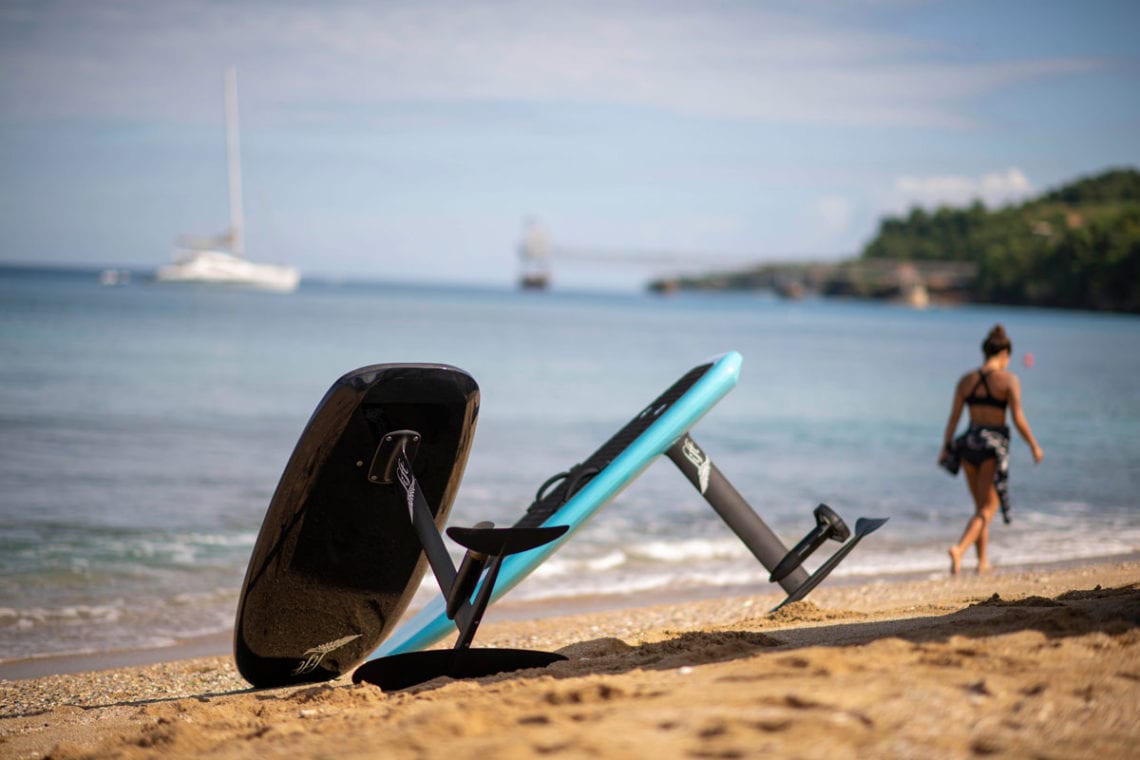
Aerofoils prices its complete sets typically between €13,000 and €16,000 including VAT, with a jet in the mast and components owners can upgrade or replace. Awake's RÄVIK boards, from €9,990 to €15,990 excluding VAT, are jetboards without a foil and belong to a different decision, covered on the Awake page. The battery page compares the packs themselves, and the brand comparison lines up all seven brands in one table.
The checklist before you order
- Your weight in a wetsuit against the maker's rider limit. Over 100 kg, a Prop drive or a SiFly; over 120 kg, a SiFly or a Waydoo rating confirmed in writing.
- The depth of your home water. Under about 1.2 meters at the launch, a shielded jet and a plan for where to start.
- The wing in the box, in square centimeters, and the price of the next wing up or down.
- The battery's watt hours and the maker's run-time conditions. A second pack costs between a quarter and a half of the set.
- The warranty: length, whether it transfers, where repairs happen, and whether commercial use or a weight clause voids it.
- A lesson on the brand you want, booked before the order. Schools teach on Fliteboard, Lift and SiFly, and Waydoo dealers offer demo rides.
- Import duties, shipping, and how the board gets to the water: a 30 kg set is a car journey, and no battery flies as luggage.
The buying guide explains how to read a data sheet, and the Waydoo and Fliteboard pages take both ranges apart board by board.