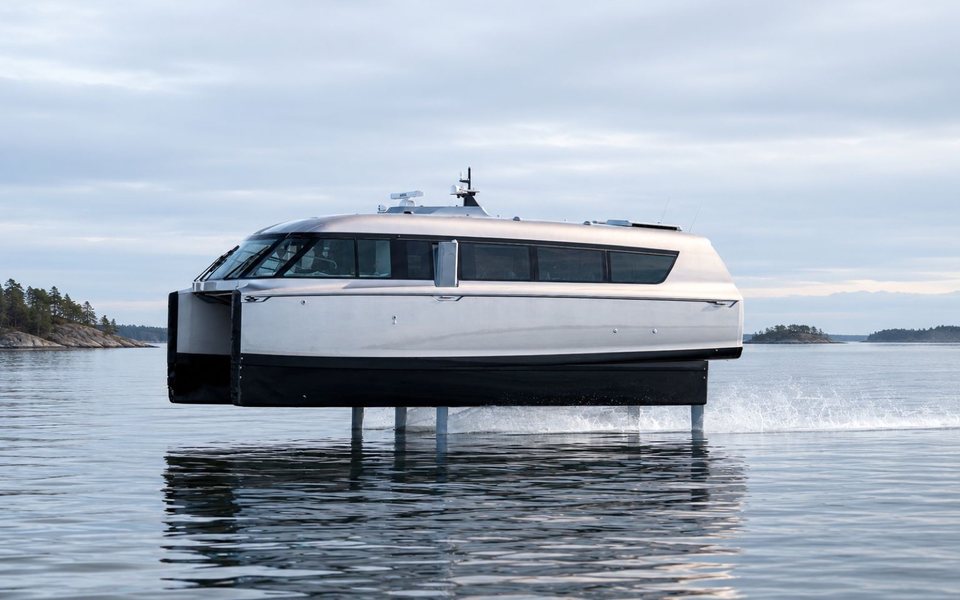
Parallel and serial: two ways to pair a diesel with a battery
Every hybrid boat carries a combustion engine, an electric motor and batteries. The designs differ in what turns the propeller. In a parallel hybrid the diesel and the electric motor both sit on the drive line, and either one, or both, can push the boat. In a serial hybrid, the diesel electric layout, the diesel never touches the propeller. It runs a generator that charges the batteries, and the batteries feed the motors.
Greenline draws the line this way: add a diesel generator to an electric yacht for range and you have a serial hybrid, while its own combined electric and diesel drives are parallel hybrids. Its range holds both. The Greenline 39 H-Drive pairs an 18 kW motor on the shaft with a Yanmar diesel. The E-Drive has one 50 kW motor and a 4 kW diesel range extender, which by the builder's own definition we take to be a serial hybrid.
Azimut uses the word more loosely. On the Seadeck 6 the three Volvo Penta IPS 500 units are plain diesels. The hybrid part is a 46.4 kWh battery with two inverters that runs the air conditioning and stabilizers at anchor with the generator off. So a “hybrid yacht” can be a boat whose electric side never turns the propeller (our reading of Azimut's specifications). Ask which kind a boat is before you compare figures.
Key facts
- Parallel hybrid
- diesel and electric motor both drive the propeller
- Serial hybrid
- diesel runs a generator, electric motors drive
- Greenline 39 H-Drive, electric
- 18 kW, 7 kn, up to 20 nm at 5 kn
- Azimut Seadeck 7, electric
- up to 11 kn, diesels off
- Greenline battery warranty
- 2,000 full cycles per cell
Electric only range, and when the diesel starts
Seven knots is the top speed of the Greenline 39 on its H-Drive, with up to 20 nm at 5 knots from a pack of up to 26.6 kWh. Anything faster is work for the Yanmar diesel, good for 18 knots. The E-Drive version reaches 11 knots on electric power and up to 75 nm at 5 knots once its range extender joins in. Models and batteries are on our Greenline page.

On a planing yacht the handover is automatic. The Azimut Seadeck 7 uses Volvo Penta's hybrid electric system, with a 160 kW electric machine between each D13 IPS 1350 Hybrid diesel and its IPS unit. Pure Electric runs the boat up to 11 knots with the diesels off; Hybrid Standard stays electric at low speed and starts the diesels above a threshold; Hybrid Boost uses both to get on the plane. Azimut allows pure electric running “for limited periods of time”.
Out at sea the tank sets the range. Azimut gives the Seadeck 7 374 nm at a 23 knot cruise with its standard engines and 332 nm at 26 knots with the optional ones. Those are diesel figures, and as we read them the battery does not move them.
Hybrid yacht builders and drive makers
Azimut calls its Seadeck line “the world's first family hybrid yacht series”, from the 17.25 m Seadeck 6 to the 25.60 m Seadeck 9. Behind the shared label, the systems do very different jobs.
Swipe sideways to see all columns
| Builder or maker | Boat or system | What the electric side does |
|---|---|---|
| Azimut | Seadeck 6 | 46.4 kWh runs the hotel load at anchor |
| Azimut with Volvo Penta | Seadeck 7 | 2 x 160 kW, up to 11 kn |
| Greenline | 39 H-Drive, E-Drive | 18 kW or 50 kW, 7 or 11 kn |
| Baglietto with Siemens Energy | Dom 133, T52 | 180 kW motor and shaft generator |
| Fountaine Pajot | Smart Electric catamarans | Pods regenerate under sail |
| Nautor Swan | Swan 88 DreamCatcher | 120 kW Torqeedo, 160 kWh |
| Silent Yachts | 60 and 80 Series, 120 Explorer | Solar electric drivetrain |
| Vetus | Hybrid Kit, retrofit | 2.1 kW on the shaft |
Baglietto's parallel system couples a Caterpillar C32 diesel through a clutch to a 180 kW electric machine, with a diesel electric mode on the gensets up to 9 knots and full electric on batteries that can grow to 900 kWh. Sailing yachts make the strongest case, or so we read it, because the sail is the main engine and the propeller can turn into a generator. The Swan 88 makes enough power at 8 knots under sail to stay self sufficient and keeps two 45 kW generators for motoring “over 2,000 nautical miles”. Oceanvolt rates its ServoProp 25 saildrive at around 3 kW of regeneration at 8 knots.
Silent Yachts reports that a Silent 62 crossed the Atlantic, some 3,800 nm, on about 5,500 liters of fuel and ran on batteries for 72% of the way, which the builder puts at about 40% less fuel than a conventional 60 foot motor catamaran. Builders without any engine, such as X Shore and Candela, are on the electric boat page.
What a hybrid saves against a plain diesel
Every conversion costs energy. Nigel Calder traced the losses for the EU funded HYMAR project. A diesel at its best uses about 230 g of fuel per kWh, and after the generator, the electric motor and a TPPL battery at 85% the figure reaches 352 g/kWh. Lithium ion does better, at 90% or more, but the chain stays long.
His model of a serial hybrid against an optimized conventional Volvo Penta installation saved more than half the fuel at 3.25 knots, yet only about half a liter an hour. At 7.5 knots the hybrid lost about 18%, some 1.3 liters an hour. A parallel hybrid keeps the low speed gain without that penalty above the crossover speed, and it needs far less battery. For both, Calder concludes it is “extremely difficult to beat the efficiency of a well optimized conventional installation” at or above cruising speed.
Low speed is where the numbers turn. Researchers at Gdansk University of Technology measured up to four times higher energy efficiency than a conventional drive for a parallel hybrid inland ship in zero emission mode (Energies, 2019). A US Greenline dealer reports 20 to 30 percent fuel savings across a season from owners, less for boats that run fast all day. Azimut claims up to 40% less CO2 a year for the Seadeck 7 against a similar traditional yacht.
Energy density explains why long range “electric” yachts keep a diesel. A liter of diesel holds a little over 10 kWh of chemical energy. A 260 kg Torqeedo Deep Blue 40 battery gives 38 kWh usable, roughly what sits in under four liters of diesel (our arithmetic). The engine's losses do not close that gap.
At anchor and in harbor, where a hybrid pays off
The night in a bay is the classic case. Without a battery bank, a generator runs until morning to keep the cabins cool. Azimut's “Zero Emission Hotel Mode” on the Seadeck 6 runs the air conditioning and stabilizers for up to four hours by day and eight at night with the generator off; on the Seadeck 7 the batteries carry every service for up to 12 hours.
Greenline publishes the sums for its 39. Four people use around 15 kWh in 24 hours with air conditioning, and the standard 1.1 kW solar roof puts back about 7 kWh a day, which the builder rates at “3 Days on Anchor”, longer or shorter with sunshine and energy management. For the non hybrid 39 Greenline gives 6.5 kWh a day without air conditioning. Sleep aboard in a hot summer and the air conditioning decides how many days you stay off the grid.
Charging a hybrid, and the battery you inherit
Shore power is the obvious way to fill the pack. On a Greenline the diesel does it faster. Under way the electric motor works as a generator at up to 50 kW, depending on the model, and the builder says the pack is full in under two hours, by the next bay. A yacht left a week on the mooring, it adds, comes back charged by its solar roof. Small retrofits charge far less. The Vetus kit puts in 720 W at most, and only while the diesel turns the shaft, so nothing at anchor.
On a used hybrid, the battery is where we would look first. Greenline warrants each cell of its air cooled LiPo packs for 2,000 full charge cycles. Ask the seller for the cycle count and the state of health from the battery management system, and for the date the pack was built.
Hybrid vs electric boat, or a plain diesel
Plan for your longest day on the water. Full electric suits short trips at displacement speed or on foils, from a berth with a socket, and lakes with limits on combustion engines. A hybrid suits coastal cruising for days at a time, open water and nights at anchor. If you run fast for hours most days, a well matched diesel serves you as well (our reading of the builder data and Calder's model).
Swipe sideways to see all columns
| How you use the boat | Best fit |
|---|---|
| Day trips from a berth with power | Full electric |
| Lakes that ban combustion engines | Full electric |
| Coastal cruising, nights at anchor | Hybrid |
| Long passages without shore power | Hybrid or diesel |
| Fast cruising for hours | Diesel |
| Sailing yacht | Hybrid or electric with generator |
The X Shore Eelex 8000 shows what a battery alone does: 126 kWh, 30 knots top, a 20 knot cruise and up to 100 nm depending on speed and use. The Candela C-8 flies on foils for 57 nm at 22 knots on 69 kWh. At the small end, Ruban Bleu in France builds license free rental boats with no hybrid version; its Scoop 2 runs 8 hours at 9 km/h on a 1.6 kW pod motor.
None of the hybrid builders here prints a list price or a hybrid surcharge, so a hybrid is a quote per configuration. The nearest public comparison is one hull with two drives, from RAND; the rest of the bill is on the electric boat cost page.
Swipe sideways to see all columns
| Boat | Drive | List price |
|---|---|---|
| RAND GT 28 (model year 2027) | Petrol | from €179,900 |
| RAND GT 28 (model year 2027) | Electric, 170 kW | €269,900 |
| X Shore Eelex 8000 | Electric, 126 kWh | from €245,000 |
| Greenline, Azimut, Baglietto | Hybrid | - |
How the rules treat a hybrid boat
None of these rule texts defines a hybrid. They name the combustion engine, or the electric motor as main propelling machinery, so, as we read them, a hybrid counts with its engine on board whatever mode it is in. In the UK, regulation 2 of The Recreational Craft Regulations 2017 (SI 2017/737) defines a propulsion engine as any internal combustion engine used “directly or indirectly” for propulsion, which on our reading takes in the generator of a serial hybrid.
Canada's Vessel Operation Restriction Regulations (SOR/2008-120, section 2(3)) bar power driven vessels, and electric drives over 7.5 kW, from the waters of their Schedule 3, except as that Schedule indicates. Section 1 defines electrical propulsion by its main propelling machinery, an electric motor powered by electric cells. A hybrid whose main propelling machinery is a diesel does not meet that definition, on our reading, and no ruling on hybrids is published, so ask Transport Canada about the water in question.
Hungary's Act XLII of 2000, § 58(1), bans boats driven by a combustion engine on Lake Balaton and a few other waters, with the exemptions listed in § 58(3). A diesel Greenline or an H-Drive falls under that ban on our reading; for an E-Drive with a diesel range extender the text gives no answer, so ask the shipping authority first. Where only an electric motor is allowed, switching to electric mode does not, as we read it, make a hybrid an electric boat. This is general information, not legal advice.