
Roxen and its one craft
Roxen Innovations is a small Swedish company with one product, the ROXEN, an electric jet ski that weighs a fraction of a petrol one. Three engineers, Magnus Sundstedt, Paul Holmstedt and Martin Eronn, founded it in Linköping in January 2021 under the name E-Watercraft. Today it has its office and production in Linköping and Stockholm, and it builds the battery itself in Sweden. Sundstedt runs the company as chief executive.
The craft began as a prototype called Eco-Jet. Roxen showed the ROXEN to the public in 2024, when, by the company's account, it won an Innovation of the Year award at Sweden's biggest boat show. In 2025 came the international debut, the first customer deposits and a nomination for the Innovation Route at the Cannes Yachting Festival. Roxen now says it is scaling up to deliver more than 200 craft.
What sets the ROXEN apart from the other electric jet skis is its build. Instead of a heavy moulded hull with built in buoyancy, it pairs a slim ABS thermoplastic hull with two black inflatable tubes along the sides. Roxen says it was designed as an electric craft from the start and is not a converted petrol design. It looks a little like a jet ski crossed with a rescue sled, and the tubes do much of the work of keeping it stable and afloat. Roxen calls it the lightest electric jet ski on the market and four times lighter than the lightest petrol watercraft. Those are the maker's claims, but the numbers behind them are published, and they are unusual.
Power, speed and range
The motor drives a water jet, and Roxen rates it at 22 kW, about 30 hp. In its own explainer on kilowatts and horsepower, Roxen describes that figure as peak power. A continuous rating is not published. That sounds modest next to a petrol ski, but the whole craft weighs about 112 kg with its battery, so 22 kW goes a long way. Roxen gives the top speed as 30 knots, about 55 km/h, and an efficient cruise of 15 to 20 knots.
Swipe sideways to see all columns
| Item | ROXEN |
|---|---|
| Motor | 22 kW (about 30 hp), described by Roxen as peak power |
| Top speed | 30 knots (about 55 km/h) |
| Cruising speed | 15 to 20 knots |
| Battery | 5.25 kWh, swappable, water cooled, IP67 |
| Time on the water | Up to 75 min or up to 27 km per charge, depending on conditions |
| Charging | Included charger, 230 V socket, about 2.5 to 3 h from empty |
| Size | 2.6 x 1.26 x 1.29 m; 2.6 x 1.16 x 0.80 m with the tubes off |
| Weight | Hull 79 kg, battery 33 kg |
| Hull | ABS thermoplastic with inflatable side tubes |
| Storage | 55 litres under the front hood, zip pockets on the side |
| Seats and maximum load | Not published |
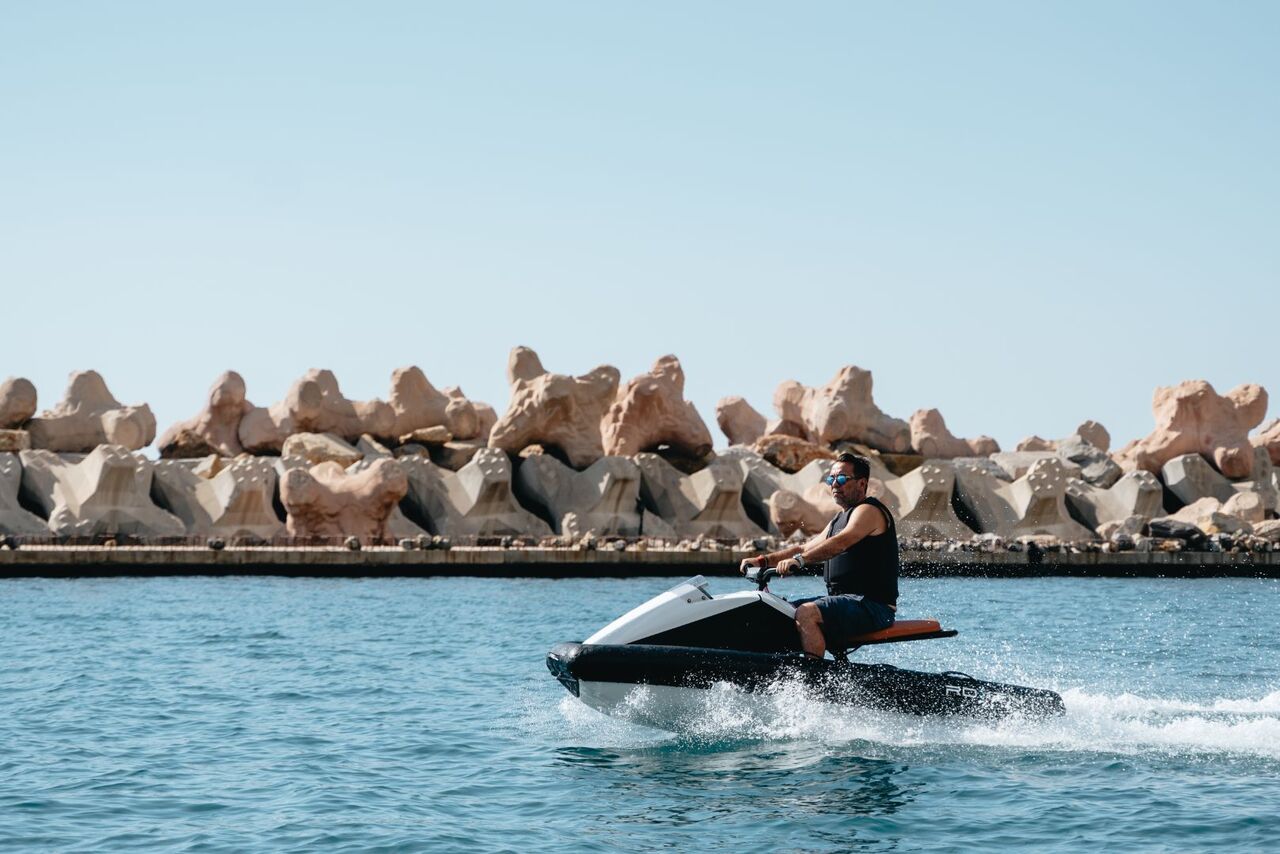
The battery holds 5.25 kWh and weighs 33 kg. The Berlin dealer E-SURFER puts its energy density at 159 Wh/kg, which squares with those two numbers. Roxen quotes up to 75 minutes or up to 27 km, 15 nautical miles, on a charge, depending on conditions. Ridden flat out the whole time, you should expect less, as with any electric craft. Under the front hood sits a 55 litre storage space, and zip pockets on the side keep a phone or keys to hand.
What Roxen has not published
A few numbers a buyer would want are missing. Roxen states no seat count and no maximum load, and its FAQ sends questions about passengers and towing to the product guidelines. E-SURFER, which has ridden a ROXEN on the Spree in Berlin, lists these gaps and notes that all the footage shows a single rider. CE certification as a recreational craft is under way, by Roxen's account, but not yet completed.
Battery, charging and running costs
The battery is the part that decides how a ROXEN day goes. Roxen builds the pack in Sweden, cools it with water and seals it to IP67, and it lifts out and swaps “in under a minute”. Every ROXEN comes with a charger made by PrimePower that runs from an ordinary 230 V socket and fills an empty pack in about 2.5 to 3 hours. There is no need for a marina charging post or a special supply.
One battery gives up to 75 minutes. Roxen's page for hire operators reckons on about 2.5 hours of riding per craft per day with one spare pack, charging one while the other is in use. A spare costs €5,900 before VAT and shipping, a third of the craft's price, so most private owners will think hard before buying one.
Electricity is where the ROXEN is cheap. A full 5.25 kWh charge at a household rate of about 26p per kWh comes to around £1.40 before charger losses. Roxen gives two figures of its own for running costs. Its product page puts electricity at about €1.10 to €1.30 an hour against about €24.80 an hour in fuel for a petrol watercraft. Its FAQ says about €1.80 an hour against €25 to €30. Either way the gap is wide, though both are the maker's estimates.
Roxen gives no cycle figure for the battery and no separate battery warranty. The 24 month warranty covers defects in materials and workmanship across all ROXEN products. For winter, Roxen asks owners to take the battery out and keep it indoors at room temperature. The full price picture for every model is on the electric jet ski price page.
Roof rack and trolley instead of a trailer
A petrol jet ski weighs 250 to 350 kg and travels on a trailer. The ROXEN hull weighs 79 kg without its battery, and Roxen sells it on the promise of “no trailer, no boat ramp”. Its FAQ says two people can lift it onto a roof rack and take it down again. The inflatable tubes come off, which brings the craft down to 2.6 m long, 1.16 m wide and 0.80 m high for storage and transport.
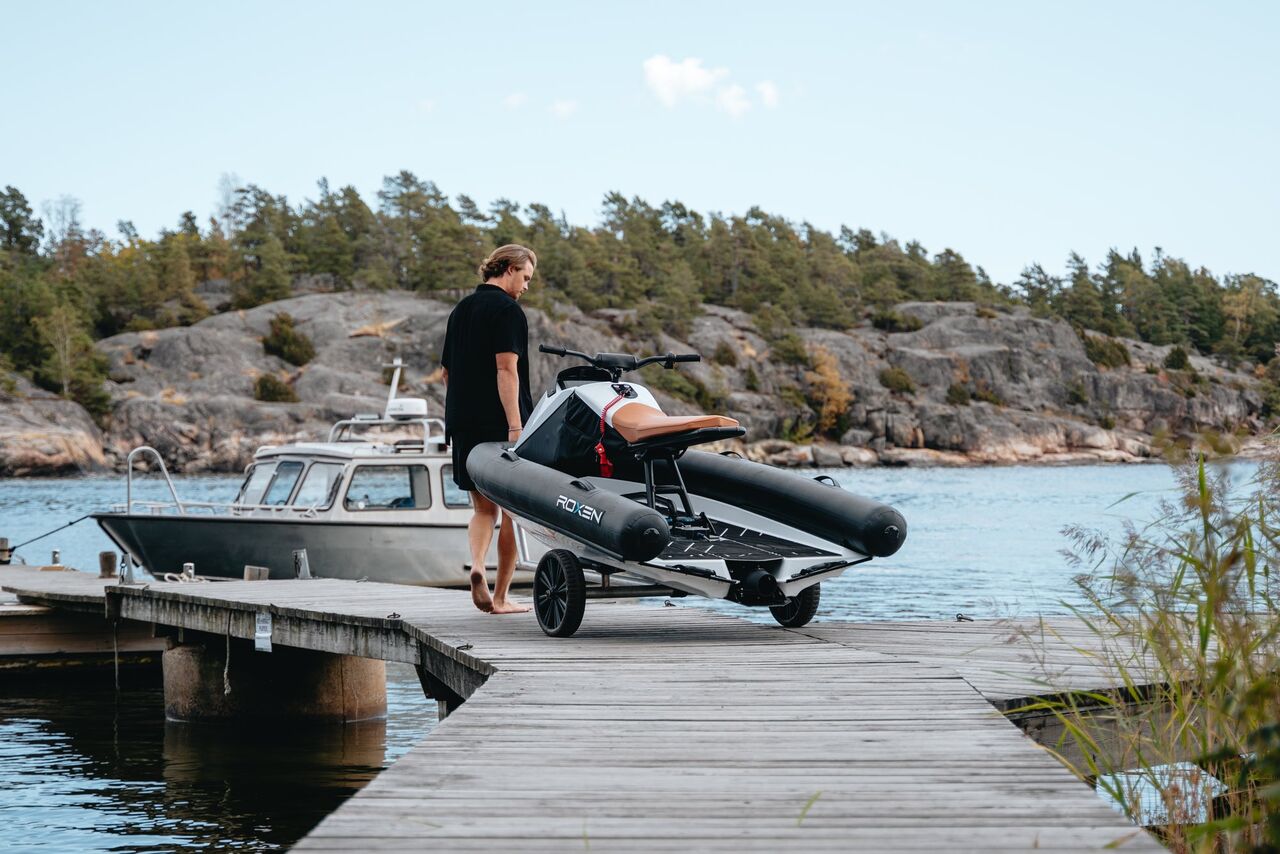
On the shore it rides on a two wheeled trolley, as in Roxen's own pictures, so one person can push it down a dock or a beach. A roof rack needs a car and a rack rated for the load, and the battery travels separately at 33 kg. For a garage, a boathouse or a flat with a parking space, the small footprint is the real gain, with no trailer to store, tax or tow.
The catch in Britain is that the water you want to ride on may tell you where to put in. Portland Harbour, for example, has powered watercraft launch only at Ferrybridge slipway. A light craft makes the walk to the water easier, but it does not change the local rules.
The ROXEN as a yacht tender
Roxen aims the ROXEN squarely at yacht owners, and the weight explains why. Carrying a petrol jet ski aboard needs a davit, a crane rated for the load or a large tender garage, and many yachts have none of them. Roxen says its craft fits on a swim platform, in a tender garage alongside a dinghy or on deck in a cradle, that two crew can lift it by hand and that one crew member can launch it.
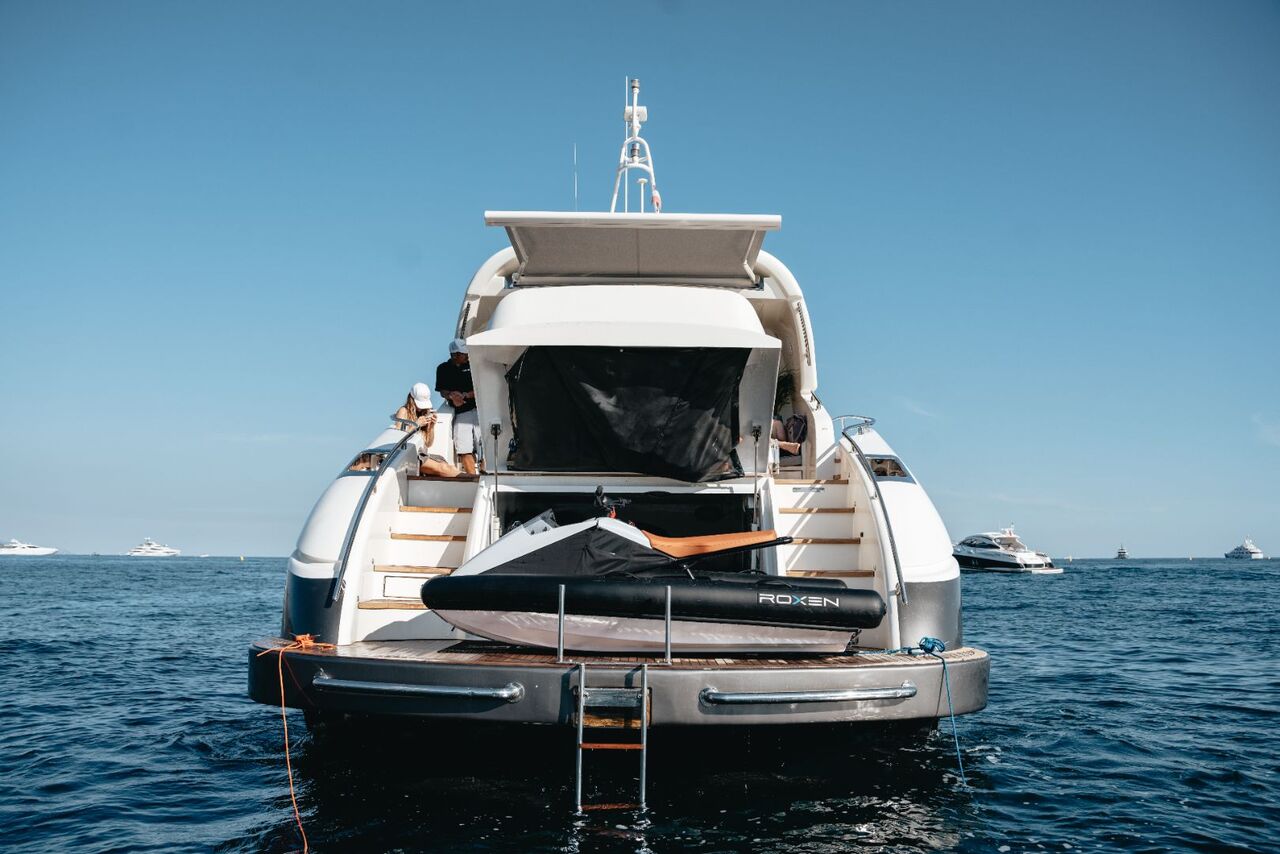
On a sailing yacht, Roxen suggests the stern rail, or towing it behind at sailing speeds. There are no fuel cans to store aboard and no petrol smell on deck, and the charger runs from the yacht's 230 V supply. Geofencing lets an owner keep guests inside a set area round the anchorage, and the app shows where the craft is.
How it rides, with speed limits and a geofence
There are no gears, no choke and no pull start. Roxen says most new riders are comfortable within minutes, and its briefing for hire customers covers only the throttle, the steering and the safety lanyard. The lanyard cuts the motor as soon as the rider comes off, and Roxen describes the craft as sealed against rain, spray and submersion.
The ROXEN is connected over 4G/LTE. Its app shows live speed, battery state, range and GPS position, takes software updates over the air and lets an owner set speed modes. A speed limit set in the app cannot be overridden from the craft, which suits a parent handing the bars to a teenager or a club with a new member. Geofencing draws a boundary on the map. Near the edge the craft slows down, and past it the power can be cut entirely. The ROXEN Tablet, sold for €230, runs the ROXEN app and shows battery, range and use.
After salt water, the craft wants a rinse with fresh water, a clean jet intake and some care for the battery. A service check after 12 months is recommended but not a condition of the warranty.
Hire fleets and clubs
Roxen calls the ROXEN “well suited to commercial rental” and its app has a Fleet Management feature for running several craft from one screen. For a hire operator, the speed limiter and the geofence deal with the two biggest worries, riders going too fast and riders going too far. A rider who falls off stops the craft with the lanyard.
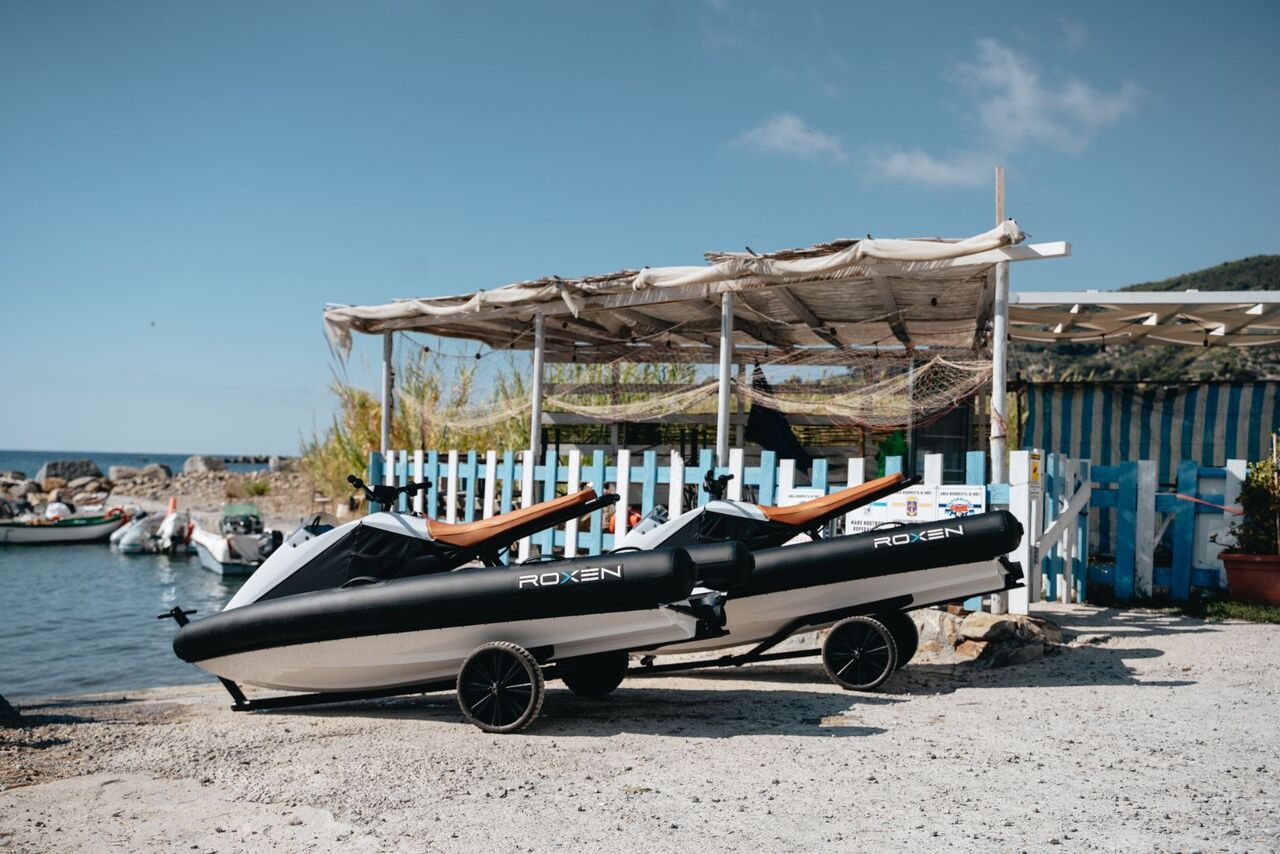
With one spare battery per craft, Roxen counts on around 2.5 hours of riding a day without downtime, and more with extra packs. A small fleet can live on trolleys on the beach, with no slipway or tractor needed to get it in and out. Roxen runs a Riders Community with demo events and meet ups in Europe and the US, and many of its dealers offer demo rides.
Price, extras and a UK figure
Roxen lists the ROXEN from €17,900 before VAT and shipping, Ex Works from Sweden unless agreed otherwise, and says prices may vary by market and dealer. In Germany, E-SURFER shows it at €21,301, which is the net price with 19% German VAT on top. Roxen publishes no list price in pounds, so the UK lines below are our own estimate.
Swipe sideways to see all columns
| Item | Price |
|---|---|
| ROXEN, excl. VAT and shipping | €17,900 (about £15,240) |
| ROXEN with 20% UK VAT | (about £18,290, before delivery) |
| ROXEN at E-SURFER, Germany, incl. 19% VAT | €21,301 |
| Reservation in Roxen's store | €500 (shown as £426 on the UK store) |
| Extra battery, excl. VAT and shipping | €5,900 |
| Spare battery reservation | €250 |
| Extra charger (one comes with the craft) | €790 |
| ROXEN Tablet | €230 |
Our pound figure converts €17,900 at the rate Roxen's store uses for UK visitors, which gives about £15,240 before VAT. Importing a craft like this into Britain carries no customs duty by our reading of the UK Trade Tariff, but 20% VAT is due on the value plus carriage, which brings the total to about £18,290 before the delivery charge. Delivery adds its own cost and raises the VAT a little more.
Irish buyers see the euro list price directly in Roxen's store, with Irish VAT and shipping to add. For how the ROXEN compares with the Taiga Orca and the petrol skis on cost, see the price comparison.
Reserving and buying one from the UK or Ireland
Roxen's online store does not sell the craft outright. It takes a €500 reservation for the next season, which holds a place in the queue and counts in full toward the price. Roxen says the deposit stays fully refundable until you sign an order confirmation, and the balance is due at delivery. A pre-order can be cancelled at any time for a full refund, or passed to someone else with Roxen's written approval. Roxen shares estimated delivery dates once production is scheduled.
You can also buy through a dealer, and Roxen says financing and leasing are offered in selected regions through its dealer partners. Neither the UK nor Ireland has a Roxen dealer yet, and the company's partners page is still recruiting them. A British buyer deals with Sweden directly and, with the craft sold Ex Works, should agree delivery before signing. Our electric jet ski for sale page covers deposits, delivery and buying used in more depth.
Warranty and service
The warranty runs 24 months on defects in materials and workmanship, for the craft, battery, charger and tablet alike. Roxen recommends a service check after 12 months but does not make the warranty depend on it. It says nothing about passing the warranty to a second owner, and with no UK workshop, any repair means talking to Sweden. For a craft whose software updates arrive over the air, that matters less than it would for a petrol engine, but a damaged hull or tube still has to go somewhere.
Licence and launching
By the RYA's account there is no national licence for riding a private jet ski in UK waters, and an electric one is no exception. Harbours and councils set their own conditions. Poole asks for a permit, Datatag registration and insurance, and Langstone and Crouch want an RYA certificate before a ski goes on the water. Notices like Poole's name e-foils and other powered craft alongside jet skis, so a ROXEN does not slip through because it has no petrol engine.
Ireland defines a personal watercraft by its combustion engine, so by our reading an electric jet ski falls under the rules for fast power craft instead once it reaches 17 knots, which a 30 knot ROXEN does. Nobody under 16 should be at the controls of one. Roxen itself says only that licence rules vary by country and points riders to the local maritime authority. The electric jet ski licence page goes through permits, ages, insurance and riding abroad.
Who the ROXEN suits
The ROXEN makes most sense for a solo rider who wants a powered craft without a trailer, a yacht owner short of deck space, or a hire business that wants quiet craft it can limit and fence in. It is light, simple to ride and cheap to charge, and it comes from a maker that publishes its prices openly.
It suits less well if you want to carry a passenger or tow a tuber, since Roxen has not published a seat count or a load limit. Seventy five minutes a battery is a session, not a day, unless you pay for a second pack. Buyers in Britain and Ireland also take on the paperwork of a direct purchase from Sweden, with no local dealer to fall back on and a CE certification still in progress. If a two seat electric ski is the goal, the heavier Taiga Orca on the electric jet ski overview is the other craft to look at, and for riding on a board instead, an eFoil travels lighter still.


