How long the makers say it takes
Most people get up on foil on their first day, by Lift's account. Waydoo claims most beginners stand within 15 to 30 minutes and fly within two to three sessions; Fliteboard allows that it might take a few sessions before you feel comfortable foiling. Standing is the quick part of it, and controlled flight the slow one.
Your pace depends on instruction, fitness, your setup, the water and any board sport you already know, in Waydoo's list. Going too fast too soon is the biggest mistake beginners make, Waydoo says, and Lift puts it at the top of its own list. Lift's cure is balance at low speed first, power after.
Two controls do the work. The trigger sets your speed and your weight sets your height. Lean forward and the board stays on the surface, shift back and the nose pitches up, as the Lift manual puts it. Most of learning to eFoil is keeping those two apart.
Water, kit and settings before the first ride
Pick calm, flat water. Lift wants a lake, a bay or a sheltered harbor with no current and little boat traffic, away from swimmers, docks and shallows. Fliteboard asks for at least 150 m (160 yards) between you and other water users, and a soft sand bottom where you can find one. Stay out of breaking surf, and never ride further out than you would swim back.
Depth matters because the foil hangs below you. Lift's sits up to 3 feet under the surface, so it asks for at least 4 feet (1.2 m) of water; Fliteboard and Aerofoils want 1.5 m (5 ft). The launch has to allow motorized boards, and local rules vary from one place to the next, as the eFoil rules page explains.
Wear a leash, an impact vest and a helmet. Fliteboard tells you to expect crashes while you learn, and a crash can put you into the board or the wing. Many beginners also skip the foot straps so their feet come free in a fall. Last of all, turn the power down to the learning setting your maker provides.
Swipe sideways to see all columns
| Maker | Learning setting | What it changes |
|---|---|---|
| Lift | Governor setting 1 | Lowest motor power |
| Fliteboard | Controller Level 1, Speed Limiting in the Flite App | Learning rider mode; a capped top speed |
| Aerofoils | Gonna-Fly remote mode | Lower trigger sensitivity |
| Awake | Eco, Sport, Extreme modes | Trigger sensitivity and top speed |
| Waydoo | Flight Assist (not on the Lite) | Helps stabilize the board; can be switched off |
Lying flat and steering with your weight
Everyone starts on their stomach, and Lift budgets 15 to 30 minutes for it: controller in your dominant hand, the other hand near the nose, a gentle squeeze on the trigger, and the board steered by shifting your weight from side to side. Waydoo wants your chest raised and your legs trailing clear of the mast.
Your trigger finger learns its job here. Practice starts and stops without a surge, and a full release the moment the line turns unsafe. Lift also warns against a death grip on the trigger.
Keep enough weight forward to hold the nose down and parallel to the water as you speed up. Fliteboard gives a pace to reach before you move on, about 6 to 10 km/h (4 to 6 mph) while prone.
On your knees, still on the surface
Lift puts both knees under you, weight forward and the board flat on the water, to practice turns and speed control. Waydoo comes up one knee at a time, near the centerline where your feet will go later, and keeps you there until you can speed up, slow down and turn without grabbing the board.
Fliteboard's guide reads the signs for you. A sinking nose means you are going too slowly, and a crash on the way to your knees means too much speed with your weight too far back.
Some riders fly from the knees before they ever stand, at 18 to 25 km/h (11 to 16 mph) in Fliteboard's guide, depending on your weight. Move your upper body back and the board lifts. Move it forward and the board touches down again.
From here on, keep your eyes on the open water ahead. “Your body tends to follow your eyes,” Waydoo writes.
Standing up and where your feet go
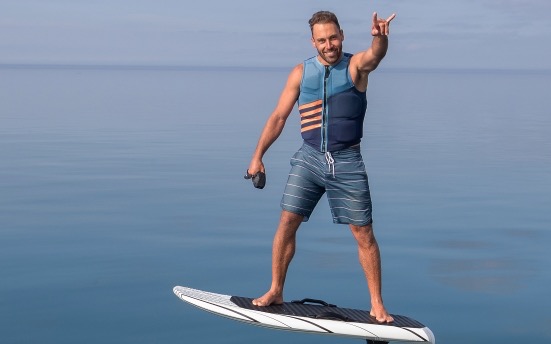
Slow down before you stand. Fliteboard picks a speed where the board feels supported but is not yet planing, 8 to 12 km/h (5 to 8 mph) depending on your weight. The front foot comes up first, where your front knee was in Lift's version, and the back foot follows in one smooth motion. Keep your hips low and the hand with the remote in front of you.
Swipe sideways to see all columns
| Maker | Feet | Body |
|---|---|---|
| Lift | Wide, square with the front of the board | Low wrestler stance, about 70% of your weight on the front foot |
| Fliteboard | Hip width, slightly offset, on the stance marks | Twisted forward, a bit like the yoga pose Warrior 1 |
| Waydoo | Roughly shoulder width, front foot angled slightly forward | Knees bent, hips centered, chest up |
Width is where they part. Lift asks for a wide stance, while Waydoo warns that “A wide side-to-side stance can create abrupt roll inputs.” Start on the marks of the board you ride and adjust from there.
Ride on the surface for a while after that, with straight runs, full releases and wide turns both ways. “Surface riding is not wasted time,” in Waydoo's words.
How the stance shifts as the board rises
As you accelerate, the motor and the bow wave push the nose up, so you press down through your front foot. “Unlike surfing, you control the board more with your front foot,” Fliteboard's guide says, and its FAQ compares the feeling to snowboarding in soft powder.
At around 10 mph the board becomes more stable, according to the Lift manual, and from here speed carries part of the load. Close to flying speed, Fliteboard has you release the front foot pressure gradually. Once you fly, Waydoo describes ankles, knees and hips as a small suspension, with height set by front against rear foot pressure while the speed holds steady.
Lift notes that “you need less power to stay on foil than to get up on foil”, so ease the trigger slightly once you are up. Add speed and rear foot together and the board can climb faster than you expect, Waydoo warns, so change one at a time.
Throttle and the speed at which the foil lifts
Fliteboard's FAQ puts the speed needed to hydrofoil at around 20 km/h. Wing size, your weight and the board all move that number, and every maker quotes its own for each stage.
Swipe sideways to see all columns
| Stage | Speed | Maker |
|---|---|---|
| Prone, before kneeling | 6 to 10 km/h (4 to 6 mph) | Fliteboard |
| Standing up on the water | 8 to 12 km/h (5 to 8 mph) | Fliteboard |
| Board becomes more stable | Around 10 mph (about 16 km/h) | Lift |
| Foiling from the knees | 18 to 25 km/h (11 to 16 mph) | Fliteboard |
| Minimum flying speed, standing | 20 to 25 km/h (12 to 16 mph) | Fliteboard |
| Lowest take off speed claimed | 15 km/h (about 9 mph) | SiFly |
As the board nears take off, hold the throttle steady. A foil that is too slow stalls. “Power affects both speed and lift” in Waydoo's guide, so a sudden squeeze lifts the board and a sudden release drops it. On a Fliteboard at Level 1, keep the trigger fully in through each move from lying to kneeling to standing, since letting it out a little can sink you.
The first flight is a few inches high
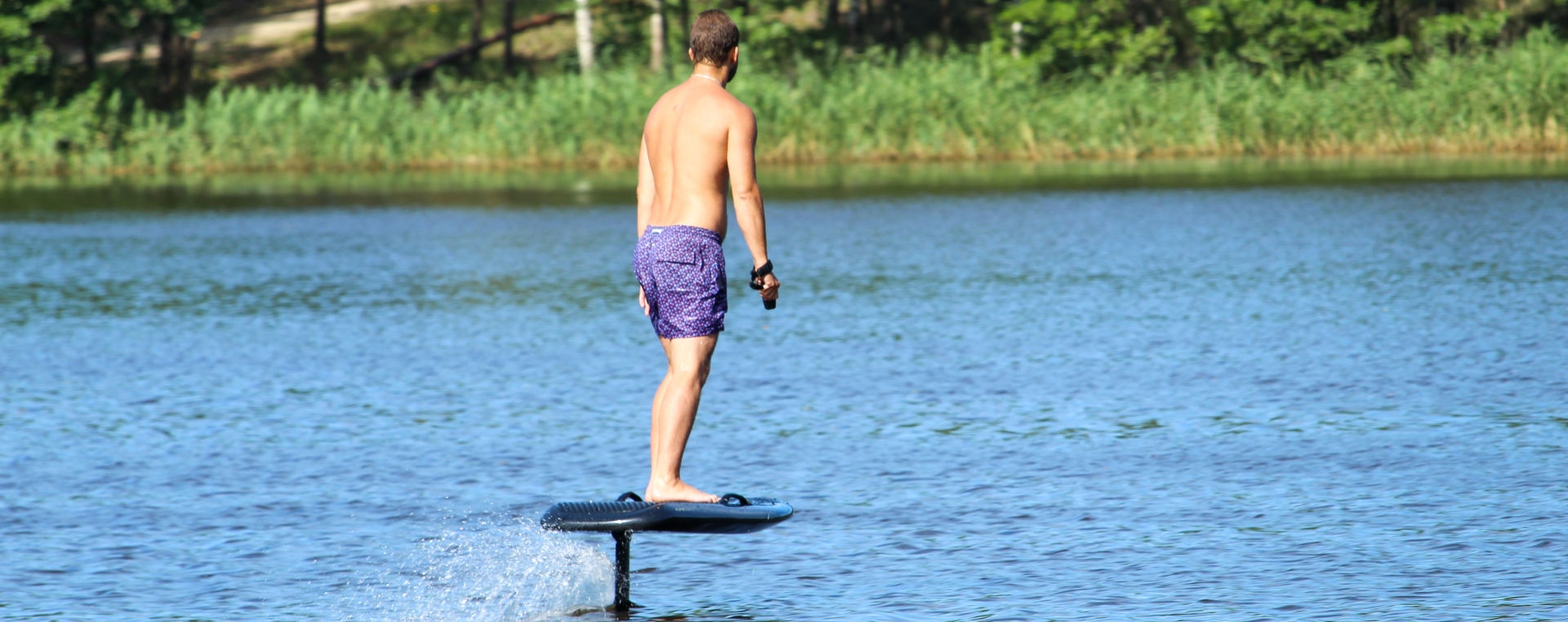
You know you are foiling when the splashing stops and only the faint hum of the motor is left, Fliteboard says.
Waydoo's formula is “stay low and delay flight”. Let the board lift only a few inches, and only once your line is steady. “Think ‘skim, lift, touch.’” Fliteboard suggests flights of about 5 m (16 ft), as low as possible, before you lean forward and touch down, and the Lift manual calls the drill touch and go's. If the nose rises fast, shift forward and release power.
Keeping the mast in the water
The mast is your margin. Fly high and there is less room before the wing breaches the surface; if it does, ease the throttle and level out, Waydoo says. Fliteboard adds that going high too quickly risks hitting the wings in a crash.
Height comes from small weight shifts. A touch more front foot brings you down, a touch less lets you rise, and the trigger stays put. “Ten calm low flights teach more than one long, unstable run,” as Waydoo's plan has it.
Falling clear of the foil
“Bailing is a critical part of learning to foil,” says the Lift manual, and it wants you to bail on purpose before a fall happens to you. When the board wobbles, jump instead of trying to rebalance.
Let go of the trigger first, get clear of the board and the wing, and protect your head. Never step over the mast or reach for the board, Waydoo adds. The makers differ on direction. Lift says to bail to the sides or back, never toward the front, and Waydoo also sends you to the side, while Fliteboard has you jump away in the direction of travel, clear of the wings. Follow the manual of the board under your feet.
Early falls happen at low speed. Lift cuts the power when the controller touches water or the trigger is released, and a Fliteboard stops the motor when the controller is submerged, but still switch the controller off before you swim back and climb aboard. If you keep falling the same way, go back to surface riding and adjust your stance.
Turning first, carving later
By the time you fly you have turned many times, lying down, kneeling and standing on the surface. In the air, Fliteboard says to wait until a straight line feels very comfortable, then make very shallow turns with small shifts of body weight.
Waydoo's checklist for a turn is controlled speed, stable height, eyes through the turn, knees bent and a wide arc. Head, hips and knees go round together, and the throttle stays steady while the radius tightens bit by bit. Turns feel smoother a little faster, Fliteboard finds, but Lift tells you to reduce speed before sharp ones.
S-turns come next, weight to the toes and then to the heels, kept wide and gentle. A wide carve follows with a gradual lean. If the wing breaks the water, you are leaning too far.
Tight carving waits until low flight and touchdowns are automatic, in Waydoo's guide. Once they are, its advice is short. “Commit to the turn.”

Beginner mistakes and the fix for each
Habits from surfing and skateboarding work against you here. An eFoil wants more front foot pressure than either, Fliteboard notes, so the surfer's weight on the back foot lifts the nose and sends the board climbing. Press down through the front foot; Lift's wrestler stance keeps about 70% of your weight there.
Too much throttle you have met already, at the top of Lift's list and Waydoo's. A hard squeeze adds lift along with speed, and the board leaves the water before your balance is ready. Go back to the lowest power setting and add power in small steps.
Looking at the board throws your balance off, Waydoo explains. Lift's fix is to look at the horizon.
Swipe sideways to see all columns
| Mistake | What happens | Fix |
|---|---|---|
| Standing too stiff | Movement goes straight into the board | Knees bent, so they absorb it |
| Over-correcting | Each correction becomes the next problem | Small weight shifts, or bail |
| A small advanced board | Less volume, less time to react | A big, stable board first |
Why learners get a big board and a large wing
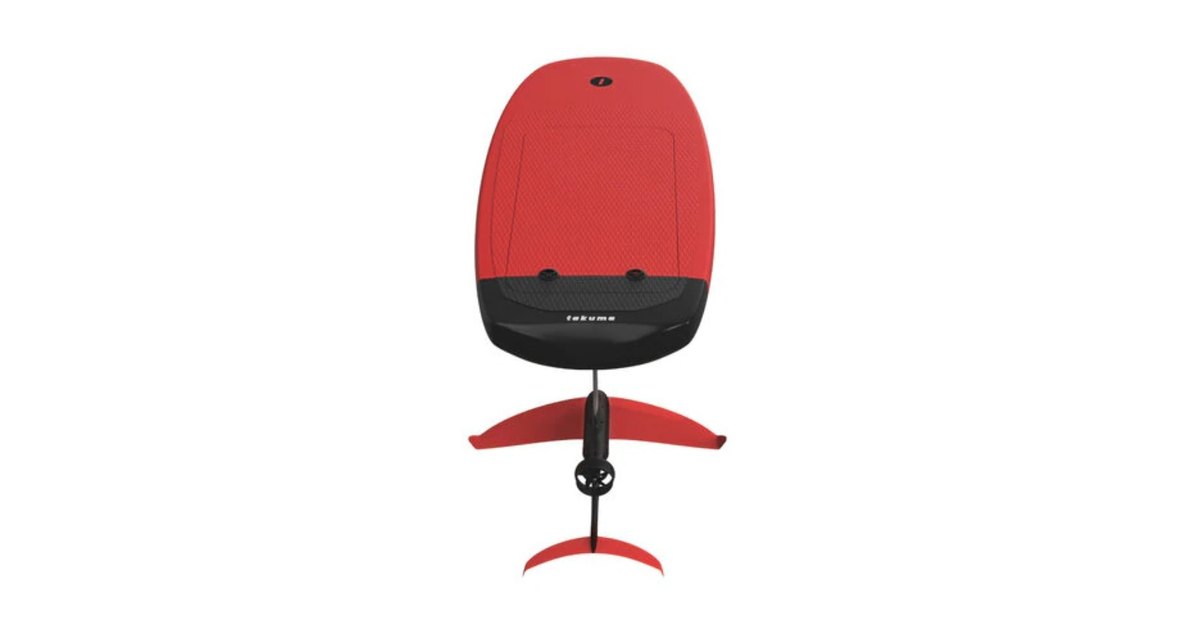
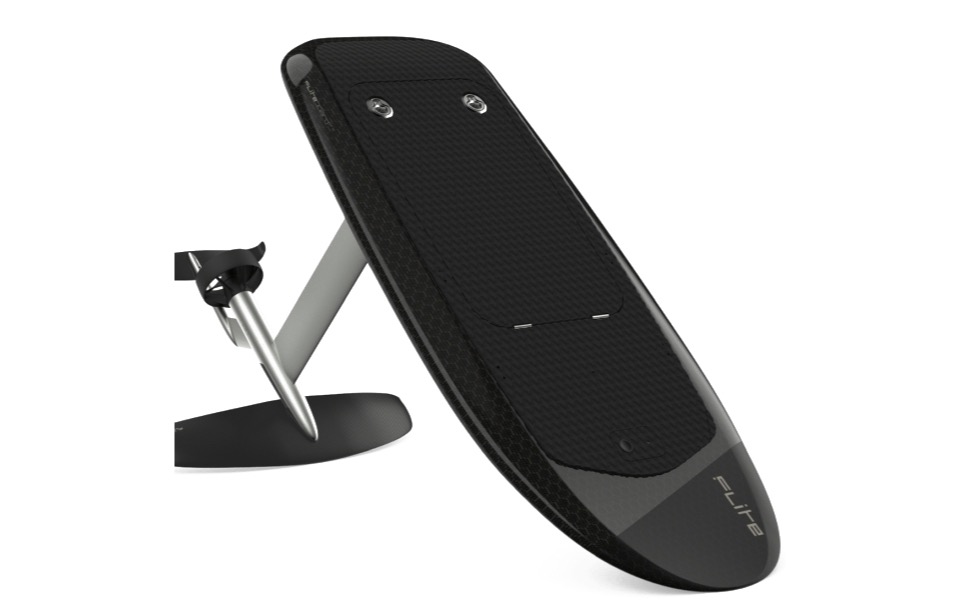
The more volume under you, the more time you have to react, so the boards made for learning are big. Lift's LIFT5 F Cruiser measures 5'4 and 83 L, Fliteboard's ICON 5'8" and 100 L, Waydoo's Flyer EVO Max Plus 130 L. Sportier boards ask more of you. Lift says the LIFTX takes a new rider longer to find balance on, and Fliteboard says its PRO isn't as easy to learn on.
Bigger wings give more lift and stability at lower speeds, and smaller ones are faster and more agile. Lift starts learners on the Surf V2 200, 250 or 300, Fliteboard on the Cruiser 1100 or the Cruiser Jet 1500, and SiFly builds its Cruiser 1900/CR340 for beginners. As you progress, Lift moves you to a smaller front such as the 150 Surf V2 or the 148 Havoc with a Flow back. Fliteboard's Speed range wings “come to life at higher speeds” and suit controlled carving.
Lift's Blowfish rails, Flitescooter handlebars and Waydoo's Flight Assist, explained on the foil assist page, all steady the early stages. Models and list prices are compared on the best eFoil for beginners.
Three sessions on Waydoo's plan
Waydoo publishes a three session plan built on “skill gates instead of a promised timeline”: you move on when you pass the gate, not when the clock says so.
- Session one is about control, with prone starts, kneeling, stopping and wide turns. Standing is optional.
- Session two is surface riding. You stand, hold a line, turn both ways and drop back to your knees, with brief low lifts only when the surface ride is calm.
- Session three is repeatable low flight, meaning short flights, controlled touchdowns and wide turns, without chasing height or speed. Carving comes after, with no session number attached.
Swipe sideways to see all columns
| Stage | What you feel | Board and wing |
|---|---|---|
| Lying flat | The board turns as your weight shifts | The biggest board you can get, lowest power |
| Kneeling | Nose sinks when too slow | Same board; Blowfish rails or handlebars |
| Standing on the surface | Motor and bow wave pushing the nose up | A large learning wing such as the Surf V2 or Cruiser 1100 |
| First low flights | The splashing stops, the motor hums | Learning wing, beginner mode still on |
| Turns in flight | Smoother with a little more speed | Learning wing, less speed before sharp turns |
| Carving | The wing breaks the water if you lean too far | A smaller front wing or a speed range wing |
End each session before fatigue ruins your technique, Waydoo advises. Its pick for the first session is a lesson with a trained instructor, and the eFoil lessons page covers booking one. If you ride on your own, tell someone where you are going and when you will be back, and carry a phone in a waterproof pouch.