Who is behind Narke
Narke Jet Kft. is a Hungarian company that builds one kind of craft, an electric personal watercraft it calls the Electrojet. Its contact page lists three sites: the head office in the Eco Center at Kamaraerdei út 2 in Budaörs, a development centre on the shore of Lake Balaton and a manufacturing site in Tapolca.
The brochure tells the founding story in a few lines. One of the founders had the idea in 2014 while sitting on the shore of Lake Balaton. He and two partners from the construction industry then teamed up with the entrepreneurs behind Como Yachts, a builder of electric yachts, and those five became the Narke founders. Plugboats named four of them in 2019: György Tóthfalussy as the concept leader, the naval architect Ákos Réder of Como Yachts, the mechanical engineer and technical manager Péter Rádi, and György Juhász of Como Yachts, who looks after manufacturing.
The link to Como Yachts still shows on Narke's own site, which says its engineers are behind the yachts too. Narke describes the Electrojet as “the world's first electric personal watercraft”, which is the company's own claim. It also says the craft went through more than five years of development and careful testing.
From the first Electrojet to the GT95
The first Electrojet appeared at the Cannes Yachting Festival in 2018, a date that New Atlas, Motor Boat & Yachting and E-SURFER all give. New Atlas described it then: a 45 kW (60 hp) motor, a top speed of 55 km/h, a carbon composite hull, about 90 minutes of normal riding and roughly two hours to charge from empty to 80%. Boatnews added that the speed was limited electronically and that the craft was 4 m long and took up to three people. New Atlas also mentioned demo events on Lake Balaton.
In February 2019 the Electrojet won the Innovation Award in the boat category at the Budapest Boat Show. Plugboats, reporting the prize, put the battery at 24 kWh, good for about an hour and a half of riding, and the charge from a household plug at under six hours.
Writing in January 2021, New Atlas called that first model the GT45 and said the first generation had “reportedly sold out pretty quickly”. Its successor, the GT95, was unveiled at a private event at Lake Balaton, with its show debut announced for Top Marques Monaco.
Motor Boat & Yachting looked at the GT95 in August 2021. The 95 hp model rides on a new hull drawn by Petestep, and Ákos Réder, Narke's chief designer, told the magazine it brings 20% more range and a softer, quieter ride. Péter Bíró, a world and European jet ski champion, test rode it for them.
Narke GT95 specifications
Every figure below comes from Narke's English brochure. Its small print says the specification may change and that speed estimates are given in good faith but without warranty.
Swipe sideways to see all columns
| Item | Narke GT95 |
|---|---|
| Length, beam, height | 4.02 m, 1.2 m, 1.1 m |
| Draught | 0.275 m |
| Dry weight | 420 kg (options add weight) |
| Maximum load | 225 kg |
| Persons | 3 |
| Design category | C |
| Motor | Narke eDrive, three phase asynchronous |
| Maximum output | 95 hp (71 kW) |
| Maximum torque | 65.5 Nm |
| Top speed | 75 km/h |
| Battery | Lithium ion, 24 kWh |
| Time per charge | Up to 2 h, depending on the driving mode |
| Charging | 1.5 h on the built-in fast charger (three phase 16 A); a 230 V household socket also works |
| Hull | Full carbon, painted |
| Display | 7 inch colour screen, readable in sunlight |
| Warranty | 3 years on the battery, 2 years on all other parts |
Some numbers are missing. The brochure gives the peak output and no continuous rating, and it states range as time, not distance. E-SURFER, describing the GT95 for its customers, quoted up to 50 km and a top speed of over 70 km/h, slightly below Narke's own figure.
On power the GT95 sits between the Swedish Roxen (22 kW) and the Taiga Orca from Canada (120 kW), and at 420 kg dry it is heavier than either. The makers' figures for all of them, and for the stand-up craft, are side by side on the electric jet ski overview.
Battery, charging and upkeep
The pack holds 24 kWh, the same capacity Plugboats reported for the first Electrojet. Narke promises up to two hours on the water per charge and makes the time depend on the driving mode, so a fast run eats into it and a slow cruise stretches it.
Charging takes an hour and a half on the built-in fast charger. That figure assumes a three phase 16 A supply, the kind of connection a marina berth or a workshop may have and many houses do not. An ordinary 230 V household socket works as well; Narke gives no time for it, and for the first model Plugboats reported under six hours.
Upkeep is where an electric craft differs most from a petrol one. The brochure lists no petrol on board, no oil, no filters and no hazardous waste, and sets a seasonal service after every 100 hours of use. The GT95 brakes and reverses electronically, and Narke rates it for fresh water and the sea.
The 7 inch display shows more than speed and charge: water temperature, UV level, weather data, sunrise and sunset, the distance and time left before the battery runs out, and ride data you can share.
Safety systems and the swim platform
More than 50 sensors watch over a hundred parameters, according to the brochure. When something drifts out of range the system warns the driver, switches to a safe mode or, in an extreme case, shuts the electric system down. A manual switch turns everything off, and if the driver falls into the water the Electrojet stops at once.
Nothing rotates outside the hull and nothing sticks out of it, which matters when people swim around the craft. The display shows the craft's exact position, and a wireless man overboard system is on the options list.
Built for three
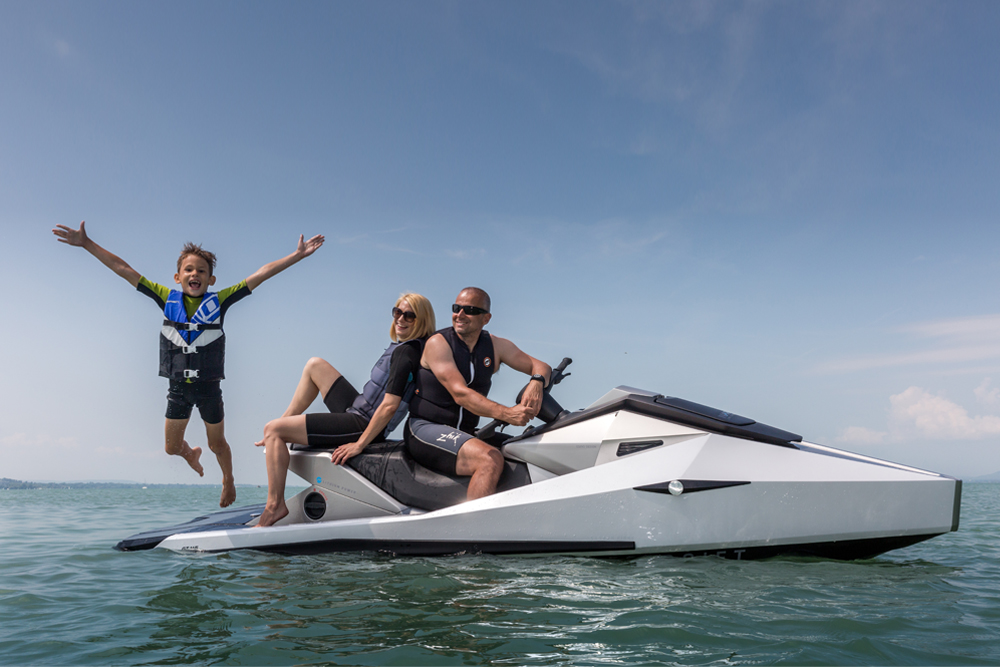
The seat takes three people, up to a load of 225 kg. Behind it a large swim platform makes climbing back aboard easier, and Narke pictures it towing children on an inflatable ring. Retractable anchor points sit at the bow and the stern. The GT95 is CE certified, in design category C.
Sold, or never delivered?
Narke's homepage opens with a short announcement: the company says it has sold all of its GT95 Electrojets and will come up with something brand new soon. It asks readers to sign up for the newsletter to hear about the next model and does not say what that model is.
E-SURFER, a German dealer that sells several electric craft, tells another story. Its blog says it tested the Narke at the Boot & Fun show in Berlin, that Narke took GT95 reservations in 2021, and that, as far as E-SURFER knows, none was delivered. It adds that customers who had paid a deposit in 2021 waited for months. On its shop page the dealer sums the craft up as announced, yes, but hardly sold.
Both accounts come from people with a stake in the market, and no third source settles it. Narke names no dealer, although its site says the network is “in continuous expansion”, and it publishes no current price or delivery date. If you meet a GT95 for sale, the history of that particular craft matters more than either story.
What a Narke GT95 cost
The prices on record date from 2021 and do not agree. New Atlas reported in January that the standard GT95 in white or red cost €39,000, and E-SURFER remembers reservations opening at the same figure. By August, Motor Boat & Yachting was quoting from €47,500, with the fast charger at €1,900 on top.
The magazine also printed the options: €470 for the wireless man overboard system, €440 for smartphone connectivity, €600 for a cover and €1,600 for a trailer. With the charger and a trailer, the August 2021 starting price came to €51,000.
None of these is a price you can order at today. Current figures for the craft you can buy are on the electric jet ski price page.
Licence and launch rules
No national licence is needed to ride your own jet ski in UK waters, and a battery changes nothing there. The government's guidance puts electrically powered craft of any size under the Watercraft Order, and harbours, lakes and councils decide who may launch. Several of them ask for the RYA Personal Watercraft Proficiency certificate as a permit condition. The full picture, harbour by harbour, is on the electric jet ski licence page.
Ireland's law defines a personal watercraft by its combustion engine, so an electric craft falls outside that word. One that reaches 17 knots still counts as a fast power craft, and the GT95's quoted 75 km/h is far above that. The owner must then take reasonable steps to keep anyone under 16 from driving it.
At home on Lake Balaton
Hungarian law bans craft with internal combustion engines on the whole of Lake Balaton. The sentence says nothing about electric drive, and in 2019 that gap turned the Electrojet into news. Readers of a Hungarian news site voted mostly against allowing it, with a designated area as the second choice. The Balatoni Szövetség, which groups the lakeside municipalities, discussed changing the law so that it would cover the craft. Its president said most of the municipalities were against it; the association had no official position yet. The government commissioner for Balaton said it could not be allowed on the whole lake and that a place should be found where it would not disturb bathers and sailors.
Narke's technical director, Péter Rádi, answered at the time that the craft must be registered before use, with an identifier, a registration number and the required rescue equipment, and that only someone with a valid boat licence may drive it. Narke, he said, gives buyers driving training and a lesson on the Balaton traffic rules. The brochure says the same thing more briefly: the GT95 is registered as a small pleasure boat.
Checks before you pay for a Narke
With no named dealer and no published price, the open questions above turn into a short list once money is involved.
- Ask who will deliver and service it. Narke names no dealer, and the seasonal service falls due every 100 hours.
- Get a delivery date in writing before you pay a deposit, and agree what happens to the money if the date passes.
- Check the warranty: three years on the battery and two on everything else, by the brochure. It does not say whether that passes to a second owner.
- On a used craft, ask for the battery's state of health and the hours run, and see the display working.
- Look at your charging point. The 1.5 hour figure needs three phase 16 A; a household socket takes far longer.
- Find out what your harbour or lake asks for before the craft arrives: permit, insurance, registration.
More on deposits, used craft and the dealers that sell the other electric models is on the electric jet ski for sale page.
The GT95 on video
Narke's own launch film shows the GT95 in the studio and on the water. A second film on the same channel goes behind the scenes of the shoot.
The maker's own photos and contact details are at narke.com ↗