What Mo-Jet is
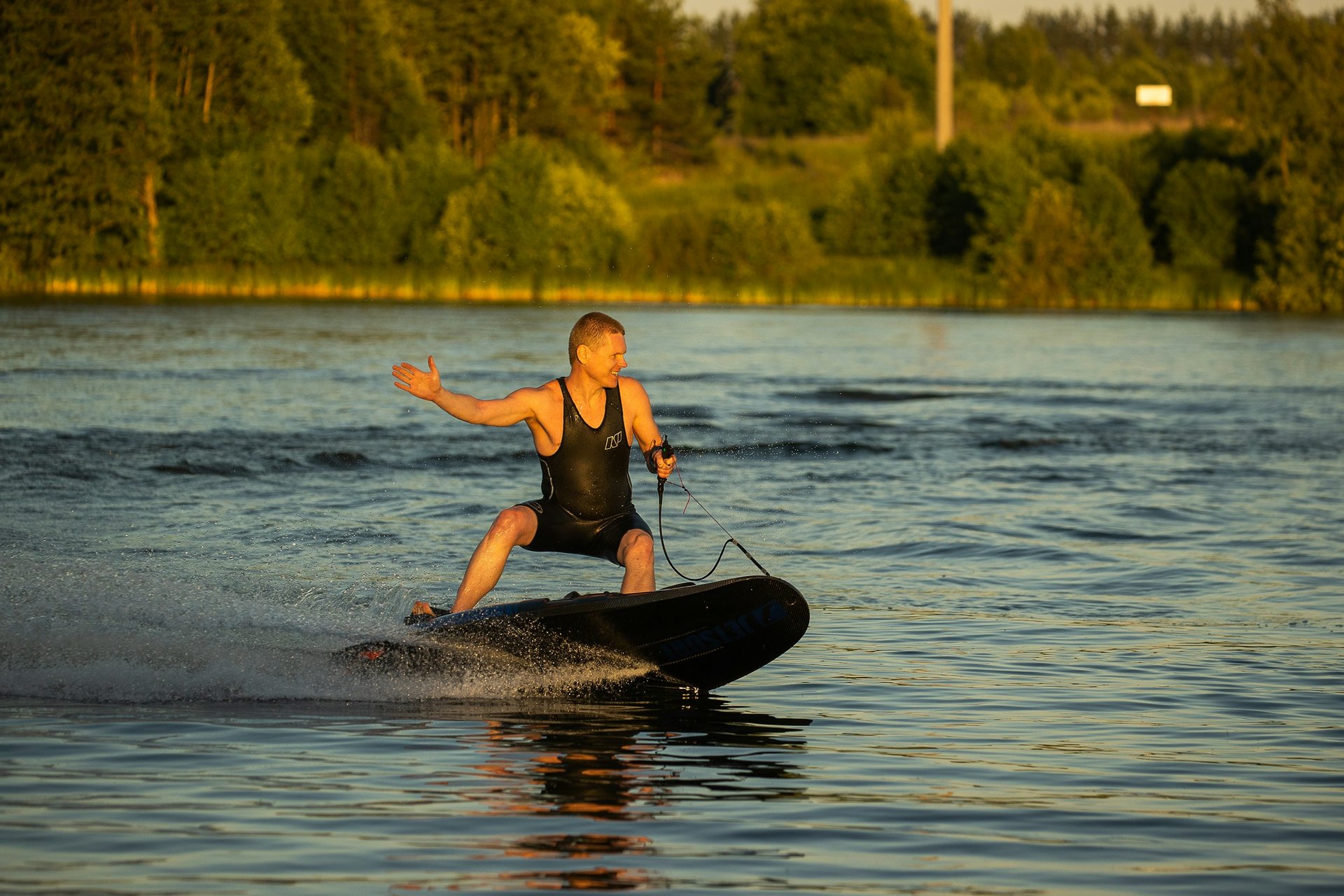
Mo-Jet is an electric jetboard built around one idea. The drive unit, with the jet, the electronics and two batteries, is a block of its own, and the part you stand, lie or sit on is a module that bolts onto it. Change the module and the drive becomes a standing jetboard, an electric bodyboard, an inflatable board for beginners or the engine of a small inflatable boat. The maker writes the name in lowercase, mo-jet, and sells the boards as sets, each with the drive, two batteries and one module.
People who look the brand up mostly ask about the price, the Beast, the bodyboard and the boat. This page answers those from the maker's product pages and terms, with the prices of the Berlin dealer E-SURFER next to them. Where the two disagree, you get both figures. If you want the wider picture of standing jetboards first, our electric surfboard guide compares the main brands.
The team in Norderstedt
Mo-Jet comes from Jetworx GmbH in Norderstedt, a town on the northern edge of Hamburg. The maker's history page starts with Benjamin Köhnsen, now the company's COO, building his first electric jetboard as a hobby while he was working as an investment banker.
The people around him had built boards before. They created the Lampuga brand at Sashay GmbH, which went insolvent in 2017. An investor carried Lampuga on in Rastatt, and former staff founded CURF Technologie GmbH. After a split in 2019 one group set out to build a lighter board that would come apart into pieces you can carry, and that board became Mo-Jet at Jetworx.
The product pages carry the line Built in Germany. The shop ships worldwide, and dealers sell the boards across Germany and the rest of the EU. Lifeguards have tried the system too. The DLRG group in Halle Saalekreis tested the Mo-Jet Rescue Board and Rescue Boat, and the maker quotes Köhnsen saying that “mo-jet can save lives and make the work of lifeguards considerably easier.” For rescue work the company lists a drive that is ready after long storage, goes in the water with two people and no slipway, draws little water and has no propeller.
The drive unit
Every Mo-Jet runs on one drive unit. It measures 90 × 65 × 21 cm (about 35 × 26 × 8 inches) and weighs 39.3 kg (87 lb) on the maker's spec sheet. The shell is polyethylene, which the company describes as resistant to torsion, impacts and punctures.
Inside sits the jetbox, a jet rated at 14 kW that spins at 15,000 rpm and pushes with about 100 kg (220 lb) of static thrust. You can buy the jetbox alone as a spare part, and on its own it weighs 12.5 kg. The drive is electric and oil free, and there is no exposed propeller anywhere on the board.
Speed figures vary a little across the maker's pages. The set pages say up to 55 km/h (34 mph). The rental page says up to 50 km/h (31 mph), about 55 km/h by the company's internal measurements, and gives the power as up to 19 PS, or 14 kW, with thrust planned for riders up to about 100 kg (220 lb). Read 55 km/h as the top of the range under the maker's own conditions.
Each set ships with the drive module, two batteries, fins, a remote control, a safety magnet that works as a kill switch, a wrench or Allen key, a user manual, the module of that set and a charger.
Surf, Body and Air
Three of the modules turn the drive into a board for one rider. They differ in how you ride and in how much they add to the drive's weight.
Swipe sideways to see all columns
| Module | How you ride | Size | Module weight |
|---|---|---|---|
| Surf | Standing | 115 × 65 × 21 cm | 13.4 kg (30 lb) |
| Body | Lying or kneeling | 45 × 71 × 21 cm | 8.3 kg (18 lb) |
| Air | Standing, inflatable hull | 154 × 75 × 14 cm | 6.2 kg (14 lb) |
The Surf set is the classic standing jetboard. With its module on the drive you ride it like any motorized surfboard, up to 55 km/h (34 mph) on the maker's page, and it can tow a second board behind it.
The Body module is the shortest piece in the range, published at 45 × 71 × 21 cm, and you ride it lying on your stomach or kneeling. That keeps you low over the water and makes the board compact and agile. It is also the cheapest complete set in the maker's shop.
The Air set replaces the hard module with an inflatable hull of 154 × 75 × 14 cm. The maker credits it with good lift and more stability, calls it ideal for beginners and points out that the hull is easy to transport. It is the lightest module at 6.2 kg.
Wake, Tender and the Beast
The Wake module, sold as Tow Boogie, makes the Surf board a tow vehicle. It needs the Surf jetboard, and a wakeboard line runs back to the rider. The bar has an emergency stop, so the board stops when your hand leaves it, with an electromagnet as a second cutoff. The maker gives ride times by what is being pulled, 15 minutes behind a wakeboard, 30 behind a surfboard and 45 behind a foilboard.
Tender is a small inflatable boat with the drive as its engine. You sit on a bench and steer with a tiller that also sets the power, and a separate lever gives reverse thrust. With one person aboard it reaches up to 50 km/h (31 mph), with two up to 35 km/h (22 mph). Drive and boat can be carried apart, so the maker says it needs no trailer, roof rack or ramp.
Swipe sideways to see all columns
| Model | Size | Run time and range on the product page |
|---|---|---|
| Tender 180 | 180 × 138 × 70 cm | 15 minutes to about 1 hour, up to 15 km |
| Tender 238 | 238 × 138 × 70 cm, about 70 kg | about 1 hour, up to 20 km |
The technical sheets of both boats give the battery a run time of up to 30 minutes, shorter than the product text. Plan your first trips with the shorter figure.
Divingjet Beast is the outlier of the shop. It pairs an electric bodyboard with an underwater jet and is built in full carbon fiber. Its jet has 20 hp and about 120 kg (265 lb) of thrust, enough for up to 58 km/h (36 mph) on the surface and up to 25 km/h (16 mph) under water. The board measures 135 × 68 × 21 cm, the battery lasts 20 to 60 minutes, and the box holds the Beast, two batteries, a quick charger and the remote.
Maker prices
The Mo-Jet shop shows prices net of VAT, as a business buyer sees them, and prints the gross price with 19% German VAT under each one. A private buyer in Germany pays the gross price, so the table uses it.
Swipe sideways to see all columns
| Set | What you get | Price incl. 19% VAT |
|---|---|---|
| Body | Drive, two batteries, bodyboard module | €11,888.10 |
| Surf | Drive, two batteries, standing module | €12,126.10 |
| Air | Drive, two batteries, inflatable hull | €12,840.10 |
| Surf & Wake | Surf set plus the Tow Boogie | €13,316.10 |
| Tender 180 | Drive, two batteries, small boat | €17,481.10 |
| Tender 238 | Drive, two batteries, larger boat | €17,838.10 |
| Divingjet Beast | Carbon board with underwater jet | €32,725 |
Net of VAT the range opens at €9,990 for the Body set and €10,190 for the Surf set, and the Beast costs €27,500. The pieces are for sale on their own as well. The drive unit alone is €9,490 net (€11,293.10 with VAT), the jetbox €5,000 net (€5,950) and one battery €1,700 net (€2,023).
The store catalogue lists the modules at net prices of €500 for the Body, €700 for the Surf, €1,300 for the Air and €890 for the Wake. A battery set costs €2,980, the 30 A fast charger €450, the 14 A standard charger €300 and a spare remote €150, all net. Once you own a drive, a second module is the cheap way to a second kind of board.
Dealer prices at E-SURFER
E-SURFER in Berlin, one of the two places where you can try a Mo-Jet, sells the range with VAT included and delivery charged on top.
Swipe sideways to see all columns
| Item | Price incl. VAT |
|---|---|
| SURF | €14,995 |
| BODY | €14,759 |
| Air inflatable | €14,995 |
| TENDER | €21,896 |
| WAKE Tow Boogie | €1,059 |
| Battery set | €3,549 |
| SURF module | €839 |
| BODY module | €595 |
| Quick Charger | €539 |
These prices sit above the maker's gross prices, €14,995 against €12,126.10 for the Surf set, and neither site explains the gap. Ask the dealer what the price covers before you order. For the rest of the market, our electric surfboard price guide lists the other brands with their list prices.
Batteries and charging
Each set comes with two batteries. They lift out of the drive and charge from an ordinary household socket, and with two sockets both are full again in about 45 minutes. The maker gives up to 40 minutes of riding per charge. A second pair swaps in plug and play, so a spare battery set gives you a second session on the same beach.
The split into two packs came from experience. Early boards used a single 17 kg battery that got too hot in summer. The pair that replaced it is liquid cooled, and each battery weighs just over 8 kg. Two light packs are easier to carry from the car to the water than one heavy one.
Transport and shallow water
The modular build shows its value once the board leaves the water. The system comes apart in seconds, and the maker says a full set fits in a Renault Twingo, a small city car. The drive is the heaviest piece of a board set at 39.3 kg. The hull of the Tender 238 is heavier still, about 70 kg.
The drive also sits shallow and has no exposed propeller. That is why the maker says starting in very shallow or muddy water is no problem. It is a claim from the company's FAQ, and a lake bed with stones or thick weed still deserves a look before you set off.
Mo-Jet next to Awake and Jetsurf
E-SURFER also sells the jetboards a Mo-Jet buyer usually looks at next. On its pages the Awake RÄVIK Explore costs €11,890, the RÄVIK Ultimate €19,090 and the Jetsurf RACE DFI SKI €15,220. At that dealer the Mo-Jet SURF lands between the two Awake boards.
What sets Mo-Jet apart is the module system, one drive for a standing board, a bodyboard, an inflatable and a boat. Our Awake page covers the RÄVIK range and its battery platform in detail, and the electric jet ski guide covers the seated machines if a board is not what you want.
Riding one in Germany
Germany is where Mo-Jet is built and where it has dealers, so its rules are the ones many buyers meet first. They class a jetboard as a personal watercraft whatever its power, unlike an eFoil board. An electric motor runs without a boating license only up to 7.5 kW of continuous power, and Mo-Jet rates its jet at 14 kW. The maker does not say whether that figure is a continuous rating. It is far above the limit in any case, so plan on a Sportbootführerschein, the German recreational boating license, which you can take from age 16.
On federal inland waterways personal watercraft may only run in areas signed for them, and the board needs an official registration mark. Our electric jet ski license guide walks through the German exam, the signs and the marks. For the UK and the US we have no checked rules for jetboards yet, so ask the local authority of the water you have in mind.
Test rides, warranty and returns
You can try a Mo-Jet at Jetworx in Norderstedt and at E-SURFER in Berlin, and the maker lists further dealers and rental partners abroad. In Spain a dealer has rented the Wake and Dive at La Reserva in Sotogrande since 2024. Our Costa del Sol page covers the lagoon there.
Bought from the maker's shop, a Mo-Jet carries a one year warranty from delivery, and the remedy is repair or replacement at the seller's choice. Consumers can withdraw from the purchase within 14 days without giving a reason, apart from the cases the terms list. The shop ships worldwide and lists its prices in euros, so a buyer in the UK or the US should ask for a quote that includes shipping and import costs.
Mo-Jet on film
The maker's video from its YouTube channel. The full range is on mo-jet.com ↗