How a jetboard works
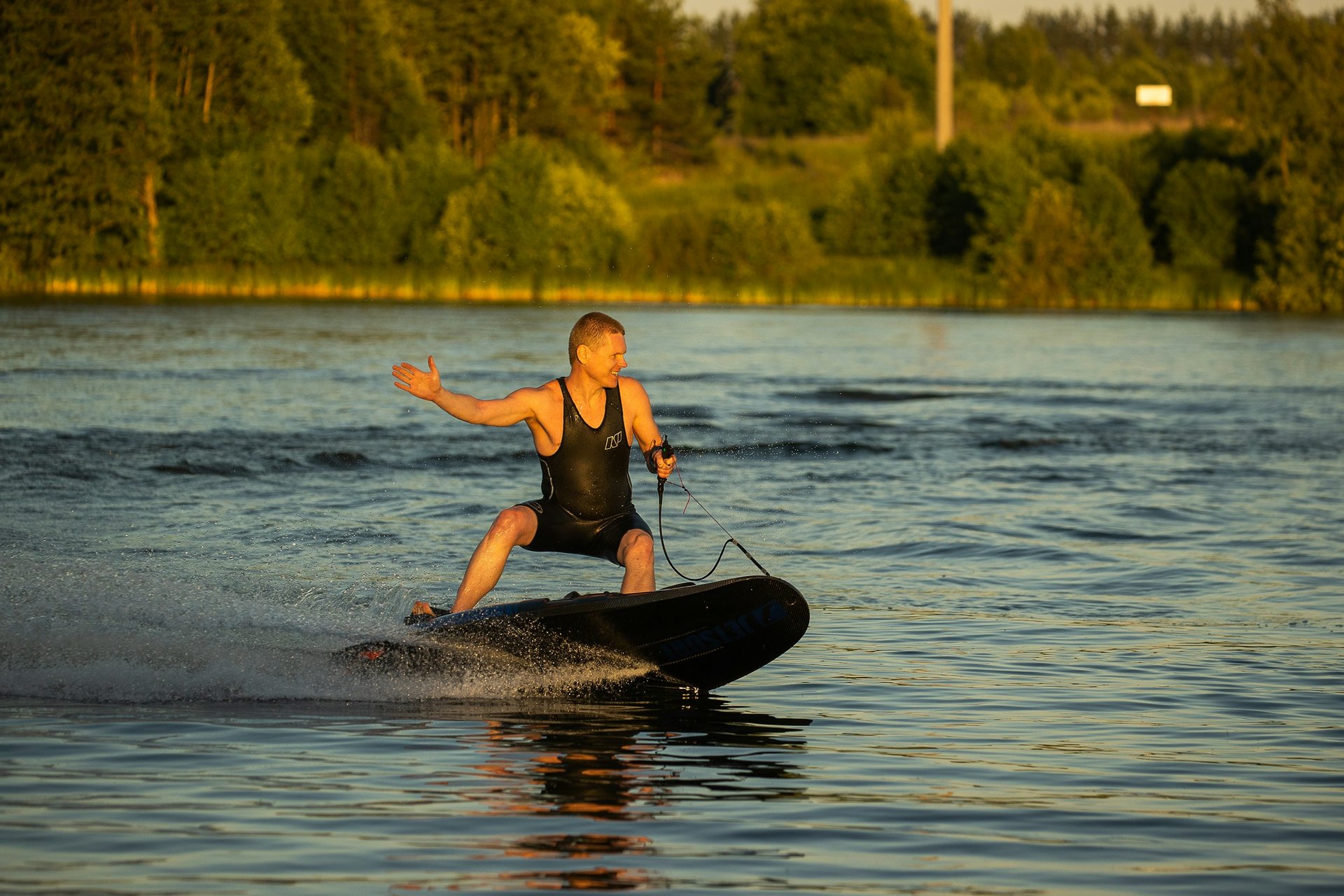
A jetboard is a surfboard with its own drive. A jet pump sits in the tail, an engine or an electric motor turns it, and the rider stands on the deck with a hand control for the throttle. There is no foil under the hull. The board planes on the surface like a small speedboat, so it feels closer to wakeboarding without the rope than to riding a wave. Shops also sell it as a motorized surfboard, a jet surfboard or a power board.
Plenty of people call every board in the category a Jetsurf, after the Czech brand that the Berlin dealer E-SURFER calls the leader in gas-powered surfboards. Jetsurf is one maker among several, covered in full in our Jetsurf guide.
The jet drive
Every board covered here moves by pushing water through a jet: an impeller spinning inside a duct, fed by an intake on the bottom of the hull. Mo-Jet in Germany lists “no exposed propeller” among its selling points, and Lind from Stockholm calls its unit an electric water jet. How much water the jet needs under it differs by maker. Mo-Jet says its drive sits shallow enough to start in very shallow or muddy water, while Lind's manual asks for at least 1.5 m (5 feet).
The hand control
Jetsurf boards use a control handle on a cord. You start the board with it, squeeze the throttle on it and lean against it for balance while you find your stance. Lind and Awake use a wireless remote. Lind's has 15 power levels grouped into four riding modes, from slow to pro, and its manual starts a beginner of average weight on a Midlength board at levels 1 to 5.
Top speeds run from 40 km/h (25 mph) on Awake's beginner board, the RÄVIK Explore, to about 55 km/h on a Mo-Jet, 60 km/h (about 37 mph) on a Lind and 64 km/h (39.7 mph) on the quickest Jetsurf, the Titanium DFI SL.
Gas or electric
A jetboard runs on a gas (petrol) engine or on a battery and an electric motor, and one maker builds both. Jetsurf, made by MSR Engines in Střelice u Brna near Brno, sells six gas models and two electric ones. E-SURFER, a Berlin dealer for eFoils and jetboards, sums up the market on its history page: eFoils have outsold jetboards since 2021, and jetboards with gas or electric drives are still sold alongside them.
The gas boards
Jetsurf's gas boards carry DFI engines: the two-stroke NG 100 DFI of 100 cc in the Adventure 2 DFI, the Race DFI SL and the Cruiser DFI, the Titanium 100 DFI in the Titanium models. The Adventure runs on unleaded 95 with fully synthetic two-stroke oil from a 2.8 liter tank, and the Cruiser DFI adds a 3.78 liter extra tank for long cruising. The maker puts consumption at less than a gallon an hour. A small lithium starter battery is good for about 150 starts and recharges in about 45 minutes, from a car socket if need be.
The gas boards are light, at 18.5 to 20.5 kg, under 40 lb by Jetsurf's own count, and the gas skis with handlebars weigh 24.9 kg. A silencer brings the noise down to 59 dB, which the maker says puts the boards in line with the EU rules for recreational craft. Jetsurf does not publish the power of its gas engines, and that matters in countries where the license limit is set in kilowatts.
Gas boards also come out of China. Zhejiang ArtPower Technologies in Tiantai sells gas surfboards under the JETFLY name.
The electric boards
Every other brand on this page builds battery boards: Mo-Jet, Lind, Awake with its RÄVIK range and GOYOJO, plus Jetsurf with the Electric 2. The packs are similar in size. Jetsurf fits a 3 kWh battery of 18 kg, Lind 3.1 kWh at 17 kg, and Awake's Flex Battery XR 4 holds 2.55 kWh and weighs 18.5 kg. Mo-Jet splits the job between two swappable batteries of just over 8 kg each.
Batteries add weight. A Jetsurf Electric 2 weighs 32.9 kg against about 20 kg for its gas siblings, and a complete Lind comes to about 34 kg. In return there is no fuel and no oil to carry, and the board is quieter. Charging takes about 45 minutes for Mo-Jet's two batteries from two household sockets, about 80 minutes for Awake, one to two hours for Lind and about three hours for Jetsurf.
Swipe sideways to see all columns
| Gas | Electric | |
|---|---|---|
| Makers | Jetsurf, JETFLY (ArtPower) | Jetsurf, Mo-Jet, Lind, Awake, GOYOJO |
| Board weight | 18.5 to 20.5 kg, skis 24.9 kg (Jetsurf) | 32.9 kg (Jetsurf Electric 2), about 34 kg complete (Lind) |
| Energy | Unleaded 95 with two-stroke oil, 2.8 l tank (Jetsurf) | Battery of 2.55 to 3.1 kWh (Jetsurf, Lind, Awake) |
| Fuel or ride time | Under a gallon of fuel an hour (Jetsurf) | 25 to 60 minutes per battery |
| Refill | Refuel at the shore | Charge in 45 minutes to 3 hours, or swap the battery |
| Top speed | 55 to 64 km/h (Jetsurf) | 40 to 60 km/h |
A battery asks for more care than a tank. Jetsurf's manual says to take the battery out for any storage longer than a week and keep it at 10 to 30 °C with no more than half its charge. Awake wants its battery stored at 80% and checked every 60 days. Charging a Jetsurf battery straight after a ride, or carrying the board with the battery connected, voids its warranty.
Jetboard makers
Jetsurf is the brand you see in racing: UIM MotoSurf events run their Stock, Stock R, Juniors, Women and Masters classes on its boards alone, with Jetsurf as exclusive manufacturer. Every current Jetsurf shares one hull of 1,800 by 600 by 150 mm with a carbon jet pump, and three of the eight models come as a ski with handlebars.
Mo-Jet comes from Jetworx GmbH in Norderstedt, on the edge of Hamburg. Its idea is a single electric drive unit with a 14 kW jet that clips into different hulls: a standing Surf board, a Body board you ride lying down, an inflatable Air board, a towing module and a small boat. The team behind it created the Lampuga brand before.
LIND Art & Technology AB registered in 2021 in Bromma, Stockholm, and has a US company in San Francisco. All its boards are built and shipped from Stockholm. The Canvas board comes in a Shortboard and a Midlength size, driven by a dual-motor jet of 20 kW (27 hp). It won a Red Dot Award: Product Design 2025 and a special mention in TIME's Best Inventions of 2026. Its co-founder Alexander Lind built his first boards under Radinn, Outside magazine reports.
Awake is a Danish company, Ride Awake ApS in Copenhagen. Its founders set it up in 2017 to build high-performance electric jetboards, and today it sells three RÄVIK boards, the Explore, the Adventure and the Ultimate, all with an 11 kW motor. One battery and one hand controller serve the RÄVIK jetboards and the VINGA eFoils from the same brand.
GOYOJO is a Hong Kong online shop with three electric boards, the V-Sprint, the V-Vertex and the V-RS Ultimate. Its spec tables call the drive a jet pump. Its product pages give different weights and ride times for the same board in different places, so compare its figures with care.
Radinn, an electric jetboard maker from Malmö, filed for bankruptcy at the end of November 2023. A new owner bought the whole company just before Christmas that year, without naming the buyer or the price.
Jetboard vs eFoil
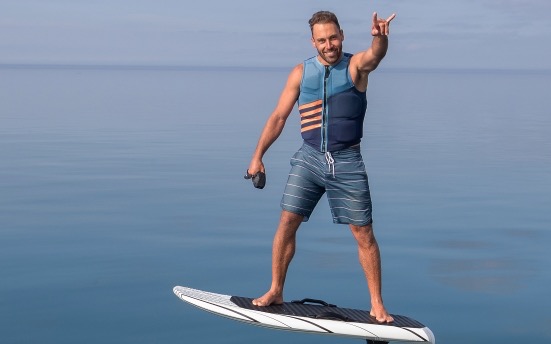
Both are boards with a motor that you ride standing up, on flat water and with no wind needed. What sets them apart is under the hull. An eFoil carries a hydrofoil with the motor on its mast. That is how Lift Foils defines one, and Lift claims the first commercial eFoil. Above a certain speed the wing lifts the board out of the water and you fly. A jetboard never leaves the surface.
The drives differ too. A jetboard runs on gas or on a battery, while the eFoils on sale today are all electric.
Awake builds both on one battery, which makes for a fair comparison. Its VINGA Carve eFoil draws 4 to 8.2 kW, stands on an 80 cm mast and rides up to 120 minutes on the XR battery. The RÄVIK jetboards use 11 kW and get 35 to 60 minutes from the same XR 4. Awake points riders who want “to fly” from its fastest jetboard to the VINGA, and sells the RÄVIK Explore as the relaxed board for the family.
Swipe sideways to see all columns
| Jetboard (Awake RÄVIK) | eFoil (Awake VINGA Carve) | |
|---|---|---|
| Rides | On the surface | Above the water on a hydrofoil |
| Drive in the market | Gas or electric | Electric |
| Motor power | 11 kW | 4 to 8.2 kW |
| Ride time on the XR battery | 35 to 60 minutes | Up to 120 minutes |
| Top speed | 40 to 55 km/h | 45 km/h |
| Germany, official guidance | Treated as a personal watercraft | Not treated as one |
The rules can split the two as well. German official guidance treats a jetboard as a personal watercraft and an eFoil not, which keeps the jetboard to marked areas on federal waterways. On Lake Annecy in France both are out: the prefecture bans motorized boards, those with a foil included.
Jetboards, eFoils and electric SUPs share a shop label, the electric surfboard, and our guide to that umbrella compares all three types for beginners. A gas jetboard belongs to the family by shape but not by drive.
Jetboard prices by class
Read the euro figures as net prices. The European makers quote them before VAT, and a private buyer in the EU pays the rate of the country the board goes to.
Swipe sideways to see all columns
| Class | Boards | List price |
|---|---|---|
| Online electric | GOYOJO V-Sprint, V-Vertex, V-RS Ultimate | $7,899 to $8,999 |
| Gas boards | Jetsurf Adventure 2 DFI, Race DFI SL, Cruiser DFI, Titanium DFI SL | €9,990 to €12,990 excl. VAT |
| Electric entry | Awake RÄVIK Explore; Mo-Jet Body, Surf and Air sets | €9,990 to €10,790 excl. VAT |
| Electric mid | Jetsurf Electric 2; Awake RÄVIK Adventure | €12,490 to €13,990 excl. VAT |
| Ski versions with handlebars | Jetsurf Race DFI SKI, Titanium DFI SKI, Electric 2 Ski | €12,790 to €13,990 excl. VAT |
| Electric performance | Awake RÄVIK Ultimate | €15,990 excl. VAT |
| Premium | Lind Canvas; LIND × RIVA | $26,950 and $33,950 in the US; €19,950 and €29,950 plus VAT in Europe |
Dealer prices with tax show what a buyer in Germany pays. E-SURFER in Berlin includes 19% German VAT and lists the Jetsurf gas boards from €13,078, the Jetsurf Electric 2 at €14,869 and the Mo-Jet Surf at €14,995. Mo-Jet's own shop shows the Surf set at €12,126.10 with the same tax, below the dealer's figure. Sealectric near Kiel sells the Lind for €23,740 with VAT and says its prices match Lind's own. In the US, Jetsurf USA lists the Electric 2 SKI at $16,490.
A spare battery adds a large sum to the bill. Lind charges €6,290 plus VAT (or $8,490 in the US), Awake €4,990 before VAT for the XR 4, and Mo-Jet €1,700 before VAT for one of its two packs. Prices for the whole category, eFoils included, are on our electric surfboard prices page.
Buying a jetboard
New boards come from the maker's shop or a dealer, and the terms differ from brand to brand. Awake builds every board to order, so it takes no returns of boards that are not faulty, though an order can be cancelled within 14 days of confirmation. Lind takes a board back within 14 days of delivery if it is unused and in its packaging. Mo-Jet gives 14 days to withdraw without a reason.
Warranties run from one to two years. Lind and Awake give two years, with the battery covered up to 600 cycles at Lind and up to 300 at Awake, whichever comes first. Mo-Jet gives one year. Jetsurf activates its warranty when you register the new board on its site, and its electric manual promises one year on materials where the law gives no longer cover.
A used jetboard
Awake no longer sells the RÄVIK 3 and RÄVIK S, and both turn up second hand and in rental fleets. Points to check:
- The battery. Warranties count cycles, so ask how many it has done. Awake sells a battery health report for €30.
- The warranty. Awake's passes to a new owner if the board was registered, but the period does not start again.
- The parts. Awake's newest hand controller works only with the XR 4 and LR 4 batteries, not with the older SR and XR packs of a RÄVIK 3 or S.
- Rental history. Awake's standard warranty excludes damage from intensive commercial use, which matters for an ex-rental board.
- Storage. A Jetsurf battery kept connected in the board or charged right after a ride loses its warranty, so ask how the seller stored it.
- Shipping. An electric jetboard travels as dangerous goods because of its battery, so agree on how the board gets to you before you pay.
The checks for a used foil board are on our used eFoil page.
Jetboard rental
Jetsurf runs test rides through the dealers, academies and ambassadors in its store locator, with a rider weight limit of 120 kg. In Berlin, E-SURFER rents the Jetsurf Electric 2 and Electric 2 Ski and gives jetboard test rides at its own site with instruction. Mo-Jet boards can be tried there too, and at Jetworx in Norderstedt.
Lind marks the partners where you can test its board. In Sweden that is its headquarters and Electrosurf, both in Bromma. Elsewhere in Europe the list covers Sealectric in Altenholz near Kiel, eSurf Poland in Szczecin, KOIFER in Bratislava, LIND France in Cannes by appointment, Porto Cervo Luxury Sport in Sardinia and Hergele Life in Istanbul.
Awake's retailer map has 110 locations worldwide, from E-SURFER in Berlin and OCEAN PERFORMANCE in Poole to Water Toys Team Barcelona and Boards of Hungary on Lake Balaton. The map does not say which of them rent or offer test rides, so call before you travel. Awake also runs test events that you can sign up for on its site.
A few rental fleets carry RÄVIK boards. Gadgets4Rent in Germany rents the older RÄVIK 3 and S, the RÄVIK 3 from €319 a day with a €1,500 deposit. Boat Charter Menorca lists a RÄVIK Explore, and Charter Liliano in Naples rents Fliteboard or Awake RÄVIK boards for at least three days, at about €350 a day before tax and delivery. In Spain, a dealer at La Reserva in Sotogrande has rented the Mo-Jet Wake and Dive since 2024.
Where jetboards are not on offer, an eFoil school is often the nearest way onto a motorized board; our eFoil rental guide lists them.
License and rules by country
In many countries the law files a jetboard with personal watercraft, and lakes and harbors often set rules of their own on top.
Germany
The federal waterways administration counts every jetboard as a personal watercraft in its official guidance, at any power, and does not count an eFoil as one. On federal inland waterways personal watercraft may ride only in areas released by the E.22 sign, apart from the shortest way there from the nearest launch point and straight passage on a touring trip. Personal watercraft also need an official registration mark there, which should apply to a jetboard as well.
On federal waterways a boat license is needed above 7.5 kW for an electric motor, counted as continuous output, and above 11.03 kW for a combustion engine; it is issued from 16. Lind publishes 20 kW and Mo-Jet 14 kW for their jets, far above the electric limit, and neither gives a continuous rating, so plan on a license for both. Awake's 11 kW and Jetsurf's electric modes up to 11 kW lie above 7.5 kW too, but without a continuous figure their status stays open, and the gas engines have no published output at all. Check with the dealer before you plan a trip.
Some lakes are closed whatever the license. The Bavarian palace administration bans motorized water sports devices, e-surfboards with and without a foil named, on its state lakes such as the Ammersee, Chiemsee and Tegernsee. Lake Constance bans personal watercraft and similar craft of any drive type; the rule does not name the jetboard, but its wording should cover one.
United Kingdom and Ireland
The UK has no national license for a private personal watercraft. Since 2023 the rules against dangerous use reach anything that carries a person under its own mechanical power, and the government's guidance says the type of power makes no difference. Harbors and councils set permits, insurance and age limits. Crouch Harbour, for one, licenses “jet skis, wetbikes, power boards and all similar recreational watercraft” and asks for a proficiency certificate and third party insurance. Ireland's code of practice says no one under 16 should operate a personal watercraft or a fast power craft.
Netherlands, France and the US
The Dutch registration authority RDW names the jetsurf and the jetboard among motorized surfboards and asks for registration of any that goes faster than 20 km/h; registrations from Belgium, Germany and the UK are accepted. In France, Lake Annecy bans motorized boards outright.
In the US, the rules that matter for a small craft are mostly state rules. Florida defines a personal watercraft as a vessel under 16 feet with an inboard motor powering a water jet pump, with no fuel named, and California has required a boater card for every operator of a motorized vessel since January 2025. Michigan registers every watercraft with a motor, electric ones included. The state boating agency can say how it classes a jetboard; ask before the first ride. More on powered boards and the law is on our eFoil rules page.
Safety on the water
A jetboard can run on without its rider, so the makers build in a way to stop it. On the Jetsurf Electric 2 a magnetic cut-off on the wrist stops the board as soon as the magnet leaves the handle. Every Mo-Jet set ships with a safety magnet. On a Lind you let go of the throttle on a fall and the motor stops. E-SURFER asks its customers to wear the magnetic kill switch leash on the ankle or the vest.
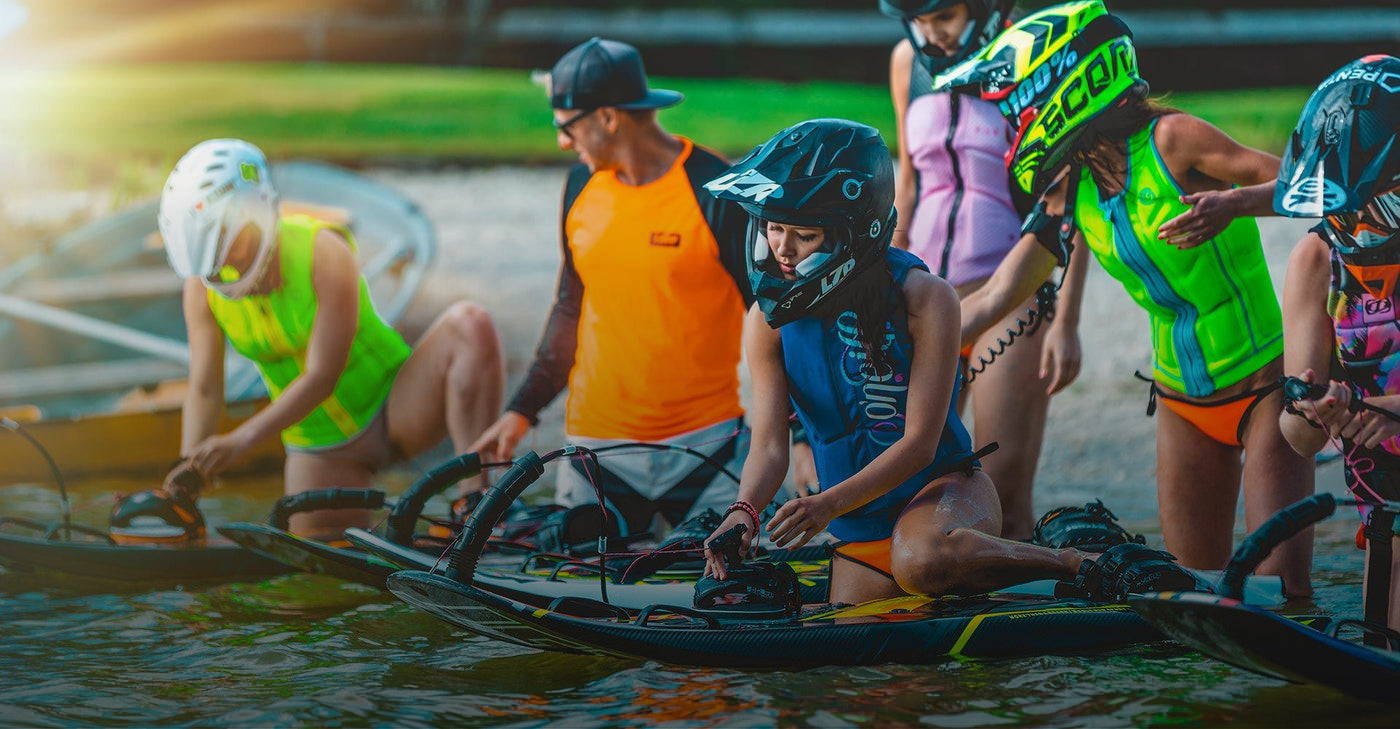
Helmet and vest are standard kit. Lind's manual asks for a helmet and an impact vest or flotation device, and Awake for a full face helmet and a life vest. Awake also warns that a board can coast up to 30 m after the power stops, and asks riders above 10 km/h to keep 50 m from the shore and from swimmers. Lind wants riders to stop at least 30 m out and paddle the rest of the way in.
Mind the limits printed in the manuals. Lind carries up to 140 kg and one person. Awake sets a rider weight of 110 kg. The Jetsurf electric boards are rated for 100 kg and the gas boards for 120 kg. For learners, Jetsurf and Awake sell an inflatable tube for extra stability, though Awake's does not fit the RÄVIK Explore.
Keep away from swimming areas, narrow canals and anyone in the water, as Awake's manual puts it, and follow the local rules of each lake or harbor.
Jetboard brands on FoilFun
Each of these makers has its own page with the full model list, specs and prices:
- Jetsurf: the Czech gas boards, the Electric 2 and the ski versions with handlebars.
- Mo-Jet: one electric drive from Norderstedt for a standing board, a bodyboard, an inflatable board and a small boat.
- Lind: the Swedish Canvas board with a 20 kW dual-motor jet.
- Awake RÄVIK: the Explore, Adventure and Ultimate from Copenhagen.
Awake's VINGA eFoils, which share the RÄVIK battery, are on our Awake eFoil page.