How fast an eFoil goes, on paper and on the water
Between 36 and 60 km/h, if you ask the makers. Waydoo rates its Flyer EVO Lite at up to 36 km/h (22.4 mph), HydroFlyer its Cruiser FF at up to 60 km/h (about 37 mph) with a 10,000 W motor, and most current boards sit in a band of 40 to 55 km/h, which is 25 to 34 mph. Fliteboard puts the average eFoil at 32 to 48 km/h (20 to 30 mph) and adds that 50 km/h runs belong to expert riders in controlled conditions with proper safety gear on.
What you will do on an ordinary afternoon is slower. Aerofoils, the maker behind the Audi e-tron foil, writes that most riders spend most of a session cruising between 20 and 30 km/h (12 to 19 mph). A sporty pace is 35 to 45 km/h. The top figure needs flat, calm water, a small front wing and a full battery, and few riders hold it for long. At 40 km/h you cover about 11 meters every second, and a fall stops being soft.
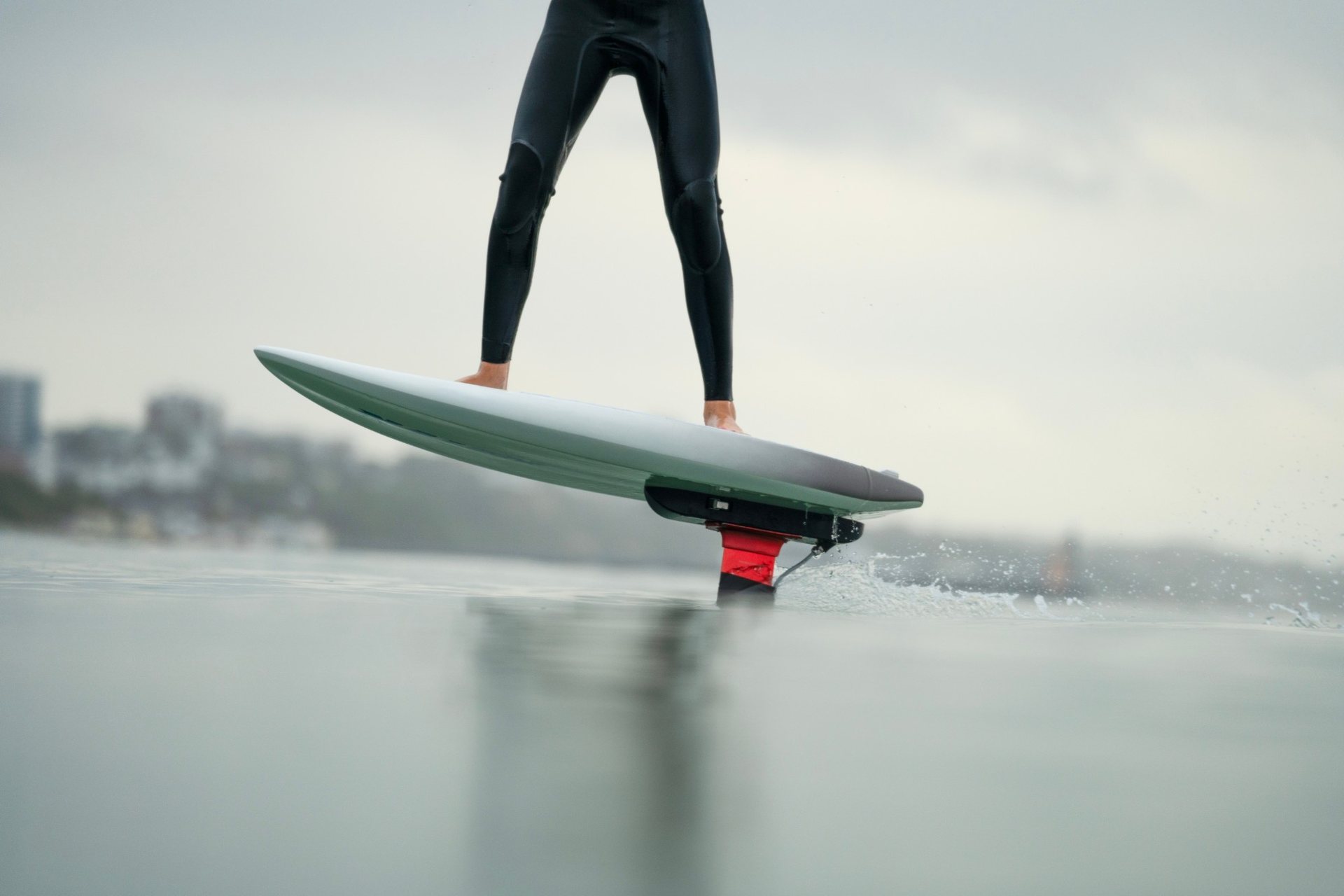
Flight begins at around 20 km/h. Below that the hull sits on the surface and drags like any board; above it the wing carries the whole weight and the hull leaves the water. An eFoil has three speeds, then: the one it needs to fly, the one you cruise at and the one in the brochure. The first two fill your day.

Top speed model by model, from the makers' own sheets
Two brands publish no top speed. Liftgives no top speed for the LIFT5, LIFT5 F or LIFTX on its own site. Its rental operation in Nice does list speeds by board: 35 km/h for the LIFT5 Cruiser 5'4, 45 km/h for the LiftX 4'8 and 50 km/h for the LIFT5 Pro 4'4. Back in 2021 the Explorer and Cruiser, both long discontinued, were quoted at 40 km/h. Manta has no eFoil top speed on record.
Swipe sideways to see all columns
| Model | Maker's top speed | What the maker adds |
|---|---|---|
| Fliteboard, all Series 6 boards | up to 55 km/h (34 mph) | Depends on weight, wing, propulsion and rider ability; no figure per board |
| Fliteboard RACE x Mercury Racing | up to 55 km/h (34 mph) | With the Race Impeller on Jet 2 and a fully charged Explore Flitecell |
| Aerofoils Adventure (Audi e-tron foil) | up to 50 km/h (31 mph) | Rider up to 120 kg |
| Aerofoils Performance | up to 55 km/h (34 mph) | Rider up to 110 kg |
| Aerofoils Competition | up to 55 km/h (34 mph) | Rider up to 100 kg |
| Aerofoils Hyperfly and Airfly | up to 50 and 55 km/h (31 and 34 mph) | Drive units up to 5 kW, about 6.8 hp |
| Awake VINGA Carve | 45 km/h (28 mph) | 4 to 8.2 kW; 60 min with the LR battery, 120 min with the XR |
| Waydoo Flyer EVO Lite | up to 36 km/h (22.4 mph) | 4,000 W |
| Waydoo Flyer EVO Max Plus | up to 45 km/h (28 mph) | - |
| Waydoo Flyer EVO Pro Plus | up to 52 km/h (32 mph) | 6,000 W |
| Waydoo Flyer EVO Master | up to 52 km/h (32 mph) | - |
| SiFly Lite, Lite+ and Stellar X | up to 40 km/h (25 mph) | - |
| HydroFlyer Cruiser AL | up to 40 km/h (25 mph) | 6,000 W, up to 2 h |
| HydroFlyer Cruiser CF | up to 50 km/h (31 mph) | 6,000 W, up to 2.5 h |
| HydroFlyer Cruiser FF | up to 60 km/h (37 mph) | 10,000 W |
| Lift LIFT5, LIFT5 F, LIFTX | - | No published figure; Lift's Nice rental lists 35, 45 and 50 km/h by board |
| Manta | - | No published eFoil figure; the TakeOff Evo foil assist quotes ride times at 18 km/h |
Takuma, before it changed its range, showed why one number per board misleads. Its Cruising board was quoted at 28 km/h with a 1900 cm² wing, 30 km/h with a 1600 and 34 km/h with a 1300, and the Carver at 35 km/h on the 1300 wing with 3 kW. One board, three wings, a 6 km/h spread. Fliteboard prints a single figure for its whole range and lists the things that move it.
Most boards from Waydoo, SiFly, Awake, HydroFlyer and Aerofoils land between 40 and 55 km/h. The 20 to 30 km/h most riders cruise at does not change with the badge.
The speed at which the hull leaves the water
Fliteboard says you need to be travelling at around 20 km/h to hydrofoil and names 20 to 25 km/h (12 to 16 mph) as the minimum flying speed in its learning guide. Aerofoils puts take-off at around 20 km/h as well, a little earlier with a big front wing and a light rider. Below that speed the hull is planing or ploughing with high drag. Once the wing lifts it clear, most of that drag is gone.
Take-off speed rises with the square root of weight divided by wing area, and Aerofoils works an example from a Freeride 1350 wing carrying 100 kg of rider and board in total, which lifts at about 20 km/h: the Easyride 2000 under the same load flies at about 16 km/h, the small Freerace 900 needs just under 25 km/h, and 125 kg on the Freeride 1350 pushes take-off to a little over 22 km/h. Salt water is about 2.5 percent denser than fresh and lowers take-off speed by only about 1 percent, so a lake and the sea lift you at almost one speed.
SiFly claims the lowest take-off speed on the market, 15 km/h, for its Cruiser 1900 wing under a 75 kg rider on a 100 liter board. The claim is the maker's own, and a very large wing under a middling load does lift early. Big wings give away top speed, in Aerofoils' rule of thumb, which puts SiFly's 40 km/h rating down to its wings as much as to its motors.
How fast a first lesson goes
Fliteboard's learning guide has you lying prone on the board at 6 to 10 km/h (4 to 6 mph), then on your knees at 18 to 25 km/h depending on weight to practise foiling, and standing up at 8 to 12 km/h (5 to 8 mph). Lift's manual describes the first prone runs settling down at around 10 miles per hour, when the board becomes more stable, and puts its advice plainly: too slow is better than too fast. Beginners ride on governor setting 1.
Schools lock this in with the remote. Lift's rental site in Nice runs lessons in a beginner mode limited to 12 km/h and says the foil starts lifting the board from that speed, with the first take-off usually coming after 30 minutes. Aerofoils puts a beginner's first steady flight at around 20 to 25 km/h and keeps beginners well below 30 km/h. A big wing and a capped remote hold the board at a speed where a tumble is a splash, and so an hour with a school costs less nerve than it looks from the beach.
Front wing, rider weight, battery and wind set your real top speed
Nothing moves top speed as much as the front wing. Smaller front wings make you faster and bigger ones lift off earlier, in Aerofoils' words, and its catalogue shows the scale: the Easyride 2000 is built for early take-off, the Freeride 1350 runs up to 46 km/h, the Freerace 900 up to 50 km/h. Fliteboard says larger wings allow earlier foiling at slower speeds while its Speed range wings come to life at higher speeds; beginners start on the Cruiser 1100 or the Cruiser Jet 1500, and at Fliteboard race events most riders bolt on the Race 700. Since the wing bolts on, a board's top speed is largely a wing choice.
Fliteboard writes that lighter riders reach higher speeds more easily and heavier riders need more power for the same speed, and Aerofoils lets its maximum rider weight fall as the boards get faster: 120 kg on the Adventure, 110 on the Performance, 100 on the Competition. Board size pulls in the same direction. Larger boards typically have a lower top speed; smaller ones such as the Fliteboard PRO and the ULTRA L2 go faster and ask for more skill in return.
How the power arrives is down to the drive. Flite's propeller unit has a reduction gearbox that quadruples the motor's torque, which helps heavier riders up and out of the water; the 55 km/h figure is stated for the jet with the Race Impeller, and the Mercury Racing impeller is said to boost top-end performance by 15 percent. Put together, the prop is built for thrust and the jet for top end. Motor power varies widely as well, from Waydoo's 4,000 W on the EVO Lite to HydroFlyer's 10,000 W on the FF.
Smaller batteries weigh less and let you reach higher speeds quicker, Fliteboard notes, though they run out sooner, and the RACE figure is given with a fully charged pack. Water and wind finish the list. Flat, calm water allows the highest speeds, a headwind slows the board and a tailwind helps.
Speed modes, gears and limiters on the remote
Every big brand lets you cap the motor. Aerofoils ships three modes, Gonna-Fly and Nice & Smooth with capped speed and Rocket Ride unlocked, over ten power levels (twenty with Double Gears) and a GPS speed limiter on top. Awake's Eco, Sport and Extreme set both throttle sensitivity and the maximum speed. Fliteboard has rider modes and a maximum speed you set in the Flite App, plus Fly Zones that pull the speed down outside a set GPS boundary. Waydoo calls its version Flight Assist with gears, SiFly offers Comfort, Intermediate and Sport, and Lift's governor setting 1 is where its manual sends beginners.
Whoever sets these caps sets the real top speed. A school, a parent or a cautious owner picks the ceiling, and the rating on the spec sheet stops applying. Lift's school in Nice teaches at 12 km/h on boards it lists at 35 to 50.
How speed eats into range and flight time
Drag grows with the square of speed, so the power needed to hold 40 km/h is far more than double what 20 km/h takes, and the battery pays. Fliteboard quotes its Flitecell Sport at approximately 1 hour 10 minutes at an average foiling speed of 25 km/h and warns that constant high speed or many restarts can empty it in under an hour. The slower you ride, the longer your battery will last, in Fliteboard's words.
The ride-time figures the brands advertise are all quoted at calm cruising pace. Aerofoils gives up to 60 minutes or 20 km on its Light battery and up to 120 minutes or 40 km on the 2.23 kWh Endurance, both with calm, steady riding; a 20 km flight in an hour is an average of 20 km/h, the bottom of the cruising band. Lift says up to 90 minutes for the 2.2 kWh LIFT5 pack and up to 45 minutes for the 1 kWh LIFTX. SiFly quotes up to 120 minutes for its PowerCell LR at 15 km/h, and Awake's 120 minutes for the VINGA Carve needs the XR battery. Spend the session at 45 km/h and none of these numbers hold.
Pack sizes, charging and ride times brand by brand are on the eFoil battery page.
Speed limits on the waters you ride
A board with a motor falls under the limit for motor craft on a given water, by our reading, and on inland water that limit often sits below the 20 km/h a foil needs to fly. The Canal & River Trust puts the limit on most of its canals at 4 miles per hour and on most rivers at 6, which is about 6 and 10 km/h, so an eFoil there could only taxi on the surface. The Neckar allows 18 km/h against the bank for small craft, Flevoland's provincial waterways 12 km/h, the Lake Constance shore zone 10 km/h for the craft allowed in it. All of these sit below flying speed.
At the other end, a few waters permit a sporty pace. Lake Constance allows 40 km/h outside the shore zone under Art. 6.02 of the BSO, Bavaria 40 km/h for motor craft under § 40 BaySchiffV, and Lombardy gives its shore of Lake Garda 20 knots by day, about 37 km/h, falling to 5 knots at night (applying that motor craft rule to eFoils is our reading). The Netherlands caps a fast motorboat at 20 km/h through the water unless the authority has designated faster waters, which is take-off speed and no more. Ireland draws a line at 17 knots, about 31 km/h: a mechanically powered craft able to reach that is a fast power craft under S.I. 921 of 2005, and Regulation 4(1) keeps under 16s off one. Most eFoils are rated above that line.
Swipe sideways to see all columns
| Water | Limit | Rule |
|---|---|---|
| UK canals and rivers | 4 mph on most canals, 6 mph on most rivers (about 6 and 10 km/h) | Canal & River Trust rules |
| Ullswater, Derwentwater, Coniston Water | 10 mph for powered craft (about 16 km/h) | Lake District National Park byelaws |
| Windermere | 10 knots, 6 knot zones (about 18 and 11 km/h) | Lake District National Park byelaws |
| Chichester Harbour | 8 knots (about 15 km/h); electric hydrofoil boards not permitted without the Harbour Master's written permission | LNTM No. 02 of 2026 |
| Poole Harbour | 10 knots; eFoils count as PWCs and need a Poole PWC Permit, exempt from the limit only in the Designated PWC Area north of Brownsea Island | LNTM 15/2026 of 17 March 2026 |
| Ireland | Fast power craft from 17 knots (about 31 km/h); reasonable steps to keep under 16s off one | S.I. 921 of 2005, Reg. 2 and 4(1) |
| Lake Constance | 40 km/h; 300 m shore zone closed to motor craft except to berth or lie still, then 10 km/h (electric up to 2 kW excepted) | BSO Art. 6.02 and 6.11 |
| Neckar | 18 km/h against the bank above km 4.60, 14 km/h in lock canals | BinSchStrO § 10.04 |
| Rhine | No general small-craft limit; stretch limits such as 5 km/h on the Lampertheimer Altrhein and 12 km/h on the Stockstadt-Erfelder Altrhein | RheinSchPV § 9.06 |
| Lake Garda, Lombardy shore | 20 knots by day, 5 at night (about 37 and 9 km/h); 300 m shore band crossed straight out at no more than 3 knots; no motor craft in the Trentino waters | L.R. Lombardia 11/2009 art. 103 and 105 |
| Lake Garda, Veneto shore | No eFoil within 300 m of the shore in the bathing season, none beyond 1 nautical mile; launch and landing at no more than 3 knots | Ordinance 13522 of 12 May 2026, art. 9 |
| Switzerland and its border waters | eFoils not admitted, so no speed limit applies | BSV Art. 121 Abs. 5; Federal Council, 1 February 2023 |
| Netherlands | Fast motorboat 20 km/h through the water unless faster waters are designated; Flevoland provincial waterways 12 km/h | BPR art. 8.06; Verkeersbesluit Flevoland 2024 |
The speed that matters most is the slow one near the shore. France allows 5 knots in its 300 m coastal band under arrêté 109/2024 and arrêté 2018/090, Spain 3 knots straight out through the 200 m strip under RD 1043/2003, and the launch corridors at Olbia and on both shores of Garda 3 knots. Three knots is about 5.5 km/h, a walking pace, and no eFoil flies at it, so the first and last 200 or 300 meters of a session are spent taxiing on the hull. Awake's own safety notes draw a similar line: no planing speed, meaning over 10 km/h, within 50 m of the shore or swimmers. Country by country detail, licenses and minimum ages are on the eFoil rules page, while the lake pages on Lake Constance, Lake Garda and Lake Como set out the shore bands water by water.
Jetboards and foil assist next to the eFoil
A jetboard reaches eFoil speeds without ever leaving the water. Awake rates its electric RÄVIK range at up to 40 km/h for the Explore with 60 minutes of ride time, 50 km/h for the Adventure with 45 minutes and 55 km/h for the Ultimate with 35 minutes, all on 11 kW motors, and its eFoil, the VINGA Carve, at 45 km/h. Jetsurf's petrol boards reach 55 km/h (35 mph) on the Adventure 2 DFI and 58 km/h (36 mph) on the 19.5 kg Race DFI SL. Set against the 60 km/h of the HydroFlyer FF, the top speeds of the two sports sit within a few km/h of each other.

A jetboard planes on its hull through every bit of chop, and the electric RÄVIK boards empty their batteries in 35 to 60 minutes. A foil flies above the chop with only the mast and wing in the water. Prices, battery sizes and who makes what are on the electric surfboard page and its price guide.
A foil assist is the opposite case, a surf foil wing with a fraction of the motor. Manta quotes the ride times of its TakeOff Evo, 3,500 W peak and up to 35 kg of thrust, for a 70 kg rider at 18 km/h on a 1300 cm² wing. A foil assist is built to get you up and gliding at foiling speed; top speed is not its job. What a foil assist costs and who it suits is on the foil assist page.
Is top speed worth chasing, and which boards have the most of it
For most buyers, no. Every current board flies from around 20 km/h and cruises at 20 to 30, so a Waydoo rated at 36 km/h and an Aerofoils rated at 55 spend an ordinary session at much the same pace. The rating starts to matter when you ride small wings in flat water and want headroom, or when you are heavy, since heavier riders need more power for the same speed. Double the speed carries about four times the energy, and Aerofoils recommends a helmet, plus an impact vest from sporty speeds on. A fall at 50 km/h hurts.
If speed is the point, four makers publish figures to match. HydroFlyer publishes the highest figure, 60 km/h on the Cruiser FF with 10,000 W, and 50 on the CF. Fliteboard's RACE x Mercury Racing reaches its 55 km/h with the Race Impeller, and at Fliteboard race events most riders fit the Race 700 wing. The Audi e-tron foil Performance and Competition are rated at 55 km/h, with the Freerace 900 wing good for 50 and rider limits of 110 and 100 kg. Waydoo rates the Flyer EVO Pro Plus and Master at 52 km/h. Lift publishes no figure.
A rider who wants to go fast one day and learn today is better served by a board with a wide wing range than by the highest number. How the brands compare on price, weight, drive and warranty is in the eFoil comparison, and the boards that make the first season easiest are on the page on the best eFoil for beginners. Pick the wing for the speed you ride at this year. The motor has more than you will use for a while.