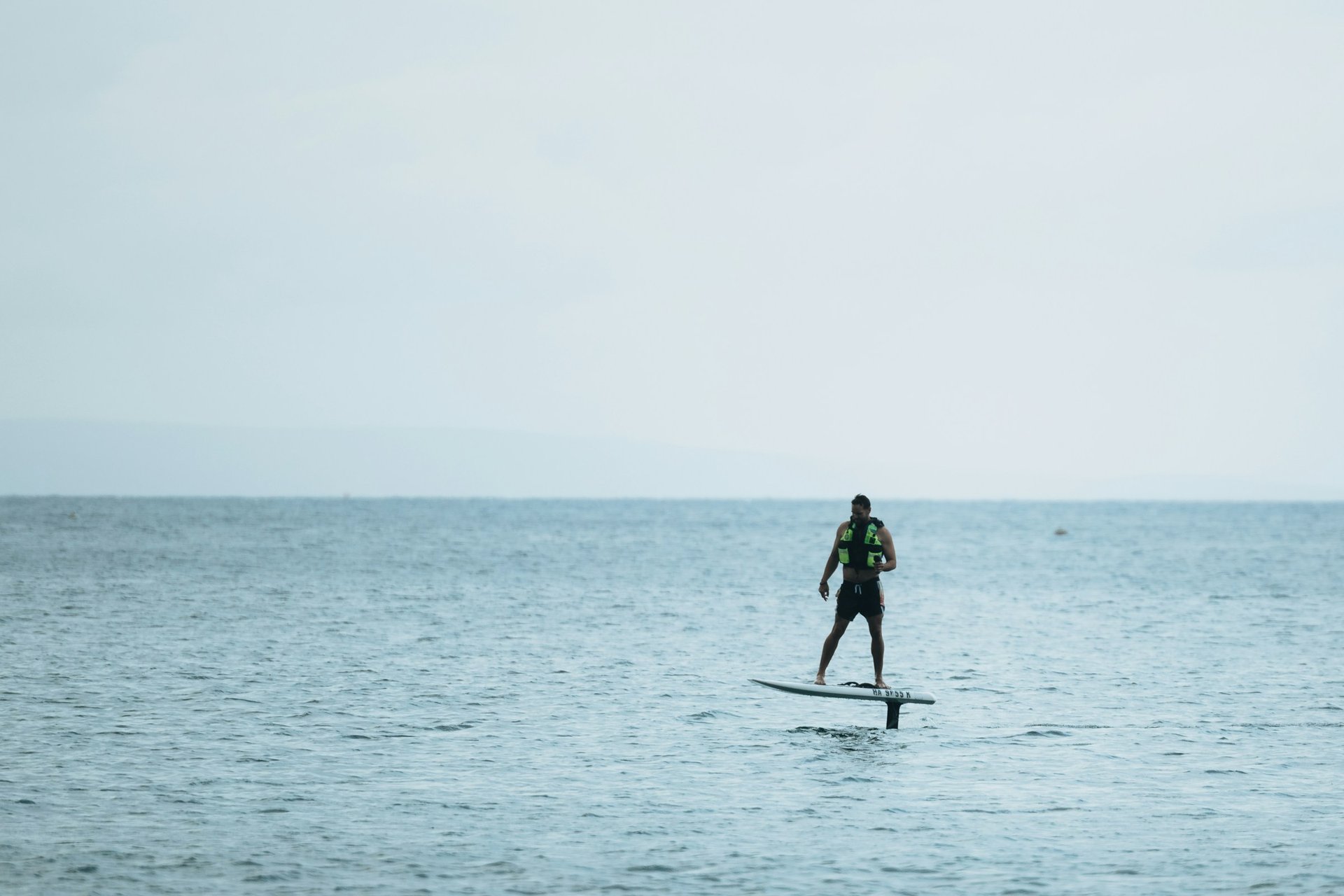
Which eFoil is easiest to learn on
Buy volume, a big front wing and a controller that can hold the power back. The Waydoo Flyer EVO Max Plus and the SiFly Rider+ both sit on 130 liter boards, the Fliteboard ICON carries 100 liters on the Cruiser Jet 1500 wing, and Lift's LIFT5 F Cruiser, at 83 liters, is what Lift calls the most forgiving board in the family. For the very first hour, the Flitescooter puts handlebars on a 237 liter inflatable board.
Volume keeps you afloat while you lie, kneel and wobble upright. A large front wing lifts early, at low speed, and stays steady once it does. Larger wings, Fliteboard says, give “more lift and stability, making them ideal for beginners, heavier riders.”
A Fliteboard starts to fly at around 20 km/h (about 12 mph). The electronics help with the rest. Fliteboard builds rider modes for learning into its remote, Awake's app sets the power from your experience and weight, and Waydoo adds a Flight Assist that helps a new rider keep balance.
Your weight has to fit the set, too. Fliteboard has tested riders up to 120 kg, Lift rates the LIFT5 F Cruiser to 113 kg (250 lb), Waydoo the Max Plus to roughly 130 kg and SiFly the Rider+ to 140 kg. The Waydoo and SiFly sets also list for several thousand less than a Fliteboard or a Lift.
Battery size, mast length and dealer service have their own checklist in our eFoil buying guide.
The beginner sets in numbers
Rider weight is the maker's limit for the complete set. Where a maker labels a board for a skill level, that label is quoted as given.
Swipe sideways to see all columns
| Set | Board | Front wing | Rider weight | Maker's level |
|---|---|---|---|---|
| Fliteboard ICON | 5'8" x 28", 100 L | Cruiser Jet 1500 C | up to 120 kg | Beginner to intermediate |
| Flitescooter | 7'0" x 35", 237 L, inflatable, handlebars | Cruiser 1800 C | up to 120 kg | Beginner |
| Lift LIFT5 F Cruiser | 5'4" x 27.5", 83 L | 200 Surf V2 | up to 113 kg | Entry board |
| Lift LIFT5 F Sport | 4'9", 67 L | 200 Surf V2 | up to 100 kg | Entry board |
| Waydoo Flyer EVO Max Plus | 130 L, EPP foam | Gliding C1500 | roughly 130 kg | Easiest EVO to learn on |
| Waydoo Flyer EVO Lite | 90 L | - | roughly 90 kg | - |
| SiFly Rider+ | 5'6", 130 L, soft top | - | 40 to 140 kg | - |
| SiFly Lite+ | 6'8", inflatable outer sections | - | 60 to 140 kg | Beginner friendly |
| Awake VINGA Carve | Compact shape, wide platform | Cruise Wing Kit (option) | - | All round, built for progression |
Fliteboard ICON and the Flitescooter
On Fliteboard's own scale the ICON runs from beginner to intermediate, and the maker calls it “the best all-rounder for any level of experience and riding style.” The 5'8" ICON at 100 liters “is the best size for most riders who are willing to take a few sessions to really get the hang of it.” The PRO, at 67 liters, “isn't as easy to learn on, particularly for heavy riders.” You can order the ICON in carbon, fiberglass or Soft Top 2, and it carries riders up to 120 kg.
New riders should start on the Cruiser 1100 or the Cruiser Jet 1500, says Fliteboard, and the ICON comes with the Cruiser Jet 1500 C. Its controller has rider modes for learning and cuts the motor as soon as it goes under water.
The Flitescooter is a different idea. A 7'0" x 35" inflatable board with a carbon core and 237 liters of volume takes removable handlebars, which Fliteboard describes as “another point of contact for stability,” and a thumb throttle sets the power. Below the board sit a 65 cm aluminum mast and the Cruiser 1800 C, Fliteboard's largest and most stable wing and the one its Fliteschools use around the world. A Bluetooth safety key cuts the power when you are no longer on the board.
“Complete beginners can learn to eFoil in minutes” on it, according to Fliteboard, and it is the only Fliteboard rated plain “Beginner”. Our Fliteboard page runs through the full lineup, from the AIR to the ULTRA.
Lift builds the LIFT5 F for a first foil
Lift has one range for people who have never foiled. The LIFT5 F, the maker says, is “built for riders getting their first eFoil or their first foil of any kind. It's the board most people start on.” It has the same power as the LIFT5, a fiberglass board, a 28" aluminum mast and bolt-on wings that Lift says are built for stability and early lift.
Two sizes. The Cruiser measures 5'4" x 27.5" x 4", holds 83 liters and takes riders up to 113 kg; Lift calls it “the most forgiving board in the LIFT5 F family.” The Sport is 4'9" and 67 liters with a 100 kg limit. Both ship with the 200 Surf V2 front wing and are rated for up to 90 minutes, and a complete Cruiser set weighs 32 kg.
For more float, Lift sells the Blowfish, a set of inflatable rails that fits both LIFT5 F sizes and adds volume and stability for $599. Lift's own first ride guide says to use it for early sessions, to start on the 5'4 Cruiser, and to fly a high-lift wing such as the 270 Camber Pro or a 200 or 250 Surf V2.
The 270 Camber Pro is the wing Lift recommends for heavier riders and new foilers, for its “maximum low-end lift and pitch stability.” For the LIFT5, the LIFTX and the rest of the range, see our Lift eFoil page.
Waydoo's Max Plus puts 130 liters under you for less
“Stable eFoil for Beginners” is how Waydoo sells the Flyer EVO Max Plus, and it is the configuration the maker points most beginners towards. The board is 130 liters of EPP foam, the front wing is the Gliding C1500, and the set also brings the battery, the Performance propulsion unit, a charger and the remote. Its Flight Assistance System helps a beginner keep balance, and once you can ride you can switch it off.
The Max Plus “is the easiest EVO to learn on, but it reaches 45 km/h (28 mph)”, says Waydoo. Heavier riders get sent to it whatever their skill level, and Waydoo gives a limit of roughly 130 kg. Its warranty, though, excludes damage from loads above 100 kg and from water less than 1.2 m deep.
Waydoo rates it for up to 120 minutes on the 2,300 Wh pack. It is also the configuration that takes the Scooter Kit, which adds handlebars and an inflatable pod.
The cheaper EVO Lite has a 90 liter board, tops out at 36 km/h and runs around 100 minutes, with a rider limit of roughly 90 kg. At the other end sits the 75 liter EVO Master, “Built for advanced riders.” Where to buy a Waydoo, and what its warranty covers in each region, is set out on our Waydoo eFoil page.
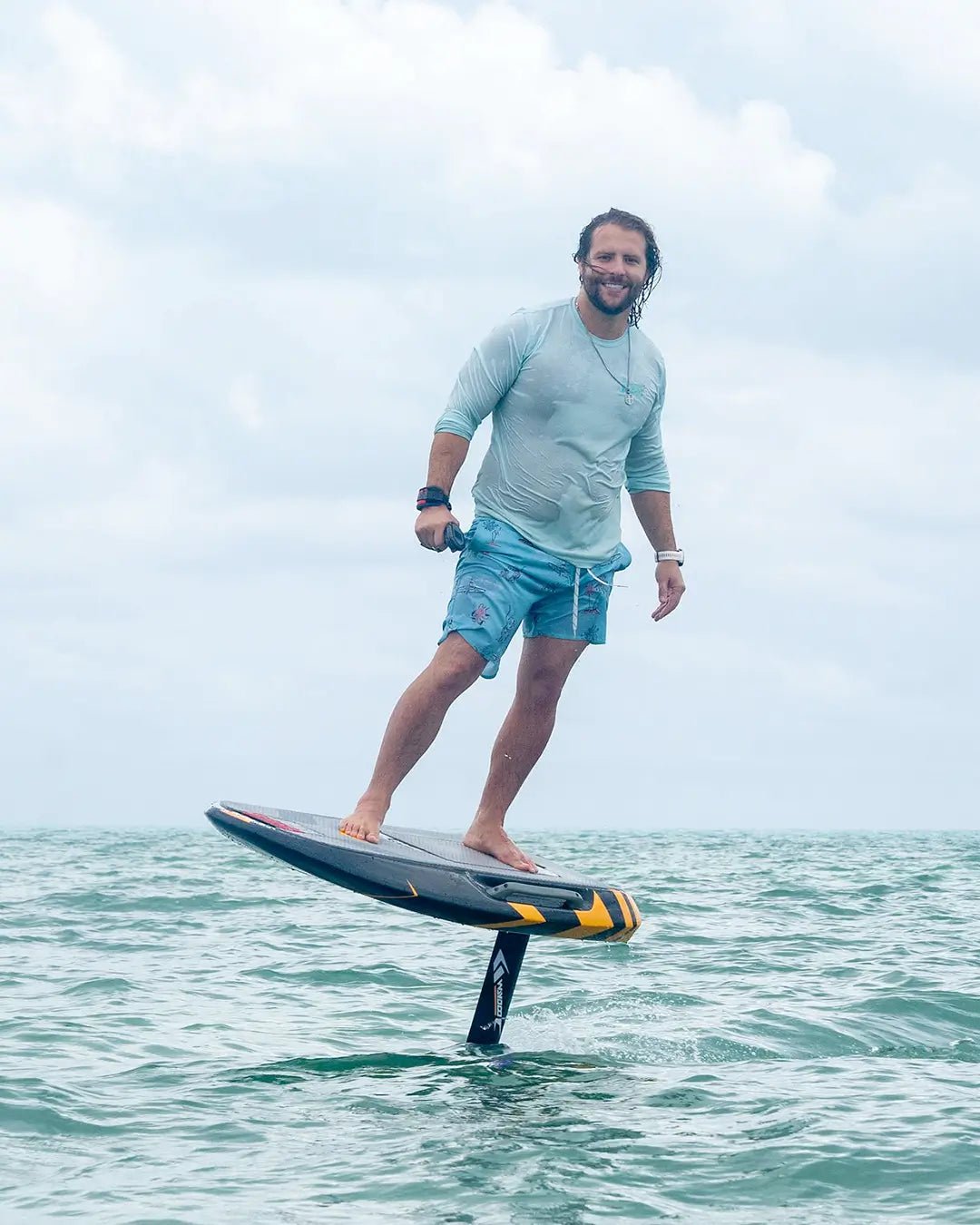
SiFly Rider+ and its add-ons for learners
The Rider+ is SiFly's go-to option for schools, yacht charters and watersports centers, and the maker says the board “prioritizes beginner riders' comfort and safety.” It is a 5'6" board of 130 liters in EPP foam with a shock absorbing soft top, rated for riders from 40 to 140 kg, and the complete set weighs 36 kg.
SiFly rates it for up to 120 minutes. Its ride times assume a 75 kg rider with the Cruiser 1900 wing on a 100 liter board at 15 km/h, so your own time on the water moves with your weight, your wing and your speed.
The Lite+ takes another route to stability. Two inflatable outer sections sit on a rigid core, the board is 6'8" long, top speed is 40 km/h and the rider range runs from 60 to 140 kg. SiFly labels it “Beginner-Friendly”.
Two add-ons are made for the first sessions. The EZ Go stabilizer sits on the mast and reduces “the chances of over-lifting and breaching the water surface”, which is when the wing breaks through and the board drops back. It lists at €599 before VAT. The Floaty, an inflatable unit for extra stability and buoyancy, costs €449 before VAT.
SiFly bundles both with a Rider+ board as its Ultimate Beginner Trio. The Stellar boards and the rest of the range are covered on our SiFly eFoil page.
Awake VINGA Carve with the Cruise Wing Kit
The VINGA Carve is Awake's all-round eFoil, “built for progression”, a compact shape on a wide platform. For the wing, Awake offers a Cruise Wing Kit at €990 before VAT and calls it “the ideal partner for the first steps”, suitable for seasoned riders as well.
Power is handled in software. In the Awake Link app, a Ride Settings Wizard asks for your experience level, your weight and the product you ride, then sets the power level to match. The standard power modes stay available. The VINGA Carve lists from €12,990 before VAT; our Awake eFoil page has the rest of the VINGA lineup.
What a beginner set costs at list price
In Europe, Fliteboard and Waydoo quote prices with VAT, SiFly and Awake without it. Add your local rate to those two before you compare.
Swipe sideways to see all columns
| Set | List price |
|---|---|
| Fliteboard AIR ICON | €8,893.50 incl. VAT |
| Fliteboard ICON Soft Top 2 | €10,829.50 incl. VAT |
| Flitescooter | €12,039.50 incl. VAT |
| Waydoo Flyer EVO Lite | €5,807 incl. tax |
| Waydoo Flyer EVO Max Plus | €6,999 incl. tax |
| SiFly Rider+ | €5,199 to €6,099 excl. VAT |
| SiFly Lite+ | €6,999 excl. VAT |
| Awake VINGA Carve | from €12,990 excl. VAT |
In the United States, Fliteboard lists the ICON at $10,999, the AIR ICON at $8,999 and the Flitescooter at $11,999. Lift asks $10,999 for the LIFT5 F, against $14,999 for the full LIFT5. Waydoo prices the Max Plus at $6,599 and the EVO Lite at $4,999, both before sales tax. SiFly has no dollar price list.
Our eFoil price page sets these figures against the rest of the market and adds the running costs.
How a first session goes, and where to book one
Lift's first ride guide sets out the progression. You lie prone for 15 to 30 minutes and steer by shifting your weight, then kneel, then stand with about 70 percent of your weight on the front foot and ride along the surface. Once the board rises onto the foil, you ease the throttle back slightly.
Lift lists the usual mistakes as going too fast too soon, standing stiff, looking down at the board, over-correcting and starting in choppy water. When you fall, fall off the back, away from the propeller.
Lift wants a first ride on calm, flat water at least 1.2 m (4 ft) deep, away from swimmers, docks, boats and shallows, with no strong current or heavy boat traffic. Wear the leash on your ankle or calf. Lift strongly recommends a helmet and an impact vest, and a life jacket for beginners.
A lesson costs a few hundred dollars, against thousands for a set, and because schools teach on these same brands it doubles as a test ride. Electric Surf Co in Austin runs a Fliteboard eFoil Experience from $299, Urban Surf in Seattle charges $350 for a lesson on Lift, and E-FoilUSA in Miami $385 for a private one. In Kent, Infinity Sport teaches on SiFly at £170 for 120 minutes. Fliteschool Sydney at Bobbin Head takes groups of up to three, from A$225 for two hours when three ride together.
Hiring a board without an instructor is a step for after the lessons. Infinity Sport hires out a SiFly Rider+ at £150 for 90 minutes, but only to riders with at least four hours of proven experience, and Grassy Flats in the Florida Keys rents only to people who have foiled before. For lessons and hire elsewhere, and what they cost, see our eFoil rental page, with local guides for Austin, Seattle, Miami, Hawaii and Sydney.
Age limits and rules for new riders
Fliteboard does “not recommend Fliteboard to be used by children under 16 years of age, subject to local laws and regulations”, wants adults to supervise, and expects every rider to know the local rules. Schools set their own limits. Hawaii eFoil Experience takes riders from 16, while Kauai Foil Experience in Hanalei starts at 13, with an adult along for anyone under 16, and asks that everyone can swim.
In the United Kingdom, Marine Guidance Note MGN 684 (M), updated 1 February 2024, counts electrically powered vessels of any size, “including, for instance, eFoils”, as watercraft under the Merchant Shipping (Watercraft) Order 2023 (paragraph 1.4). The Order has been in force since 31 March 2023. We take that to mean an eFoil ridden at sea in UK waters falls inside the Order like any other powered watercraft.
In Florida, section 327.395(1) of the Florida Statutes (2026) says that anyone born on or after 1 January 1988 needs a Florida boating safety identification card and photo ID on board to operate a vessel with a motor of 10 hp or more. The statute does not name eFoils, so whether a board counts is open; ask the state before you ride there. Treat all of this as general information rather than legal advice; the country by country detail is on our eFoil rules page.
Buying second-hand: whose warranty carries over
Three of the five makers let a warranty follow the board. Fliteboard passes its transferable provisions to a new owner, except after a total loss. Awake moves a registered warranty across through its support team, and SiFly transfers it with the original invoice. Waydoo covers the original buyer only, within the service region where the board was sold, and Lift's one year warranty does not transfer at all.
Fliteboard gives two years on all its products, but commercial use voids that warranty. A Fliteboard sold off by a school or a rental fleet comes without it.
The battery decides what the board is worth. SiFly warrants its battery for two years or 300 cycles and wants the hydrofoil serviced every 100 motor hours or 12 months, so ask for the service record. Awake covers its battery for 24 months or 300 cycles and sells a Battery Health Report for €30 before VAT.
On a Lift, open the hatch. The eBox sits in it, and Lift names water getting in through a damaged hatch seal, with salt water corrosion, as the most common failure. Lift's Gen4 battery does not fit the LIFT5 or LIFTX, so an older pack is no spare for a new board.
Takuma no longer sells new boards, so a Takuma is a used purchase only. Its story is on our Takuma page, and how to inspect any second-hand board is on our used eFoil guide. Battery wear and charging are covered in depth under eFoil battery life.
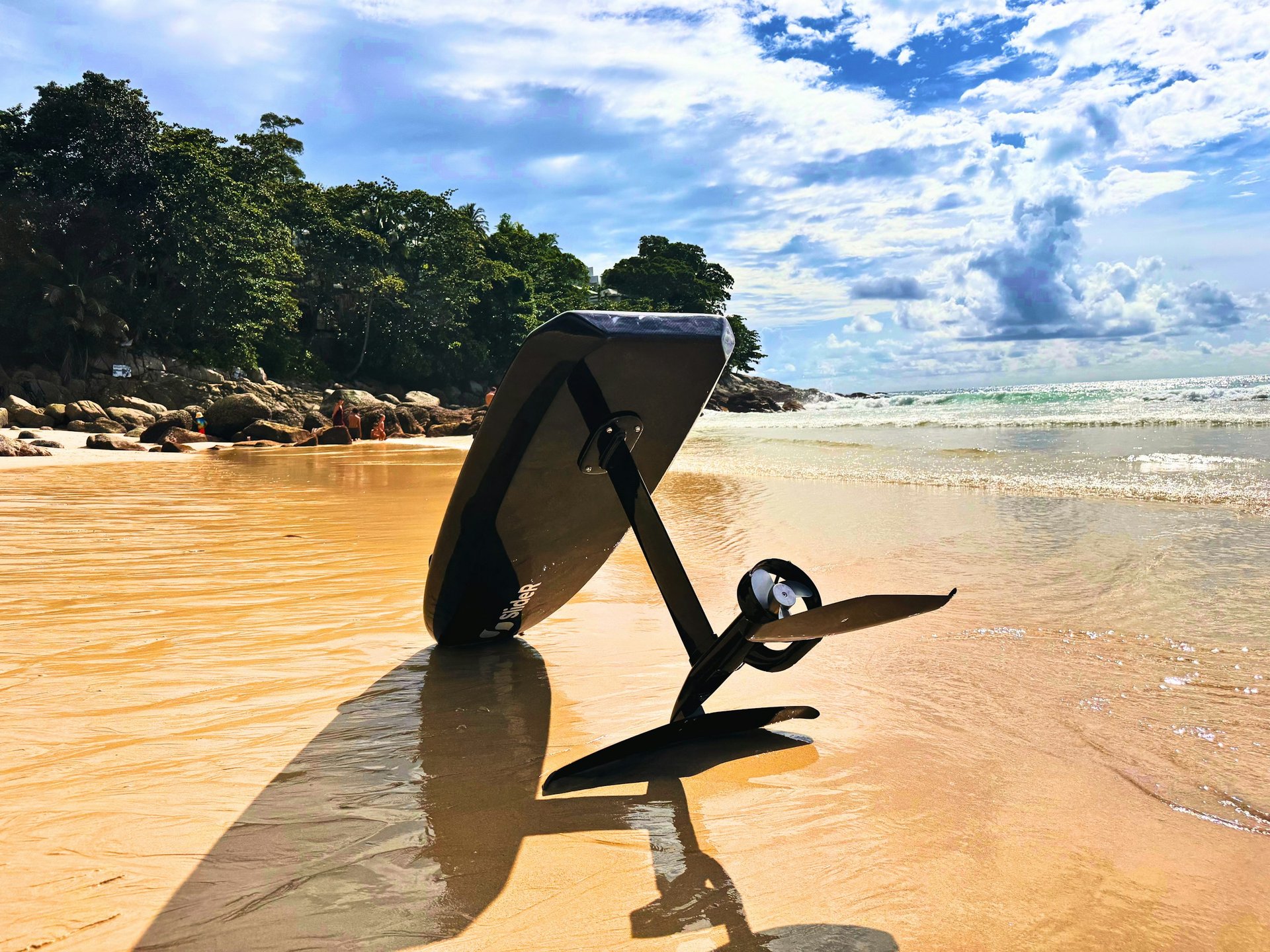
What a beginner can leave in the shop
Carbon first. A Fliteboard ICON in carbon costs €12,523.50 in Europe, against €10,829.50 for the Soft Top 2, and both are a 5'8" board of 100 liters. Fliteboard's fast charger adds €883.30 to a set over the standard charger, and the larger Explore battery adds €1,573 over the Nano. Both can wait until you know how long you ride and how often.
At Lift the Elite Hand Controller costs $895, where the standard Lift Hand Controller costs $529. The LIFT5 F ships with the standard one.
Some boards ask too much of a first-time rider, and the makers' own labels say which. Fliteboard rates the ULTRA L3, a 4'4" carbon board of 49 liters, as Advanced, and the PRO and RACE as intermediate to advanced. Waydoo builds the EVO Master for advanced riders, SiFly rates the Stellar X as Advanced, and Lift's LIFTX is for riders who already foil.
Frequently asked questions
What is the best eFoil for a complete beginner?
The Waydoo Flyer EVO Max Plus, the Lift LIFT5 F Cruiser, the SiFly Rider+ or the Fliteboard ICON. On the makers' own specs, each puts a high volume board on a large front wing. Choose on price and on who can service the board near you.
Do I need a lesson before riding my own eFoil?
Not strictly, though Fliteboard recommends one at a Fliteschool and says most people with no board sports background learn in under an hour. Lift has beginners start on their belly in calm water at least 1.2 m deep, and says most get up on foil on their first day.
Will the cheapest set do for learning?
Only for a lighter rider. Waydoo's EVO Lite lists at $4,999 with a 90 liter board for riders up to roughly 90 kg. The Max Plus, the one Waydoo points beginners to, costs $6,599 and carries up to roughly 130 kg.
How fast does a beginner eFoil go?
Around 20 km/h (about 12 mph) is enough to fly a Fliteboard. The Max Plus can reach 45 km/h (28 mph).
Which eFoil warranties pass to a second owner?
Fliteboard, Awake and SiFly let a warranty pass to a second owner on their own terms, while Waydoo covers the original buyer only and Lift's one year warranty stays with the first owner. Ask for the battery's cycle count and service record before you pay. Takuma no longer sells new boards, so a Takuma can only be bought used.