A foil board that sinks when you stand still
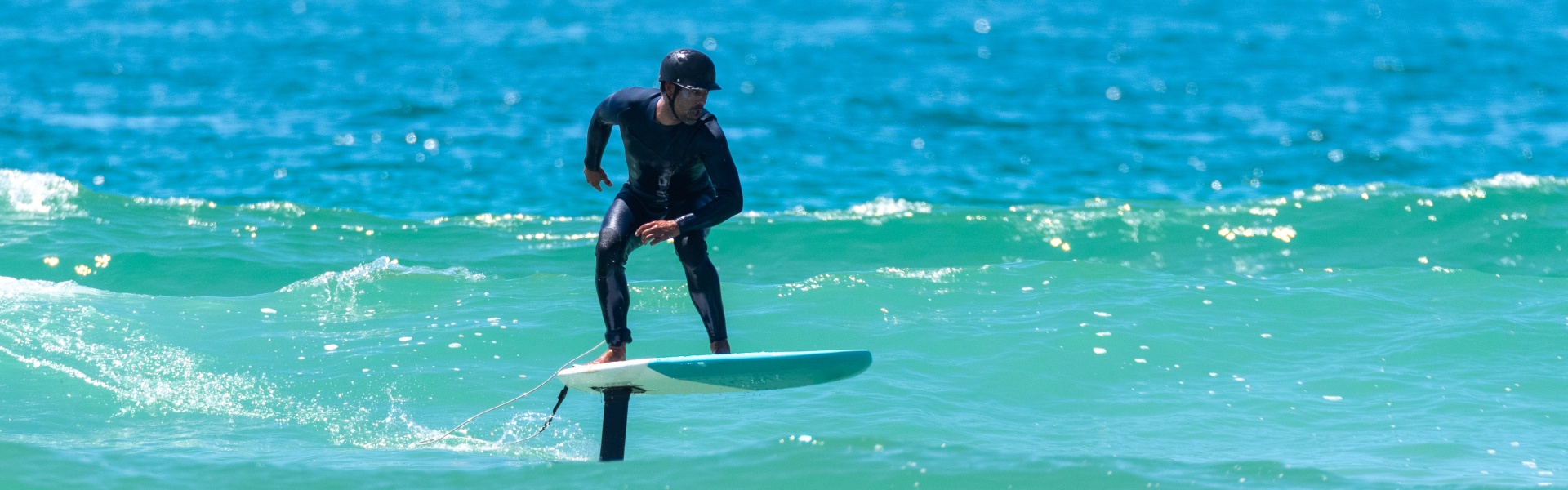
Pump foiling moves a hydrofoil board across flat water with nothing but your legs, without any wind, wave, boat or motor. You press the board down and let it rise, over and over, and the foil turns that movement into lift and forward drive.
A pump foil board holds about 7 to 15 liters, and a liter of water carries about a kilogram, so it cannot float an adult standing on it. You fly or you swim. The usual launch is a run and a jump off a dock, so the board is already moving when your feet land.
Duotone credits the sport's growth to its independence from wind and weather, the many spots that work, the small amount of gear and the workout. The learning curve is the hard part. Expect to climb back onto the jetty soaking wet more than once.
How pumping keeps the foil flying
In a physics model of the sport published on arXiv, leg pumping drives a vertical oscillation that the foil converts into lift and thrust. The front wing does most of the lifting. The stabilizer carries less weight but keeps the board steady in pitch through its longer lever arm.
On the board you push down with the back leg to drive the foil up, then press the nose back down with the front leg, using the whole body and letting the arms set the beat. MACkite likens it to hopping. Beginners tend to forget the release. “It's about unloading the foil at the right moment,” MACkite writes, so take your weight off at the top of each pump.
Fly high, since less mast in the water means less drag. A steady cadence with a short glide between pumps beats hard, exhausting bursts. Pump wings are drawn for this slow flight: Armstrong describes its APF as a thick, high camber section optimized for low speeds and a relaxed cadence.
The dock start, from run-up to first pump
The dock decides as much as your legs do. Slingshot calls around knee height perfect, and published figures run from 10 to 70 cm above the water; Duotone wants the edge about 10 cm lower than your mast is long. Allow 2 to 3 m of run-up. The front wing should fit under the edge at the start, with no posts, buoys or chains to catch it, and the water must be deep enough that the foil never touches bottom. Wet wooden planks get slippery.

Good jetties are often private or fenced off, so ask the owner first. With no dock at all, a ladder, a plank and a few lashing straps make a small launch.
- Hold the board by the rails, foil slightly in the water: front hand on the heel-side edge near the nose, back hand on the toe-side edge near the tail.
- Run three to five steps with the nose pushed slightly down, keeping the board as flat as possible.
- Jump back foot first, front foot right after, so the foil does not stall. Hands stay on the board until you are airborne.
- Land gently, back foot over the mast, front foot just behind your front hand, eyes forward.
- Let go, center your stance and start pumping at once.
Small foils need a fast run. Sroka says its 2000 cm² high aspect wing needs almost no speed, and riders can start it from a standstill. Slingshot warns that dock starting can take hundreds of attempts.
Beach starts, wake starts and a little motor
Takoon builds its pump gear for dock starts, beach starts, rock starts and wakefoiling, and recommends a 70 cm mast for beach starts and shallow water. Pick a beach that drops quickly into depth, or the foil keeps hitting the sand. A folding ladder stood in the water can replace a pontoon.
Behind a boat, you build speed on the tow, let go of the rope and keep the board flying on your legs. A foil assist does the takeoff for you: a small motor and battery under a pump, prone or downwind setup, after which your own legs do the gliding and pumping. Foil Drive lists its Assist Slim complete kits at €3,842 to €4,734 including VAT.
Pump foil board, wing and mast sizes
The board should be small, stiff and low in volume. Duotone points to around 15 liters, surf magazin finds 10 to 15 enough, and Sroka works with 14 to 17 liters. A flat rocker from the tail to the front foot pumps efficiently, while a little lift in the nose keeps it from diving, so the board glides and relaunches after touching the surface. GONG shapes its Kluber that way and calls the fiberglass Kluber V1 the ideal board for discovering dock starts. A large wing foil board is the wrong tool, especially for the start.
On the front wing, area buys low speed lift and span buys glide. Duotone and MACkite start beginners above 2000 cm²; riders who already foil with a wing, kite or parawing manage with about 1,700 to 2,000 cm², by MACkite's figures. High aspect pump wings accelerate more easily and glide longer, but they are harder to relaunch after a turn, and Sroka rates mid aspect wings the easiest for a first takeoff. A large medium aspect wing of 1600 to 2100 cm² from your wing foil gear will also pump.
Pump masts run shorter than wind sport masts, about 70 to 85 cm. Too short means constant touchdowns, too tall means drag and a higher dock; Slingshot recommends 72 or 82 cm. A short fuselage of 60 to 70 cm pumps more reactively, and a small rear wing cuts drag, though a larger one eases the start. For an 80 kg rider, surf magazin suggests this starting set:
- high aspect pump wing, 1700 to 2100 cm²
- 66 cm fuselage
- 75 to 82 cm mast
- a small board, ideally 3'4"
Pump foil boards, wings and packages with list prices
A complete set starts below €1,000 with Takoon's wooden pack. At Duotone the dock start pair is the Strider board and the AMP foil.
Swipe sideways to see all columns
| Product | Sizes | List price |
|---|---|---|
| Takoon Pump Wood board | 80 or 90 cm | €280 |
| Takoon Pump Carbon board | 80 cm, 7 l; 90 cm, 10 l | €399 |
| Takoon Pack Pump One Wood (board, foil, stabilizer) | 1600 / 1800 / 2000 cm² | €900 / €929 / €959 |
| Takoon Foil Pump Front Wing | 1500 / 1700 / 1900 cm² | €449 / €479 / €499 |
| F-One JAM front wing | 1400 / 1600 / 1900 cm² | €999 / €1,049 / €1,089 |
| Armstrong APF front foil | 1350 / 1675 / 1880 cm² | US$999.99 / US$999.99 / US$1,049.99 |
| AXIS Pump and Dock Start Package PNG V2 1300 | wing, 600 mm fuselage, 75 cm mast, rear wing | US$1,825 to US$1,834 |
| AXIS DOCK 880 carbon board | 88 x 42 cm | US$1,079 |
| Slingshot Puddle Pumper V2 board | - | US$399 |
| Slingshot One-Lock Pump Progression Package | Glide 1525 wing, 72 cm mast, board | US$2,499 |
AXIS calls its packages proven starting points and runs them up to US$3,476 for the long distance Fireball 1750. The tails sell separately: F-One's PUMPING XXS 200 at €340, Armstrong's Pump 202 stabilizer at US$289.99.
Beginner mistakes at the dock, and the fixes
- The nose climbs on the run-up. Keep the board flat, nose slightly down.
- The hands let go early. They stay on until you are airborne.
- The run-up speed does not suit the wing: a small wing needs a fast run, a big one hardly any.
- Feet in the wrong place. Practice the stance on the pontoon, because it is hard to fix in flight.
- Staying heavy through the whole pump. Unweight at the top and keep a steady cadence.
- Flying too low, or on a mast so short that the board keeps touching down. Fly high and pick a longer mast.
Landing off balance is the hardest to rescue. “If you are too far forward, backward, left, or right, you start with an imbalance that will be difficult to correct,” Sroka warns. When the ride ends, go with the board in the direction it travels. “Fighting the fall is how you make foil contact,” in MACkite's words.
How to pump foil on day one
Aim to stay on your feet after the jump, nothing more. Dock starting is physically demanding, so keep the session to 30 to 60 minutes.
- Watch a tutorial of each step before you go.
- Put on a helmet and an impact vest, check the depth and look for swimmers within 30 m. Tighten every screw on the foil.
- Walk the run-up two or three times without the board.
- Belly starts: jump onto your belly holding the board, glide a few meters, stand up if you can.
- Full dock starts. Expect to fall often.
- Film a few attempts and check where your feet land.
Courses follow the same arc. The University of Bern's 90-minute introduction, run by Sunsetshop at Biel, starts with theory, moves on to dry pumping exercises and a balance board on shore, and ends on the water with first glides in the shallows, first rides with the trainer's support and finally a ride alone. Northern Kites on West Kirby Marine Lake in England offers three two-hour lessons at £99 per person, for at most two people: Intro to Pumpfoil, Improve Your Pumpfoil and Dock Start.
How long pump foiling takes to learn
Most riders feel confident after 3 to 4 lessons, by Northern Kites' count. Riding on your own and linking several glides takes longer, commonly 30 hours of practice or more, the school adds. Fitness, how often you go out and help from an instructor all move that figure, Duotone notes. Wing, downwind and kite foilers learn faster, and snowboard, skateboard or surf experience helps.
Pump foil safety: helmet, vest and deep water
Duotone calls a helmet and an impact vest crucial for beginners. Never dock start over shallow water, and check the depth everywhere the board might travel after a fall. In a harbor, Sroka advises holding on to the board as you fall so it cannot hit a moored boat, and keeping it off the dock to spare your gear.
Pump foil next to surf foil, wing foil and SUP foil
Every foil sport pumps. On a surf foil pumping keeps the board flying with no wave underneath and links one wave to the next; a SUP foil rider links one bump to the next. On windless days surf magazin calls pump foiling the perfect doldrums alternative to wing foiling, and a very solid foundation for all foil sports.