

Paje first, then Jambiani and Kiwengwa
Zanzibar's wind sports all happen on the east coast of Unguja. Paje, on the southeast side, is the busy end of it. Kite Centre Zanzibar counts more than ten kite schools along that one beach, and three of the centers that publish a wing program are among them. If you have never held a wing, the basics are in our wingfoil guide.
Paje and Jambiani sit on a single gently curving beach, maybe 15 kilometers from north to south by Kite Centre's estimate, with one reef, one wind and one set of tides. Jambiani is about 7 km south of Paje and has a handful of schools. Bwejuu, five minutes north, has more seaweed farms and coral and a small beach, and it only works once the tide is more than half in. Kite Centre leaves it to experienced, self sufficient riders and never teaches there.
Further north the schools disagree. Kite Centre files Nungwi and Kiwengwa under resort beaches, “great for swimming, not really kite spots”. The Kiwengwa guide in IKSURFMAG, written by the team that runs the Duotone Pro Center there, calls it the longest white sand beach on the island and says the water stays deep enough to foil, with a small natural lagoon left even at low tide. The wind at Kiwengwa is side onshore, and the waves out on the reef are for advanced riders only.
Paje or Jambiani
Swipe sideways to see all columns
| Paje | Jambiani | |
|---|---|---|
| From ZNZ airport | 50 km, 60 to 75 minutes | 55 km, 75 to 90 minutes |
| Wind | 14 to 22 knots in both seasons | 14 to 22 knots in both seasons |
| Water | Flat lagoon, chest deep at high tide | Flat lagoon, a little more reef showing at low tide |
| Schools | 10+ with IKO certification | 3 to 4 small ones |
| Kites on a peak day | 50 to 150 | 10 to 30 |
Kite Centre sends a complete beginner to Paje, where there is a choice of IKO schools and everything is a short walk away. A solo intermediate rider gets fewer people and lower costs in Jambiani. Zanzikite, the Jambiani school with a wing page, teaches at Mwendawima and describes it as a wide beach with warm water and a shallow, flat lagoon, and says its instructors know the currents, tides and wind of that spot.
Behind the reef at Paje
About 1.5 km off Paje beach a reef takes the swell. Past it the waves typically run 1 to 1.5 m and reach 3.5 m on a big kusi day. Inside, the water stays flat over a sandy bottom. At low tide you can stand across hundreds of meters with no current pulling at you, and at high tide the lagoon is chest deep and still flat. Kite Centre sums up its wing water as “flat, shallow, and safe, perfect for your first steps on the water”.
A seaweed farming area splits the lagoon in front of Kite Centre in two, easy to spot and easy to cross. Even at low tide the school rates this water as good for wing foiling, and for SUP and snorkeling.
South toward Jambiani the reef is more exposed and more sandbars show at low tide, with more rocks and patches of coral. The riding areas there are much smaller and better at high water, and pockets of the lagoon get shallow enough that Kite Centre rates them less good for foiling on a low spring tide.
Read the tide before the forecast
Spring tides come around full moon and new moon. Low water can then empty the lagoon almost to the reef, and high water can cover most of the beach. At neap tides the water hardly moves. Kite Centre plans its lessons around the tide, so a booked lesson takes care of itself. Rental hours do not, and a tide table belongs next to the wind forecast when you pick them.

Kaskazi from late December, kusi from mid June
Two trade winds carry the year. The kaskazi blows from the northeast from the end of December to mid March, usually at 14 to 18 knots. The kusi comes from the southeast from mid June to mid October and is the stronger one, often 18 to 22 knots. Both arrive side shore on Paje beach. Kite Centre puts the average around 16 knots, and the wind usually builds toward late afternoon and early evening.
Swipe sideways to see all columns
| Kaskazi | Kusi | |
|---|---|---|
| Direction | Northeast | Southeast |
| Months | End of December to mid March | Mid June to mid October |
| Typical wind | 12 to 18 knots | 14 to 22 knots, lighter mornings, often 20+ on July and August afternoons |
| Air temperature | 27 to 30 °C | 24 to 27 °C |
| Kite Centre's view | “The patient teacher” | The stronger of the two |
December is the hinge. Its first 10 to 15 days are still transition, with the kaskazi building at 12 to 16 knots and the odd lighter day. Somewhere around 15 to 20 December it locks in at 14 to 18 knots, with the water at 27 to 28 °C, and Kite Centre rates that stretch best for beginners, light wind foilers and intermediate riders.
Between the seasons the wind gets patchy and drops below kiteable strength, in the long rains from about mid March to May and the short rains from late October to early December. Kite Centre's own rule of thumb is shorter: come any time outside April and November.
Other schools draw the months a little differently
Aquaholics gives its season as 15 December to 15 March and the start of June to the end of September, with January and February plus June, July and August as the most consistent months. Zanzikite says the trade winds at Mwendawima blow steadily from May to October. The Kiwengwa guide gives 15 to 25 knots and very few windless days in the windy seasons, the kaskazi from December to March and the kusi from July to September.
January, February, July and August fall inside the seasons of Kite Centre, Aquaholics and the Kiwengwa guide alike. If your dates are fixed, those four months are the safest bet.
Water at 24 to 28 °C
The sea stays warm all year. Kite Centre leaves the wetsuit off its packing list and suggests a 2 mm shorty or a neoprene top only for people who get cold easily between June and September, when the kusi air runs a few degrees cooler than in the kaskazi.
Five centers with a wing program
Three in Paje, one in Jambiani, one in Kiwengwa. All five teach the wing next to the kite, and the course plans have little in common. One keeps you on a SUP board before the foil goes on, another sells a three hour intro with no experience needed.
Kite Centre Zanzibar, Paje
An IKO certified school on Paje beach that uses Duotone gear. Its wing courses come as a ladder of three. TRY covers first control of the wing and how the board works. LEARN adds a controlled start and stop, building power and your first meters of riding, and asks for no prior experience. RIDE takes you onto the foil: first flights, riding in both directions and working upwind. Every step is private or semi private, in lessons of 1.5 or 2 hours, open to complete beginners and to riders who come from kiting or windsurfing.
Aquaholics Kite & Surf, Paje
Aquaholics teaches on Naish wing foil gear, for complete beginners and for people who have already tried. Its instructors, the school says, all come with extensive experience or IKO certification. Lessons are one to one: Discover is a single hour of gear preparation, a safety briefing, wing handling on the beach and a first go on the board; Progress runs two hours; Go getter takes four, billed as “Zero to Riding”.
Book at the Paje office. The second base in Dongwe, at The Sands Beach Resort, serves only wave surf trips.
Zanzibar Kite Paradise, Paje
The water sports center of the Zanzibar White Sand Luxury Villas & Spa resort teaches kitesurfing, wing foiling and eFoil with IKO certified instructors, uses Ozone kites, wings and foils exclusively, and keeps a rescue boat on the water during every lesson. Its wing course has five steps. First Steps is theory, beach training and a first try with the wing in the water. Get Started puts you on a SUP board for first turns and runs upwind and downwind. Only at Rookie do you move to the wingfoil board for the first flights. Rider adds distance and speed control, and Hero, the last step, teaches upwind riding and foil turns on the way to riding on your own.
Zanzikite, Jambiani
An Ozone partner school at Mwendawima with IKO certified lead instructors. Its wing offer is a 3 hour intro session with all the equipment included and no experience needed. Every student gets an impact vest and a helmet and a full safety briefing before going in the water, and the school promises no hidden fees.
Duotone Pro Center Zanzibar, Kiwengwa
The only one of the five in the north sits next to the Mvuvi Boutique Resort and belongs to it. Its IKO listing names kitesurf, wing foil, kitefoil and SUP lessons and rental, with a rescue boat on hand in deep water. The team's own guide lists the latest Duotone, Fanatic and Ion equipment. No wing price is published, so ask for one when you book.
Euros at Kite Centre, dollars elsewhere in Paje
Kite Centre prices in euros. Aquaholics and Zanzibar Kite Paradise, the other two Paje centers with a public list, quote US dollars. Zanzikite keeps its full price list in a PDF, and the Duotone center in Kiwengwa publishes no wing price.
Swipe sideways to see all columns
| School | Lessons | Rental |
|---|---|---|
| Kite Centre Zanzibar, Paje | From €99 per person with a partner, from €129 private | From €49 (all its Duotone rental gear) |
| Aquaholics, Paje | $100 for 1 hour, $190 for 2, $340 for 4, $480 for 6, private | Wing: $60 an hour, $90 half a day |
| Zanzibar Kite Paradise, Paje | $220 for 2 hours, $390 for 4, $540 for 6, $700 for 8, $850 for 10, private | Wing, board and foil: $70 an hour, $100 half a day, $130 a day, $590 a week |
| Zanzikite, Jambiani | - | - |
| Duotone Pro Center, Kiwengwa | - | - |
Kite Centre's online prices are for booking ahead. Pay at the desk and expect around 5 to 15 % more. Its rental runs from 1 to 14 days, and wing gear is part of the fleet; the €49 starting price covers all its rental gear, not wings alone.
At Aquaholics two people can share a lesson, one instructor and one set of gear, and split the hourly price. Lessons include gear insurance; rentals do not, and the school points renters to worldwide cover such as the VDWS “Safety Tool”. A spot can be held without payment until a month before the trip.
Zanzibar Kite Paradise sells its five course steps as private packages of 2 to 10 hours, so the hourly rate falls the more you book. If you plan to buy your own kit after the trip, the wing foil gear guide covers sizes and what a first setup costs.
eFoil in Paje when the wind stays away
Zanzibar Kite Paradise runs eFoil lessons and rentals on the Paje lagoon, silent electric hydrofoils with “no wind required, all levels welcome”. When the wind fails, it can switch a booked student to the eFoil or a SUP.
A private eFoil lesson there costs $190 for one hour. Rental is $90 for 30 minutes and $150 for an hour, one person on the board. Kite Centre, Aquaholics and Zanzikite list no eFoil. Prices from other destinations are collected on the eFoil price page.
Rashguard, reef shoes and a type G adapter
Light, mostly. This is Kite Centre's student list, trimmed for a wing rider.
- A rashguard and long sleeves for the water. No wetsuit; a 1 or 2 mm neoprene top is optional for the breezier weeks from July to September.
- Reef safe sunscreen with SPF 50, a hat with a chin strap and sunglasses on a leash.
- Water shoes for reef walks at low tide and the rocky paths in the villages.
- DEET repellent, mostly for the evenings.
- US dollars in cash and a type G plug adapter.
- Your own foil, if you ride one with a mast and wing combination you have dialed in. Kite Centre's own line on the lagoon is “Foiling here is incredible.”
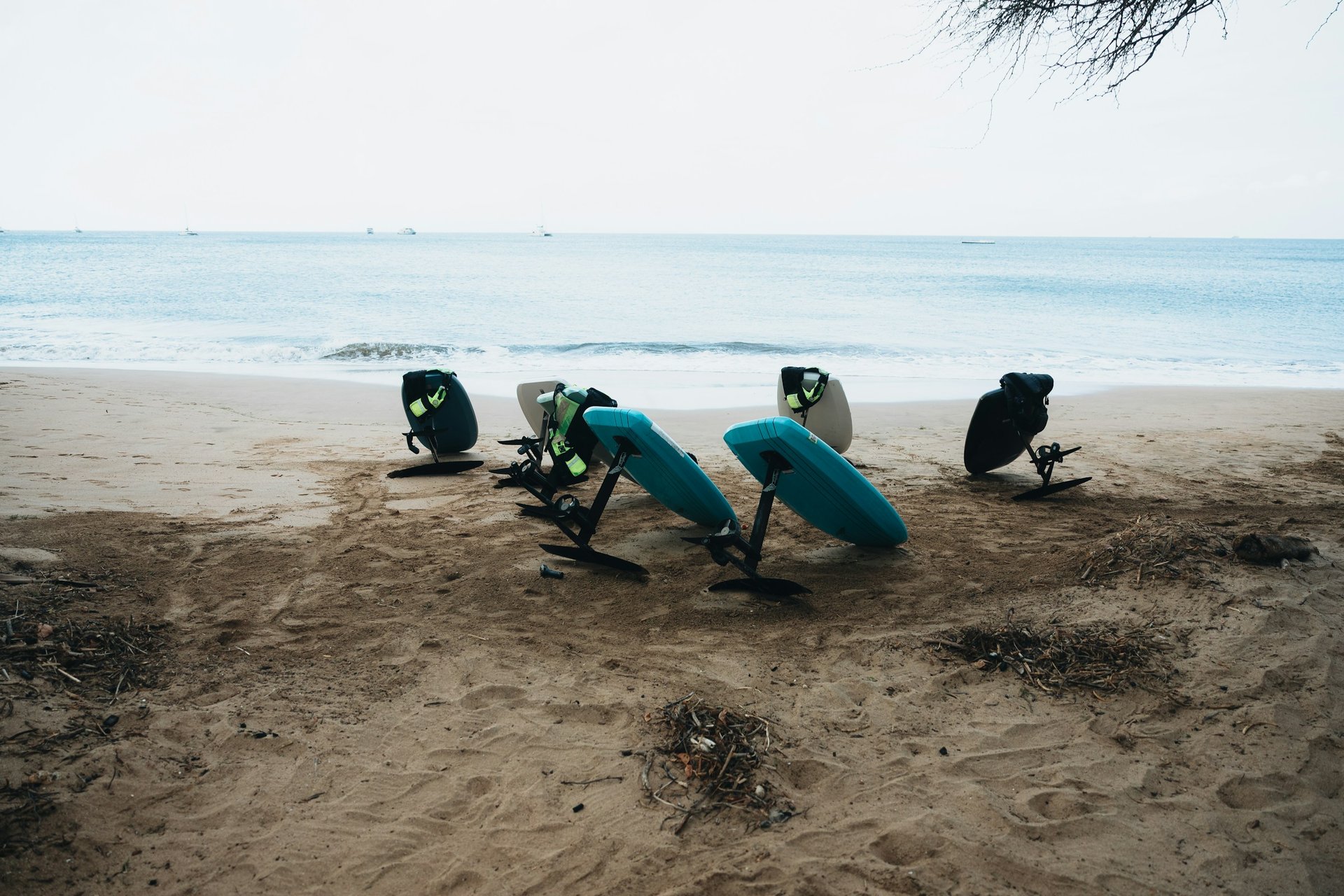
Wings, boards and foils can all be rented in Paje, so a first trip needs no gear of your own.
Getting to Paje, and the papers to carry
Flights land at Abeid Amani Karume International Airport (ZNZ), about 5 km south of Zanzibar City on Unguja. Paje is about 50 km away, a drive of 60 to 90 minutes, and Kite Centre's estimate for a private taxi is USD 50 to 70 for the car. Kiwengwa is about an hour's transfer from the airport. Arriving by sea, fast ferries run from Dar es Salaam to the ferry terminal in Stone Town, with Azam Marine among the operators.
Visa and passport
Zanzibar uses the visa of the United Republic of Tanzania. The Tanzanian embassy in Washington lists the ordinary single entry visa at USD 50. Its exceptions are USD 100 for citizens of the USA, who receive a multiple entry visa valid for 12 months, USD 100 for Ireland and USD 200 for Pakistan. Applications go through the government's electronic visa system at visa.immigration.go.tz, which covers both Tanzania Mainland and Zanzibar: you fill in the form, pay and submit online, and the decision arrives by email. The passport has to be valid for at least six months.
Kite Centre's packing list adds two blank passport pages and says the visa can also be paid in cash on arrival. On the same list, a yellow fever certificate is needed only if you arrive from a country with yellow fever risk, and not on a direct trip from Europe or the US.
The ZIC inbound insurance
From 1 October 2024 the Revolutionary Government of Zanzibar made inbound travel insurance from the Zanzibar Insurance Corporation (ZIC) compulsory for every foreign visitor. The policy covers a stay of up to 92 days, costs USD 44 per person and is bought through visitzanzibar.go.tz. The Embassy of the United Republic of Tanzania in Japan relayed the rule in a notice of 11 September 2024. The notice gives no law number or article, and on our reading the requirement rests on a government decision announced by notice.
Your own travel insurance is a separate matter. Kite Centre's list warns that standard policies often exclude “adventure sports”, so check that yours covers wing foiling before you fly. Cards work in most hotels and restaurants, while the visa on arrival and tips want US dollars in cash. Fees and entry rules change from time to time, so check them before you book; none of this is legal advice.