No eFoil ride for visitors at present
A holiday in Mauritius does not come with an eFoil session, at least for now. OceanFly, the dealer behind the demo rides at Tamarin Bay on the west coast, says so on its demo page: “Demo rides are only for residents of Mauritius. We can't offer eFoil rides to tourists while the regulatory framework is still pending.”
The other eFoil name on the island is SkySurf, which sells SiFly boards. Its Lessons & Rental offer, 1.5 hours with the team, still carries a Coming Soon label. No hotel, resort water sports center or school lists eFoil either, as far as we know, so nobody will take a visitor out on one today.
What holds it up is a legal question. Mauritius registers and licenses pleasure craft, and in our reading the text of its law does not settle whether an eFoil is one.
What the Tourism Authority Act 2006 says about pleasure craft
Leisure boats come under the Tourism Authority Act 2006 (Act No. 32 of 2006). Section 2 defines a pleasure craft as a vessel used for the recreation or pleasure of the person carried on it, including a recreational platform or a floating craft, minus any craft prescribed as exempt. In the navigational area, which includes the sea:
- Section 40(2): a pleasure craft must be registered and carry a registration mark.
- Section 57(1)(a): nobody operates one without a pleasure craft license (section 59) or a provisional license (section 65A) in force for that craft.
- Section 91(1): no pleasure craft between sunset and sunrise without the prescribed lights.
- Section 92(1), as amended by Act 38 of 2011: dangerous operation carries a fine of Rs 10,000 to Rs 100,000 and up to two years in prison.
- Section 101: maximum speeds may be prescribed, and the Minister may prohibit or restrict pleasure craft by a notification in the Gazette.
Where an eFoil sits in that text
OceanFly's legal guide calls the situation “still evolving and not fully defined”. An eFoil, it says, does not clearly fit the pleasure craft that Mauritius regulates and licenses, yet it has a motor. Private, non-commercial use is not prohibited, while “there are currently no licenses available for commercial” eFoil activity such as schools or rentals.
We read the Act the same way. It never mentions eFoils, and the wording of section 2 leaves open whether one counts as a pleasure craft. OceanFly says the Tourism Authority is working on a framework for eFoiling, so the rules may change. We set these texts out for someone planning a trip, and none of it counts as legal advice. How other countries license and register eFoils is on the eFoil rules page.
Dolphin zones, marine parks and buoy colors
Pods of dolphins turn up in Tamarin Bay early in the morning, and OceanFly tells its riders not to chase them and to stay 50 meters or more back. The law draws wider circles.
Dolphin and whale watching regulations
The Tourism Authority (Dolphin and Whale Watching) Regulations 2012, Government Notice No. 154 of 2012, in operation since 1 November 2012, set a prohibited zone within 50 meters of the closest dolphin (100 meters for a whale) and a regulated zone out to 150 meters (200 for a whale). A pleasure craft enters and leaves the regulated zone at no-wake speed and never drives through a pod (regulations 2, 6 and 12).
Regulation 10 goes further for sports. Nobody may knowingly go kite surfing, jet skiing, paragliding, diving or windsurfing within 500 meters of the closest dolphin or whale. eFoils are not on that list, but we take the prudent distance to be far greater than the operator's 50 meters.
Marine parks, lanes and swimming zones
The Fisheries and Marine Resources (Marine Protected Areas) Regulations 2001, GN 172 of 2001 as amended by GN 196 of 2007, keep any boat or vessel out of a Marine Park or Marine Reserve without a permit (regulation 12(1)). Blue Bay Marine Park in the southeast covers 353 hectares. In Balaclava Marine Park in the northwest, water skiing is confined to two ski lanes, in the Pointe aux Piments lagoon and in Turtle Bay.
Swipe sideways to see all columns
| Marker | Zone | Rule |
|---|---|---|
| Green buoys | Conservation zone (reg. 19) | Entry by permit only, no wake, 3 knots at most |
| White buoys with vertical red stripes | Traffic lane (reg. 21) | No wake, 3 knots at most |
| Orange buoys | Ski lane (reg. 22) | - |
| Yellow floats and buoys on the seaward side | Swimming zone (reg. 24) | No boat, craft, pedalo, kayak, surfboard or similar device, motorized or not |
Regulation 30 sets the fines: Rs 2,000 to Rs 20,000 for a first conviction, Rs 20,000 to Rs 35,000 and up to six months in prison for a second.
Just south of Tamarin, the Grande Rivière Noire navigation channel got its own 2012 regulation (GN No. 212 of 2012, made under section 129(2)(o) of the Tourism Authority Act, in operation from 1 December 2012). It banned mooring and any activity in the channel and held pleasure craft and fishing boats there to 5 knots.
All of these texts name pleasure craft and boats, never eFoils. The cautious course, as we read them, is daylight riding, no entry to the yellow-buoyed swimming zones or the navigation channels, and no Blue Bay or Balaclava marine park without a permit.
For any kind of water sport, UK government travel advice for Mauritius says to make sure the operator holds a valid permit issued by the Ministry of Tourism, that the boat carries enough life jackets and that the captain can contact the coastguard.
What a resident's eFoil demo at Tamarin looks like
OceanFly is the trading name of Onyx Dynamics Ltd of Telfair, Moka, “the exclusive Lift Foils redistributor” on the island. It sells the Lift LIFT5 and LIFTX, and the demo is a try-before-you-buy ride for people who live in Mauritius. It runs in three parts:
- A 10 minute briefing on the beach about the gear and the controls, with the waiver signed on your phone.
- 30 or 60 minutes on the water, with the instructor in the water beside you.
- A debrief with a cold drink.
OceanFly bills the half hour as “a first taste, one person, full attention” and marks the hour Recommended. A single instructor, a certified ocean and water safety and first aid responder, runs every demo in English or German. By the operator's account, most first-timers are up and flying within the session.

No board sport background is needed. You do have to swim comfortably in open water and stay calm when you fall into deep water. The boards run with adjustable speed limits, the controller cuts power the moment you fall, and helmets and flotation devices are included. Section 6 of the terms (version 2.0, effective 29 May 2026) ties every demo to the weather, the water and the operator's safety call on the day, and lets the operator refuse or stop a session.
Tamarin Bay from the water
The meeting point is Tamarin Public Beach, with parking 10 meters from the water. OceanFly calls the bay “the most reliable spot on the West Coast” because it goes deep: at low tide you walk out 10 to 20 meters, at high tide you ride from the shore. Le Morne, by the same guide, is a different case: “Low tide at Le Morne? Almost impossible. You're stuck on the beach.”
Riders go in from the center of the beach, over some stones but no coral. Beginners keep to the middle third of the bay, where the water is flat and the depth predictable. The left side has anchored boats, surfers, hidden rocks and sometimes knee-deep coral. The right side is open.
Boat traffic is light, and the current is mild inside the bay but stronger outside it. Tours along the coast are for advanced riders only, never solo. Surfers and swimmers get 20 meters or more. “They have right of way.”
Mauritius eFoil conditions by month
Summer runs warm and humid from November to April, winter cool and dry from June to September, with May and October in between. The trade winds blow most of the year and harder in winter, with gusts above 70 km/h.
Swipe sideways to see all columns
| Months | Sea | Mean wind | Days with rain |
|---|---|---|---|
| January to April | about 28 °C | 8 to 10 km/h | 8 to 10 a month |
| May | 27 °C | about 11 km/h | 5 |
| June | 26 °C | 15 to 17 km/h | 2 to 4 |
| July | 25 °C | 15 to 17 km/h | 2 to 4 |
| August and September | 24 °C | 15 to 17 km/h | 2 to 4 |
| October | 25 °C | about 13 km/h | 2 |
| November | 26 °C | about 8 km/h | 3 |
| December | 27 °C | about 8 km/h | 7 |
The west is the sheltered side. In August, Medine averages 17 km/h and 3 rain days, against 15 rain days at Fuel in the east and at Plaisance in the south.
January to April look like the calmest months on the west coast, but they fall in the cyclone season, which UK travel advice puts at November to May, with phased warnings from Mauritius Meteorological Services. May, October, November and December pair light to moderate wind with few rain days.
The time of day counts as much as the month. At Tamarin the operator rates 6 to 9 am best and 4 to 6 pm good, and says to avoid 11 am to 2 pm, when the wind picks up.
Kite and wing at Le Morne instead of an eFoil
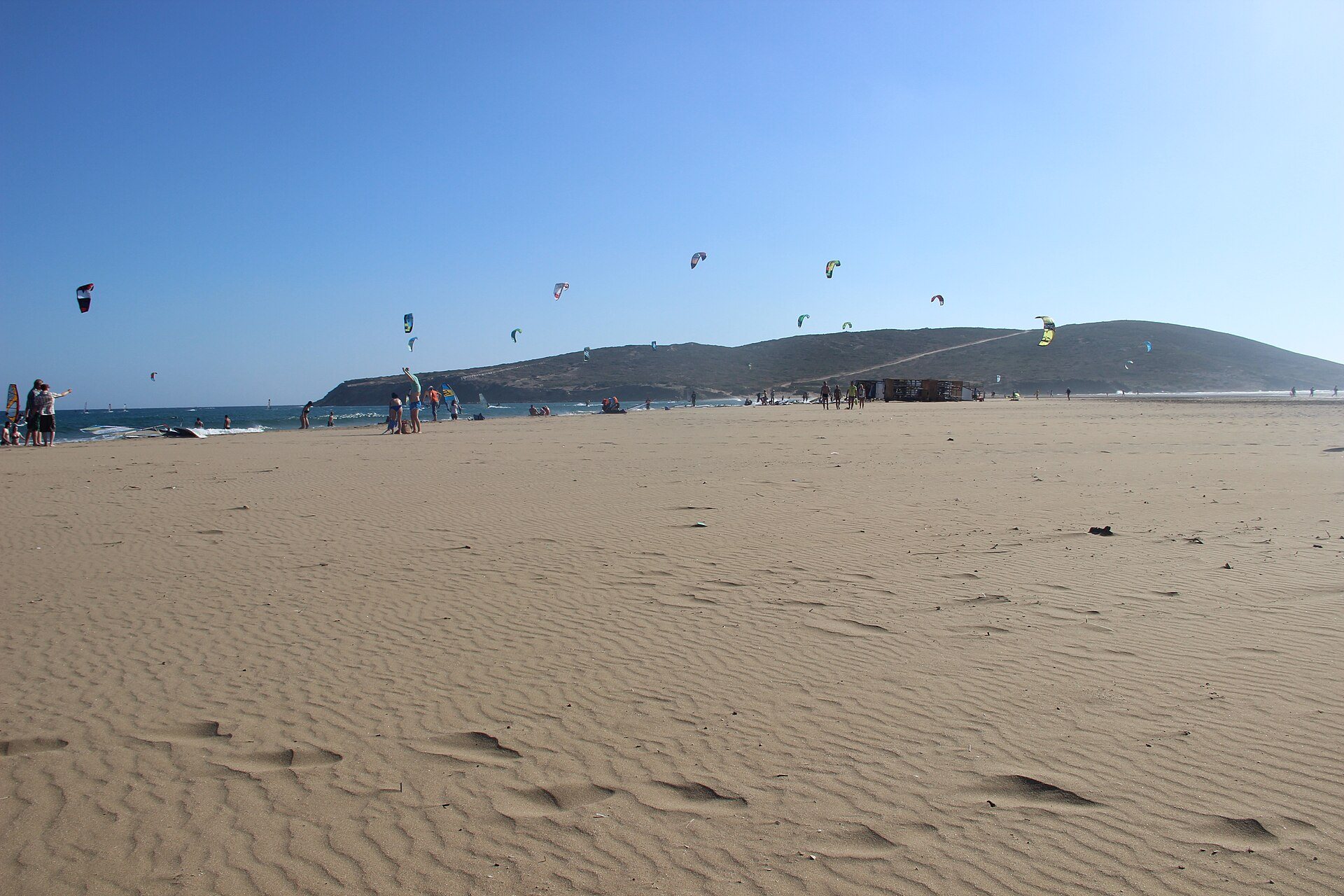
Le Morne Brabant is the peninsula at the southwestern tip of the island, crowned by a basalt monolith 556 m high. UNESCO added Le Morne to its World Heritage List in 2008 as a cultural site. To the left of the main beach, IKSURFMAG describes a “huge expanse of shallow flat water” for beginners, freeride and freestyle, flatter still behind small sandbars. Coral sits underfoot, so wear booties while you learn.
The southeasterly trades blow cross-shore from the left on the main beach. June to November is the best stretch, with 60% of days above Force 4 and air at 20 to 26 °C.

In the southeast, We Glide at Pointe d'Esny teaches kite and wing with boat assistance in “the island's largest lagoon” and runs downwinders to Île aux Cerfs.
The trade-wind months that make Le Morne a kite and wing spot are, as we see it, the windy ones for an eFoil, and its lagoon is shallow with coral underfoot. An eFoil belongs in deep Tamarin Bay in the early morning and in the light-wind months, while kite and wing need the very wind an eFoil rider finds hard going. For the gear and the learning curve, start with the wingfoil or kitefoil guide. Another trade-wind lagoon, Paje, is on the Zanzibar wing foiling page. If an eFoil is the point of the trip, resorts in the Maldives sell sessions to their guests.
When to check again for eFoil in Mauritius
The framework is still being written, so look again before a trip. Three signs would mean a visitor can ride:
- OceanFly's demo FAQ drops the residents-only line.
- SkySurf's Lessons & Rental loses its Coming Soon label.
- The Tourism Authority licenses commercial eFoil activity.
Until a ride opens, the eFoil rental guide shows how sessions work elsewhere, and the beginner boards and eFoil price pages cover buying.


