
How the hour with E-Foil Dubrovnik runs
E-Foil Dubrovnik sells a single product, an hour on a SiFly eFoil with an instructor, for one rider or two. The instructor collects you from your accommodation in the Dubrovnik area, drives to wherever the sea is best that day, and drives you back afterwards without charging for the ride.
Instruction, the board and the safety kit are in the price, with a vest and a helmet for every rider. The helmet deserves a word. It is a communication helmet, so you hear the instructor while you ride and can talk to a partner on the second board, or play music once the board stops wobbling. The school promises “no hidden costs”, and the single extra is a drone, which for €20 films your session in 4K.
The boards are SiFly (the brand has its own page here, our SiFly eFoil page). The school keeps stable setups for beginners and more responsive ones for advanced riders, so someone who already flies does not spend the hour on a board set up for a first timer.
You need no experience. By the school's own account, riders are flying within 20 minutes. EFOIL RENTAL CROATIA puts a charge on its coastal rental boards at 30 to 60 minutes of riding, so one battery roughly covers the hour.
The school names no minimum age, so give every rider's age with the booking, children's above all. A wetsuit is not on the list of what is included, and a first hour on a foil means falling in more than once. The sea is above 21 °C from June to September on the long term averages, but only about 13 to 18 °C from November to May, so outside summer ask about a suit when you book. What separates a lesson, guided ride time and a full day's hire is on our eFoil rental page.
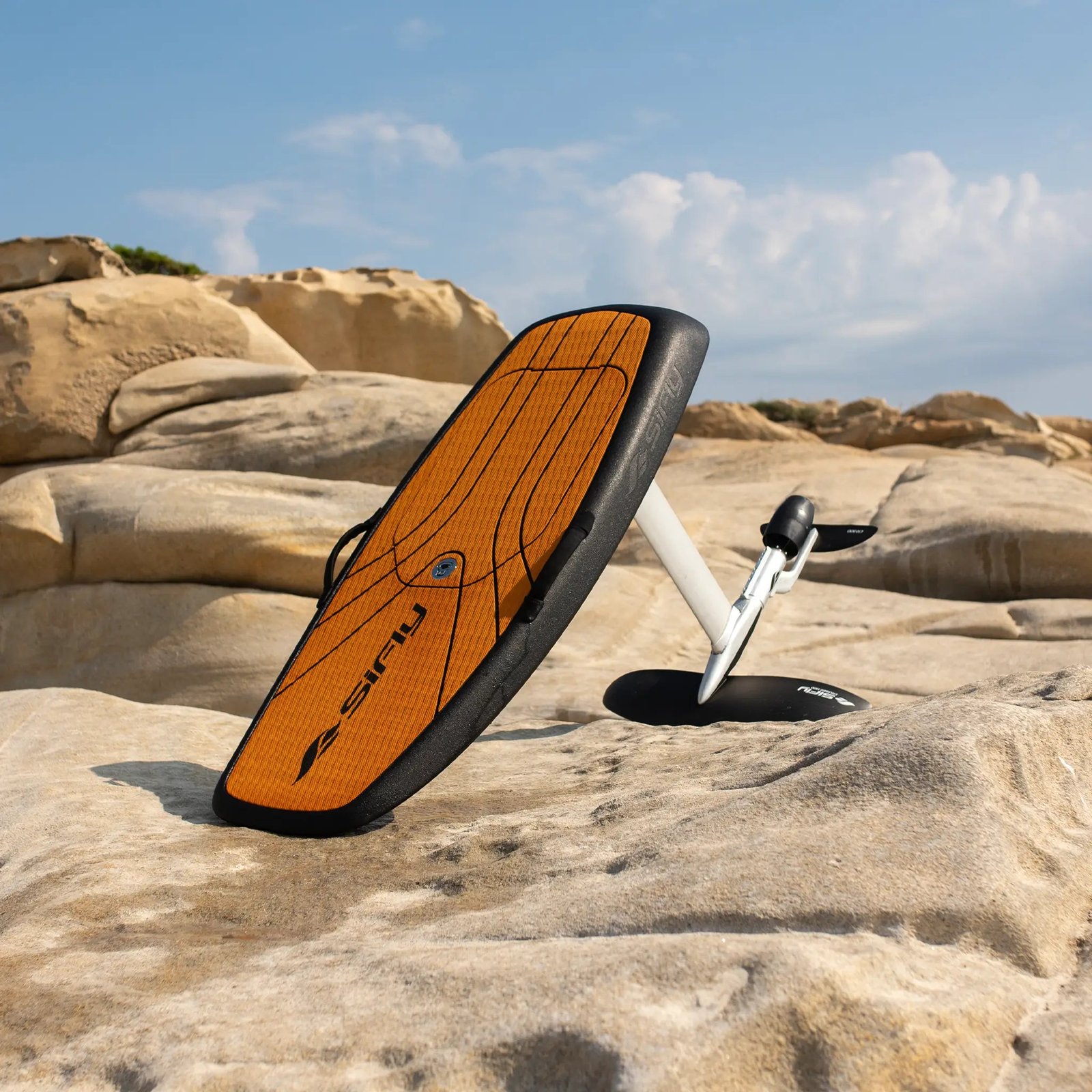
Solo at €99, two boards for €159
One rider pays €99 for the hour. Two pay €159 together, and that buys two boards side by side, one each, with the helmets linking you to each other and to the instructor. That is about €80 a head, close to €40 under the price of two solo hours.
Booking goes through WhatsApp, a phone call or the contact form on efoildubrovnik.com ↗. A same day request is possible; the slot counts as booked once the school confirms it.
Swipe sideways to see all columns
| Operator and place | What you get | Price |
|---|---|---|
| E-Foil Dubrovnik | 1 h with instructor, one rider | €99 |
| E-Foil Dubrovnik | 1 h with instructor, two riders on two boards | €159 total |
| E-Foil Dubrovnik | 4K drone video of your session | €20 |
| Blue Mind Marine, delivered | Waydoo Flyer One Plus, one week | from €890 |
| Blue Mind Marine, delivered | Waydoo Evo Pro Plus or Evo Max Plus, one week | from €990 |
| EFOIL RENTAL CROATIA, delivered | Dubrovnik, Cavtat, Mlini and Župa by arrangement | - |
| Sea Adventures, Lumbarda (Korčula) | 30 min / 1 h / 2 h with instructor, per person | €80 / €120 / €200 |
| Kite School Bol (Brač) | 45 min lesson / 30 min rental | €110 / €80 |
| Wind Rose, Šibenik | 30 min / 45 min / 1 h lesson | €90 / €110 / €130 |
Weekly boards from Zagreb and Zadar
A board for the whole week comes from Zagreb. Blue Mind Marine, which sells Waydoo there as an authorized dealer, drives rental boards to any address in Croatia, and Dubrovnik, Cavtat, Slano and Zaton are on its list: a villa, a yacht, a marina berth or a beach. The Flyer One Plus starts at €890 a week, the Evo Pro Plus and Evo Max Plus at €990, and shorter periods are on request.
Dubrovnik lies beyond the roughly 100 km that EFOIL RENTAL CROATIA, the Zadar operation of Sport Group, normally covers, so it brings a board to Dubrovnik, Cavtat and Mlini only when that is agreed in advance, for weekly rentals, villas, yachts and groups. The price of a Dubrovnik booking is worked out case by case. For the islands the company says Hvar, Brač, Korčula, Vis, Rab and Lošinj normally need a ferry or yacht arrangement before a board can reach them.
Further up the Dalmatian coast
If part of the trip is on Korčula, Sea Adventures in Lumbarda gives SiFly lessons out of a small bay that has neither current nor boat traffic, takes riders from 12 with an adult and teaches in English and French. On Brač, Kite School Bol runs eFoil lessons and rentals near Zlatni Rat, and in Šibenik Wind Rose teaches on Fliteboards from age 14. Wing foilers have FootLoose SurfClub in Viganj on Pelješac, which teaches from a boat from May to the end of September, and Water Donkey in Kućište nearby. The whole coast from Istria down is on our Croatia eFoil page, and the wing side on the wingfoil guide.
The walls, Lokrum and the Elafiti on a map
Nobody can point you to a launch beach, because the spot changes with the wind and the instructor chooses it on the day. What the map does tell you is where the session will not be.
Under the Old Town walls and out to Lokrum, the water belongs to the kayak tours, and an eFoil session is not something to plan there. Lokrum itself lies 600 m off the city, with Fort Royal on its highest point at 96 m, and has been a special reserve of forest vegetation since 1948. Boats run from the Old City port, where the Luža office sells tickets. The reserve's code bars entry without a ticket, staying before the first or after the last reserve boat, and drones without its authorization, and the island closes to visitors in winter. The €20 drone fee covers the footage only. Permission to fly over Lokrum is the reserve's to give.
Gruž sits about 2 km northwest of the Old City. It is the main port, home to the largest market and the main bus station, and it is where the cruise ships tie up. Beyond it, northwest along the coast, run the Elafiti. Three of them are lived in all year and have daily ferries. Koločep is the closest, 5 km from Gruž harbor; Lopud lies between Koločep and Šipan; Šipan is the largest at 15.8 km², with the villages of Šipanska Luka and Suđurađ.
South of the city the coast runs on to Cavtat, the main settlement of Konavle, 15 km away, and the airport is near Čilipi, about 15.5 km from the centre.
Ship lanes off Lapad and the Koločep Channel
Ships bound for the port come in on two approaches, some between Greben and Koločep, others through the Koločep Channel north of the islet of Daksa. Keep clear of the water between the Elafiti and Lapad. It is the shipping route into Gruž.
The Koločep Channel has a rule of its own. The Croatian navigation safety rulebook (Pravilnik o sigurnosti pomorske plovidbe, NN 52/2025 of 21 March 2025, Article 55, paragraphs 2 and 3) closes the channel, the water north of rt Vratnik, rt Biskup on Jakljan, Rt Kuk on Lopud and rt Bat at Zaton, to cargo ships of 500 gross tonnage and more, to all tankers and to ships carrying dangerous cargo, scheduled coastal lines excepted. In our reading the ban does not reach an eFoil, which rides there under the general rules for personal craft.
Fitting the hour into a cruise call or a day trip
Cruise ships call at Dubrovnik from early March to the end of the year, and some years all year round. The port books them under a “2+1” rule: two large ships alongside in Gruž, one large ship lying in front of the Old City. Tell the school which of the two is yours.
From the cruise berths in Gruž the Old City is 30 to 40 minutes on foot, or 10 to 15 minutes on a Libertas city bus to Pile. The free pickup is built around accommodation in the Dubrovnik area, and a ship is not an address, so a cruise passenger agrees the meeting point with the school when booking.
Add the hour on the water to the drive out and back, then leave a margin for the way back to the ship before all aboard. On a long call the morning suits the board best, since the water is usually calmer then, and the walls can wait for the afternoon.
Send the WhatsApp message before you sail, with the date, the ship's time in port, the number of riders and their ages. The school does answer same day requests, but with only a few hours ashore you want the slot confirmed before the gangway goes down.
If you are staying in Cavtat, Mlini or Župa Dubrovačka, ask whether your address counts as the Dubrovnik area before relying on the free ride.
Book the morning, before the maestral fills in
Once summer weather has settled, the maestral takes over at Dubrovnik. It blows from the northwest, stays weak in the morning, strengthens through the afternoon and fades again toward evening. Afternoon sea breezes run strong here, nearly twice the values measured at Rijeka in the north, and a first flight goes better on the flat water of the early hours.
On Korčula, Sea Adventures schedules its lessons for 9am and notes that afternoons tend to be windier; EFOIL RENTAL CROATIA, for its part, keeps first sessions to the early morning or to a calmer part of the day. Mean wind at Dubrovnik is about 3.5 m/s (around 7 knots) from May to September and close to 5 m/s in winter.
Those figures are averages. Gusts at Dubrovnik have reached 44 m/s in winter and close to 30 m/s in summer, so a storm can turn up in July too. The Croatian weather service, DHMZ, publishes a marine forecast for small craft ↗ for the Adriatic. On an unsettled day the monthly figure is no guide; that forecast decides whether the session happens.
When bura or jugo blows
Bura is a strong, cold and mostly dry northeasterly, mainly a winter wind, with gusts up to twice its mean speed. In the south it is weaker and rarer than on the northern Adriatic, but it is known for its strength in Rijeka dubrovačka, the Ombla inlet just north of Gruž.
Jugo comes from the southeast, steady and strong. On the southern Adriatic it is most frequent from autumn to the end of winter; in summer a spell usually lasts up to three days. It pushes a long swell ahead of it, sometimes before the wind itself arrives, so a glassy morning can still roll. Before jugo the maestral drops out, and with it the calm morning pattern. A day with jugo in the forecast is the day to ask the instructor if the session still makes sense.
Sea temperature off Dubrovnik, month by month
February is the coldest month in the water, at 12.7 °C. The sea warms to about 18 °C in May, 21 °C in June and 23 °C in July and August, stays above 22 °C through September and is still near 20 °C in October. From September it cools month by month until February.
Swipe sideways to see all columns
| Month | Sea temperature |
|---|---|
| January | 13.0 °C |
| February | 12.7 °C |
| March | 13.2 °C |
| April | 14.8 °C |
| May | 17.8 °C |
| June | 21.4 °C |
| July | 22.9 °C |
| August | 23.3 °C |
| September | 22.1 °C |
| October | 19.8 °C |
| November | 17.1 °C |
| December | 14.7 °C |
| Year | 17.7 °C |
June to September is warm enough; in May and from late October, check the wetsuit question with the school, and from December to April, with the sea at about 13 to 15 °C, settle it before you pay. Cruise ships call from early March, so a spring port day falls in the cold half of the year. The DHMZ also publishes today's sea temperatures ↗ along the coast.
The rulebook, the 300 m line and the beach permit
An eFoil goes unmentioned in the rulebook that governs it. That rulebook is the Pravilnik o sigurnosti pomorske plovidbe ↗, the rulebook on safe navigation published as NN 52/2025 on 21 March 2025. Article 45, point 6, defines a personal craft (“osobno plovilo”) and names electric boards and scooters of any propulsion among them. We take an eFoil to be one of those, so it rides under the personal craft rules.
Under Article 49, paragraph 4, a personal craft may be used from sunrise to sunset, within 300 m of the shore, and not inside a managed bathing area. Paragraph 6 keeps motor driven ones at least 50 m from the shore, and paragraph 7 allows riding beyond 300 m only with a motor boat escort from the organizer or the renter. Taken together, and this is our reading, the three leave an unescorted eFoil a daylight strip between 50 m and 300 m out.
A managed bathing area (Article 45, point 12) is a beach closed off on the sea side, in most places by a buoy line, and inside it only pedal boats and paddle boards are allowed (Article 49, paragraph 5). Paragraph 3 of Article 49, as replaced by NN 40/2026 ↗ of 17 April 2026, sets the distance from that boundary. Craft under 15 m keep 50 m away, craft of 15 to under 30 m and seaplanes 100 m, and craft of 30 m and more 300 m. Paragraph 12 adds 50 m from any diver's marker buoy.
Speed comes in Article 50. Within 300 m of the shore, in narrow channels and in port approaches, all vessels (plovni objekti) must move with special care at no more than 8 knots, about 15 km/h, and the harbor master may set other limits locally (paragraphs 1 and 3). The rulebook sets no minimum age for personal craft; operators set their own.
The beach falls under a different law. The Maritime Domain and Seaports Act (Zakon o pomorskom dobru i morskim lukama, NN 83/2023 ↗ of 21 July 2023), Article 12, paragraph 1, point 3, bars carrying on an activity on the maritime domain without a legal basis under the Act. Permits for such activities follow the government decree in NN 16/24, supplemented by NN 48/2026 ↗ of 8 May 2026. As we read it, a rental stand on a beach needs that permit, which is one reason some schools work from a fixed beach while others, E-Foil Dubrovnik among them, collect you and drive you to the water.
On a guided hour most of this sits with the instructor; with a delivered board it sits with you. Other countries are covered on our eFoil rules page.