From Centraal Station to the right water
The canals are out. Dutch operators give about 15 km/h as the speed at which an eFoil lifts off with a big wing, and 15 to 20 km/h for proper foiling, while most of the city's canals are capped at 6 km/h for every vessel. So eFoiling in Amsterdam happens on the open water at the edge of the city, or a train ride away on the Loosdrecht lakes.
Five schools sit on that ring. How much of the day you can give it, and whether you have a car, decides between them.
- A free afternoon and public transport only: Flying Fish on the Nieuwe Meer, a metro ride and a short walk from the center.
- Staying in the east of the city, or booking for a group of friends: Amsterdam Watersports at IJburg, tram 26 from Centraal Station.
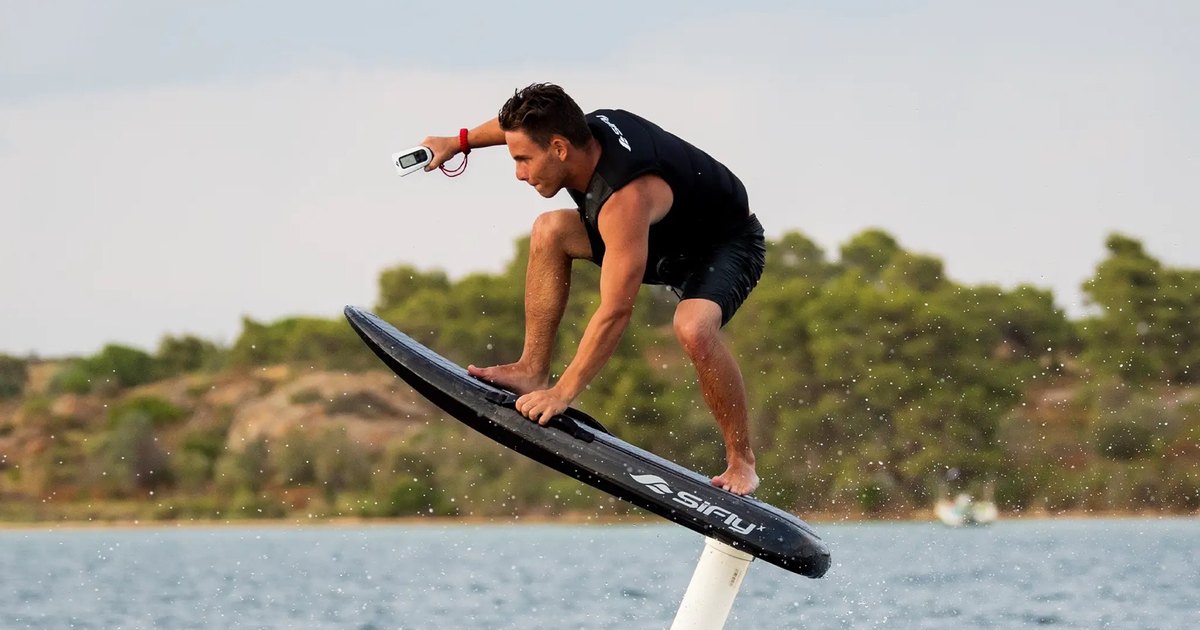
- A SiFly board and wide water: WingXperience at Marina Muiderzand in Almere, across the IJmeer.
- Two or three people who want a small group and a Fliteboard: Letsfoil on the Westeinderplassen at Aalsmeer.
- A whole day out, with lakes in place of a ring road: Flying Fish Loosdrecht, about half an hour by car, or the Intercity to Hilversum and a bus or bike from there.
- Coming in from Brussels on the Eurocity Direct: get off at Amsterdam Zuid, ride metro 50 or 51 one stop to Amstelveenseweg and walk to the Nieuwe Meer.
Swipe sideways to see all columns
| School | Water | Boards | Booking site | Without a car |
|---|---|---|---|---|
| Flying Fish | Nieuwe Meer, Jollenpad 10 | Waydoo | English | metro 50 or 51, or tram 24 to VUmc, then a walk |
| Amsterdam Watersports | IJburg, on the IJmeer | - | English | tram 26 from Centraal Station |
| WingXperience | Marina Muiderzand, Almere | SiFly | English | - |
| Letsfoil | Westeinderplassen, Aalsmeer | Fliteboard | Dutch | - |
| Flying Fish Loosdrecht | Loosdrecht lakes | Waydoo | Dutch | Intercity to Hilversum, then bus or bike |
A booking page in English is no promise of a lesson in English, so ask for an English speaking instructor when you book. If you are new to these boards, the guide to how an eFoil works covers the motor, the mast and the remote before you get wet.
Nieuwe Meer, the closest lesson
Jollenpad 10 sits in the Amsterdamse Bos neighborhood, on the shore of the Nieuwe Meer and right beside the A10 ring road. Flying Fish eFoil School works from there, behind Restaurant Het Bosch. Drivers use the paid parking on the Punterspad, a few hundred meters away, and walk along the path to the school. By public transport you take metro 50 or 51 to Amstelveenseweg, or tram 24 from Centraal Station to VUmc, and cover the last stretch on foot, a little over a kilometer either way.
The Amsterdam school sells a certificate. Three lessons of 40 minutes cost €269, and after them you may ride on your own, renting a board from €60 per hour. Groups of six or more start at €49.95 per person, with helmet and impact vest included.
Every lesson is booked as one hour, on your own board or a shared one, where you take turns and pay less. A standard lesson runs 45 minutes to an hour once you count the explanation and the ride out to the lake and back. Arrive a quarter of an hour early. You must be at least 16 and a reasonable swimmer.
A wetsuit costs €9.50 to rent. Helmet and impact vest are free, and you bring swimwear and a towel. You sign a waiver when you book, and the school is insured for third party damage and injury. The board needs no wind or waves, and when the weather turns unsuitable the school moves your lesson free of charge.
Flying Fish is an official Waydoo partner and the Dutch importer of the brand, so every board at its schools is a Waydoo; our Waydoo eFoil page compares the models.
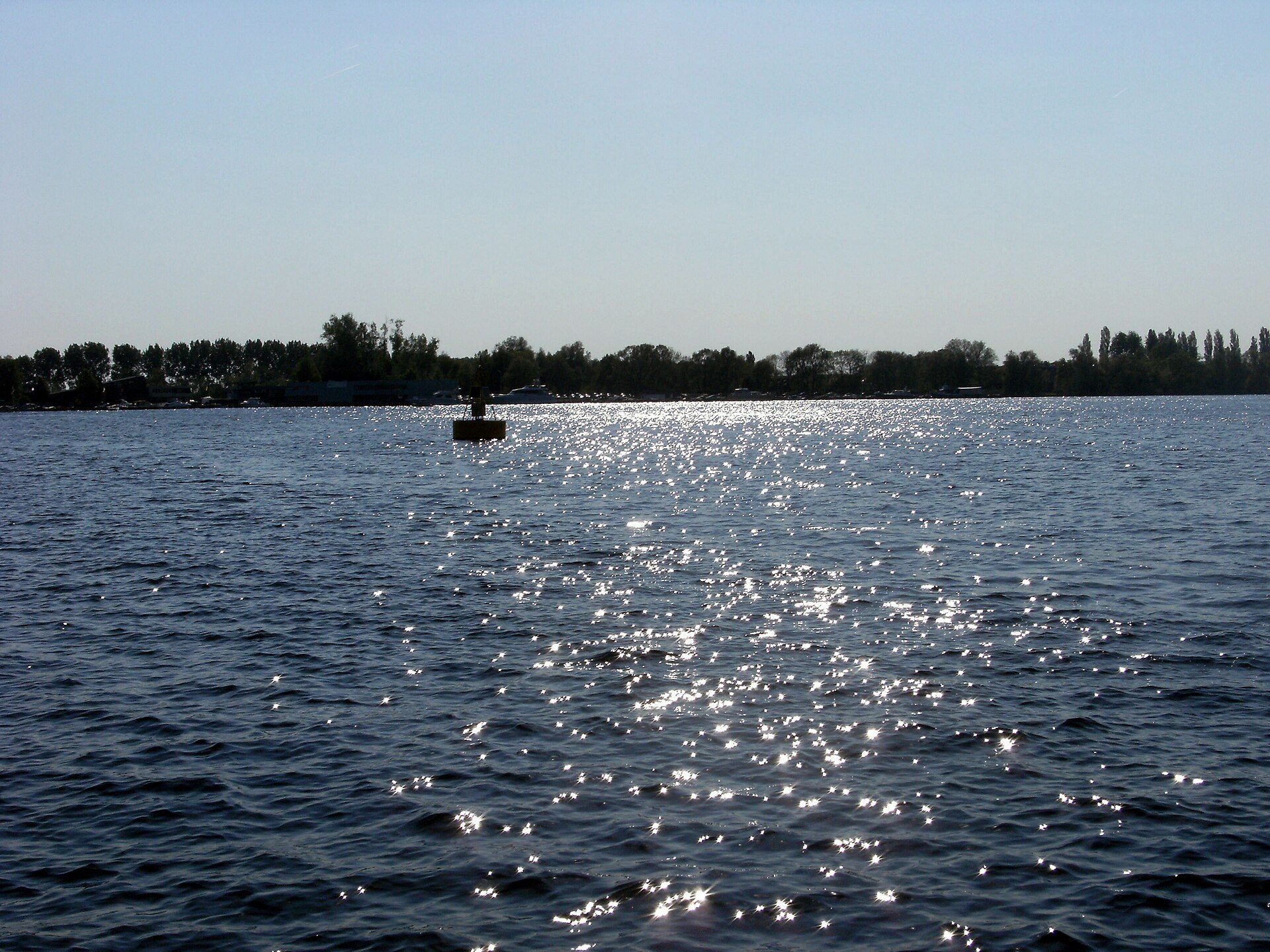
You share this water. Amsterdam's waterways bylaw counts the Nieuwe Meer as part of the Kostverlorenvaartroute, one of the city's main through routes, which runs from the Binnen-IJ via the Schinkel and the Nieuwe Meer to the Ringvaart. The province also designates three swimming places on it for the bathing season, from 1 May to 1 October: Zwemsteiger, Noord and West.
East on the IJmeer, south at Aalsmeer
IJburg lies on the IJmeer. Dutch law lists the IJmeer, with the IJsselmeer and the Markermeer, as water of maritime character, and that matters for the license if you ever ride a fast board of your own there.
Amsterdam Watersports at IJburg
Tram 26 runs from Centraal Station to IJburg, where Amsterdam Watersports is based. Its eFoiling is priced per booking: €109 for one person, €179 for two, €259 for three and €339 for four. From five to ten people the price is €79 each. Bookings are made online, on a page in English. IJburg also has a designated swimming place for the summer season.
WingXperience at Marina Muiderzand
Across the IJmeer, WingXperience teaches from Marina Muiderzand in Almere on SiFly boards. A private hour costs €129 and gives you 45 minutes of foil time. Two people sharing an hour pay €99 each and take turns. The €295 pack combines one private hour with two rental hours of 60 minutes, and groups of four or more get 90 minutes on two eFoils from €65 per person.
Helmet, impact vest and wetsuit are part of the price. Bring swimwear, a towel, sunscreen and spare clothes, and expect to wear a leash every time. When the conditions are poor the school sets a new time, usually up to 48 hours in advance. The SiFly eFoil page has the boards in detail.
Letsfoil on the Westeinderplassen
Down at Aalsmeer, Letsfoil teaches on the Westeinderplassen in front of the Kempers Watersport harbor. It works with Fliteboard, takes at most three people at a time and charges €125 per person for 1.5 hours with instruction. Its website is Dutch only; a lesson in English is a matter of asking ahead. The boards are on our Fliteboard page.
Loosdrecht lakes, half an hour out
The Loosdrecht lakes lie about 22 km in a straight line from Amsterdam Centraal, roughly 30 km by road, and Flying Fish Loosdrecht teaches there. Plan on about half an hour in a car. The First to Fifth lakes form one connected stretch of water, while the Stille Plas, further on, is reached only through narrow, shallow passages.
Flying Fish Loosdrecht works from Oud Loosdrechtsedijk 272c, on the grounds of Bonnema Watersport. A private lesson costs €139.95 for 60 minutes on the water with your own instructor and a wetsuit. Three to five people pay from €69.95 each for 45 minutes on the water, every rider on a board of their own. The certificate is three lessons of 45 minutes for €210, after which a board rents for €60 per hour; without a course the school does not rent out eFoils at all, though it does rent SUPs.
The minimum age is 16 and the upper weight limit 105 kg. Wetsuit, impact vest and helmet come with the lesson, which runs in four parts: welcome and changing, instruction on land, the session on the water and a wrap up. Be there fifteen minutes before your slot with a towel, swimwear and dry clothes. The booking pages are Dutch only. Bonnema Watersport itself books eFoiling only as part of a group outing of about two hours.
A decree that names the eFoil
Wijdemeren, the municipality around the lakes, governs them with the Besluit Motorboten Loosdrechtse Plassen 2023 (version of 19 June 2024). Every mechanically propelled craft counts as a motorboat, and the explanatory note mentions the eFoil by name. The limits in arts. 1 to 4 are 12 km/h on the lakes, 9 km/h on the Stille Plas, and 6 km/h within 100 m of a bank, jetty, breakwater or moored boat. From half an hour after sunset (22.00 at the latest) until 8.00 the whole area drops to 6 km/h.
The municipality offers an online day exemption for fast riding, but its form excludes jet skis, water scooters, eFoils and similar craft. Municipal enforcement officers and the police are on the water every day, and breaking the rules can mean a fine. As we read the decree, a board that can exceed 20 km/h remains a fast motorboat on these lakes even when ridden at 12 km/h, and whether an eFoil counts as a device similar to a jet ski under the decree's ban (art. 6(1)(c)) is not settled. Riders who bring their own board should ask the municipality before they launch.
The Spiegelplas, the Wijde Blik, the Kievitsbuurten and the Vinkeveense Plassen fall outside this decree, each under its own manager or rules, and no eFoil school is based on any of them. Designated bathing sites on the Loosdrecht side include De Strook, Vuntus strandje, Strand Markus Pos and Strand Meent.
Getting to Loosdrecht without a car
Direct Intercity trains run from Amsterdam Centraal to Hilversum, and buses link Hilversum with Loosdrecht. Wijdemeren points visitors to the public transport planner 9292ov.nl for the exact connection. From Hilversum station the school is about 9 km by bike; riding all the way from Amsterdam Centraal is about 30 km.
The bike is what the municipality asks for where possible, because parking around the recreation areas fills up on warm weekends and in the summer holidays. If you do drive, the school has parking on the Bonnema Watersport grounds, with two public car parks nearby.
Why the canals are the wrong place for an eFoil
Since a city decision of 15 September 2016 (Gemeenteblad 2016, 131231), most Amsterdam canals have a limit of 6 km/h for all vessels, marked with B.6 signs. The main through routes keep 7.5 km/h: the Kostverlorenvaartroute, which takes in the Nieuwe Meer, and the Amstelroute, plus the Ertshaven, the Entrepothaven and the Spoorwegbassin. That 7.5 km/h figure belongs to the main routes and to the cap on rental boats; the canals themselves stay at 6.
Put the limits in a row: 6 km/h in the canals, 7.5 km/h on the main routes and on the Nieuwe Meer, and 12 km/h on the Afgesloten IJ and the Loosdrecht lakes. None of them reaches the 15 to 20 km/h that operators give for foiling.
Renting a board out inside the city meets a second obstacle. Under the Verordening op het binnenwater 2010, art. 2.4.1(1), anyone who carries passengers or makes a craft available for use, other than for free, needs a permit from the city. The Regeling op het binnenwater 2020 (arts. 2.2.2 to 2.2.4) then requires every rental craft without crew to carry a device that keeps it at or under 7.5 km/h, a single lever speed control and an RFID chip or similar, and bars it from the port, the Open Havenfront and the Nieuwe Herengracht for as long as it is rented. Put those articles together and, in our view, a self drive eFoil rental in the canals stops being a realistic product.
The emission free zone and the vignette
Bring any kind of motor craft into the city and two Amsterdam rules apply to it. Since 1 April 2025 pleasure craft need emission free propulsion within the Singelgracht south of the railway, the Singelgracht itself included (Besluit uitstootvrije zone pleziervaart centrumgebied Amsterdam 2025, Gemeenteblad 2025, 61778). The Amstelroute and the Kostverlorenvaartroute out to the Nieuwe Meer lie outside the ban. A battery electric board is, as far as we can see from the text of the decision, what the emission free exception covers.
The second rule is a fee, not a ban. Amsterdam charges binnenhavengeld, an inland harbor fee, on pleasure craft using its public water outside the port. Muscle powered canoes, kayaks and SUPs are exempt, as are soft inflatables without any motor (and the boats of rowing and sailing schools). A craft that never takes a mooring owes no levy, but it must carry a passage vignette, the doorvaartvignet, and sailing without a vignette you need is banned (Verordening Binnenhavengeld Pleziervaart 2026, arts. 2, 7 and 8, in force from 1 April 2026; Verordening op het binnenwater 2010, art. 2.1.4(2)). On those texts we would expect a privately owned eFoil on the city waters to need at least a passage vignette, the IJ excepted.
The city's own guide for boaters adds a few habits of the water: keep to the right hand side of the canal, never drink alcohol when you are in charge of a vessel, and remember that groups of 12 or more need a licensed passenger vessel with a skipper. Two stroke outboards older than 2007 are not permitted.
The IJ belongs to shipping
The IJ, the broad water behind Centraal Station, is port water run by the Centraal Nautisch Beheer. On the Afgesloten IJ, between the Stenen Hoofd and the Kop Javaeiland, the limit is 12 km/h; west of the Stenen Hoofd large ships are limited by their draught and small craft by 20 km/h (Besluit CNB/139/2012, Staatscourant 2012, 26984; Gemeenteblad 2020, 131328).
On the Afgesloten IJ and the buoyed Buiten IJ, a small craft may only sail with a motor ready for immediate use that can hold at least 6 km/h, and it must carry a radar reflector when visibility is bad (Binnenvaartpolitiereglement art. 9.04(1) and (6), annex 15). The IJ, in short, is a shipping lane, and we would not put a first lesson on it.
Riding your own board in the Netherlands
Dutch inland shipping law draws its line at 20 km/h. A craft that can go faster is a snelle motorboot, a fast motorboat, and the label brings a set of duties with it. Outside designated waters it may not exceed 20 km/h, its driver must be at least 18, it is registered in the owner's name, and anyone steering one standing up must wear a life jacket (Binnenvaartpolitiereglement arts. 1.01, 1.09(1), 8.01(1), 8.05(5) and 8.06(1)). The RDW, the Dutch vehicle authority, counts an eFoil as a motorized surfboard, and one that goes faster than 20 km/h must be registered.
A craft under 15 m that can exceed 20 km/h also needs the small boat license, the klein vaarbewijs (Binnenvaartbesluit art. 16(1)(d), (2) and (4)). Part I covers rivers, canals and lakes; the maritime waters such as the IJmeer need the license for all inland waters, part II. Matched to the waters on this page, and the matching is ours, that is part I for a fast board on the Nieuwe Meer, the canals and the IJ, and part II on the IJmeer.
The government campaign Varen doe je Samen points out that some eFoils reach up to 30 km/h. A board limited to 20 km/h has fewer rules: a driver of 16 or older above 13 km/h, or 12 or older if the board cannot go faster than 12 km/h. Nature areas and city canals can be limited to as little as 6 km/h.
Schools set their own minimum water depth, for example at least 1.5 m, as advice and not as a legal rule. How the rules compare across other countries is on our eFoil rules page, and the rest of the Dutch schools, from Friesland to Limburg, are on the Netherlands page. This section is a lay summary of the texts it cites, not advice from a lawyer.
Water temperature and wind through the season
April means cold water. On the IJ, Rijkswaterstaat's station at the NDSM wharf measured a monthly mean of about 12 °C in April in both 2024 and 2025, rising to about 22 °C in high summer and falling back to 15 °C by October. The station measures the IJ, so take the figures as a guide for the Nieuwe Meer and Loosdrecht, not as readings from them.
Swipe sideways to see all columns
| Month | 2024 | 2025 |
|---|---|---|
| April | 12 | 12 |
| May | 17 | 17 |
| June | 18 | 19 |
| July | 20 | 22 |
| August | 22 | 22 |
| September | 20 | 19 |
| October | 15 | 15 |
Wind plays no part in an eFoil lesson, and the summers here are calm in any case. At KNMI's De Bilt station, near Loosdrecht, the daily mean wind from May to September averaged about 3 m/s over 2016 to 2025, and only about 2 % of those days reached Beaufort 4.
Schools and booking links
Flying Fish
Amsterdam, Nieuwe Meer, Netherlands
Jollenpad 10, 1081 KC Amsterdam
- Rental: from €60, 1 h, Waydoo
Rents only to riders who passed a course
Amsterdam Watersports
Amsterdam, Netherlands
- Lesson: €109
- Lesson: €179, for 2 riders
- Lesson: €259, for 3 riders
- Lesson: €339, for 4 riders
WingXperience
Almere, IJmeer, Netherlands
- Lesson: €129, 1 h, SiFly
- Lesson: €99, 1 h, SiFly
- Lesson: from €65, 1 h 30 min, SiFly
- Lesson: €295, 3 h, SiFly
Letsfoil
Aalsmeer, Westeinderplassen, Netherlands
Kempers Watersport, Herenweg 100, 1431 GX Aalsmeer
- Lesson: €125, 1 h 30 min, Fliteboard
Flying Fish Loosdrecht
Loosdrecht, Netherlands
Oud-Loosdrechtsedijk 272c, Loosdrecht
- Lesson: €139.95, 1 h
- Rental: €60, 1 h
Rents only to riders who passed a course
Updated November 2, 2026