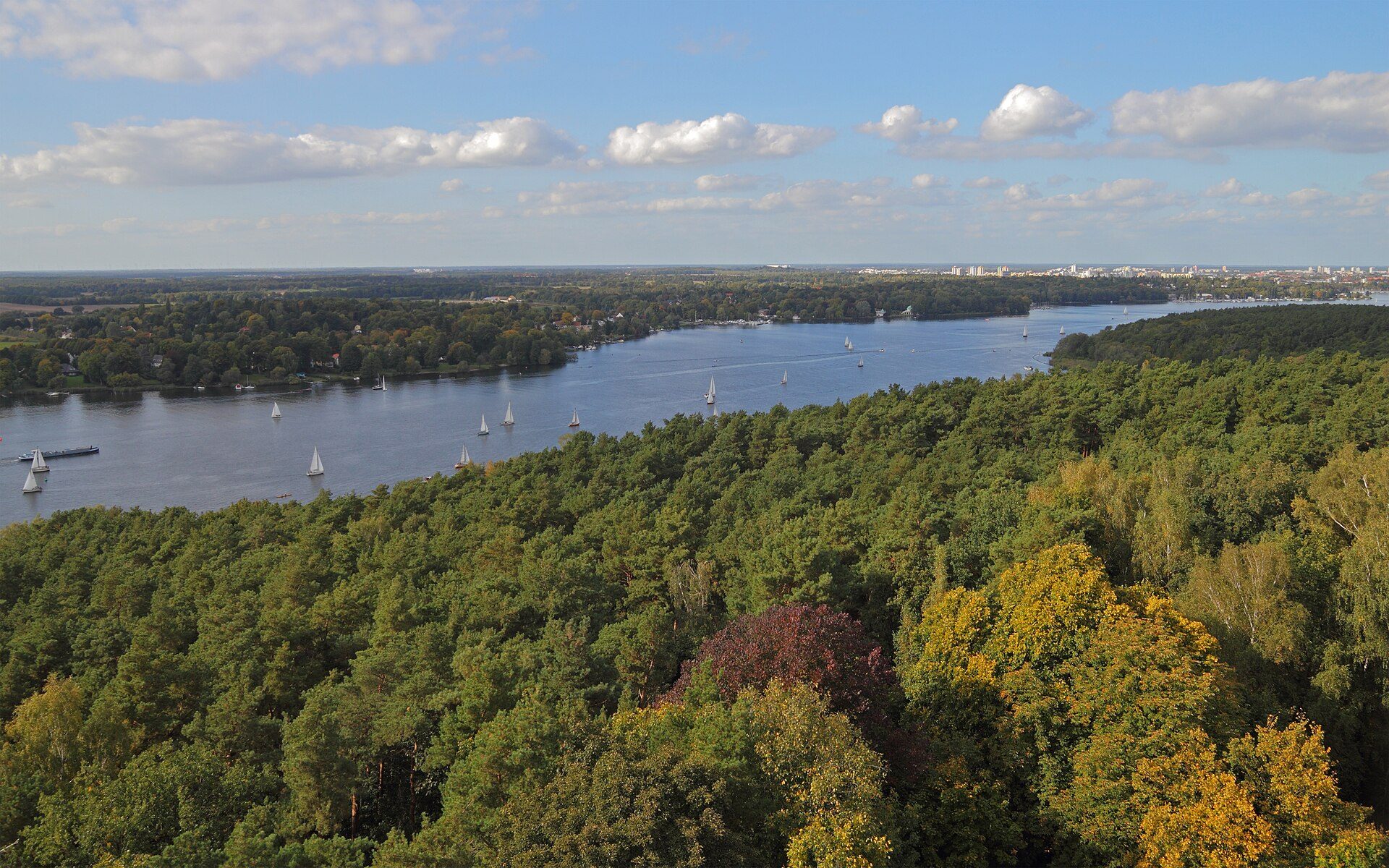
Hamburg rides its eFoils at Oortkaten, on the upper Elbe
Every eFoil lesson in Hamburg begins at Oortkaten. The spot lies in Ochsenwerder, in the district of Bergedorf, at Elbe kilometer 607.5, the point that federal waterway law names as the upper limit of the Port of Hamburg. Both schools teaching in the city, eFoilution and Sealectric, work from the Oortkatenufer, the bank along that stretch, under the postcode 21037.
From the Jungfernstieg or the Speicherstadt, Hamburg looks like a city made for this sport. It has a lake in the middle of town, miles of canals, a huge river and several lakes on its outskirts. Very little of that water lets a board climb onto its foil. The Alster needs a permit that hardly anyone gets. The canals, the Bille and the Dove Elbe above its lock are held to 8 km/h. The lakes are missing from the city's list of navigable waters, which in our view leaves a motor there to the water authority. Downstream lies the port itself, with its own traffic rules and ships that have the right of way.
Oortkaten is where those limits loosen. Sealectric calls its harbor sheltered water, perfect for beginners. Outside the harbor mouth runs a tidal river with shipping, one the city does not count as bathing water.
The Alster is a permit question, and the answer is nearly always no
The Aussenalster is the obvious first idea, a big flat lake right in the center of town. The Alsterschifffahrtsverordnung of 3 January 2006 (HmbGVBl. 2006 p. 2) allows motor craft on the navigable Alster above that lock only with a permit (§ 1 and § 2 (1)). Section 2 (2) then lists twelve cases in which a permit can be granted, among them passenger boats, support boats for regattas, rescue craft and businesses that need a motorboat for their work. Leisure riding on a motorized board, as we read that list, is not one of them.
The city is blunt about the odds. A permit is granted only in justified exceptional cases, the application goes in at least two weeks ahead, and the fee runs from €10 to €200. Since 1 January 2025, boats without an earlier Alster permit may run only on electric drive. An eFoil is electric, which clears that one condition of a new permit and, as far as we can see, exempts it from nothing else.
Speed would end the idea even with paperwork in hand. Port traffic law caps every powered craft on the Alster and its canals at 8 km/h unless signs say otherwise. A Lift board lifts off at 12 to 13 km/h and a Fliteboard needs around 20 km/h. At the legal limit, either one is a slow, heavy surfboard with a propeller underneath.
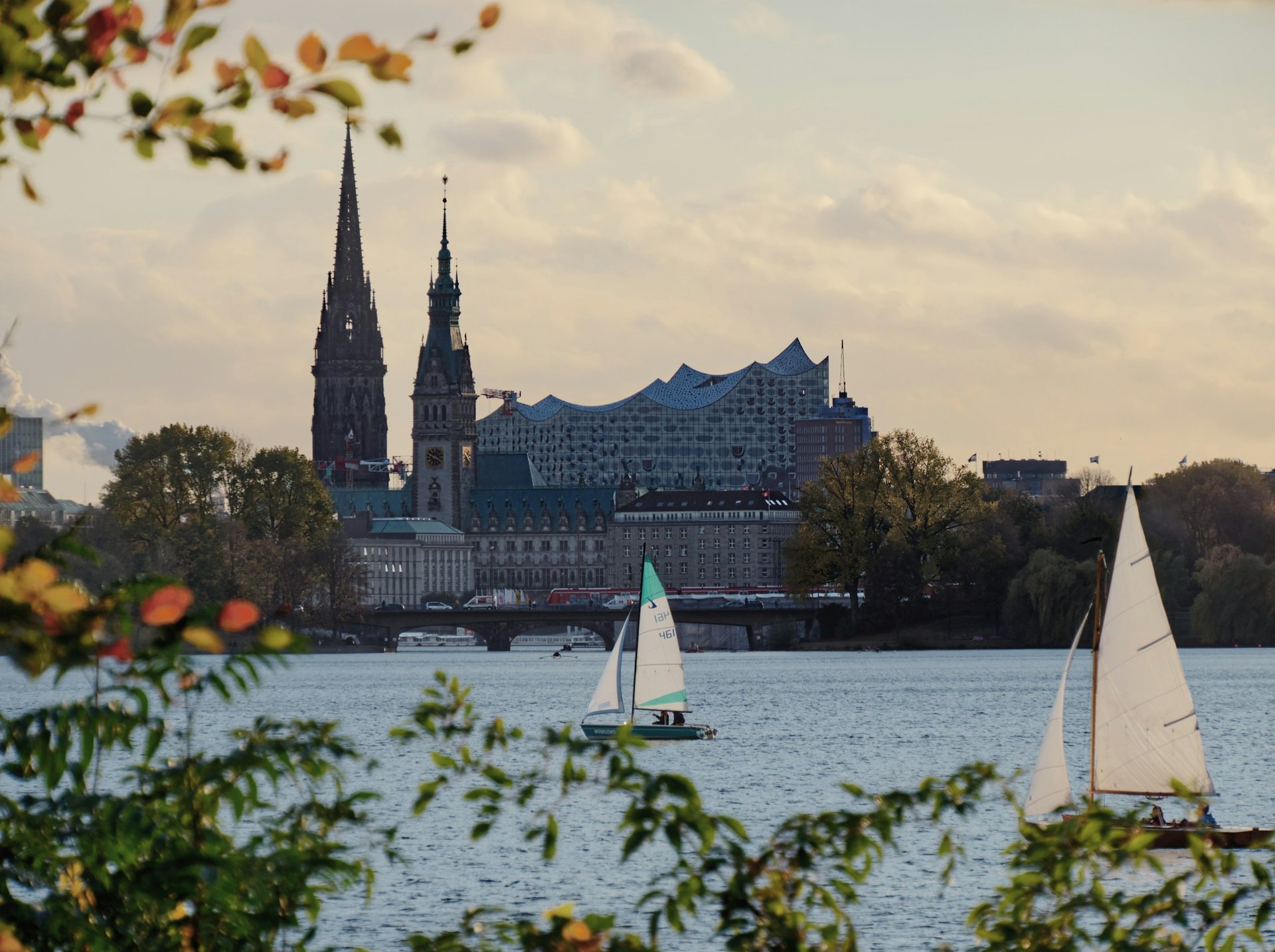
Canals, the Dove Elbe and the outlying lakes
The 8 km/h figure comes from § 23 (2) of the Hafenverkehrsordnung (HVO), and it covers far more than the Alster. The list takes in the Alster and the Bille with their canals, the Hammerbrook, Steinwerder and Wilhelmsburg canals, the Speicherstadt Fleete, the Harburg inner harbor, and the Dove Elbe above the Tatenberger Schleuse with the Neuer Schleusengraben and the Schleusengraben. Signs can set another speed, and § 23 (3) lets the authority allow deviations in special cases. Without a sign or a permit, we see no way for a board to fly on any of them.
The Dove Elbe looks like the exception. It is an 18 km side arm of the Elbe that joins the Norderelbe behind the Tatenberger Schleuse, and its widened reach near the mouth of the Gose-Elbe serves as a regatta course for rowing and canoeing. Above the lock it falls under the 8 km/h rule. On event days such as triathlons and rowing championships the regatta course closes to traffic altogether. The rowing federation's guide marks the Gose-Elbe closed to motorboats, and where the Gose and Dove Elbe meet lies the nature reserve Die Reit.
For the lakes the question is a different one. Hamburg's Verordnung zur Bestimmung der schiffbaren Gewässer of 5 May 1987 (HmbGVBl. 1987 p. 99, annex as amended 19 June 2012) lists the waters that count as navigable. The Oortkaten and Zollenspieker harbors are on it, as is the Dove-Elbe from the Hausdeichbrücke in Neuengamme down to the Elbe. The Gose-Elbe is missing, and so are the Hohendeicher See, the Eichbaumsee, the Allermöher See and the Öjendorfer See. Our reading is that a motor on any of those unlisted waters needs a permit from the water authority. For the Hohendeicher See, whose other name Oortkatener See has nothing to do with the harbor, the city says it outright: motor craft of any kind, eFoils included, need a water-law permit.
Some offers with Hamburg in their name never touch Hamburg water. Gadgets4Rent's Hamburg page names no base, and of the waters it lists (the Elbe shore, the Allermöher See, the Öjendorfer See, the Bille shore) it says itself that riding there is not allowed or unclear. E-Surfer's “eFoil Hamburg / Ostsee” runs from Ancora Marina in Neustadt in Holstein on the Baltic, about an hour from the city, and its own page says Hamburg has hardly any suitable water for test rides.
Two schools on the Oortkatenufer
eFoilution is the Hamburg station of foilution GmbH, a Berlin company that also teaches on the Müggelsee and the Wannsee (see the Berlin guide) and at Binz on Rügen. Its address is simply Oortkatenufer, 21037 Hamburg, and it rides Lift boards. A solo beginner course costs €250and lasts about two hours, 90 minutes of them on the water. The school supplies wetsuit, impact vest and helmet, and the coach rides beside or behind you. Two people who book together pay €200 each and learn side by side on two Lift 5'4 Cruisers fitted with the 300 or 250 V2 Surf-Wing.
Once you have done that course you can come back and rent. A session costs €150 on a Lift 4'9 Sport or 5'4 Cruiser, and it is open only to people who learned with eFoilution. No deposit changes hands. You bring an ID card and private liability insurance.
Sealectric is a Fliteboard school from Altenholz near Kiel with courses and board rental in Kiel and Hamburg. It used to teach at changing spots around Hamburg. Now it works from a floating base, a houseboat in the Hafen Oortkaten at Wassertreppe 6, Oortkatenufer, where it runs beginner and taster courses, rents boards and lets you try gear. Its booking calendar lists an eFoil course of 1 hour 30 minutes for one, two or three people, a two-hour rental, four-hour team events for four to eight people, and Fliteboard Flitecell battery rental from one day to a week. A certified Fliteboard instructor takes the course. The beginner voucher costs €189 for one person and €339 for two, 19 % VAT included, and it can be used in Kiel, Hamburg or Berlin.
Swipe sideways to see all columns
| eFoilution | Sealectric | |
|---|---|---|
| Boards | Lift (5'4 Cruiser, 4'9 Sport) | Fliteboard |
| Base | Oortkatenufer, 21037 Hamburg | Houseboat at Wassertreppe 6, Oortkatenufer |
| Beginner course | About 2 h, 90 min on the water | 1 h 30 incl. briefing |
| Course price | €250 solo, €200 each for two | €189 for one, €339 for two (voucher) |
| Group | One rider, or two on identical boards | One to three riders |
| Rental | €150 per session, own graduates only | 2 h, from age 16 |
| Minimum age | 16 | 16 (team events and batteries 18) |
| Also | - | Team events for 4 to 8, Flitecell battery rental |
Schools and rental stations
eFoilution
Hamburg, Dove Elbe, Germany
Oortkatenufer, 21037 Hamburg
- Lesson: €250, 2 h
- Rental: €150, Lift 4'9 Sport, Lift 5'4 Cruiser
Rents only to riders who passed a course
Sealectric
Hamburg, Dove Elbe, Germany
Oortkatenufer 6, 21037 Hamburg
- Lesson: €189, 1 h 30 min, Fliteboard
- Lesson: €339, 1 h 30 min, for 2 riders, Fliteboard
Updated November 2, 2026
Lift or Fliteboard, a course for two or a group of three
Couples and pairs of friends who want to learn together have an easy pick in eFoilution's course for two: two identical Cruisers, one coach, €200 each. Sealectric suits a single rider holding a gift voucher, or a small group of up to three that wants one booking. A firm planning a day out can look at Sealectric's team events, which run four hours for four to eight people aged 18 or more.
The brands get airborne at different speeds. Lift gives 12 to 13 km/h as the point where its board lifts off, and Fliteboard puts the speed needed to foil at around 20 km/h. Both figures sit above the 8 km/h that governs the canals, the Alster and the Dove Elbe above its lock.
For a second visit the rental rules decide. eFoilution's €150 session is open only to its own graduates. Sealectric's calendar lists a two-hour rental from age 16, so a rider who learned somewhere else asks there what experience the school expects.
Traveling with a Fliteboard of your own? Sealectric rents Flitecell batteries by the day or for up to a week, from age 18, so the board can come without its spare packs.

Why the age limit is 16 on the Elbe and 12 on the Baltic
Sixteen is the floor at both schools in Hamburg, for courses and rentals alike. Sealectric raises it to 18 for team events and Flitecell rentals, and asks that everyone who takes part can swim.
eFoilution explains where its line comes from. On inland water it treats an eFoil as a boat and teaches from 16. On the Baltic it treats the board as sports equipment and teaches from 12, with a parent present. The inland figure matches federal law, since § 1.09 Nr. 1 of the Binnenschifffahrtsstraßen-Ordnung (BinSchStrO) of 16 December 2011 puts the helm of a powered craft in the hands of a person at least 16 years old.
A family with a 13-year-old therefore has no option in Hamburg itself. eFoilution's Baltic station at Binz on Rügen is the place where that teenager can learn under the school's 12-plus rule. Age limits in other countries differ again; the eFoil rules guide lists them country by country.
From Hauptbahnhof to the houseboat
Lessons run in the warm months, and the dates exist only in each school's booking calendar. eFoilution sells its Hamburg slots on its course page, under the tab for Oortkaten. Sealectric books through the calendar on sealectric.de/schulung/, and online booking closes 48 hours before the start, so a sunny morning is too late to book that day online. Both schools sell gift vouchers.
By public transport it is the S-Bahn from Hauptbahnhof out to Bergedorf, then bus 127 from Bergedorf station to the Oortkatenweg stop, and from there a walk of about 1.5 to 2 km to the water. Check the trip in the HVV journey planner before you set off.
Drivers park on the big car park at the front. Sealectric asks people not to park on the spit by the jetty. From the car park you walk onto that spit, a strip of land between the Elbe and the harbor basin, and the houseboat lies at the second jetty. Meet the instructor there 15 minutes before your start. Anyone who came along to watch can sit on the houseboat's sun deck.
Swimwear, a towel and, for a rental, your ID
Courses come with the protective kit, so you pack light: swimwear to wear under the wetsuit, and a towel. Both schools hand out wetsuit, helmet and impact vest, and at Sealectric a buoyancy or impact vest stays on for the whole session. Sealectric also wants everyone who takes part able to swim.
An eFoilution rental asks for a little more: your ID card, private liability insurance, swimwear, and your own wetsuit if you have one.
Liability insurance is the item a visitor may have to look into. eFoilution takes no deposit for a rental board and asks for that policy instead, so check before the trip that yours covers you in Germany. For how rental works elsewhere, see the eFoil rental guide.
Port law, licenses and marking at Oortkaten
Oortkaten sits on a legal seam. Upstream of kilometer 607.5 the federal inland waterway rules apply. Downstream, the port is run under Hamburg's Hafenverkehrsordnung (HVO) of 12 July 1979, as amended on 6 August 2019. The Oortkaten harbor gets both. HVO § 6 Nr. 1 counts it and the Zollenspieker harbor among the port's edge areas, and § 1 (2) adds the federal inland rules in those two harbors. The water police state the same in their leaflet for sport boaters.
Out on the port river, powered sport craft may run at up to 12 knots (22 km/h) through the water under HVO § 23 (1). The water police sum up what they expect from small boats there:
- Keep to the right side of the fairway, shore to shore. Above the Elbe bridges up to Oortkaten only deep-draught ships may leave the right side.
- Right before left applies in the edge areas.
- Ships with right of way have absolute priority.
- Sport craft may not enter the tanker harbors.
- In poor visibility, a boat without radar and VHF goes out only with at least one shore in sight, and crosses a fairway only with both shores in sight.
In a lesson these are the instructor's concern. They become yours the day you bring your own board.
No license is needed for an electric sport boat whose motor does not exceed 7.5 kW in operating mode S1 (continuous) under DIN EN 60034-1. That waiver sits in § 5 (1) Nr. 1 b of the Sportbootführerscheinverordnung (SpFV) of 3 May 2017. eFoilution describes its own boards as license-free small craft under 15 hp.
Marking is the stickier point. Under § 2 (1) with § 1 of the Kleinfahrzeug-Kennzeichnungsverordnung (KlFzKV-BinSch) of 21 February 1995, small craft on federal inland waterways where the BinSchStrO applies must carry an official mark, and only craft of no more than 2.21 kWare excluded. The official mark with its certificate costs €29.70 under annex no. 301 of the WSBGebV. As we read it, the duty reaches the Elbe upstream of kilometer 607.5, not the port and not Hamburg's own waters, and inside the Oortkaten harbor the question is unsettled. For a lesson or rental it is the school's matter, since both schools ride their own boards.
That is how we read the texts named above, no more. On the water, signs and the water police have the last word.
Tide, murky water and a summer season
The Elbe at Oortkaten is tidal. At the OVER gauge, 2 km upstream, the mean tidal range is about 3 m; at St. Pauli it is about 3.6 m, and the city speaks of up to 3.5 m.
Hamburg does not treat the Elbe as bathing water, and its reasons read like a briefing for anyone who falls off a board. Strong suction and wash from shipping. A flood current of up to 7 km/h. Drop-offs you cannot see. Water so turbid it hinders rescue.
Reason enough to learn inside the sheltered harbor basin and leave the open river for later.
Even in the summer season both schools put you in a wetsuit. For other places to ride in Europe, start from the eFoil spots overview.